


Synonym name: 8-hydroxypsoralen
Catalogue No.: BP1459
Cas No.: 2009-24-7
Formula: C11H6O4
Mol Weight: 202.165
Botanical Source: Cnidium dubium, Cryptodiscus didymus (preferred genus name Prangos), Evodia hupehensis, Selinum tenuifolium, Aegle marmelos (bael fruit), Angelica archangelica (angelica), Pastinaca spp., Poncirus trifoliata, etc
Purity: 95%~99%
Analysis Method: HPLC-DAD or/and HPLC-ELSD
Identification Method: Mass, NMR
Packing: Brown vial or HDPE plastic bottle
Can be supplied from milligrams to grams.
For Reference Standard and R&D, Not for Human Use Directly.
Inquire for bulk scale.
HPLC of Xanthotoxol
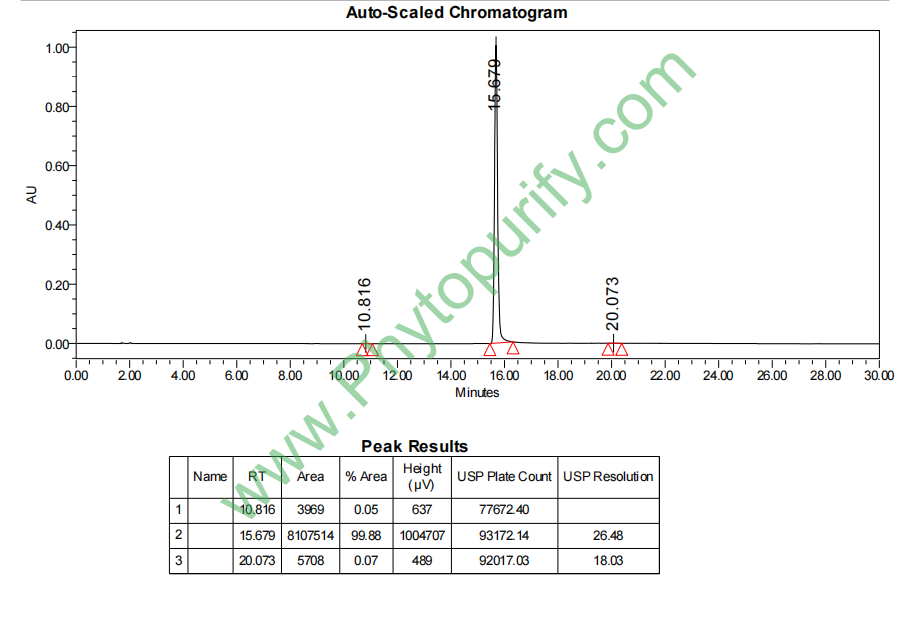
Storage conditions:Short-term storage at 2~8℃, long-term storage at -20 ~ -80℃
63.5800
1.8576
1.6880
.0818
5.4813
16.8920
High
83.7336
2.7409
Yes
No
No
No
Yes
Yes
1.5
Yes
No
Yes
Yes
Natural products have always been an important treasure trove for innovative drug discovery, among which coumarin compounds have attracted much attention due to their wide range of biological activities. Xanthotoxol, also known as 8-hydroxypsoralen, is a typical linear furan coumarin. As a key derivative of psoralen, it is not only a known cytochrome P450 enzyme (CYP450) inhibitor, but also exhibits multiple pharmacological effects including anti-inflammatory, antioxidant, neuroprotective, and significant antifungal activity. In recent years, with the increasing severity of multidrug-resistant fungal infections and the urgent need for new treatment strategies for complex diseases such as neurodegenerative diseases and chronic inflammation, Zanthoxylum bungeanum has once again become a hot topic in pharmacological research due to its unique multi-target mechanism of action. This article aims to systematically review the chemical characteristics, plant sources, pharmacological activities, molecular mechanisms of action, medicinal properties, and clinical application potential of Sichuan pepper toxin phenol, in order to provide comprehensive academic references for the in-depth development and transformation research of this natural product.
The chemical name of Sichuan pepper toxin phenol is 8-Hydroxypsoralen, and its CAS number is 2009-2014-7. Structurally, it is a linear furan coumarin with a basic skeleton composed of benzo [a] - pyranone (coumarin) and a fused furan ring. Its molecular formula is C11H6O4 and its molecular weight is 202.1650. Compared with the parent compound Psoralen, Zanthoxylum bungeanum introduces a phenolic hydroxyl group (- OH) at the 8th position of the benzene ring (i.e. the para position of the furan ring), which significantly alters its physicochemical properties and biological activity.
The presence of the phenolic hydroxyl group enhances the polarity of the molecule, with a topological polar surface area (TPSA) of 63.58 Å ². The calculated value of its lipid water partition coefficient (LogP) is approximately 1.86, indicating that Zanthoxylum bungeanum has moderate lipophilicity, which facilitates its penetration into cell membranes. However, its water solubility is relatively low (about 0.082 mg/mL), which may to some extent affect its formulation development. The preliminary safety assessment in vitro showed that its mutagenicity was low in Ames test (value of 1.5), and it had no significant inhibitory effect on hERG potassium channels, indicating a low risk of cardiac toxicity. Of particular note is that its predicted physicochemical properties indicate a high blood-brain barrier permeability, providing an important material basis for its application in central nervous system diseases such as neuroprotection.
Sichuan pepper toxin phenol is widely present in various plants such as Apiaceae, Rutaceae, and Moraceae. Its main plant sources include traditional Chinese medicine Angelica dahurica(Angelica dahurica)、cnidium fruit(Cnidium monnieri)、Sichuan pepper(Zanthoxylum Spp.) and fig(Ficus carica)In the leaves and fruits. In these plants, Sichuan peppercorn toxin often coexists with other structurally similar coumarin compounds such as psoralen, isopsoralen, Sichuan peppercorn toxin, etc.
Organic solvent extraction is commonly used to extract toxic phenols from plant materials. Common solvents include methanol, ethanol, ethyl acetate, and chloroform. The classic extraction process is to reflux extract or ultrasound assisted extract the dried and crushed plant materials with appropriate solvents, combine the extraction solutions, and concentrate them under reduced pressure to obtain the crude extract. Subsequently, further separation and purification steps are required to obtain high-purity Sichuan pepper toxin phenol. The commonly used orthogonal separation techniques include:
1. Liquid-liquid extraction Using solvents of different polarities (such as petroleum ether, ethyl acetate, n-butanol) to segment the crude extract and enrich coumarin components.
2. column chromatography Silica gel column chromatography is the most commonly used method, which uses gradient elution with different ratios of petroleum ether ethyl acetate or chloroform methanol systems.
3. High performance liquid chromatography Preparation HPLC is a key step in obtaining high-purity Sichuan pepper toxin phenol (for standard or in-depth pharmacological research), usually using a reverse phase C18 column with methanol water or acetonitrile water as the mobile phase.
In recent years, some green extraction techniques such as supercritical CO2 extraction and microwave-assisted extraction have also been explored to improve extraction efficiency and selectivity.
Zanthoxylum bungeanum toxin exhibits diverse and significant pharmacological activities, and its research has expanded from traditional antibacterial fields to modern medical hotspots such as neuroprotection and anti-inflammatory effects.
Antifungal activity This is one of the most highly regarded activities of Sichuan pepper toxin, especially against increasingly severe drug-resistant fungal infections. Research has shown that Sichuan peppercorn toxin has an effect on various pathogenic fungi, including Candida albicans(Candida albicans)Smooth Candida albicans(C. glabrata)And Cryptococcus neoformans(Cryptococcus neoformans)All of them exhibit inhibitory activity. Its function is not limited to inhibiting growth, but can also damage the integrity of fungal cell membranes, inhibit biofilm formation, and show synergistic effects on azole resistant strains, indicating its potential as an antifungal sensitizer.
Anti inflammatory and antioxidant activity Sichuan pepper toxin phenol has strong free radical scavenging ability and antioxidant activity, which can effectively reduce oxidative stress damage. In various acute and chronic inflammation models (such as lipopolysaccharide induced macrophage inflammation model, mouse ear swelling model, arthritis model), Sichuan peppercorn toxin can significantly inhibit the production and release of pro-inflammatory mediators (such as TNF - α, IL-1 β, IL-6, NO, PGE2), demonstrating clear anti-inflammatory effects.
Neuroprotective effect Thanks to its excellent blood-brain barrier permeability and antioxidant properties, Sichuan peppercorn toxin has shown protective effects in neurological disease models. Research reports indicate that it can improve cognitive impairment in Alzheimer's disease model animals and alleviate neurotoxicity induced by β - amyloid protein; In models of cerebral ischemia-reperfusion injury and Parkinson's disease, protective effects can also be achieved by reducing neuronal apoptosis and oxidative damage.
Other activities In addition, studies have also found that Sichuan peppercorn toxin has anti anxiety and anti depression like effects (possibly related to 5-HT system regulation), certain anti-tumor activities (inducing tumor cell apoptosis and cycle arrest), as well as potential effects such as antispasmodic and cardiovascular protection.
The multiple pharmacological activities of Sichuan pepper toxin phenol stem from its interactions with multiple molecular targets, forming a multi-target action network.
1. Mechanism and targets of antifungal action:
The antifungal mechanism of Sichuan pepper toxin phenol is complex, involving multiple target pathways, which may be one of the reasons why it is not easy to develop drug resistance. The known relevant targets include:
* The synthetic pathway of ergosterol By inhibiting the activity of ERG11 (lanosterol 14 α - demethylase, CYP51A1), it interferes with the biosynthesis of ergosterol, a key component of fungal cell membrane, which is similar to the target of commonly used azole drugs but may have different action sites.
* Cell wall synthesis May affect the activity of chitin synthase (CHS3) and β -1,3-glucan synthase (FKS1), and disrupt cell wall integrity.
* Drug efflux pump Research has shown that it can downregulate or inhibit the multidrug resistance proteins of Candida, such as CDR1, CDR2, and MDR1, thereby reversing fungal resistance.
* Other targets It may also involve affecting mitochondrial function (MLS1) and hyphal growth associated proteins (ALS3).
2. Mechanisms of anti-inflammatory and neuroprotective effects:
The core signaling pathways for its anti-inflammatory and neuroprotective effects are concentrated in:
* NF - κ B signaling pathway Zanthoxylum bungeanum toxin can effectively inhibit the degradation of I κ B α and p65 nuclear translocation under inflammatory stimulation, thereby blocking the transcriptional activity of NF - κ B and downregulating the expression of a series of downstream pro-inflammatory factors.
* MAPK signaling pathway It can inhibit the phosphorylation activation of p38 MAPK, JNK, and ERK induced by lipopolysaccharides, and regulate inflammation and cellular stress upstream.
* Nrf2/HO-1 pathway By activating the antioxidant response element ARE and upregulating the expression of phase II detoxifying enzymes such as heme oxygenase-1 (HO-1), the antioxidant defense ability of cells is enhanced.
* Cytochrome P450 enzyme inhibition As a CYP450 inhibitor, its inhibition of CYP3A4 and CYP1A2 (IC50 of 7.43 μ M and 27.82 μ M, respectively) may affect the metabolism of endogenous and exogenous drugs. This characteristic needs to be carefully evaluated in drug interactions, but it may also be used for the treatment of specific diseases (such as reducing the activation of carcinogens).
Although Sichuan pepper toxin phenol has rich pharmacological activity, its development as a drug candidate still requires systematic pharmacological evaluation.
Pharmacokinetic properties At present, there is relatively limited research on the in vivo pharmacokinetics of Sichuan pepper toxin phenol. Based on its structural characteristics, it can be inferred that it may be absorbed in the small intestine after oral administration. Its moderate LogP value is beneficial for absorption, but its lower water solubility may limit its dissolution rate. The phenolic hydroxyl groups in its molecules may undergo extensive II binding metabolism, such as glucuronidation and sulfation. As an inhibitor of CYP3A4 and CYP1A2, it may interact with other drugs metabolized by the same enzyme. Its high blood-brain barrier permeability has been indirectly confirmed in multiple neuroprotective studies, which is a significant advantage.
Challenges and optimization directions in drug development:
1. Poor water solubility This is one of its main shortcomings. It can be improved through formulation technology, such as making nanocrystals, cyclodextrin inclusion complexes, phospholipid complexes, or solid dispersions.
2. Potential Metabolism and Interactions Its CYP inhibitory properties require detailed drug drug interaction assessments in preclinical and clinical stages.
3. structural optimization By using medicinal chemical methods to modify its structure, such as preparing prodrugs to improve bioavailability, or introducing specific functional groups to enhance targeting and reduce potential toxicity.
4. Deep evaluation of safety Although the preliminary Ames test and hERG data are optimistic, comprehensive preclinical toxicology studies are still needed, including long-term toxicity, reproductive toxicity, etc.
The diverse biological activities of Sichuan pepper toxin phenol have brought broad application prospects in multiple therapeutic fields.
1. Field of antifungal therapy In the face of the global challenge of drug-resistant fungal infections, the multi-target antifungal mechanism of Zanthoxylum bungeanum and its inhibitory effect on resistance pumps make it a promising new type of antifungal drug, or combined with existing azole drugs to enhance efficacy and overcome resistance. Local medication (such as treating skin fungal infections and oral candidiasis) may be the first breakthrough direction.
2. Neurodegenerative diseases Its excellent neuroprotective, anti-inflammatory, and antioxidant properties, combined with good brain entry ability, make it potentially valuable in the prevention and treatment of diseases such as Alzheimer's disease, Parkinson's disease, and stroke. It can be explored as a disease modifier or adjuvant therapy drug.
3. Inflammatory diseases For chronic inflammation related diseases such as rheumatoid arthritis, inflammatory bowel disease, and neuroinflammation, Sichuan peppercorn toxin exerts anti-inflammatory effects by regulating the NF - κ B and MAPK pathways, and has the potential to be developed as a new type of anti-inflammatory drug.
4. Optimize the structure as a lead compound The molecular skeleton of Sichuan pepper toxin phenol is an ideal starting point for medicinal chemistry. Future research can focus on:
*Synthesize a series of derivatives and systematically study their structure-activity relationships.
*Improve its water solubility, targeting, and metabolic stability through chemical modification.
*Develop nano delivery systems based on Sichuan pepper toxin phenol, such as liposomes and polymer nanoparticles, to improve their pharmacokinetic properties and achieve targeted drug delivery.
Challenges and Prospects To push Sichuan pepper toxin phenol from the laboratory to clinical practice, systematic preclinical development work still needs to be completed, and issues such as its water solubility and potential metabolic interactions need to be addressed. Strengthening interdisciplinary cooperation, combining modern drug design, formulation technology, and pharmacological research, is the key to promoting the rejuvenation of this ancient natural molecule and ultimately benefiting patients.
As a natural linear furan coumarin, Sichuan peppercorn toxin has shown remarkable pharmacological activities in antifungal, anti-inflammatory, antioxidant, and neuroprotective fields due to its unique chemical structure and multi-target mechanism of action. Especially its potential in combating drug-resistant fungi and neurodegenerative diseases meets the current unmet clinical needs. Despite facing challenges in drug formulation such as water solubility, these challenges are providing opportunities for innovation in medicinal chemistry and pharmacy. In the future, through in-depth mechanism research, rational structural optimization, and advanced formulation development, Sichuan pepper toxin phenol is expected to be successfully transformed from a potential natural active molecule into a new drug candidate for treating various refractory diseases, continuing to interpret the immortal value of natural products in drug discovery.
