


Product name: Isopimpinellin
Synonym name: 4,9-Dimethoxypsoralen
Catalogue No.: BP0792
Cas No.: 482-27-9
Formula: C13H10O5
Mol Weight: 246.218
Botanical Source: Cnidium monnieri(L.)Cuss.
Physical Description:
Type of Compound: Coumarins
Purity: 95%~99%
Analysis Method: HPLC-DAD or/and HPLC-ELSD
Identification Method: Mass, NMR
Packing: Brown vial or HDPE plastic bottle
Storage: Store in a well closed container, protected from air and light. Put into refrigerate or freeze for long term storage.
Whenever possible, you should prepare and use solutions on the same day. However, if you need to make up stock solutions in advance, we recommend that you store the solution as aliquots in tightly sealed vials at -20℃. Generally, these will be useable for up to two weeks.
The product could be supplied from milligrams to grams
Inquire for bulk scale.
Chengdu Biopurify Phytochemicals Ltd. is a leading company in the research, development, manufacture and marketing of High Quality Phytochemicals and Extracts(especially Active Ingredients from Traditional Chinese Medicine,TCM), Natural Active Pharmaceutical Ingredients worldwide.
The main services:
A. Supply active ingredients and reference standards of TCM, from mgs to kgs scale
B. Custom extraction and purification, target Herb Active Ingredients
C. Custom synthesis and semi-synthesis for Natural Active Ingredients
D. CR(contract research), CM(contract manufacture) and PD(process development) services from lab scale, pilot scale to commercial scale(GMP is also available)
E. TCM compounds library for drug screen,more than 3000 compounds available, many of them are rare and unique.
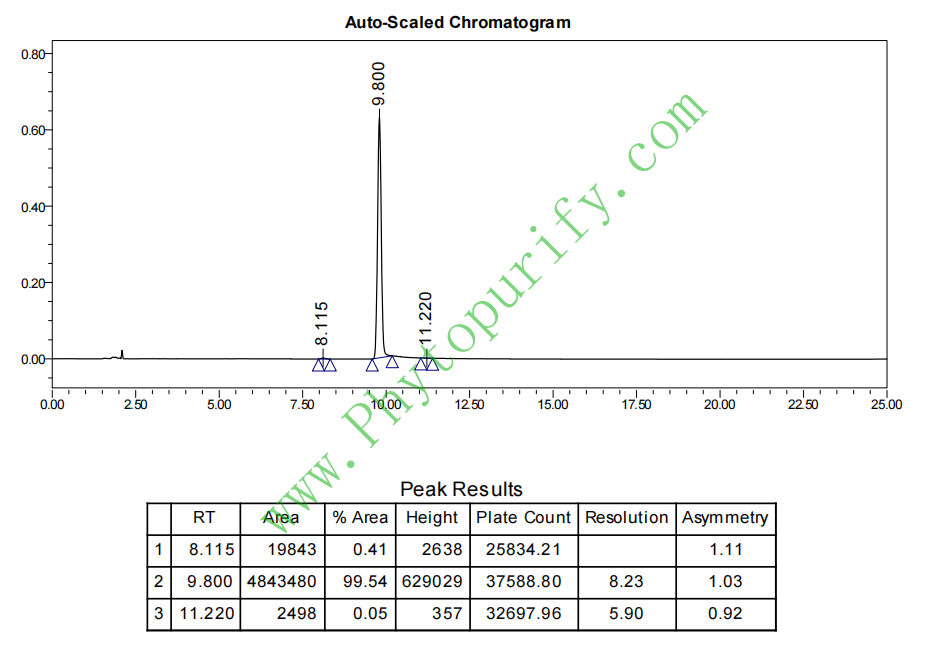
HPLC of Isopimpinellin
Storage conditions:Short-term storage at 2~8℃, long-term storage at -20 ~ -80℃
61.8100
1.9551
1.9551
.0291
3.4825
26.2937
High
81.7676
2.5611
Yes
No
Yes
No
Yes
Yes
1.5
Yes
No
Yes
Yes
Isoepinellin, CAS number 482-27-9, is a naturally occurring furan coumarin compound initially isolated from the fungus Glomerella cingulata. As an important member of the furan coumarin family, isoprenoid lactone has received widespread attention in pharmacology and natural product chemistry in recent years due to its unique chemical structure and diverse biological activities. Research has shown that anise lactone not only has significant oral activity, but also exhibits potential for anti-inflammatory, anti-tumor, and antiparasitic effects (especially against leishmaniasis), demonstrating promising prospects for drug development.
The purpose of this review is to systematically summarize the chemical structure and physicochemical properties, plant and microbial sources, extraction and isolation methods of isofennel lactone, with a focus on its pharmacological activity and mechanism of action. Combined with its pharmacological parameters, it explores its clinical application prospects and future research directions, providing theoretical basis and research references for the in-depth development of this compound.
Isocoumarin belongs to the class of furan coumarins, with a chemical formula of C14H10O4 and a molecular weight of 246.2180. Its structural feature is the fusion of a furan ring onto the core skeleton of coumarin, specifically the closure of furan rings at positions 7 and 8 to form a furan coumarin skeleton. This structure endows isoprenoid lactone with unique physicochemical properties and biological activity.
In terms of physical and chemical properties, the LogP value of isofennel lactone is 1.9551, indicating its moderate lipid solubility, which is beneficial for cell membrane permeability and in vivo distribution. Its topological polar surface area (TPSA) is 61.8100, belonging to the moderate polarity range, balancing water solubility and lipid solubility. Low water solubility (0.0291 mg/mL) suggests limited solubility in aqueous phase, which may affect its oral bioavailability. The high permeability of the blood-brain barrier indicates its potential to act on targets related to the central nervous system. HERG channel inhibition is negative, indicating a low risk of cardiac toxicity. The Ames test result is 1.5, indicating a low risk of genotoxicity and good safety.
In summary, the physicochemical properties of isofennel lactone are suitable for oral administration and have a certain ability to penetrate the central nervous system, laying the foundation for its pharmacological activity and clinical application.
Isocoumarin was initially isolated from the fungus Glomerella cingulata, and has also been reported in various plants, mainly distributed in plants of the Umbelliferae and Rutaceae families, especially those containing secondary metabolites of coumarins. Its natural sources are abundant, providing a reliable material basis for subsequent extraction and application.
The extraction method usually uses organic solvent extraction combined with chromatographic separation technology. The commonly used extraction solvents include ethanol, methanol, and ethyl acetate. The extraction process generally involves crude extraction first, followed by purification of isoprenoid lactone through methods such as silica gel column chromatography and reverse phase high performance liquid chromatography (RP-HPLC). In recent years, supercritical CO2 extraction technology and microwave-assisted extraction technology have also been introduced to improve extraction efficiency and purity, reduce the use of organic solvents, and comply with the concept of green chemistry.
In addition, the study of biosynthetic pathways provides a theoretical basis for the biosynthetic engineering modification of isoaniside, which is expected to achieve large-scale production through microbial fermentation or genetic engineering methods.
The pharmacological activity research of fennel lactone mainly focuses on anti-inflammatory, anti-tumor, and antiparasitic aspects, showing multi-target and multi mechanism biological effects.
Anisetine exerts anti-inflammatory effects by regulating various inflammation related signaling pathways. Both in vitro and in vivo experiments have shown that it can significantly inhibit the expression of pro-inflammatory factors such as IL-6 and TNF - α, suppress the activity of inflammatory mediator synthase PTGS2 (COX-2) and NOS2 (inducible nitric oxide synthase), and alleviate inflammatory reactions. In addition, isoprenoid acid can inhibit the activation of key transcription factor NF - κ B, block the expression of downstream inflammatory genes, and alleviate inflammation related tissue damage.
The preventive effect of anisetine on tumors is particularly prominent. Research has shown that it can block the formation of DNA adducts induced by 7,12-dimethylbenz [a] anthracene (DMBA) and inhibit the occurrence of skin tumors. This mechanism involves the regulation of carcinogenic metabolizing enzymes and antioxidant stress resistance by isoprenoid lactone, reducing DNA damage and mutation accumulation, thereby exerting a chemopreventive effect. In addition, isoprenoid acid has shown the ability to inhibit cell proliferation and induce apoptosis in various tumor cell lines, indicating its potential anti-tumor therapeutic value.
Leishmaniasis is a parasitic disease caused by Leishmania parasites, with limited treatment options and drug resistance issues. Isoanisole has shown significant inhibitory effects on Leishmania parasites, which may be achieved by interfering with the parasite's energy metabolism and cell membrane integrity, providing new ideas for the development of antiparasitic drugs.
Some studies have also reported that isofennel lactone has neuroprotective, antioxidant, and analgesic activities, but the relevant mechanisms still need to be further elucidated.
The multiple pharmacological activities of isofennel lactone are attributed to its regulation of various molecular targets, mainly involving inflammatory signaling pathways, regulation of cell apoptosis, and metabolism of carcinogens.
Anisetine inhibits the formation of adducts between carcinogenic substance DMBA and DNA, preventing gene mutations and reducing tumor occurrence. Its antioxidant effect reduces ROS levels and protects cellular DNA from oxidative damage. In addition, isoprenoid acid regulates cell cycle related proteins and apoptosis signaling pathways, promoting tumor cell apoptosis.
At present, the mechanism is not fully understood, and it is speculated that isoproterenol may cause parasite death by disrupting the metabolic pathways and cell membrane structure of Leishmania parasites.
The pharmacological parameters of isofennel lactone show that it has good potential for drug development:
In terms of pharmacokinetics, existing research is relatively limited, but based on its physicochemical properties, isoprenoid lactone is well absorbed orally and widely distributed in the body, especially in the central nervous system. The metabolic pathway may involve the liver CYP450 enzyme system, and further research is needed on its metabolic stability and drug interactions. The excretion pathway is not yet clear, and a systematic evaluation of its in vivo dynamic characteristics is needed in the future.
Due to its multi-target and multi mechanism pharmacological activity, isofennel lactone has shown broad clinical application prospects.
The regulatory effect of isoproterenol on various inflammatory factors makes it a potential candidate drug for the treatment of chronic inflammatory diseases such as rheumatoid arthritis, inflammatory bowel disease, and neuroinflammation. Its natural source and lower toxicity advantages are conducive to the development of safer anti-inflammatory drugs.
Anisetine has shown significant effects in the prevention of cancer induced by chemical carcinogens and is suitable for cancer prevention in high-risk populations. In addition, its inhibitory effect on tumor cells suggests that it can be used as an adjuvant anti-tumor drug, combined with existing chemotherapy regimens to improve efficacy and reduce toxic side effects.
In response to parasitic infections such as leishmaniasis, anisetin provides a new drug candidate molecule, which is expected to break through the limitations of existing drug resistance and side effects, and promote the innovative development of antiparasitic drugs.
As a naturally occurring furan coumarin compound with abundant sources and unique structures, isoprenoid lactone has demonstrated great potential for drug development due to its significant anti-inflammatory, anti-tumor, and antiparasitic activities. Its good pharmacological parameters and safety have laid the foundation for clinical application. In the future, through in-depth mechanism research, pharmacokinetic optimization, and clinical validation, isofennel lactone is expected to become a new natural medicine for the treatment of various diseases, contributing new strength to human health.
