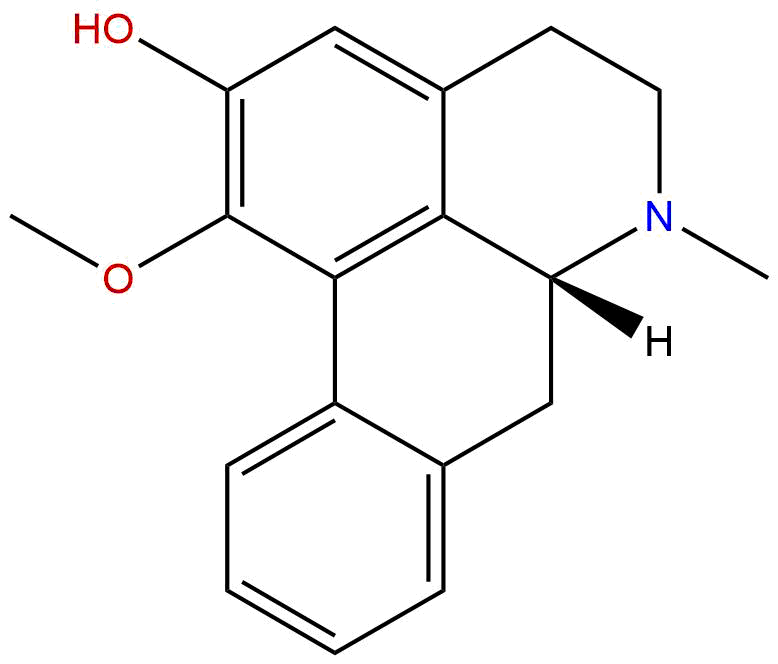


Product name: O-Nornuciferine
Synonym name: (-)-N-Methylasimilobine,(-)-Nornuciferine,O-Nornuciferine,N-Methylasimilobin
Catalogue No.: SBP03626
Cas No.: 3153-55-7
Formula: C18H19NO2
Mol Weight: 281.355
Botanical Source:
Type of Compound: Alkaloids
Purity: 95%~99%
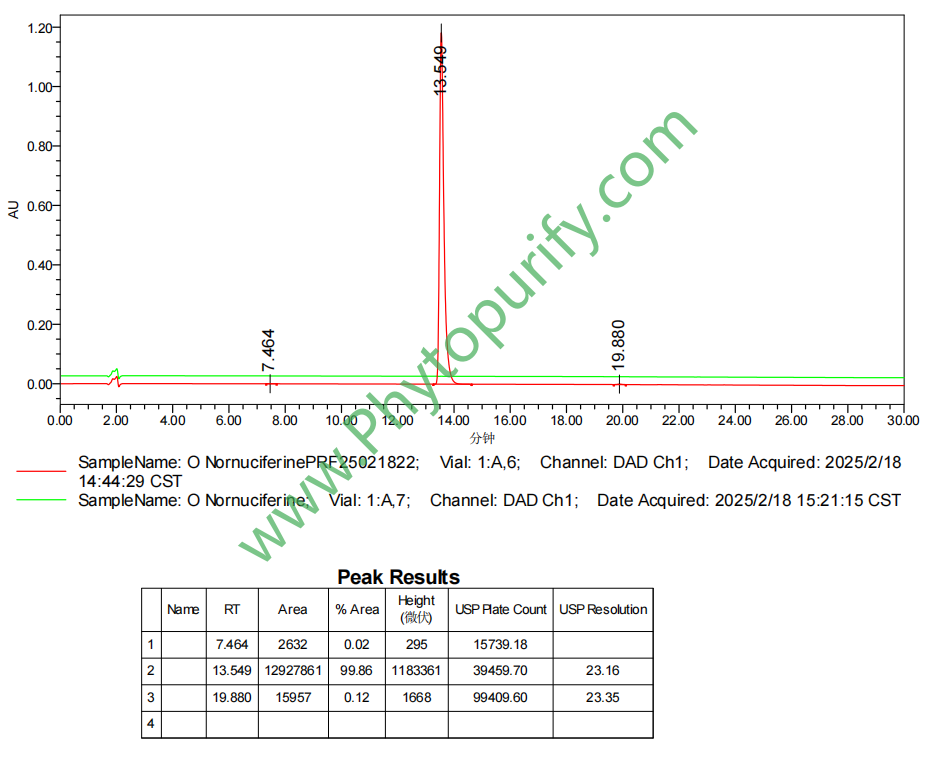
Analysis Method: HPLC-DAD or/and HPLC-ELSD
Identification Method: Mass, NMR
Packing: Brown vial or HDPE plastic bottle
Storage: Store in a well closed container, protected from air and light. Put into refrigerate or freeze for long term storage.
Whenever possible, you should prepare and use solutions on the same day. However, if you need to make up stock solutions in advance, we recommend that you store the solution as aliquots in tightly sealed vials at -20℃. Generally, these will be useable for up to two weeks.
The product could be supplied from milligrams to grams
Inquire for bulk scale.
For Reference Standard and R&D, Not for Human Use Directly.
HPLC of O-Nornuciferine
Storage conditions:Short-term storage at 2~8℃, long-term storage at -20 ~ -80℃
32.7000
3.2013
2.6473
.0349
7.0202
14.9418
High
84.6066
2.9473
No
Yes
No
No
Yes
No
0.6
Yes
No
No
No
Natural products, as an important source of drug discovery and development, play an irreplaceable role in the history of human disease treatment. Among them, alkaloid compounds have always been a hot topic in medicinal chemistry and pharmacology research due to their structural diversity and significant biological activity. O-Nornuciferine (CAS number: 3153-55-7), as an aporphine type alkaloid isolated from the traditional medicinal plant lotus leaf, has attracted much attention in recent years due to its potential neuropsychiatric activity. Early research mainly focused on its properties as a hERG channel inhibitor, but the latest evidence suggests that its pharmacological spectrum extends far beyond this, especially in the field of anti anxiety, demonstrating the potential for multi-target action. Anxiety disorder, as a common mental disorder, has a complex pathophysiological mechanism involving abnormalities in monoaminergic, GABAergic, neurotrophic factors, and multiple signaling pathways. Existing anti anxiety drugs such as benzodiazepines and selective serotonin reuptake inhibitors (SSRIs) are effective, but often come with tolerance, dependence, and multiple side effects. Therefore, developing new, efficient, and less side effect anti anxiety drugs is currently an important research direction. O-demethylated lotus leaf alkaloid exhibits unique multi-target regulatory properties by acting on monoamine oxidase A (MAOA), serotonin transporter (SLC6A4), multiple serotonin receptors (such as HTR1A, HTR2A), dopamine D2 receptor (DRD2), GABA_A receptor subtypes (GABRA1, GABRB2, GABRG2), and downstream CREB-BDNF signaling pathway. This article aims to systematically review the chemical properties, plant sources, pharmacological activities, molecular mechanisms of action, pharmacological properties, and development prospects of O-demethylated lotus leaf alkaloid as a novel candidate for anti anxiety drugs, in order to provide comprehensive academic references for the in-depth research and translational applications of this compound.
O-demethylated lotus leaf alkaloid is a typical aporphine type isoquinoline alkaloid. Its parent nucleus structure is composed of a benzoquinoline system. Compared with Nuciferine, its structural difference lies in the substitution of the methoxy group on the A-ring benzene ring with a hydroxyl group (i.e. demethylation), forming a phenolic hydroxyl structure. This structural modification significantly affects its physicochemical properties and pharmacological activity.
The basic physicochemical parameters are as follows: the molecular weight is 281.3550 g/mol, and the calculated lipid water partition coefficient (LogP) is 3.20, indicating that the compound has moderate lipophilicity and is beneficial for penetrating cell membranes and the blood-brain barrier. The topologically polar surface area (TPSA) is 32.70 Å ², which is relatively small and further supports its good membrane permeability. The theoretical water solubility is 0.0349 mg/mL, which belongs to the category of slightly soluble to poorly soluble. This suggests that solubilization strategies may need to be considered in formulation development, such as making salts or using cyclodextrin inclusion. The key pharmacological prediction shows that it has a high blood-brain barrier permeability, which is crucial for the development of central nervous system drugs. HERG inhibition is predicted as' no ', reducing its potential risk of inducing QT interval prolongation and apical torsion type ventricular tachycardia, with good safety prospects. The Ames test predicted a value of 0.6, indicating a low risk of mutagenicity.
The presence of phenolic hydroxyl groups not only enhances their ability as hydrogen bond donors, but may also affect their interaction patterns with target proteins and make them more susceptible to phase II metabolic binding reactions such as glucuronidation and sulfation. These physicochemical properties together form the basis for the biological activity and pharmacokinetic behavior of O-demethylated lotus alkaloids.
O-demethylated lotus alkaloid mainly comes from the lotus plant in the Nymphaeaceae family(Nelumbo nucifera The leaves of Gaertn., also known as the traditional Chinese medicine "lotus leaf". Lotus leaves have been used since ancient times for clearing heat and relieving summer heat, promoting hair and yang, cooling blood and stopping bleeding. Modern research has confirmed that they are rich in various active ingredients such as alkaloids, flavonoids, and polysaccharides, among which aporphine alkaloids are one of their characteristic components.
In the plant body, O-demethylated huperzine is a possible metabolic precursor or coexisting component of methylated aporphine alkaloids such as huperzine. Its content is influenced by factors such as variety, place of origin, harvest season, and leaf maturity. Usually, mature lotus leaves are used as extraction materials.
The extraction method mainly follows the conventional extraction and separation process of alkaloids:
1. Preliminary extraction After drying and crushing lotus leaves, acidic aqueous solutions (such as 0.5% -1% hydrochloric acid or acetic acid) or alcohol water mixed solvents (such as 70% -95% ethanol) are commonly used for percolation, reflux, or ultrasound assisted extraction. Acid water extraction can utilize alkaloids for salt solubilization, while alcohol extraction has high efficiency and strong penetration.
2. Purification and Enrichment After concentration, the extract is subjected to alkaline precipitation by adjusting the pH value, or liquid-liquid extraction is performed using organic solvents such as chloroform, dichloromethane, and ethyl acetate to transfer free alkaloids to the organic phase. Subsequently, column chromatography technology was used for further separation and purification. Silica gel, alumina, or macroporous adsorption resin were commonly used as the stationary phase, and gradient elution was performed using solvent systems such as chloroform methanol in different ratios.
3. Identification and quantification The isolated monomeric compounds were structurally confirmed by nuclear magnetic resonance (NMR, including ¹ H and ¹ ³ C NMR), mass spectrometry (MS), infrared spectroscopy (IR), and comparison with reference thin layer chromatography (TLC) or high-performance liquid chromatography (HPLC). Quantitative analysis often uses high-performance liquid chromatography ultraviolet detection (HPLC-UV) or more sensitive liquid chromatography-mass spectrometry (LC-MS/MS).
In recent years, green extraction techniques such as supercritical fluid extraction (SFE) and microwave-assisted extraction (MAE) have also been explored to improve extraction efficiency and selectivity. However, due to its lower content in plants compared to hesperetin, the large-scale acquisition of high-purity O-demethylated hesperetin still requires optimization of the separation process.
The pharmacological activity research of O-demethylated lotus leaf alkaloid has expanded from the initial focus on cardiovascular effects (hERG inhibition) to a broader field of central nervous system, with anti anxiety activity being the current research focus.
1. Central nervous system activity
* Anti anxiety effect Multiple in vivo pharmacological experiments have confirmed the significant anti anxiety activity of O-demethylated lotus alkaloids. In classic anxiety models such as mouse elevated cross maze test, light dark box test, and social interaction test, this compound can dose dependently increase the animal's dwell time in the open arm, tendency to enter the open box, and social behavior. Its effect is comparable to or has different characteristics from the positive drug diazepam, and no obvious sedation or motor coordination disorders were observed within a certain dose range (normal performance in the rotating rod test). This suggests that its anti anxiety effect has good specificity.
* Potential antidepressant and sedative effects Due to its mechanism of action involving the monoaminergic and GABA systems, a trend of shortening immobility time in mice has also been observed in some forced swimming and tail suspension experiments, suggesting potential antidepressant activity. At high doses, it may exhibit a mild sedative effect.
2. Other potential activities
* Cardiovascular effects As a hERG channel inhibitor, it exhibited certain potassium channel blocking activity in in vitro electrophysiological experiments, which was a focus of early research. However, its inhibitory strength may be weaker than some potent hERG blockers, and its high blood-brain barrier permeability may make its main effect more central. Its impact on overall cardiac safety needs to be evaluated in a more comprehensive preclinical model.
* Antioxidant and anti-inflammatory properties Alpha alkaloids often have antioxidant properties. The phenolic hydroxyl structure of O-demethylated lotus leaf alkaloid may enable it to have the ability to scavenge free radicals and inhibit lipid peroxidation, indirectly participating in neuroprotection. Further research is needed to determine whether it exerts anti-inflammatory effects by regulating pathways such as NF - κ B.
The anti anxiety effect of O-demethylated lotus leaf alkaloid is not achieved through a single target, but presents a synergistic regulatory network of multiple targets and systems, which provides a theoretical basis for its development into drugs with novel mechanisms of action.
1. Monoaminergic nervous system regulation
* MAOA inhibition O-demethylated lotus leaf alkaloid can inhibit the activity of monoamine oxidase A (MAOA), reduce the degradation of serotonin (5-HT), norepinephrine (NE), and dopamine (DA) in the brain, and thus increase the level of monoamine neurotransmitters in synaptic cleft. This partially overlaps with the mechanism of action of classic MAOI antidepressant/anti anxiety drugs.
* Regulation of the 5-hydroxytryptamine system It is an inhibitor of the serotonin transporter (SLC6A4), similar to SSRIs, which enhances 5-HTergic neurotransmission by blocking 5-HT reuptake. At the same time, it can also act as a partial agonist of 5-HT1A receptors (producing anti anxiety and anti depression effects) and an antagonist of 5-HT2A receptors (possibly reducing anxiety, improving sleep, and producing hallucinogenic antagonistic effects). This bidirectional regulation of 5-HT receptor subtypes may bring more balanced therapeutic effects and fewer side effects.
* Dopamine system regulation The antagonistic effect on dopamine D2 receptor (DRD2) may help regulate dopamine function in the midbrain limbic pathway, alleviate anxiety related hypervigilance and reward system disorders.
2. GABAergic nervous system enhancement
* GABA_A receptor positive allosteric regulation Research has shown that O-demethylated lotus leaf alkaloid can act on different subtypes of GABA_A receptors, including α 1 (GABRA1), β 2 (GABRB2), and γ 2 (GABRG2) subunits. It may act as a ligand for the benzodiazepine site (BZD site) or other conformational regulatory sites, enhancing the binding of GABA to receptors or promoting the opening of chloride ion channels, thereby producing central inhibitory and anti anxiety effects. But its intensity and spectrum of action may differ from classical benzodiazepines, which may be the reason why it produces anti anxiety effects and causes less strong sedation and muscle relaxation.
3. Neuronutrition and signal pathway regulation
* Upregulation of CREB-BDNF pathway Long term administration of O-demethylated lotus leaf alkaloid can activate the transcription factor CREB (cAMP response element binding protein), thereby promoting the expression of brain-derived neurotrophic factor (BDNF). BDNF is crucial for the survival, plasticity, and functional maintenance of neurons in brain regions such as the hippocampus and prefrontal cortex. The activation of this pathway is considered one of the ultimate common pathways through which multiple antidepressant/anti anxiety drugs take effect, helping to reverse neuroplastic damage caused by chronic stress or anxiety states.
In summary, O-demethylated lotus leaf alkaloid exerts anti anxiety effects through a unique multi-target synergistic mode of "MAOI+SSRI+5-HT1A activation/5-HT2A antagonism+GABA_A receptor regulation+neurotrophic enhancement", from rapid neurotransmitter regulation to long-term neuroplasticity improvement. It may have a faster onset, more comprehensive therapeutic effect, and a better spectrum of side effects.
Based on its physicochemical properties and preliminary in vitro ADMET (absorption, distribution, metabolism, excretion, toxicity) predictions, O-demethylated lotus leaf alkaloid shows certain potential as a drug, but still requires systematic experimental data support.
1. Absorption and distribution
* absorb Moderate LogP values (~3.2) and small TPSA (~32.7 Å ²) indicate good oral bioavailability potential, which can be effectively absorbed by the intestine through passive diffusion.
* distribution Predict that it has High blood-brain barrier permeability This is a key prerequisite for its central anti anxiety effect. Its distribution volume may be large, making it easy to enter lipid rich brain tissue.
2. Metabolism and excretion
* Metabolism As a compound containing phenolic hydroxyl groups, the metabolic pathways of O-demethylated lotus alkaloids may include phase I metabolism (such as cytochrome P450 enzyme mediated oxidation reactions) and phase II binding reactions (especially glucuronidation and sulfation of phenolic hydroxyl groups). It is necessary to clarify its main metabolic enzymes (such as CYP2D6, CYP3A4, etc.) to evaluate the risk of drug drug interactions. The Ames test predicted a negative result (0.6), indicating a low risk of genetic toxicity.
* excretion Metabolites are mainly excreted through the kidneys (conjugates) or bile.
3. Preliminary safety assessment
* cardiotoxicity:HERG inhibition predicted as' no 'This is a very favorable safety signal that significantly reduces its potential risk of inducing fatal arrhythmias, surpassing many known alkaloids with hERG inhibitory effects.
* acute toxicity A systematic acute toxicity test (such as LD50 determination) is required to determine its safe dose range.
* Long term toxicity The long-term toxicity of its administration, its impact on major organs (liver, kidney, heart, brain), and potential dependence (especially involving the GABA system) need to be evaluated through standardized repeated administration toxicity tests.
At present, there are insufficient public reports on the pharmacokinetic studies of O-demethylated lotus leaf alkaloid system (such as absolute bioavailability, half-life, clearance rate, and other parameters in rats, dogs, and other animals), which is a data gap that must be filled in the process of its preclinical development.
O-demethylated lotus leaf alkaloid, as a natural small molecule with multi-target effects, has promising development prospects in the treatment of neurological and psychiatric disorders, especially anxiety disorders.
1. Development of new anti anxiety drugs
* Advantage Its multi-target mechanism may lead to more comprehensive symptom improvement, faster onset of action (balancing rapid GABAergic regulation and monoamine regulation), and possibly fewer side effects (such as sexual dysfunction, weight gain, excessive sedation, etc.). Its non potent hERG inhibitory properties provide advantages for its cardiovascular safety.
* positioning It may be developed as a first-line anti anxiety medication or used as an alternative or enhanced treatment for patients with poor efficacy or intolerance to existing SSRIs/SNRIs.
2. Expand other indications
* depression Given its regulatory effects on the monoamine system and BDNF pathway, it may also be effective in the treatment of depression, especially depression with anxiety symptoms.
* Substance dependence and withdrawal Acting on the DA and 5-HT systems, it may have therapeutic potential for anxiety caused by substance dependence and withdrawal, such as nicotine and alcohol.
* Neurodegenerative disease-related psychiatric symptoms Its neuroprotective potential (antioxidant, promoting BDNF) may help improve neurological and psychiatric symptoms such as anxiety and depression that accompany Alzheimer's and Parkinson's disease patients.
3. Challenges faced and future research directions
* Chemical optimization Although it has inherent activity, its pharmacological properties can be improved through structural modifications, such as designing prodrugs for phenolic hydroxyl groups to enhance oral bioavailability, or fine-tuning the structure to optimize target selectivity spectra.
* System preclinical research It is urgent to complete comprehensive preclinical pharmacodynamic (more animal model validation), pharmacokinetic (ADME parameters), and toxicological (acute toxicity, long-term toxicity, reproductive toxicity, etc.) evaluations to meet the requirements of new drug clinical research applications (IND).
* Deep analysis of mechanism It is necessary to use techniques such as molecular docking, site directed mutagenesis, and photoaffinity labeling to accurately elucidate its binding mode and strength of action (Ki/IC50 value) with each target, clarify whether it is a "dirty medicine" or a "clever medicine", and the weight of each target's contribution.
* Formulation development To address the issue of poor water solubility, it is necessary to develop suitable formulations such as nanocrystals, solid dispersions, or liposomes to ensure stable absorption and therapeutic effects in vivo.
* Clinical study design If entering clinical practice in the future, it is necessary to carefully design a trial plan to verify its superiority or non inferiority compared to existing standard therapies, and clarify its optimal treatment window and safety profile.
O-demethylated lotus leaf alkaloid is an important research value aporphine type alkaloid discovered from traditional Chinese medicine lotus leaves. Beyond its early recognition of hERG channel inhibitory properties, this compound exhibits unique multi-target anti anxiety pharmacological activity by synergistically regulating MAOA, SLC6A4, HTR1A, HTR2A, DRD2, GABA_A receptor, and CREB-BDNF signaling pathway. Its excellent blood-brain barrier permeability, low prediction of cardiac toxicity (hERG inhibition negative), and mutagenic risk have laid a solid pharmaceutical foundation for its further development. However, there is still a long way to go from lead compounds to candidate drugs and ultimately to marketed drugs, which requires collaborative research from multiple disciplines such as medicinal chemistry, pharmacology, pharmacy, and toxicology to complete systematic and standardized preclinical and clinical studies. The study of O-demethylated lotus leaf alkaloid not only provides new candidate molecules and a unique perspective on the mechanism of action for the development of anti anxiety drugs, but also once again demonstrates the enormous potential and scientific value of searching for modern disease treatment solutions from the treasure trove of natural products. With the continuous deepening of research, it is expected to occupy a place in the future field of neuropsychiatric disease treatment.
