


Product name: Mesaconitine
Synonym name: N-Desethyl-N-methylaconitine; Japaconitine A; Japaconitine B
Catalogue No.: BP0935
Cas No.: 2752-64-9
Formula: C33H45NO11
Mol Weight: 631.719
Botanical Source: Alkaloid from Aconitum manschuricum and many other Aconitum spp. (Ranunculaceae)
Physical Description: White powder
Type of Compound: Alkaloids
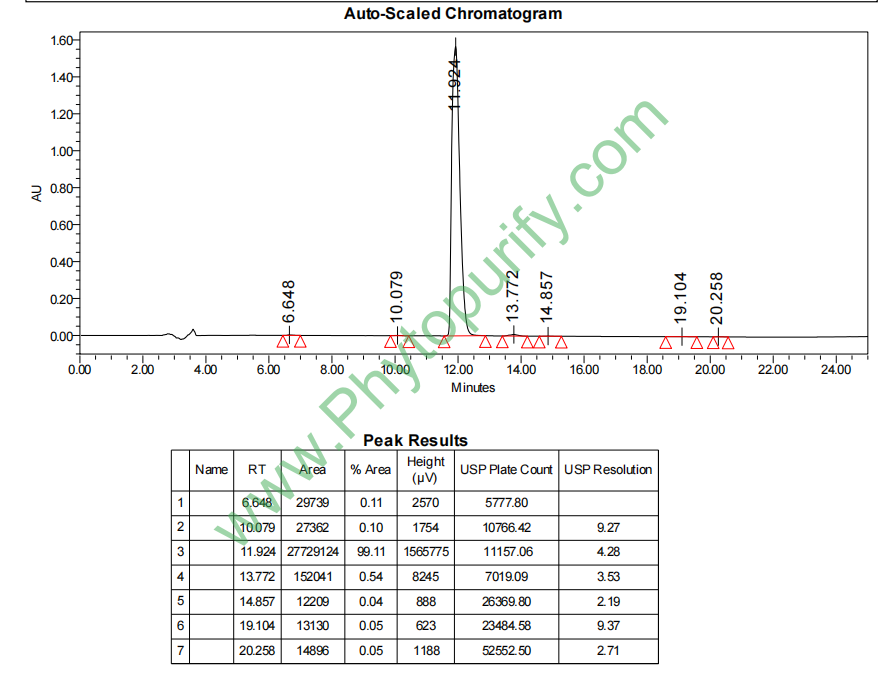
Purity: 95%~99%
Analysis Method: HPLC-DAD or/and HPLC-ELSD
Identification Method: Mass, NMR
Packing: Brown vial or HDPE plastic bottle
Storage: Store in a well closed container, protected from air and light. Put into refrigerate or freeze for long term storage.
Whenever possible, you should prepare and use solutions on the same day. However, if you need to make up stock solutions in advance, we recommend that you store the solution as aliquots in tightly sealed vials at -20℃. Generally, these will be useable for up to two weeks.
The product could be supplied from milligrams to grams, up to kilograms
Inquire for bulk scale.
Descriptions:
Mesaconitine increases the [Ca2+]i level in endothelial cells by influx of Ca2+ from extracellular spaces, suggests that mesaconitine-induced Ca2+ influx and activation of nitric-oxide synthase in endothelial cells and, thus, induced vasorelaxation in rat aorta.[1]
Mesaconitine is highly toxic, can inhibit Efflux transporters, including P-glycoprotein (P-gp), breast cancer resistance protein (BCRP), and multidrug resistance-associated protein isoform 2 (MRP2).[2]
Mesaconitine has antinociceptive activity, has inhibition of stimulus-triggered and spontaneous epileptiform activity in rat hippocampal slices.[3,4]
Mesaconitine has antiinflammatory activity, can inhibit carrageenin-induced hind-paw edema in sham-operated mice as well as adrenalectomized mice, it do not affect the biosynthesis of the prostaglandins. [5]
References:
[1] Mitamura M, Horie S, Sakaguchi M, et al. Eur J Pharmacol, 2013, 436(3):217-25.
[2] Ling Y, Yang X, Zhen Y, et al. Toxicol Lett, 2013, 216(2-3):86-99.
[3] Suzuki Y, Oyama T, Ishige A, et al. Planta Med, 1994, 60(5):391-4.
[4] Ameri A. Eur J Pharmacol, 1998, 342(2-3):183-91.
[5] Hiroshi H, Hiroshi T, Mitsuo F, et al. Eur J Pharmacol, 1982, 82(1-2):65-71.
[6] Zhou J, Ling Y E, Tang L, et al. China Journal of Traditional Chinese Medicine & Pharmacy, 2013, 38(10):1521-5.
HPLC of Mesaconitine
Storage conditions:Short-term storage at 2~8℃, long-term storage at -20 ~ -80℃
Mesaconitine (CAS number: 2752-64-9), as one of the main active alkaloids in Aconitum plants, has long been a focus of attention in the field of natural product pharmacology due to its unique chemical structure and significant pharmacological activity. Aconitum plants have been widely used in traditional Chinese medicine since ancient times, especially in pain relief, anti-inflammatory, and cardiovascular diseases, showing good therapeutic effects. As an isomer of neoaconitine, aconitine has a complex molecular structure and multi-target properties. In recent years, with the development of modern pharmacological technology, its mechanism of action and potential clinical application value have gradually been revealed.
This article aims to systematically review the chemical structure and physicochemical properties, plant sources, and extraction methods of aconitine, explore its pharmacological activity and mechanism of action in depth, analyze its pharmacokinetic characteristics based on pharmacological parameters, and finally look forward to its clinical application prospects, providing theoretical basis and practical guidance for subsequent related research.
Aconitine is a dihydroditerpenoid alkaloid with the molecular formula C36H51NO11 and a molecular weight of 631.7190. Its structure contains multiple ester groups and ether bonds, with high polarity and complex three-dimensional conformation. The LogP value of aconitine is 1.5884, indicating its moderate lipophilicity, which facilitates cell membrane penetration but is not overly hydrophobic. Its topological polar surface area (TPSA) is 153.45 Å ², indicating strong polarity characteristics that may affect its bioavailability and blood-brain barrier penetration ability.
The water solubility is 0.1765 mg/mL, which belongs to low solubility compounds, indicating the need to consider solubility enhancement strategies in formulation development. The blood-brain barrier has low permeability, which may limit the direct action of the central nervous system, but also reduce the risk of central toxicity. The hERG channel inhibition experiment result was negative, indicating a low risk of cardiotoxicity from aconitine. The Ames test result is 0.6, indicating low mutagenicity and good safety basis.
Aconitum alkaloids are mainly found in Aconitum spp., especially in Aconitum carmichaelii and its variants, which are abundant in content. Aconitum plants are widely distributed in China, Japan, and other regions of East Asia, and have always been used as traditional Chinese medicinal materials. The rhizome is the main medicinal part, containing various alkaloids, among which aconitine is one of the important active ingredients.
The common methods for extracting aconitine include solvent extraction, acid-base separation, and column chromatography purification. Traditional processes often use ethanol or methanol as solvents to obtain crude extracts through reflux extraction, and then use acid-base extraction to separate alkaline alkaloids. Further purification is often carried out using silica gel column chromatography, counter current chromatography, or high-performance liquid chromatography (HPLC) techniques to ensure the purity and activity of aconitine. In recent years, green extraction technologies such as ultrasound assisted extraction and microwave-assisted extraction have also been applied to improve extraction efficiency and reduce environmental pollution.
Aconitum alkaloids have various pharmacological activities, especially the most significant analgesic effect. Its analgesic effect has been validated in various animal models, including thermal pain, mechanical pain, and inflammatory pain models. Compared with traditional opioid analgesics, aconitine exhibits strong analgesic efficacy within a certain dosage range and relatively fewer side effects.
In addition, aconitine also exhibits multiple pharmacological effects such as anti-inflammatory, antiarrhythmic, and neuroprotective effects. Its anti-inflammatory effect is mainly achieved by inhibiting the release of inflammatory mediators and regulating immune cell function. In terms of cardiovascular function, aconitine can regulate the electrophysiological properties of myocardial cells and has potential antiarrhythmic effects. The neuroprotective effect is related to its regulation of neurotransmitters and antioxidant capacity.
The pharmacological mechanism of aconitine is complex, involving multiple molecular targets, especially in the field of analgesia, showing the characteristic of multi-target synergistic regulation. Its main targets include:
The multiple synergistic effects of these targets give aconitine a unique advantage in pain relief and treatment of related diseases.
Evaluation of drug properties is an important step in the development of new drugs. The physicochemical properties of aconitine demonstrate its potential as a drug, but there are also some challenges. Its molecular weight is relatively large, polarity is strong, and water solubility is low, which may affect oral bioavailability. The blood-brain barrier has low permeability, which limits its direct effects on the central nervous system, but helps to reduce central toxicity.
The hERG channel inhibition experiment was negative, indicating a low risk of cardiac toxicity, which is beneficial for safety evaluation. The Ames test results showed that its mutagenicity was low and met safety requirements. Pharmacokinetic studies have shown that aconitine is metabolized rapidly in vivo, mainly through the liver enzyme system, and the metabolites need further identification. Its half-life is moderate and suitable for multiple administrations to maintain its efficacy.
Future optimization of drug properties can be achieved through structural modification, nanocarrier encapsulation, and development of sustained-release formulations to improve their bioavailability and targeting, and reduce potential toxic side effects.
Aconitine, as a natural product with multi-target effects, has shown extensive clinical application potential. Its significant analgesic effect makes it of great value in the treatment of chronic pain, neuropathic pain, and inflammatory pain. Compared with traditional opioid drugs, aconitine may reduce the risk of drug resistance and dependence, providing a new analgesic treatment option.
In addition, its anti-inflammatory, antiarrhythmic, and neuroprotective effects provide new ideas for the treatment of cardiovascular and neurodegenerative diseases. With the development of pharmaceutical formulation technology, the pharmacokinetic defects of aconitine are expected to be improved, further promoting its clinical translation.
Future research should focus on in-depth analysis of its mechanism of action, systematic improvement of safety evaluation, and the conduct of clinical trials. The interdisciplinary integration will promote the transformation of aconitine from laboratory research to clinical application, and drive innovation in the development of natural product drugs.
As an important active ingredient in Aconitum plants, aconitine has shown broad application prospects in the fields of analgesia and related disease treatment due to its unique chemical structure and multi-target pharmacological effects. Its pharmacological parameters show a good safety basis, but there are also challenges in terms of bioavailability and pharmacokinetics. In the future, through structural optimization and the application of advanced formulation technology, it is expected to overcome these limitations and promote its clinical translation.
In summary, aconitine not only enriches the research content of natural product pharmacology, but also provides valuable resources for the development of new analgesic drugs. We look forward to more in-depth basic and clinical research to promote its safe and effective clinical use, and achieve the successful transformation of natural products into modern drugs.
