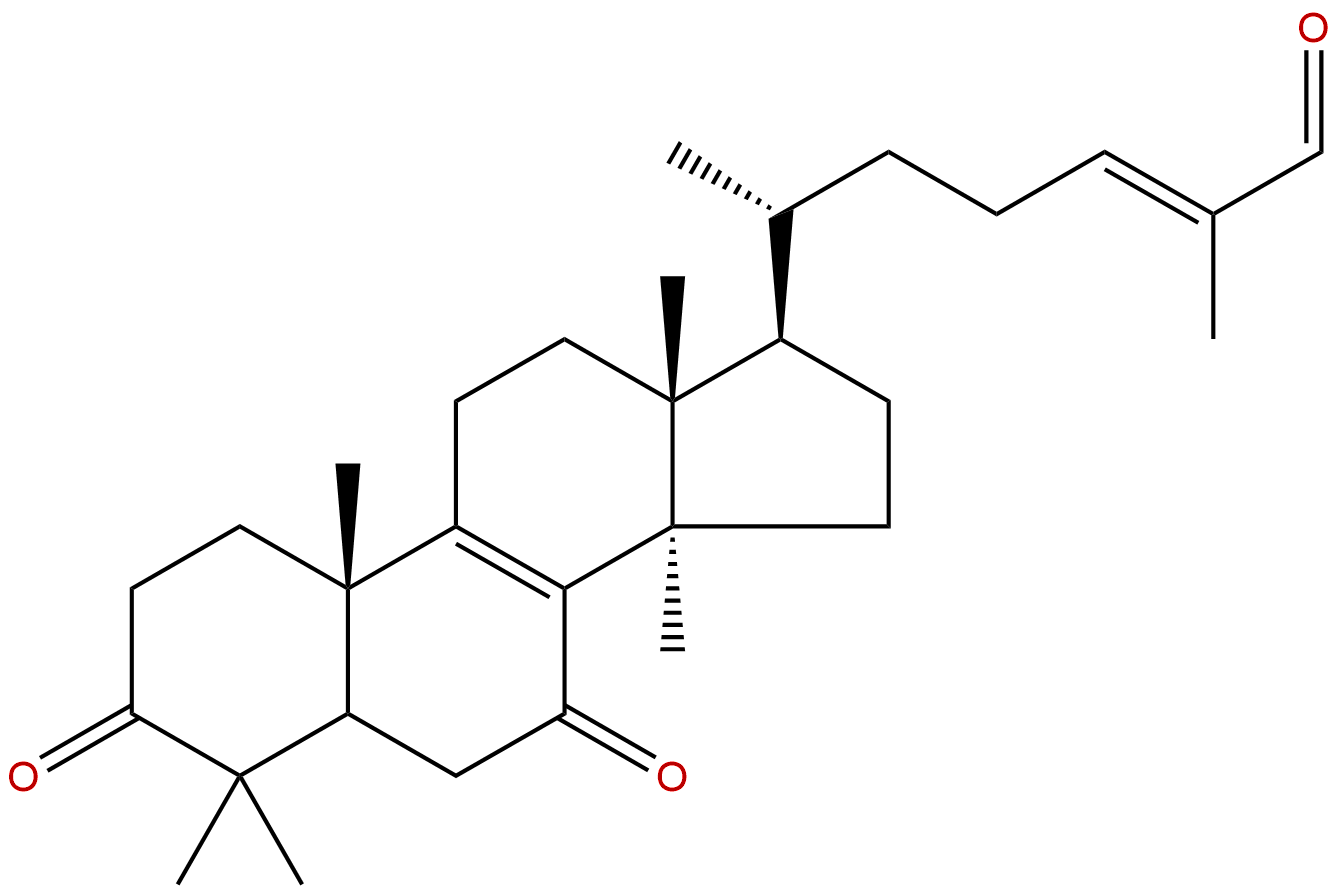


Product name: Lucialdehyde B
Synonym name:
Catalogue No.: BPF0305
Cas No.: 480439-84-7
Formula: C30H44O3
Mol Weight: 452.679
Botanical Source: Ganoderma lucidum (reishi)
Physical Description: Powder
Type of Compound: Triterpenoids
Purity: 95%~99%
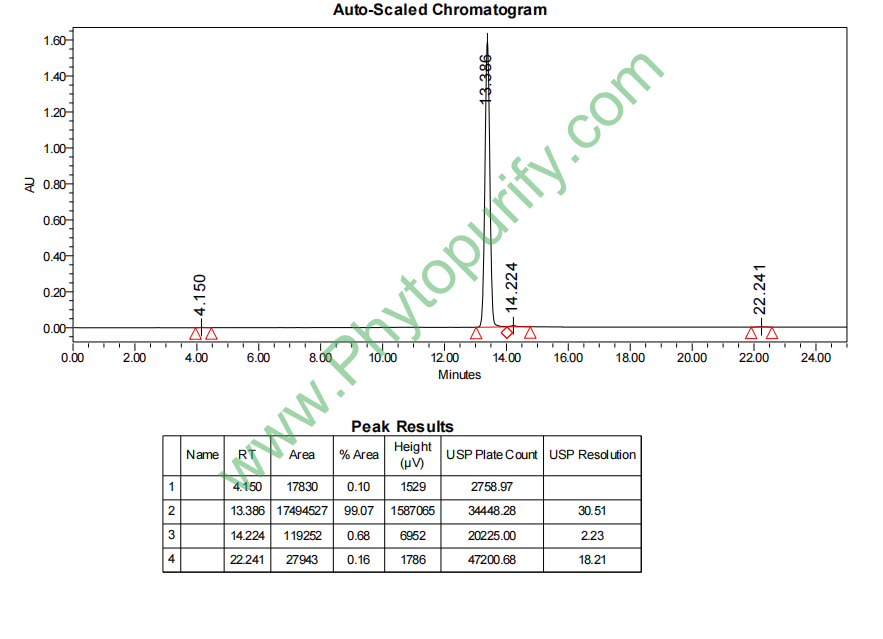
Analysis Method: HPLC-DAD or/and HPLC-ELSD
Identification Method: Mass, NMR
Packing: Brown vial or HDPE plastic bottle
Storage: Store in a well closed container, protected from air and light. Put into refrigerate or freeze for long term storage.
Whenever possible, you should prepare and use solutions on the same day. However, if you need to make up stock solutions in advance, we recommend that you store the solution as aliquots in tightly sealed vials at -20℃. Generally, these will be useable for up to two weeks.
The product could be supplied from milligrams to grams, up to kilograms
Inquire for bulk scale.
Descriptions:
Lucialdehyde B exhibits potent inhibitory activity against herpes simplex virus. It shows cytotoxic effects on Lewis lung carcinoma (LLC), T-47D, Sarcoma 180, and Meth-A tumor cell lines.
HPLC of Lucialdehyde B
Storage conditions:Short-term storage at 2~8℃, long-term storage at -20 ~ -80℃
51.2100
6.0070
6.0070
.0004
8.2358
16.2067
High
88.7719
4.7999
No
Yes
No
No
No
No
0.0
No
No
No
Yes
Natural products, as an important source of drug discovery, play an irreplaceable role in the long history of human fight against diseases. Fungi, especially higher medicinal fungi, have attracted much attention due to their unique secondary metabolite libraries. Ganoderma lucidum(Ganoderma lucidum)As a traditional medicinal fungus with thousands of years of application history in East Asian countries such as China, Japan, and South Korea, it is known as the "fairy grass" or "auspicious grass". Modern pharmacological research has confirmed that Ganoderma lucidum and its extracts have various biological activities such as immune regulation, anti-tumor, antioxidant, antiviral, liver and heart protection. These broad pharmacological effects are closely related to the rich and diverse chemical components they contain, among which triterpenoids and polysaccharides are considered the most important active ingredient groups in Ganoderma lucidum.
Among the numerous triterpenoid compounds in Ganoderma lucidum, Lucialdehyde B (hereinafter referred to as Luc-B) is a representative tetracyclic triterpenoid aldehyde compound. Since its isolation and identification from Ganoderma lucidum fruiting bodies, Luc-B has attracted widespread attention from medicinal chemists and pharmacologists due to its significant antiviral and cytotoxic activities, especially its killing effect on various tumor cell lines. Unlike the high content of ganoderic acids in Ganoderma lucidum, the structural feature of Luc-B is the presence of an aldehyde (- CHO) functional group on its side chain, which may be closely related to its unique biological activity.
In recent years, with the continuous deepening of research on Luc-B, its anti-tumor mechanism has gradually been revealed, involving the regulation of multiple key signaling pathways and targets, such as apoptosis related proteins MCL1 and BCL2, transcription factor STAT3, matrix metalloproteinase MMP2, topoisomerase TOP1/TOP2A, and hypoxia inducible factor HIF1A. These findings not only provide a molecular level explanation for understanding the anti-tumor activity of Luc-B, but also lay a theoretical foundation for its potential clinical applications. However, Luc-B also faces challenges commonly found in natural products, such as extremely poor water solubility (0.0004 mg/mL), high lipid solubility (LogP=6.007), and potential high brain permeability, which pose special requirements for its future drug development pathways.
This article aims to provide a systematic review of the research status of Luc-B, covering its chemical structure and physicochemical properties, plant sources and extraction methods, pharmacological activity, mechanism of action and molecular targets, pharmacological evaluation and pharmacokinetic characteristics. Based on this, it explores its clinical application prospects and future research directions, in order to provide reference for the in-depth research and development of this promising natural triterpenoid compound.
Lucialdehyde B (Luc-B) belongs to the tetracyclic triterpenoid class in chemical classification, and its basic skeleton is derived from lanostane. Similar to most Ganoderma triterpenoids, the mother nucleus of Luc-B consists of four rings: A, B, C, and D. The A and C rings are hexagonal rings, while the B and D rings are pentagonal rings, forming a typical four ring triterpenoid skeleton. The uniqueness of Luc-B lies in its C-17 side chain structure. This side chain typically contains an unsaturated double bond and a critical terminal aldehyde group (- CHO), which is the origin of its name "Lucialdehyde". The presence of this aldehyde group endows Luc-B with high chemical reactivity, making it possible for it to act as a Michael receptor and covalently bind with nucleophilic groups (such as the thiol group of protein cysteine residues) in the body, which may be an important chemical basis for its pharmacological activity. In addition, Luc-B molecules also contain multiple oxygen-containing functional groups such as hydroxyl (- OH) and carbonyl (C=O) groups, which not only affect their polarity, but also serve as key sites for non covalent interactions such as hydrogen bonding and hydrophobicity with biological targets.
From the perspective of physical and chemical properties, the molecular formula of Luc-B is C ∝₀ H ₄₄₄ O3, with a molecular weight of 452.6790 g/mol. Its lipid water partition coefficient LogP is as high as 6.0070, indicating that the compound has strong lipophilicity and is easily soluble in organic solvents such as chloroform, methanol, ethanol, ethyl acetate, etc., while its solubility in water is extremely low, only 0.0004 mg/mL. This extremely poor water solubility is one of the main obstacles in the development of Luc-B as an oral medication, seriously affecting its ability to be absorbed from the gastrointestinal tract into the systemic circulation. Its polar surface area (TPSA) is 51.2100 Å ², which is lower than the threshold for passive diffusion through the blood-brain barrier (approximately 60-70 Å ²). Combined with its high LogP value, it is predicted that Luc-B has a high blood-brain barrier penetration ability. This characteristic may be advantageous in treating brain tumors or neurological disorders, but it may also increase the risk of central nervous system toxicity. In addition, preliminary computer simulation predictions indicate that Luc-B has a low risk of inhibiting hERG potassium ion channels (hERG inhibition: No), and the Ames test result is negative (0.0), suggesting that it may not have direct mutagenicity. These pharmacological parameters provide key guidance information for the subsequent drug chemical modification and formulation design of Luc-B.
Lucialdehyde B mainly comes from the fungus Ganoderma lucidum in the family Myceliaceae(Ganoderma lucidum)The sub entity. Lingzhi, as a wood rot fungus widely distributed in temperate and subtropical regions, has mature artificial cultivation techniques, providing sufficient raw material guarantee for the large-scale acquisition of Luc-B. In addition to Ganoderma lucidum itself, other fungi belonging to the same genus, such as Ganoderma lucidum(Ganoderma sinense)Or Songshan Lingzhi(Ganoderma tsugae)Similarly, it may also contain similar triterpenoid components, but the content and distribution pattern of Luc-B may vary significantly among different varieties, origins, and growth stages of Ganoderma lucidum. Generally speaking, mature Ganoderma lucidum fruiting bodies have a richer variety and content of triterpenoid compounds.
Luc-B, as a lipophilic component, is mainly extracted based on the principle of "similar solubility" using organic solvents. Traditional extraction methods include solvent impregnation, percolation, and reflux extraction. Common extraction solvents include ethanol, methanol, chloroform, ethyl acetate, etc. Due to the low polarity of Luc-B, medium polarity solvents or mixed solvents are usually chosen for extraction. For example, using 95% ethanol or methanol for reflux extraction of Ganoderma lucidum fruiting body powder can obtain total triterpenoid extracts including Luc-B. In order to improve extraction efficiency and selectivity, modern extraction techniques such as ultrasound assisted extraction and microwave-assisted extraction have also been applied to the extraction of Luc-B, which can shorten the extraction time and improve the yield of target compounds.
After obtaining the crude extract, a series of separation and purification steps are required to obtain high-purity Luc-B monomer. The classic separation process typically includes liquid-liquid extraction (such as fractional extraction using solvents of different polarities such as petroleum ether, chloroform, and ethyl acetate, with Luc-B typically enriched in the chloroform or ethyl acetate extraction layer), silica gel column chromatography (gradient elution using different ratios of chloroform methanol or petroleum ether acetone elution systems), and preparative high-performance liquid chromatography (Pre HPLC) for final refinement. In the separation process, thin-layer chromatography (TLC) combined with ultraviolet detection or color reagents (such as vanillin sulfuric acid color) are often used for tracking. In recent years, new separation technologies such as high-speed countercurrent chromatography (HSCCC) have also been successfully applied to the separation of triterpenoids from Ganoderma lucidum, with advantages such as high separation efficiency and low sample loss. Finally, the isolated compound was structurally identified using spectroscopic techniques such as nuclear magnetic resonance spectroscopy (NMR) and mass spectrometry (MS), confirming its identity as Lucialdehyde B.
Since the discovery of Lucialdehyde B, its pharmacological activity research has mainly focused on its anti-tumor and antiviral aspects, among which anti-tumor activity is the most deeply and widely studied field.
1. Cytotoxic activity and anti-tumor effect
Numerous in vitro cell experiments have shown that Luc-B exhibits significant cytotoxic effects on tumor cell lines from various tissue sources. Early studies confirmed that Luc-B has inhibitory activity on mouse Lewis lung cancer cell (LLC), human breast cancer cell T-47D, mouse sarcoma Sarcoma 180 cell and mouse Meth-A fibrosarcoma cell. These findings reveal that Luc-B has broad-spectrum anti-tumor potential. Subsequent research further expanded the range of its sensitive cell lines, including human liver cancer cells (such as HepG2, Huh7), human colon cancer cells (such as HCT116, SW480), human lung cancer cells (such as A549), human prostate cancer cells (such as PC3), and so on. It is worth noting that there are differences in the sensitivity of different tumor cells to Luc-B, which may be related to the activation status of specific signaling pathways or the expression levels of target proteins in different cell lines.
The inhibitory effect of Luc-B on tumor cells is usually manifested as inducing cell apoptosis and/or inhibiting cell proliferation. Through morphological observation (such as cell shrinkage and nuclear fragmentation), flow cytometry detection (such as Annexin V/PI double staining and hypodiploid peak analysis), and biochemical indicators detection (such as activation of Caspase-3/9 and cleavage of PARP), it has been confirmed that Luc-B can induce tumor cell apoptosis in a dose-dependent and time-dependent manner. In addition, some studies have also found that Luc-B can cause cell cycle arrest, such as blocking cells in the G1 or G2/M phase, thereby inhibiting the unlimited proliferation of tumor cells.
2. Antiviral activity
In addition to its anti-tumor activity, Luc-B has also been reported to have certain antiviral effects. Although there are relatively few related studies, preliminary results suggest that Luc-B may have inhibitory activity against certain viruses. For example, studies have shown that triterpenoids from Ganoderma lucidum (possibly including Luc-B) have inhibitory effects on the reverse transcriptase or protease of human immunodeficiency virus (HIV), thereby affecting the virus's replication cycle. In addition, there have been reports on the anti influenza virus, hepatitis virus and other activities of Ganoderma lucidum extracts, but further in-depth and systematic research is needed on the antiviral spectrum and mechanism of action of Luc-B monomer components.
3. Other pharmacological activities
Given that triterpenoids typically have a wide range of biological activities, Luc-B may also have other potential pharmacological effects, such as anti-inflammatory and antioxidant effects. However, there are currently insufficient research reports on Luc-B in these areas, mainly at the level of Ganoderma lucidum crude extract or total triterpenoids. In the future, specialized research on Luc-B monomers is needed to comprehensively evaluate their pharmacological activity spectrum.
The anti-tumor mechanism of Lucialdehyde B is multi-level and multi-target, involving the regulation of multiple key biological processes such as cell apoptosis, proliferation, invasion and metastasis, and angiogenesis. In recent years, with the development of molecular biology technology, its mechanism of action has gradually been elucidated, mainly involving the following core pathways and targets.
1. Regulating apoptosis related proteins: MCL1 and BCL2
The dysregulation of cell apoptosis is an important characteristic of tumor occurrence and development. The BCL2 family proteins play a central role in regulating the mitochondrial apoptosis pathway, with the balance between anti apoptotic proteins (such as BCL2, MCL1, BCL-XL) and pro apoptotic proteins (such as BAX, BAK) determining cell life and death. Research has shown that Luc-B can downregulate the expression levels of anti apoptotic proteins MCL1 and BCL2 in various tumor cells, while upregulating the expression of pro apoptotic protein BAX. This change in expression profile leads to an increase in the ratio of BAX/BCL2, promotes mitochondrial outer membrane permeability, releases cytochrome c, activates the Caspase cascade reaction, and ultimately induces cell apoptosis. MCL1, as a key anti apoptotic protein in the BCL2 family, is closely associated with drug resistance in various tumors due to its high expression. The inhibitory effect of Luc-B on MCL1 provides potential for overcoming tumor drug resistance.
2. Inhibit the STAT3 signaling pathway
Signal transducer and activator of transcription factor 3 (STAT3) is a key transcription factor that is continuously activated in various malignant tumors, promoting cell proliferation, survival, angiogenesis, and immune escape. The activation of STAT3 depends on the phosphorylation of its Tyr705 site. Phosphorylated STAT3 forms a dimer and enters the nucleus, regulating the transcription of downstream target genes such as Cyclin D1, Survivor, VEGF, MMP2, etc. Research has confirmed that Luc-B can effectively inhibit the phosphorylation of STAT3, block its nuclear translocation and transcriptional activity. By inhibiting the STAT3 signaling pathway, Luc-B can downregulate the expression of its target genes, thereby inhibiting tumor cell proliferation, inducing apoptosis, and potentially suppressing tumor invasion and metastasis.
3. Inhibition of matrix metalloproteinase MMP2 and resistance to invasion and metastasis
The invasion and metastasis of tumor cells are the main causes of death in cancer patients. Matrix metalloproteinases (MMPs) can degrade the extracellular matrix and are key enzymes in the invasion and metastasis of tumor cells. MMP2 (gelatinase A) is highly expressed in various invasive tumors and is closely related to the malignancy and poor prognosis of the tumors. Research has found that Luc-B can significantly reduce the protein expression and enzyme activity of MMP2 in tumor cells. This effect may be related to the inhibition of upstream signaling pathways such as STAT3 or MAPK by Luc-B, as MMP2 is a transcriptional target of these pathways. By inhibiting MMP2, Luc-B can weaken the migration and invasion ability of tumor cells, indicating its potential for anti metastasis.
4. Targeting Topoisomerase TOP1 and TOP2A
DNA topoisomerase is an enzyme necessary for cellular DNA replication, transcription, and chromosome separation. TOP1 and TOP2A are two important topoisomerases that regulate the topological structure of DNA by cutting and reconnecting DNA strands. Many clinically effective anti-tumor drugs, such as camptothecin and etoposide, exert their cytotoxic effects by inhibiting the activity of topoisomerases. Research has shown that Luc-B can inhibit the activity of TOP1 and TOP2A. This inhibitory effect may lead to the accumulation of DNA damage, triggering cell cycle checkpoints and inducing cell apoptosis. Luc-B, as a natural topoisomerase inhibitor, may have a different mode of action from existing drugs, providing a new lead compound for the development of novel topoisomerase targeted drugs.
5. Regulating hypoxia inducible factor HIF1A and angiogenesis
The hypoxic microenvironment inside solid tumors is an important factor driving malignant progression and drug resistance. Hypoxia inducible factor 1 alpha (HIF1A) is a core transcription factor that cells respond to hypoxia. It can activate the expression of a series of genes that promote angiogenesis (such as VEGF), glycolysis, and cell survival. Research has found that Luc-B can inhibit the protein expression or transcriptional activity of HIF1A. By downregulating HIF1A, Luc-B can reduce the expression of its downstream target gene VEGF, thereby inhibiting the formation of tumor neovascularization. The anti angiogenic effect is considered another important aspect of Luc-B's anti-tumor activity.
6. Other potential targets
In addition, Luc-B may also exert anti-tumor effects by affecting other signaling pathways. For example, it may interfere with the RAS-RAF-MEK-ERK proliferation signaling pathway by inhibiting the phosphorylation of MAPK1 (ERK2); For hormone dependent tumors (such as breast cancer), Luc-B may play its role by affecting the activity of estrogen receptor ESR1 or aromatase CYP19A1. The multi-target characteristics of Luc-B give it unique advantages in anti-tumor treatment, but also increase the complexity of its mechanism of action research.
Although Lucialdehyde B has demonstrated remarkable anti-tumor activity in vitro, its development as a candidate drug still faces severe challenges, mainly due to its poor drug properties.
1. Physical and chemical properties and drug like properties
According to the Lipinski Five Rules, an ideal drug like molecule should typically meet the following criteria: molecular weight<500, LogP<5, The number of hydrogen bond donors is less than 5, and the number of hydrogen bond acceptors is less than 10. The molecular weight of Luc-B is 452.68, which complies with the rules; But its LogP is as high as 6.007, significantly exceeding the threshold of 5, indicating its excessive lipophilicity. High LogP values typically lead to poor water solubility, high metabolic clearance rates, and increased risks of non-specific binding and toxicity. In fact, the water solubility of Luc-B is only 0.0004 mg/mL, which is an extremely insoluble compound in water, severely limiting its oral bioavailability. In addition, its TPSA is 51.21, which is beneficial for crossing the blood-brain barrier, but may also increase the accumulation of drugs in brain tissue, leading to potential central nervous system toxicity.
2. Pharmacokinetic prediction
At present, there is very limited experimental data on the in vivo pharmacokinetics (ADME) of Luc-B, mainly relying on computer simulation predictions. Due to its extremely poor water solubility, the dissolution and absorption of Luc-B in the gastrointestinal tract will be extremely difficult after oral administration, and its oral bioavailability is expected to be extremely low. Intravenous injection may be a more feasible route of administration, but it also requires addressing its water solubility issues, such as using cosolvents (such as cyclodextrin, surfactants) or preparing them into new drug delivery systems such as liposomes and nanoemulsions. The prediction shows that Luc-B has high blood-brain barrier penetration, which suggests its potential in the treatment of brain tumors, but its neurotoxicity also needs to be closely monitored. In addition, highly lipophilic compounds are often easily metabolized by the liver's cytochrome P450 enzyme system and may be excreted through bile, resulting in shorter half lives and higher clearance rates.
3. Security assessment
Preliminary computer toxicology predictions (such as negative Ames test and low risk of hERG inhibition) provide some positive information for the safety of Luc-B. However, computer predictions cannot completely replace actual biological evaluations. In vivo toxicity studies, especially toxicity assessments of major organs such as the liver, kidneys, and nervous system, are an essential part of Luc-B's preclinical research. Given its high lipophilicity and potential bioaccumulation, long-term toxicity studies are particularly important.
4. Pharmaceutical chemical modification strategy
Given the excellent in vitro activity and poor drug formation of Luc-B, structural modification and optimization are key factors in promoting its clinical application. Possible strategies include:
- Introducing hydrophilic groups Introducing hydrophilic fragments such as phosphate groups, amino acids, sugar groups, or polyethylene glycol (PEG) chains onto the Luc-B parent nucleus or side chains to enhance their water solubility.
- Prodrug design Convert the aldehyde or hydroxyl groups of Luc-B into prodrug forms, such as esters, aldehydes, etc., and release the original drug through enzymatic or chemical conversion in vivo, thereby improving its absorption and distribution characteristics.
- nano-formulation Using carriers such as liposomes, polymer nanoparticles, and albumin nanoparticles to encapsulate Luc-B not only solves its water solubility problem, but also achieves targeted delivery and sustained release control, improves treatment index, and reduces toxic side effects.
Lucialdehyde B, as a natural tetracyclic triterpenoid compound derived from traditional Chinese medicine Ganoderma lucidum, has unique chemical structure and multi-target pharmacological mechanism of action, which makes it show unique application prospects in the field of anti-tumor drug development.
1. Value as an anti-tumor lead compound
The cytotoxic activity of Luc-B on various tumor cell lines, as well as its regulatory effects on key anti-tumor targets such as MCL1, STAT3, MMP2, TOP1/2A, HIF1A, etc., indicate its enormous potential for development as a multi-target anti-tumor lead compound. Especially its inhibitory effects on MCL1 and STAT3, which are currently hot topics in the development of anti-tumor drugs, but there is still a lack of efficient and low toxicity inhibitors in clinical practice. The natural skeleton of Luc-B provides a valuable structural template for the development of novel MCL1 or STAT3 inhibitors.
2. Potential in combination therapy
Due to the different mechanism of action of Luc-B compared to many existing chemotherapy drugs, it may have the potential to be used in combination with chemotherapy, targeted therapy, or immunotherapy. For example, Luc-B may enhance the sensitivity of tumor cells to conventional chemotherapy drugs such as paclitaxel and cisplatin by downregulating MCL1 and BCL2, overcoming drug resistance. Meanwhile, inhibiting the STAT3 signaling pathway can reverse the immunosuppressive state in the tumor microenvironment and enhance the efficacy of immune checkpoint inhibitors (such as PD-1/PD-L1 antibodies). Therefore, Luc-B or its derivatives are expected to be used as chemotherapy sensitizers or immunomodulators in combination with existing treatment regimens, achieving synergistic effects.
3. Challenges faced and future research directions
Despite its broad prospects, the clinical application of Luc-B still faces significant challenges, mainly concentrated in the following areas:
- Optimization of drug properties How to overcome the bottleneck of poor water solubility and low bioavailability of Luc-B through medicinal chemistry or advanced formulation technology is the key to whether Luc-B can be developed into a drug.
- In vivo efficacy and toxicity verification At present, research mainly remains at the cellular level in vitro, lacking systematic in vivo pharmacological and toxicological evaluations. In the future, it is necessary to establish suitable animal tumor models (such as xenograft tumor models and in situ tumor models) to comprehensively evaluate the anti-tumor activity, pharmacokinetic characteristics, and safety of Luc-B and its derivatives in vivo.
- In depth elucidation of the mechanism of action Although multiple targets have been identified, the direct target protein of Luc-B is still unclear. Using chemical biology methods such as activity-based proteomic analysis (ABPP) to identify and validate the direct targets of Luc-B will help to gain a deeper understanding of its mechanism of action and provide precise guidance for structural optimization.
- Study on Structure Activity Relationship Systematically studying the contributions of different functional groups (especially aldehyde groups, hydroxyl groups, and double bonds) in Luc-B molecules to their activity and drug properties, establishing a complete structure-activity relationship (SAR) model, is the basis for designing better derivatives.
Lucialdehyde B, as a structurally unique tetracyclic triterpenoid aldehyde compound in Ganoderma lucidum, has become a highlight in the field of natural product anti-tumor research due to its significant cytotoxic activity against various tumor cell lines and regulatory effects on key anti-tumor targets such as MCL1, STAT3, MMP2, TOP1/2A, HIF1A, etc. Its multi-target action characteristics conform to the concept of "multi-target therapy" in modern drug development, demonstrating unique advantages in overcoming tumor resistance and combination therapy. However, poor drug properties such as poor water solubility and high lipophilicity are the main obstacles that hinder its transition from laboratory to clinical use. Future research should focus on improving drug properties through drug chemical modification or advanced nanoformulation technology; Conduct in-depth studies on in vivo pharmacodynamics and toxicology; Identify its direct target using chemical biology methods; And systematically clarify its structure-activity relationship. We have reason to believe that through interdisciplinary collaborative efforts, Lucialdehyde B and its derivatives have the potential to play an important role in future anti-tumor drug development, providing new ideas and candidate drugs for humanity to overcome cancer.
