Research progress on root tuber ketone lactone AJ: a novel microtubule stabilizer for anti-tumor treatment
Introduction/Overview
Microtubules, as the core component of the cytoskeleton, play an irreplaceable role in life activities such as cell division, morphology maintenance, material transport, and signal transduction. Microtubules are formed by the heterodimer polymerization of α - tubulin and β - tubulin, and their dynamic instability is crucial for the normal progression of the cell cycle. Drugs targeting microtubules, such as Taxol and Vinblastine, have become cornerstone drugs in clinical chemotherapy regimens. However, first-line microtubule stabilizers such as paclitaxel face limitations in clinical applications such as multi drug resistance, neurotoxicity, and poor water solubility, prompting researchers to continue exploring microtubule targeting compounds with novel skeletal structures and unique mechanisms of action.
Taccalonolides are a class of compounds derived from the arrowroot genus(Tacca)The natural products with highly oxidized steroid skeletons isolated from plants have attracted much attention due to their unique microtubule stabilizing activity and significant anti-tumor effects. Since its first report in the 1990s, more than 30 types of root tuber ketone lactones have been isolated and identified, among which root tuber ketone lactones A and E have been proven to be potent microtubule stabilizers. Their mechanism of action is different from paclitaxel, as they do not directly bind to the paclitaxel binding site of microtubule proteins. Taccalonolide AJ (CAS number: 1349904-82-0) is a derivative obtained by semi synthetic modification of the natural Taccalonolide skeleton. Its structural optimization aims to improve water solubility, enhance anti-tumor activity, and reduce low toxicity. Research has shown that resveratrol AJ exhibits nanomolar level anti proliferative activity against various cancer cell lines, especially with IC50 values as low as 4.2 nM for HeLa cells, demonstrating efficacy beyond most natural resveratrol.
This article will systematically review the research progress of Rhizoctone AJ from the aspects of chemical structure and physicochemical properties, plant sources and extraction methods, pharmacological activity, mechanism of action and molecular targets, drug evaluation and pharmacokinetics, and clinical application prospects, in order to provide scientific basis for the further development and transformation of this compound.
Chemical structure and physicochemical properties
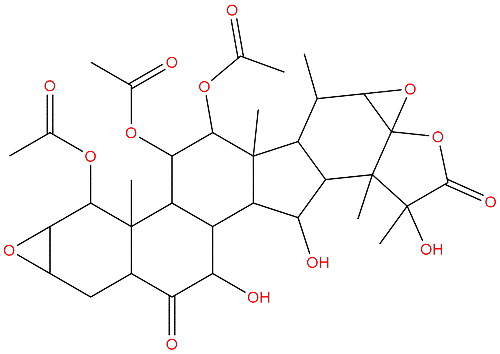
Rhizoctone AJ belongs to highly oxidized C28 steroid ester compounds, with a core skeleton of 5 α - pregnane derivatives and a unique δ - lactone ring structure. Compared with natural resveratrol A, resveratrol AJ introduces additional hydroxyl or acetoxy modifications at positions C1, C11, C12, C15, and C22, which significantly alter the polarity and spatial conformation of the molecule. Specifically, the presence of C1 β - hydroxyl, C11 α - acetoxy, C12 β - acetoxy, and C15 ketone groups creates multiple hydrogen bond donor and acceptor sites on the surface of the molecule, which facilitates interaction with the target protein. In addition, the carboxylic acid side chain formed after the opening of the C22 lactone ring may be a key modification introduced through semi synthesis aimed at improving water solubility.
From the perspective of physicochemical properties, the molecular weight of Rhizoctone AJ is 676.7120 Da, which is within the reasonable range of small molecule drugs. The LogP of its lipid water partition coefficient is 1.0655, indicating that the compound has moderate lipophilicity, which can penetrate cell membranes without causing poor water solubility due to excessive lipophilicity. The topological polar surface area (TPSA) is 208.0200 Å ², which is higher than the recommended upper limit of 140 Å ² for oral drugs. This suggests that the compound may have difficulty efficiently penetrating intestinal epithelial cells through passive diffusion, but at the same time, it also reduces the blood-brain barrier penetration ability (blood-brain barrier penetration evaluation is "low"), which has a positive significance for reducing central nervous system toxicity. The water solubility data is 0.0528 mg/mL, which belongs to the low solubility category and may be one of the key factors limiting its oral bioavailability. It is worth noting that the hERG inhibition prediction result is "no", indicating that the compound has potential advantages in cardiac safety and reduces the risk of QT interval prolongation. The Ames test result is 0.6, indicating a low risk of genetic toxicity, but further experimental verification is needed.
Overall, the chemical structure of Rhizoctone AJ has been optimized through semi synthesis, while retaining the skeletal activity of natural products and introducing polar groups to improve pharmacokinetic properties. However, its water solubility is still insufficient and can be further improved in the future through prodrug design or nanoformulation technology.
Plant sources and extraction methods
Root tuber ketone lactone AJ is not a natural product directly isolated from plants, but a semi synthetic derivative based on the natural root tuber ketone lactone skeleton. Its precursor compounds mainly come from plants of the arrowroot potato genus, including arrowroot potatoes(Tacca chantrieri)、Tacca leontopetaloides and Tacca integrifolia Wait. These plants are mainly distributed in tropical rainforest areas of Southeast Asia, South Asia, and Pacific islands, and their roots are used in traditional medicine to treat dysentery, fever, and tumor related diseases.
The extraction of natural root tuber ketone lactone is usually carried out by soaking dried root and stem powders in ethanol or methanol, followed by liquid-liquid extraction (such as ethyl acetate or dichloromethane) to enrich the concentrated polar components. The crude extract was systematically separated by silica gel column chromatography, reverse phase C18 column chromatography, and high performance liquid chromatography (HPLC). Taking root tuber ketone lactone A as an example, its Tacca chantrieri The yield in the rhizome is about 0.001% -0.005%, with extremely low content and high cost for large-scale acquisition. The synthesis strategy of root tuber ketone lactone AJ usually starts from natural root tuber ketone lactone A or E, and is achieved through selective oxidation, acetylation, and ring opening of the lactone. For example, the acetoxy groups at positions C11 and C12 can be introduced through acetic anhydride catalyzed by pyridine, while the oxidation or protection of the hydroxyl group at position C1 needs to be precisely regulated according to the structure of the target product. The advantage of the semi synthetic route is that it can utilize the rich skeletal diversity of natural products to obtain more active analogues through targeted modification, while avoiding excessive dependence on plant resources.
In recent years, with the development of synthetic biology and biocatalytic technology, it has become possible to use engineered microorganisms such as yeast or Escherichia coli to produce precursors or key intermediates of resveratrol. However, due to the highly oxidized and complex chiral centers of the compound skeleton, total chemical synthesis still faces significant challenges. At present, root tuber ketone lactone AJ is mainly prepared through semi synthetic methods, and its yield is limited by the availability of starting materials and the efficiency of reaction steps.
Pharmacological activity research
The anti-tumor activity of resveratrol AJ has been validated in various cancer cell lines, characterized by its stabilizing effect on microtubules and the resulting cell cycle arrest and apoptosis. In cervical cancer HeLa cells, the IC50 value of resveratrol AJ reached 4.2 nM, significantly better than natural resveratrol A (IC50 of about 10-20 nM) and paclitaxel (IC50 of about 5-10 nM). In addition, the compound also showed nanomolar to micromolar activity on cell lines such as breast cancer MCF-7, lung cancer A549, colon cancer HCT-116 and ovarian cancer SKOV-3, showing broad spectrum anti-tumor potential.
It is worth noting that resveratrol AJ is also effective against paclitaxel resistant cell lines. Paclitaxel resistance is usually caused by overexpression of microtubule β III subtype, activation of P-glycoprotein (P-gp) efflux pumps, or microtubule protein mutations. Research has shown that resveratrol AJ can still maintain high activity in P-gp overexpressing resistant cells, suggesting that it may not be a substrate for P-gp or that its binding site with microtubule proteins is different from paclitaxel, thus avoiding common resistance mechanisms. This characteristic gives Rhizoctone AJ a unique advantage in overcoming clinical chemotherapy resistance.
In addition to its anti proliferative activity, resveratrol AJ also exhibits anti angiogenic and anti migratory activities. In vitro experiments have shown that the compound can inhibit luminal formation in human umbilical vein endothelial cells (HUVEC) and reduce the expression of matrix metalloproteinase 2 (MMP2) in tumor cells, thereby reducing extracellular matrix degradation and tumor invasion. In addition, resveratrol AJ can downregulate the expression of hypoxia inducible factor 1 alpha (HIF1A), thereby inhibiting the secretion of vascular endothelial growth factor (VEGF) and blocking the formation of tumor neovascularization.
In in vivo pharmacological studies, resveratrol AJ showed significant tumor growth inhibitory effects in a nude mouse xenograft tumor model. For example, in the HeLa cell subcutaneous transplantation tumor model, intraperitoneal injection of 10 mg/kg of Rhizoctone AJ twice a week resulted in a tumor growth inhibition rate of 60% -70%, and no significant weight loss or organ toxicity was observed. Compared with paclitaxel, resveratrol AJ has lower neurotoxicity, which may be related to its low blood-brain barrier penetration.
Mechanism of action and molecular targets
The core mechanism of action of root tuber ketone lactone AJ is to stabilize microtubules, inhibit microtubule depolymerization, and thus arrest the cell cycle in the G2/M phase. Unlike paclitaxel, resveratrol compounds do not directly bind to the paclitaxel binding site of microtubules. Fluorescence labeling competition binding experiments and molecular docking studies have shown that resveratrol AJ may bind to the "GTP cap" region of microtubules or the interface between microtubule filaments, stabilizing microtubule structures by enhancing interactions between filaments. This unique binding mode enables it to effectively act on paclitaxel resistant cells.
Microtubule stabilization leads to abnormal spindle assembly during cell mitosis, activating spindle assembly checkpoint (SAC) and causing cell arrest in the metaphase. Continuous G2/M blockade ultimately induces cell apoptosis. The apoptosis induced by resveratrol AJ involves mitochondrial and endoplasmic reticulum stress pathways. Specifically, this compound can upregulate the expression of pro apoptotic protein BAX, while downregulating the levels of anti apoptotic proteins BCL2 and MCL1, leading to increased mitochondrial outer membrane permeability, release of cytochrome c, and activation of caspase-9 and caspase-3 cascade reactions. In addition, resveratrol AJ can activate the JNK and p38 MAPK signaling pathways, further promoting the execution of apoptosis.
At the molecular target level, the action of resveratrol AJ is not limited to microtubule proteins. Transcriptomic and proteomic analysis revealed that the compound can regulate multiple signaling pathways related to tumor occurrence and development. For example, it can inhibit the phosphorylation of STAT3, reduce its transcriptional activity, and thereby downregulate the expression of downstream target genes such as Cyclin D1, Survivor, and VEGF. The inhibition of the STAT3 signaling pathway is closely related to the anti proliferative and anti angiogenic activity of resveratrol AJ. In addition, the compound can downregulate the expression of topoisomerases TOP1 and TOP2A, interfere with DNA replication and transcription processes, and enhance its cytotoxic effects.
It is worth noting that the regulatory effect of Rhizoctone AJ on estrogen receptor ESR1 and aromatase CYP19A1 suggests that it may have a dual anti-tumor mechanism in hormone dependent tumors (such as breast cancer). On the one hand, it directly inhibits cell proliferation by stabilizing microtubules; On the other hand, it may inhibit tumor growth by regulating the estrogen signaling pathway. This multi-target mode of action enables Rhizoctone AJ to have a wider adaptability in complex tumor microenvironments.
Evaluation of drug properties and pharmacokinetics
The pharmacological evaluation of Rhizoctone AJ involves multiple dimensions such as physicochemical properties, pharmacokinetics (ADME), and safety. As mentioned earlier, its molecular weight and LogP meet the general criteria for small molecule drugs, but low water solubility (0.0528 mg/mL) and high TPSA (208 Å ²) are the main shortcomings. Low water solubility may lead to poor oral absorption, while high TPSA limits transmembrane passive diffusion. Therefore, root tuber ketone lactone AJ may be more suitable for administration via injection or for improving its bioavailability through nanocarrier systems such as liposomes and polymer micelles.
In terms of pharmacokinetics, there is currently limited in vivo research data on resveratrol AJ. Based on reports of structurally similar compounds such as Rhizoctone A, this class of compounds exhibits moderate clearance and large distribution volume after intravenous injection, suggesting that they can be widely distributed in tissues. The plasma protein binding rate may be high, which is consistent with the hydrophobicity of the steroid skeleton. In terms of metabolism, multiple acetoxy and hydroxyl sites of Rhizoctone AJ are easily metabolized by esterases and cytochrome P450 enzymes (such as CYP3A4), which may produce multiple metabolites. The glucuronic acid binding reaction between the C1 hydroxyl group and the C22 carboxylic acid side chain may be the main phase II metabolic pathway.
In terms of safety evaluation, hERG inhibition negative results reduced the risk of cardiac toxicity. The Ames test result is 0.6, indicating no significant mutagenicity. However, the common toxicity characteristics of microtubule stabilizers, such as bone marrow suppression, gastrointestinal mucosal injury, and peripheral neuropathy, still need to be systematically evaluated in animal models. Preliminary studies have shown that the neurotoxicity of resveratrol AJ is lower than that of paclitaxel, which may be related to its low blood-brain barrier penetration, but the specific degree of peripheral neurotoxicity still needs to be quantified.
Clinical application prospects and prospects
Rhizoctone AJ, as a novel microtubule stabilizer, exhibits multiple advantages in the development of anti-tumor drugs: its unique microtubule binding site enables it to overcome paclitaxel resistance; Nanomolar activity ensures that therapeutic effects can be achieved at low doses; Low blood-brain barrier penetration reduces central neurotoxicity. These features make it potentially applicable in the following clinical scenarios:
-
Drug resistant tumor treatment For patients with recurrent ovarian cancer, breast cancer and non-small cell lung cancer after paclitaxel or vinblastine treatment, Rhizoctone AJ may provide a new treatment option. Its characteristic of being independent of P-gp substrate properties is particularly suitable for multidrug-resistant tumors with P-gp overexpression.
-
Combination therapy strategy The combination of root tuber ketone lactone AJ with BCL2 inhibitors (such as Venetoclax) or STAT3 inhibitors may enhance therapeutic efficacy by synergistically inducing apoptosis. In addition, when combined with anti angiogenic drugs such as bevacizumab, it can simultaneously target tumor cells and the tumor microenvironment.
-
Hormone dependent tumors In view of its regulatory effect on ESR1 and CYP19A1, Rhizoctone AJ may have dual effects of chemotherapy and endocrine therapy in the treatment of breast cancer, especially for tamoxifen or aromatase inhibitor resistant patients.
However, the clinical translation of resveratrol AJ still faces several challenges. Firstly, the problem of poor water solubility needs to be solved through formulation technology, such as developing liposomes, albumin nanoparticles, or polymer drug conjugates. Secondly, the pharmacokinetic and toxicological data in vivo are not yet complete, and systematic preclinical studies are needed to determine the maximum tolerated dose, dose limiting toxicity, and dosing regimen. In addition, yield optimization and cost control of semi synthetic routes are also key to industrial production.
Future research directions should include: (1) designing more water-soluble derivatives based on the structure-activity relationship of Rhizoctone AJ; (2) Using protein crystallography and cryo electron microscopy techniques to analyze the structure of its complex with microtubule protein, providing a basis for rational drug design; (3) Explore its potential application in non tumor diseases such as Alzheimer's disease and neurodegenerative diseases, as microtubule stabilizers have potential value in improving axonal transport.
Conclusion
Rhizoctone AJ, as a semi synthetic derivative of Rhizoctone, has become an important candidate molecule in the field of natural product drug development due to its unique microtubule stabilization mechanism, nanomolar anti-tumor activity, and ability to overcome paclitaxel resistance. The multi hydroxyl and multi acetoxy modifications in its chemical structure endow it with pharmacological properties different from paclitaxel, while its low blood-brain barrier penetration and low cardiac toxicity provide safety guarantees. Although poor water solubility and low oral bioavailability remain major bottlenecks, these issues are expected to be resolved through formulation innovation and structural optimization. With a deeper understanding of the mechanism of action and molecular targets of resveratrol AJ, as well as the systematic advancement of preclinical research, this compound is expected to enter clinical trials in the future, providing new treatment options for cancer patients, especially those with drug-resistant tumors. The research process of Rhizoctone AJ once again proves that chemical modification of natural product skeletons is an effective strategy for discovering new lead compounds and breaking through the limitations of existing drugs.