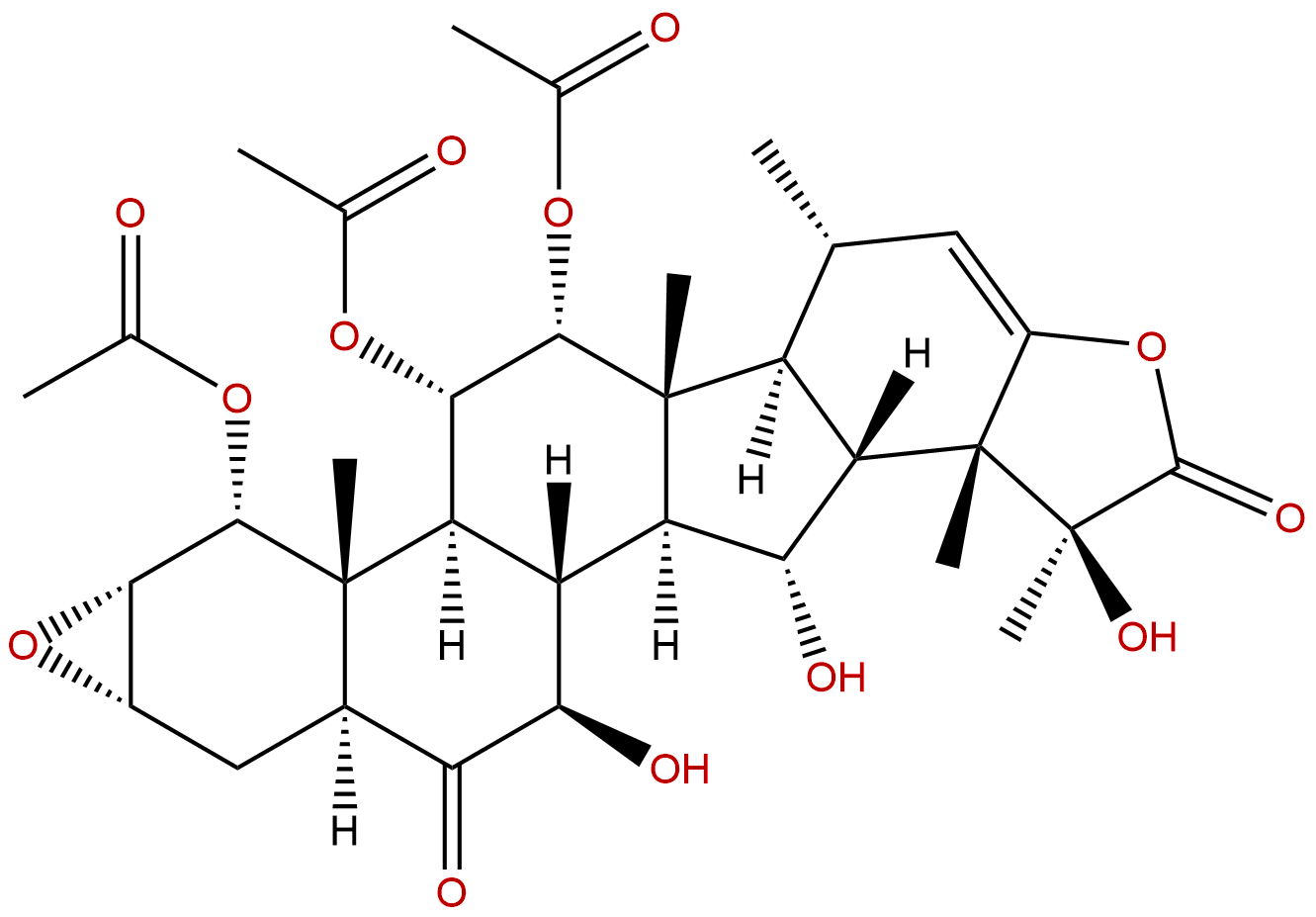


Product name: taccalonolide B
Synonym name:
Catalogue No.: BP3379
Cas No.: 108885-69-4
Formula: C34H44O13
Mol Weight: 660.713
Botanical Source:
Physical Description: Powder
Type of Compound: Steroids
Purity: 95%~99%
Analysis Method: HPLC-DAD or/and HPLC-ELSD
Identification Method: Mass, NMR
Packing: Brown vial or HDPE plastic bottle
The product could be supplied from milligrams to grams. Inquire for bulk scale.
We provide solution to improve the water-solubility of compounds, thereby facilitating the variety of activity tests and clinic uses.
For Reference Standard and R&D, Not for Human Use Directly.
HPLC of taccalonolide B

Storage conditions:Short-term storage at 2~8℃, long-term storage at -20 ~ -80℃
195.4900
1.1375
1.1374
.0513
1.9460
4.1948
Low
60.2215
6.3526
No
No
No
No
Yes
No
0.0
Yes
No
Yes
Yes
Cancer and viral infectious diseases are major challenges facing global public health today. Despite significant progress in chemotherapy drugs and antiviral therapy, the emergence of multidrug resistance (MDR) and the evolution of virus resistant strains severely limit the clinical efficacy of existing drugs, and there is an urgent need to develop lead compounds with novel mechanisms of action. Natural products have always been an important source of innovative drug discovery due to their structural diversity and rich biological activity. Taccalonolide B, a steroid compound isolated from plants of the Dioscoreaceae family, has attracted much attention since its discovery due to its unique microtubule stabilization mechanism and significant inhibitory activity on multidrug-resistant tumor cells. In recent years, research has further revealed its potential value in the field of antiviral therapy, making it a star molecule with multi-target and multi indication development potential. This article aims to systematically review the chemical structure, plant origin, pharmacological activity, mechanism of action, pharmacological evaluation, and clinical application prospects of Rhizoctone B, in order to provide comprehensive academic references for the in-depth research and development of this compound.
Rhizoctone B (CAS number: 108885-69-4) is a structurally complex steroid lactone compound. Its molecular formula is C ∝₄ H ₅₂ O ₁₂, and its molecular weight is 660.7130. The molecular skeleton is composed of the classic steroid core (cyclopentane and phenanthrene), but its notable feature is the presence of multiple highly oxidized substituents attached to the core, including multiple hydroxyl groups, acetoxy groups, and a key lactone ring (usually located on the side chain or D ring). These structural modifications are important foundations for its biological activity. Its complex stereochemical structure, including multiple chiral centers, is crucial for its specific binding to biomolecules such as microtubules.
Based on the analysis of physicochemical parameters related to drug properties, the lipid water partition coefficient (LogP) of Rhizoctone B is 1.1375, indicating its moderate lipophilicity, which facilitates its penetration into cell membranes. Its topological polar surface area (TPSA) is as high as 195.49 Å ², mainly due to the numerous oxygen atoms (hydroxyl, acetyl, lactone carbonyl) in the molecule. High TPSA is usually not conducive to passive transmembrane transport and may affect its oral bioavailability. Its water solubility prediction value is 0.0513 mg/mL, which belongs to poorly soluble compounds, posing challenges for its formulation development. In the preliminary toxicity prediction, the Ames test result was 0.0 (negative), indicating that it may not have direct genetic toxicity; The prediction of hERG inhibition is' no ', indicating a lower risk of causing QT interval prolongation in the heart. However, its blood-brain barrier (BBB) permeability is predicted to be "low", which means it may have difficulty entering the central nervous system, which is a limitation for treating brain tumors or viral infections, but may also reduce the risk of central nervous system side effects.
Root tuber ketone lactone B mainly comes from the Dioscoreaceae family, arrowroot tuber genus(Tacca)Plants. Initially, it was from Tacca plantaginea Separated from the tubers of arrowroot potatoes. Subsequent research has found that other plants belonging to the same genus, such as Tacca chantrieri(Konjac sweet potato)Tacca integrifolia The presence of this compound and its analogues (collectively known as Taccalonolides) indicates that this family of compounds is a characteristic secondary metabolite of this genus of plants.
Its extraction and separation usually follow the classic process of natural product chemistry. Firstly, dry plant materials (usually tubers) are crushed and subjected to cold soaking or heating reflux extraction with organic solvents (such as methanol, ethanol, or a mixture of methanol and dichloromethane) to extract chemical components with varying polarities to the maximum extent possible. After merging the extracts, the crude extract was obtained by vacuum concentration. Subsequently, the crude extract was subjected to preliminary fractionation using liquid-liquid partitioning method (such as extraction with petroleum ether, ethyl acetate, and n-butanol in sequence). Rhizoctone B is usually enriched in the ethyl acetate fraction due to its equal polarity. Further purification relies on various chromatographic techniques. Silica gel column chromatography is commonly used for preliminary separation, using solvent systems of different polarities (such as chloroform methanol gradient elution) for elution. After collecting the fraction containing the target compound, it is finely purified by reverse phase silica gel column chromatography (such as C18 packing, using methanol water or acetonitrile water as the mobile phase), high performance liquid chromatography (HPLC), or preparative thin layer chromatography (PTLC) to obtain high-purity Rhizoctone B monomer. Structural identification involves the comprehensive use of nuclear magnetic resonance (NMR, including ¹ H, ¹ ³ C, 2D-NMR), mass spectrometry (MS), infrared spectroscopy (IR), and X-ray single crystal diffraction techniques.
Rhizoctone B exhibits broad and potent pharmacological activities, mainly focused on anti-tumor and antiviral fields.
1. Antitumor activity:
The most prominent activity of Rhizoctone B is its strong anti proliferative effect as a microtubule stabilizer. In vitro cytotoxicity experiments have shown that it exhibits nanomolar level inhibitory activity against various human cancer cell lines. For example, its half maximal inhibitory concentration (IC ₅₀) on the growth of ovarian cancer SK-OV-3 cell line is 208 nM, demonstrating extremely strong cytotoxicity. More importantly, resveratrol B has a significant inhibitory effect on multidrug-resistant (MDR) tumor cells. Research has confirmed that it is still effective against cell lines overexpressing P-glycoprotein (Pgp, encoded by MDR1 gene) or multiple resistance related proteins (MRP7), and can overcome classical multidrug resistance mediated by these efflux pumps. This characteristic distinguishes it from traditional microtubule stabilizers such as paclitaxel, which often fail in MDR tumors due to being a substrate for Pgp. In addition, in vivo studies have also observed that resveratrol B can effectively inhibit tumor growth in mouse transplant tumor models, and has no cross resistance with paclitaxel.
2. Antiviral activity:
In recent years, research has expanded the potential of resveratrol B in the field of antiviral therapy. Its antiviral spectrum may involve multiple viruses with diverse targets of action. Based on the provided target information, its potential mechanisms may include:
* Antiherpesvirus (such as HSV, HCMV): It may inhibit viral DNA replication and gene expression by acting on essential proteins for viral replication, such as UL42 (DNA polymerase auxiliary subunit), UL54 (DNA polymerase catalytic subunit), ICP27 (post transcriptional regulatory protein) and thymidine kinase (TK).
* Anti-HIV-1: Potential targets include the co receptors CCR5 and CXCR4 involved in virus entry, as well as key viral replication enzymes such as HIV-1 protease (HIV1-PR) and integrase (INT). By interfering with the entry of the virus or inhibiting key steps in its lifecycle, it may be possible to prevent HIV infection and replication.
* Others: The target myeloperoxidase (MPO) may be associated with regulating the excessive inflammatory response caused by viral infection.
Although the correlation between these targets is mainly based on computational prediction or preliminary screening, it provides a clear direction for the in-depth study of Rhizoctone B as a multi-target antiviral lead compound.
The core mechanism of action of Rhizoctone B lies in its specific interaction with the cellular microtubule system.
1. Microtubule stability and cell cycle arrest:
Similar to paclitaxel, resveratrol B can bind to microtubules, particularly promoting microtubule polymerization, stabilizing microtubule structures, and preventing their depolymerization. This abnormal microtubule stabilization can disrupt the normal dynamic assembly and disassembly of spindle bodies during cell mitosis, leading to spindle checkpoint activation and blocking the cell cycle in the G2/M phase. Continuous M-phase blockade ultimately triggers cell apoptosis. However, the binding site with paclitaxel may be different. Studies have shown that resveratrol B does not directly compete with the classical binding site (paclitaxel site) of paclitaxel on β - tubulin, suggesting the existence of a unique or partially overlapping binding pocket. This unique binding pattern may be the key structural basis for its ability to evade Pgp mediated efflux and effectively target MDR cells.
2. Mechanisms to overcome multidrug resistance (MDR):
Rhizoctone B is not an effective substrate for P-glycoprotein (Pgp). Its large rigid structure and specific chemical properties may make it difficult for Pgp to recognize and pump out of the cell, allowing it to accumulate to an effective concentration in MDR cells overexpressing Pgp, exerting microtubule stabilization and cytotoxic effects. In addition, it is also effective against cells overexpressing MRP7, further demonstrating its ability to overcome multiple efflux pump resistance.
3. Potential molecular targets for antiviral effects:
Its antiviral mechanism is still under exploration, but based on known targets, it may involve:
* Directly inhibit viral enzymes/proteins: Inhibiting the activity of HIV-1 protease (HIV1-PR) and preventing the correct processing of viral precursor proteins; Inhibiting integrase (INT) and blocking the integration of viral DNA into the host genome; Or inhibit the DNA polymerase complex of herpes virus (UL42/UL54).
* Block virus entry: As an antagonist or allosteric modulator of CCR5 or CXCR4, it interferes with the binding of HIV-1 to host cell co receptors.
* Regulating host response: By affecting host factors such as MPO, it regulates oxidative stress and inflammatory damage associated with viral infection.
It should be emphasized that the validation of these antiviral targets and their specific modes of action require further biochemical and cellular biology experiments to confirm.
Although Rhizoctone B exhibits excellent activity in vitro, its pharmacological development still faces many challenges, and systematic pharmacokinetic research data is relatively limited.
1. Absorption, distribution, metabolism, and excretion (ADME):
* Absorption: High TPSA and low water solubility indicate that its oral bioavailability may be poor. It is likely to need to be administered through an parenteral route, such as intravenous injection. Formulation strategies, such as making liposomes, nanoparticles, or using solubilizing excipients, may be key to improving their solubility and absorption.
* Distribution: Moderate LogP values are beneficial for its distribution to tissues, but high TPSA limits its passive transmembrane transport. Its low blood-brain barrier permeability limits the therapeutic application of central nervous system diseases, but it may also reduce neurotoxicity. The distribution and accumulation in tumor tissue require in vivo imaging or pharmacokinetic studies to clarify.
* Metabolism and excretion: As a steroid compound, it may be a substrate of the liver cytochrome P450 (CYP) enzyme system, undergoing metabolic reactions such as hydroxylation and deacetylation. Its metabolites, main metabolic pathways, and whether toxic metabolites are produced are still unclear. The excretion pathway may mainly be through bile or kidneys, depending on their polarity after metabolism.
2. Preliminary safety assessment:
Based on computational predictions, it has no genotoxicity (Ames negative) and no significant risk of hERG inhibition, which is a positive signal. However, the common side effects of microtubule stabilizers, such as neurotoxicity (peripheral neuropathy), bone marrow suppression (neutropenia), and possible allergic reactions, need to be comprehensively evaluated in preclinical animal toxicity tests. Whether its unique structure can bring safety features superior to paclitaxel is one of the key areas of future research.
3. Formulation Challenge:
Due to its extremely low water solubility, the development of stable, safe, and effective injectable formulations is the primary technical obstacle to advancing its clinical translation. Nanodrug delivery systems, such as albumin nanoparticles and polymer micelles, are highly promising solutions that can improve solubility and target tumor tissues through enhanced permeability and retention (EPR) effects, potentially enhancing efficacy and reducing systemic toxicity.
Rhizoctone B, as a natural product with dual anti-tumor and antiviral potential, has broad clinical application prospects but a long road ahead.
1. Anti tumor therapy:
Its most direct application prospect is to treat advanced cancer resistant to traditional microtubule inhibitors such as paclitaxel, especially ovarian cancer, breast cancer, lung cancer and other solid tumors that overexpress Pgp or MRP7. It can be used as an option for second-line or third line treatment, or in combination with non Pgp substrate drugs with other mechanisms of action. In response to its poor blood-brain barrier permeability, local administration (such as intraperitoneal infusion therapy for ovarian cancer peritoneal metastasis) or the development of brain targeted delivery systems can be explored for the treatment of brain tumors.
2. Antiviral therapy:
In the field of antiviral therapy, its multi-target properties may help to deal with viruses that are prone to developing drug resistance, such as HIV and HSV. The development of novel antiviral drugs based on the B skeleton of root tuber ketone lactone, or their combination with existing antiviral drugs to delay drug resistance, is a direction worth exploring. Especially for viruses that currently lack efficient drugs or complex viral co infection situations, their multi-target effects may have advantages.
3. Future research directions and challenges:
* Structural optimization: By using medicinal chemical methods to modify its structure, the aim is to improve water solubility, enhance activity, reduce toxicity, and enhance pharmacokinetic properties. Simplifying its complex structure and synthesizing essential pharmacophores for activity are key.
* Deepening mechanism of action: Accurately elucidate its binding site (eutectic structure) with microtubule proteins, and experimentally verify its antiviral targets and specific mechanisms.
* Comprehensive preclinical development: Complete the pharmacological (more in vivo models), pharmacokinetic (ADME studies), and toxicological (GLP compliant acute and long-term toxicity trials) evaluations of the system.
* Innovative delivery system: Vigorously develop advanced nano formulations suitable for this insoluble compound.
* Explore combination therapy: Evaluate its synergistic effect with immune checkpoint inhibitors, targeted drugs, or other chemotherapy drugs.
Rhizoctone B is a treasure discovered from traditional medicinal plants, and its unique chemical structure gives it a significant advantage over the classic microtubule stabilizer paclitaxel - it can effectively combat multidrug-resistant tumors. In recent years, the emergence of its antiviral potential has further enhanced its charm as a multi-target therapeutic drug. Although the inherent physical and chemical property defects (low solubility) and unclear pharmacokinetic and toxicological characteristics pose major challenges on the road to clinical application, these challenges are also issues that modern medicinal chemistry, pharmacy, and pharmacology can focus on addressing. Through interdisciplinary collaboration, in-depth structural optimization, mechanism exploration, and formulation innovation of Rhizoctone B have the potential to transform it from an efficient "test tube molecule" into a clinical new drug that can benefit cancer patients and viral infections, providing new Chinese wisdom and natural solutions to overcome the global medical challenge of multidrug resistance.
