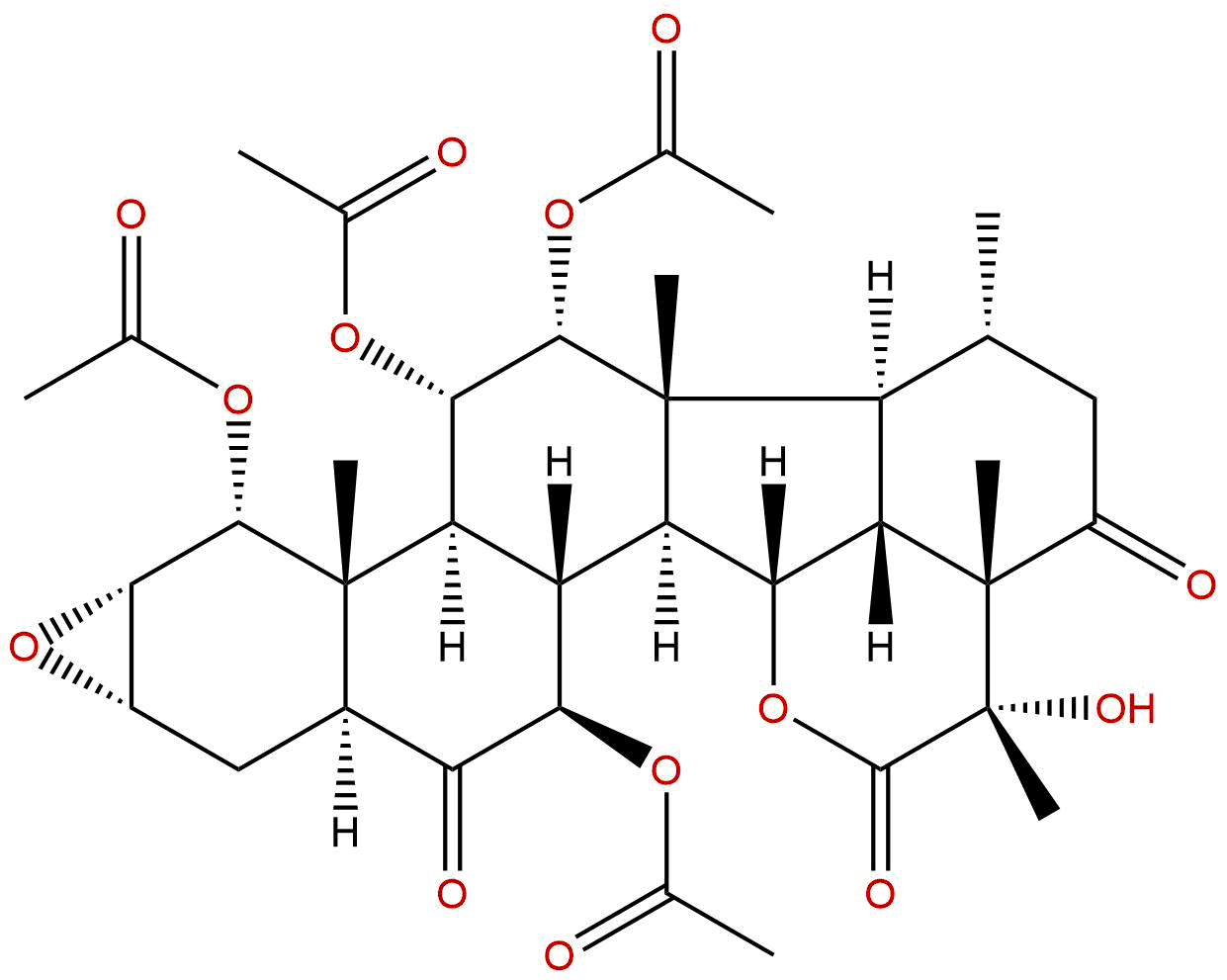


Product name: Taccalonolide C
Synonym name:
Catalogue No.: BP2124
Cas No.: 117803-96-0
Formula: C36H46O14
Mol Weight: 702.75
Botanical Source: Tacca chantrieri Andre.
Type of Compound: Steroids
Purity: 95%~99%
Analysis Method: HPLC-DAD or/and HPLC-ELSD
Identification Method: Mass, NMR
Packing: Brown vial or HDPE plastic bottle
Storage: Store in a well closed container, protected from air and light. Put into refrigerate or freeze for long term storage.
Whenever possible, you should prepare and use solutions on the same day. However, if you need to make up stock solutions in advance, we recommend that you store the solution as aliquots in tightly sealed vials at -20℃. Generally, these will be useable for up to two weeks.
The product could be supplied from milligrams to grams
Inquire for bulk scale.
For Reference Standard and R&D, Not for Human Use Directly.
Storage conditions:Short-term storage at 2~8℃, long-term storage at -20 ~ -80℃
198.4000
1.6863
1.6865
.0150
2.7349
7.3895
Low
59.7749
6.2488
Yes
No
No
No
Yes
No
0.6
Yes
No
Yes
Yes
Taccalonolide C (CAS number: 117803-96-0) is a natural product derived from the Tacca spp. of the Araceae family, and has received widespread attention in recent years due to its significant anti-tumor activity. As a new type of microtubule stabilizer, Rhizoctone C shows unique pharmacological properties in the fight against a variety of malignant tumors, especially in the treatment of refractory tumors such as pancreatic cancer. Pancreatic cancer is a kind of digestive system malignant tumor with strong invasion and poor prognosis. It is urgent to develop new effective drugs. Rhizoctone C regulates the proliferation, apoptosis and drug resistance of tumor cells through multiple targets, providing a new idea for the treatment of pancreatic cancer.
This article aims to systematically review the chemical structure and physicochemical properties, plant sources and extraction methods, pharmacological activity and mechanism of action, pharmacological evaluation and pharmacokinetic characteristics of Rhizoctone C, and explore its prospects and challenges in clinical applications, in order to provide theoretical basis and reference for the drug development and mechanism research of this natural product.
Rhizoctone C belongs to the class of steroid lactones, with a molecular formula of C39H50O12 and a molecular weight of 702.75. Its structural core is a typical steroid skeleton, containing multiple hydroxyl and lactone rings, endowing it with high polarity and biological activity. In terms of physical and chemical properties, the LogP value of Rhizoctone C is 1.6863, indicating its moderate lipid solubility, which is beneficial for cell membrane penetration. Its polar surface area (TPSA) is 198.4 Å ², indicating strong solubility in polar environments. However, its water solubility is low, only 0.0150 mg/mL, suggesting limited solubility in the aqueous phase, which may affect its bioavailability.
In addition, resveratrol C has a low blood-brain barrier penetration ability, indicating its potential toxicity in the central nervous system is low. The hERG channel inhibition experiment showed a negative result, indicating a lower risk of cardiac toxicity. The Ames test result is 0.6, indicating a low risk of genotoxicity and a good safety basis.
Ketone lactone C is mainly found in Tacca spp. of Araceae plants, especially in the roots and tubers of species such as Tacca chantrieri and Tacca integrifolia, where its content is relatively high. Sweet potato plants are widely distributed in tropical and subtropical regions, traditionally used as folk medicines in Southeast Asia, with various pharmacological activities such as anti-inflammatory and anti-tumor effects.
The common methods for extracting ketorolactone C from root tubers include solvent extraction, column chromatography separation, and high-performance liquid chromatography (HPLC) purification. Generally, ethanol or methanol is used as the extraction solvent to obtain crude extracts through ultrasound assisted extraction or reflux extraction. Subsequently, the compound was separated and purified using techniques such as silica gel column chromatography and reverse phase C18 column chromatography, and its structure was confirmed by nuclear magnetic resonance (NMR), mass spectrometry (MS), and other methods. In recent years, the application of supercritical fluid extraction and membrane separation technology has improved extraction efficiency and purity, providing technical support for large-scale preparation.
The anti-tumor activity of Rhizoctone C has been validated in various in vitro and in vivo models. It mainly inhibits tumor cell proliferation by promoting microtubule aggregation, stabilizing microtubule structure, blocking cell cycle progression, inducing tumor cell apoptosis. Compared with the traditional microtubule stabilizer paclitaxel, resveratrol C exhibits different binding sites and resistance profiles, especially maintaining strong activity in drug-resistant tumor cells.
For pancreatic cancer, Rhizoctone C shows significant cytotoxicity, which can inhibit the proliferation and migration of pancreatic cancer cell lines, induce apoptosis, and weaken the invasive ability of tumors. Animal model studies have shown that resveratrol C can effectively delay the growth of pancreatic tumors, improve survival rates, and have low toxic side effects, demonstrating good therapeutic potential.
In addition, resveratrol C also exhibits multiple effects in regulating the tumor microenvironment, inhibiting tumor drug resistance, and anti angiogenesis, providing a mechanistic basis for its comprehensive anti-tumor effect.
The anti-tumor mechanism of Rhizoctone C involves multiple signaling pathways and key molecular targets, especially in pancreatic cancer. The main targets include:
In summary, resveratrol C exerts its anti-tumor effect through multi-target and multi pathway synergistic effects, especially in regulating the proliferation, apoptosis, and drug resistance mechanisms of tumor cells, which is of great significance.
The pharmacological evaluation of Rhizoctone C shows that it has certain advantages and challenges. In terms of physical and chemical properties, a moderate LogP value is beneficial for the cell membrane penetration of drugs, but lower water solubility may limit their oral bioavailability. Drug formulation technologies such as nanocarriers and liposomes need to be used to improve solubility and stability.
The low penetration ability of the blood-brain barrier suggests a lower risk of side effects in the central nervous system, which is beneficial for safety. The negative inhibition of hERG and the lower risk of genotoxicity provide a safety guarantee for its clinical development.
Pharmacokinetic studies are still in the preliminary stage, and the metabolic pathways in vivo mainly involve oxidation and hydroxylation reactions of liver enzymes. The half-life is moderate and suitable for daily administration. Due to its high molecular weight and polarity, the distribution of resveratrol C is limited and mainly concentrated in tumor tissues and liver, reducing the toxicity to non target tissues.
Future research needs to further optimize its pharmacokinetic characteristics, enhance in vivo stability and targeting, in order to achieve better therapeutic outcomes.
As a new natural anti-tumor agent, Rhizoctone C has broad clinical application potential, especially in the treatment of refractory tumors such as pancreatic cancer. Its multi-target mechanism of action helps overcome the resistance problem of single target drugs and improve the persistence and effectiveness of treatment.
At present, there has been positive progress in preclinical research on Rhizoctone C, but it has not yet entered the stage of large-scale clinical trials. In the future, the focus should be on drug safety, dosage optimization, and combination therapy research, exploring their synergistic effects with existing chemotherapy drugs and immune checkpoint inhibitors.
In addition, based on its physicochemical properties and pharmacokinetic characteristics, developing new drug delivery systems such as nano drug carriers and targeted delivery systems will be the key to enhancing their clinical application value. Combining modern molecular biology and medicinal chemistry techniques, in-depth analysis of its mechanism of action, screening of efficient derivatives, will help promote the pharmacological process of Rhizoctone C.
As a natural product with unique structure and multi-target anti-tumor activity, Rhizoctone C shows good pharmacological activity and safety, especially in the treatment of pancreatic cancer. The mechanism of action of its multiple pathways and targets provides new ideas for overcoming tumor drug resistance. Although there are still challenges such as poor water solubility and the need to optimize pharmacokinetics, with the development of extraction and purification technologies and drug delivery systems, Rhizoctone C is expected to become an important candidate for the development of anti-tumor drugs.
Future research should focus on in-depth mechanism analysis, drug optimization, and preclinical safety assessment to promote its early clinical application and benefit cancer patients. In summary, as a research hotspot in the field of natural product pharmacology, Rhizoctone C has broad development prospects and application value.
