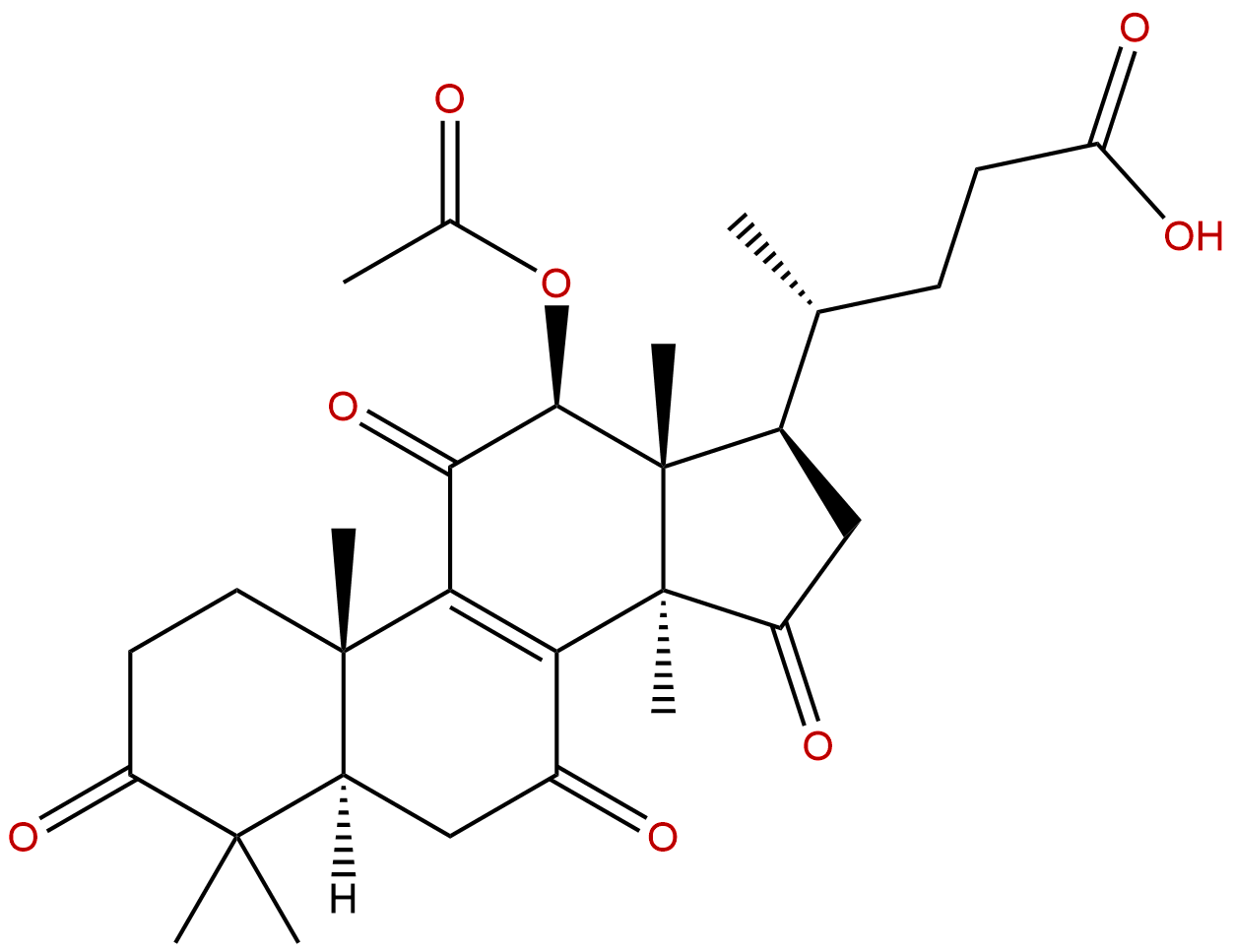
Chizhi acid D: research progress on anti-tumor triterpenoids derived from Ganoderma lucidum
1. Overview
Lucideng acid D (also known as Lucideng acid D2) is a traditional and precious medicinal fungus derived from Ganoderma lucidum(Ganoderma lucidum)Natural triterpenoid compounds isolated from the middle. Its CAS number is 98665-16-8, molecular formula is C29H38O8, and molecular weight is 514.6150 g/mol. As a highly oxidized lanostane triterpenoid, gibberellic acid D has attracted much attention in natural product chemistry and pharmacology research. Its most significant feature is its ability to inhibit the proliferation of human liver cancer cell line HepG2, demonstrating potential anti-tumor activity. Lingzhi, as the "Oriental Fairy Grass", has a history of more than two thousand years of application in traditional Chinese medicine classics, and is believed to have the effects of strengthening the body and promoting longevity. Modern pharmacological research has revealed that one of the pharmacological substances of Ganoderma lucidum is its rich triterpenoid components, and gibberellic acid D is one of the representative active molecules. In recent years, with the rise of molecular targeted therapy and natural medicine research and development, the study of natural products with unique structures and clear activities such as gibberellic acid D not only helps to clarify the scientific connotation of the traditional efficacy of Ganoderma lucidum, but also provides valuable lead compounds for the development of new anti-tumor drugs. This article will provide a systematic and professional popularization of red sesame acid D from its chemical structure, plant origin, pharmacological mechanism, medicinal evaluation, and research prospects.
2. Chemical structure and physicochemical properties
The chemical structure of Gibberellic acid D belongs to the lanostane type tetracyclic triterpenoid, which is highly oxidized and contains multiple oxygen-containing functional groups. From the provided SMILES string, its stereochemical configuration can be resolved: it is a complex molecule with multiple chiral centers, containing markers such as [@ @ H] and [@ @ H], indicating its specific three-dimensional spatial conformation, which is crucial for its recognition and binding to biological targets. The functional groups in the molecule include carboxyl (- COOH), acetoxy (- OCOCH3), and ketocarbonyl (C=O), and the presence of these polar groups significantly affects their physicochemical properties.
According to the provided pharmacokinetic parameters, its molecular weight (MW) is 514.6150 g/mol, slightly higher than the upper limit of conventional small molecule drugs (usually<500 Da). The topological polar surface area (TPSA) is 131.88 Å ², which is relatively high and reflects the presence of multiple hydrogen bond acceptors (oxygen atoms) in the molecule, which typically affects its membrane permeability. The lipid water partition coefficient LogP is 2.8077 and LogD is 0.2476. LogP is the logarithmic value of the partition coefficient of a compound in the n-octanol/water system, used to measure lipophilicity; LogD is the apparent partition coefficient at a specific pH (usually physiological pH 7.4). The LogP value of Gibberellic acid D indicates that it has a certain lipophilicity, but the LogD value is significantly lower, which is likely due to the dissociation of its carboxyl group (- COOH) at physiological pH, which exists in the form of an anion, greatly enhancing its water solubility. Its water solubility value is 0.0155 (usually measured in mg/mL or mol/L, not specified here, but the value is relatively small), indicating that it is a poorly soluble compound, but can be improved after ionization.
Overall, Gibberellic acid D is a natural triterpenoid acid with medium molecular weight, multiple chiral centers, multipole functional groups, and the potential for partial ionization under physiological conditions. The complexity of its structure is the foundation of its biological activity, but it also poses challenges for its synthesis, modification, and formulation development.
3. Plant sources and traditional applications
The only natural source of gibberellic acid D is Ganoderma lucidum, scientific name Ganoderma lucidum It belongs to the Ganoderma family. Ganoderma lucidum mainly grows on decaying broad-leaved forests in Asia. Its fruiting bodies are lignified, and the surface of the fungal cap has a lacquer like luster, making it a highly recognizable large fungus.
The application history of Ganoderma lucidum has a long and rich history. In China, Ganoderma lucidum was first found in the "Shennong Bencao Jing" and is classified as a top-grade herb. It is known for its ability to alleviate hearing loss, promote joint health, protect the spirit, nourish essence and qi, strengthen muscles and bones, and has good color. Throughout history, medical practitioners have used it to treat various diseases such as fatigue, cough, asthma, insomnia, indigestion, and neurasthenia, and regarded it as a precious treasure for nourishing and strengthening the body, and strengthening the body. In other regions of East Asia such as Japan and South Korea, Ganoderma lucidum is also widely used in traditional medicine. The medicinal parts of Ganoderma lucidum are mainly its fruiting bodies, and modern methods also use mycelial fermentation cultivation.
Traditional applications are mostly based on compound or whole plant extracts, and their efficacy is considered to be the result of the synergistic action of multiple active ingredients (such as polysaccharides, triterpenoids, sterols, proteins, etc.). Among them, triterpenoids are considered the main source of the bitter taste of Ganoderma lucidum and an important group of pharmacological active ingredients. As a member of the triterpenoid family of Ganoderma lucidum, the isolation and structural identification of Zhizhi acid D is a result of modern natural product chemistry research. It links the traditional functions of Ganoderma lucidum with specific chemical molecules, achieving a leap from traditional experience to modern science. The in-depth study of single components such as gibberellic acid D is an important entry point for understanding the "multi-component multi-target" mode of action of Ganoderma lucidum.
4. Pharmacological activity and mechanism of action
The core pharmacological activity of Ganoderma lucidum acid D is its anti-tumor effect, which is manifested by inhibiting the proliferation of HepG2 liver cancer cells. Its mechanism of action is not a single pathway, but rather by regulating multiple key signaling molecules and pathways in tumor cells, inducing cell cycle arrest and apoptosis, thereby achieving anti-tumor effects. The five target information provided by the database (TP53, CASP3, MYC, BAX, CDKN1A) outline their potential functional networks.
1. TP53 (p53): This is one of the most important tumor suppressor genes, known as the 'guardian of the genome'. The p53 protein is activated during cellular stress (such as DNA damage), which can induce cell cycle arrest (for DNA repair) or initiate apoptosis programs (if the damage is irreparable). Many tumor cells have p53 dysfunction or mutation. Gibberellic acid D may restore its tumor suppressive function by stabilizing or activating p53 protein, thereby triggering downstream apoptotic signals.
2. CASP3 (Caspase-3): This is a key protease in the execution stage of cell apoptosis, belonging to the cysteine protease family. Once activated by upstream signals such as the mitochondrial pathway or death receptor pathway, Caspase-3 cleaves multiple cellular substrate proteins, leading to irreversible cell death. Chizhi acid D may directly promote apoptosis of tumor cells by upregulating or activating Caspase-3.
3. BAX: This is a pro apoptotic protein in the Bcl-2 family. Under the stimulation of apoptotic signals, BAX will transfer to the outer membrane of mitochondria, forming pores, leading to the loss of mitochondrial membrane potential and the release of cytochrome C into the cytoplasm, thereby activating Caspase-9 and Caspase-3. Gibberellic acid D may promote mitochondrial apoptosis by upregulating the expression of BAX.
4. CDKN1A (p21/WAF1): This is an important target gene downstream of p53, and its encoded p21 protein is an inhibitor of cyclin dependent kinase (CDK). P21 inhibits the activity of CDK cyclin complex by binding to it, thereby preventing cells from entering the S phase (DNA synthesis phase) from the G1 phase, leading to cell cycle arrest. Gibberellic acid D may induce p21 expression through p53 dependent or independent pathways, blocking tumor cells in the G1 phase and inhibiting their proliferation.
5. MYC (c-Myc): This is a proto oncogene that encodes the transcription factor c-Myc, which promotes cell proliferation, metabolic reprogramming, and immortalization. The abnormally high expression of c-Myc is closely related to the occurrence and development of various tumors. Gibberellic acid D may weaken the proliferation driving signals of tumor cells by inhibiting the expression or activity of c-Myc.
Mechanism of action integration speculation:
Gibberellic acid D may activate tumor suppressor protein p53 (TP53) through some initial signal that has not been fully elucidated, such as causing changes in intracellular reactive oxygen species levels or specific kinase pathways. Activated p53 upregulates the expression of pro apoptotic protein BAX and cell cycle inhibitory protein p21 (CDKN1A) through transcription; On the other hand, it may inhibit the expression of the oncogene MYC. Upregulation of BAX induces mitochondrial apoptosis pathway, ultimately activating apoptosis executor Caspase-3 (CASP3), leading to cell apoptosis. Meanwhile, upregulation of p21 leads to cell cycle arrest in the G1 phase, inhibiting cell proliferation. The downregulation of MYC further weakens the proliferation ability of cells. The synergistic effect of these targets together constitutes a multi-target mechanism network of action for gibberellic acid D to inhibit HepG2 cell proliferation and exert anti-tumor activity. Of course, this is only a reasonable speculation based on known targets, and the specific order of action, direct or indirect relationship of action, still requires further molecular biology and biochemical experiments to verify.
5. Evaluation of drug properties
Drug efficacy assessment aims to determine whether an active compound has the potential to be developed into an oral or injectable drug. We combined Lipinski's Rule of Five (RO5) with the provided detailed parameters to analyze gibberellic acid D.
Lipinski's Five Rules Evaluation:
1. Molecular weight (MW)<500 Da The MW of red sesame acid D is 514.6, slightly exceeding the upper limit of the rule. This may have a certain negative impact on its oral absorption.
2. Lipid water partition coefficient LogP<5 The calculated LogP is 2.81, which complies with the rules.
3. The number of hydrogen bond donors (HBDs) is less than 5 From the structural formula, it can be inferred that the number of HBDs (mainly hydroxyl OH and carboxylic acid COOH) may be 2-3, which conforms to the rules.
4. The number of hydrogen bond acceptors (HBAs) is less than 10 The molecule contains 8 oxygen atoms, all of which can be used as HBAs. The quantity is 8, which complies with the rules.
In summary, Zhizhi acid D violates the rule of "molecular weight less than 500" (one violation). Based on experience, compounds that violate a rule still have a potential for oral absorption of about 50%, so they have not completely lost their potential as drugs, but need attention.
Analysis of other key pharmacological parameters:
- Permeability and absorption The Caco-2 cell permeability (Caco2_permeability) is 4.3545 (unit not provided, usually × 10 ⁻⁶ cm/s), which is in the moderate or good range, indicating that it may have some intestinal absorption capacity. The effective permeability (Peff) of the human body is 2.8044 (usually measured in x 10 ⁻⁴ cm/s), which also supports its moderate oral absorption potential. However, its high TPSA (131.88) and potential ionization properties (low LogD) may limit its ability to cross membranes through passive diffusion.
- distribution The plasma protein binding rate (PPB) is as high as 87.55%, which means that most drugs in the blood bind to proteins, and the concentration of free drugs is low, which may affect their distribution to tissues and the efficacy of the drug. The blood-brain barrier (BBB) penetration is marked as "low", which is consistent with the characteristics of high TPSA and high protein binding rate, indicating that it is difficult to enter the central nervous system, which is unfavorable for the treatment of brain tumors, but may also reduce the risk of central nervous system side effects.
- Metabolism and toxicity The Ames test result is 0.0 (usually negative), chromosomal aberration is "none", and hERG inhibition is "no". These are important early safety indicators that preliminarily suggest that gibberellic acid D is non mutagenic, non genotoxic, and has a low risk of cardiac toxicity. Skin sensitization (Skid_Sens) is "no", but respiratory sensitization (Resp_Sens) is "yes", which needs to be noted during development. Photo_tox is rated as' none '.
- Hepatotoxicity warning In serological indicators, serum alkaline phosphatase (Ser_LK) and alanine aminotransferase (Ser_LT) show "yes", which may indicate potential liver cell effects or hepatotoxicity signals of gibberellic acid D under experimental conditions. This is an aspect that needs to be focused on in subsequent safety evaluations.
Comprehensive Assessment:
Red sesame acid D, as a natural product lead compound, exhibits a clear anti-tumor activity mechanism and a relatively acceptable early safety profile (except for potential hepatotoxic signals). The main challenge for its medicinal properties is that: ① the molecular weight is slightly larger, which may affect absorption; ② The physicochemical properties are between hydrophilic and lipophilic, with low LogD, which may lead to poor solubility and permeability; ③ High plasma protein binding rate may affect drug efficacy; ④ The potential risk of liver toxicity needs to be clarified. Future pharmaceutical chemistry optimization work may revolve around these points, such as reducing molecular weight while retaining pharmacophores through structural modifications, adjusting LogD to optimize solubility permeability, and reducing protein binding rates.
6. Research Status and Application Prospects
At present, research on gibberellic acid D is still in the preclinical stage, mainly focusing on natural product chemistry (extraction, isolation, structural identification), in vitro pharmacology (cellular level anti-tumor activity and mechanism exploration), and preliminary pharmacological evaluation. Existing research has preliminarily revealed its molecular network that inhibits tumor cell proliferation by regulating multiple targets such as p53, Caspase-3, BAX, p21, c-Myc, providing scientific evidence for its anti-tumor effect.
However, there are still many unknown areas that need to be explored:
1. In depth mechanism of action More experiments are needed to verify whether gibberellic acid D directly interacts with the aforementioned targets or indirectly regulates them; What is the initial upstream signal of its function; Is there a difference in the mechanism of action among different types of tumor cells.
2. Pharmacodynamic validation in vivo At present, the data is mainly based on cell experiments, and there is an urgent need to verify its in vivo anti-tumor effect, optimal dosage and route of administration in tumor bearing animal models (such as mouse xenograft tumor models).
3. Comprehensive pharmacokinetic studies It is necessary to systematically study its absorption, distribution, metabolism, and excretion (ADME) processes in animal bodies, clarify its bioavailability, tissue distribution characteristics, and main metabolites.
4. Security system evaluation In addition to preliminary toxicity screening, more systematic preclinical safety evaluations such as acute toxicity, long-term toxicity, and reproductive toxicity need to be conducted, with particular attention paid to potential liver toxicity indicated.
5. Structural optimization and derivative development Based on its active skeleton, systematic structure-activity relationship research and structural modification are conducted with the aim of improving activity, enhancing drug properties (such as solubility, permeability, metabolic stability), reducing potential toxicity, and obtaining better candidate drug molecules.
Application prospects:
The application prospects of red sesame acid D are mainly reflected in two aspects:
Firstly, as Identification of active ingredients in natural health products or functional foods With the increasing standardization requirements for Ganoderma lucidum products, characteristic triterpenoids such as gibberellic acid D can be used as quality control indicators to evaluate the quality and consistency of Ganoderma lucidum extracts.
Secondly, as a developer Lead compounds of novel anti-tumor drugs Its unique multi-target mechanism of action may help overcome the problem of resistance to single target drugs. Despite the challenges of developing it directly into a drug, it provides an extremely valuable template for pharmaceutical chemists. Through reasonable structural modification, it is expected to develop derivatives or analogues with stronger activity, better drug properties, and higher safety, providing new candidate drugs for tumor treatment. In addition, combining it with existing chemotherapy drugs to explore synergistic effects and reduce toxic side effects is also a valuable research direction.
In short, Ganoderma lucidum acid D is a bridge connecting the traditional wisdom of Ganoderma lucidum with modern biomedical research. Continued in-depth research on it will not only deepen our understanding of the pharmacological substance basis of Ganoderma lucidum, but also have the potential to contribute a unique innovation source with Chinese characteristics to the field of anti-tumor drug development.