


Synonym name: L-Sulphoraphane
Catalogue No.: BP1347
Cas No.: 142825-10-3
Formula: C6H11NOS2
Mol Weight: 177.28
Botanical Source: Broccoli seeds
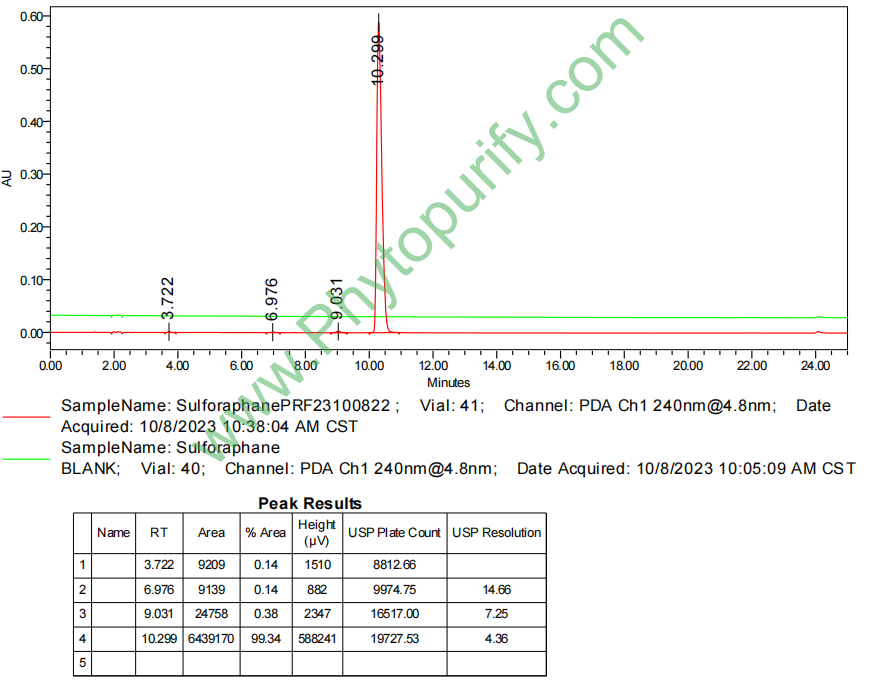
Purity: 5%, 10%, 90%, 98%
Analysis Method: HPLC-DAD or/and HPLC-ELSD
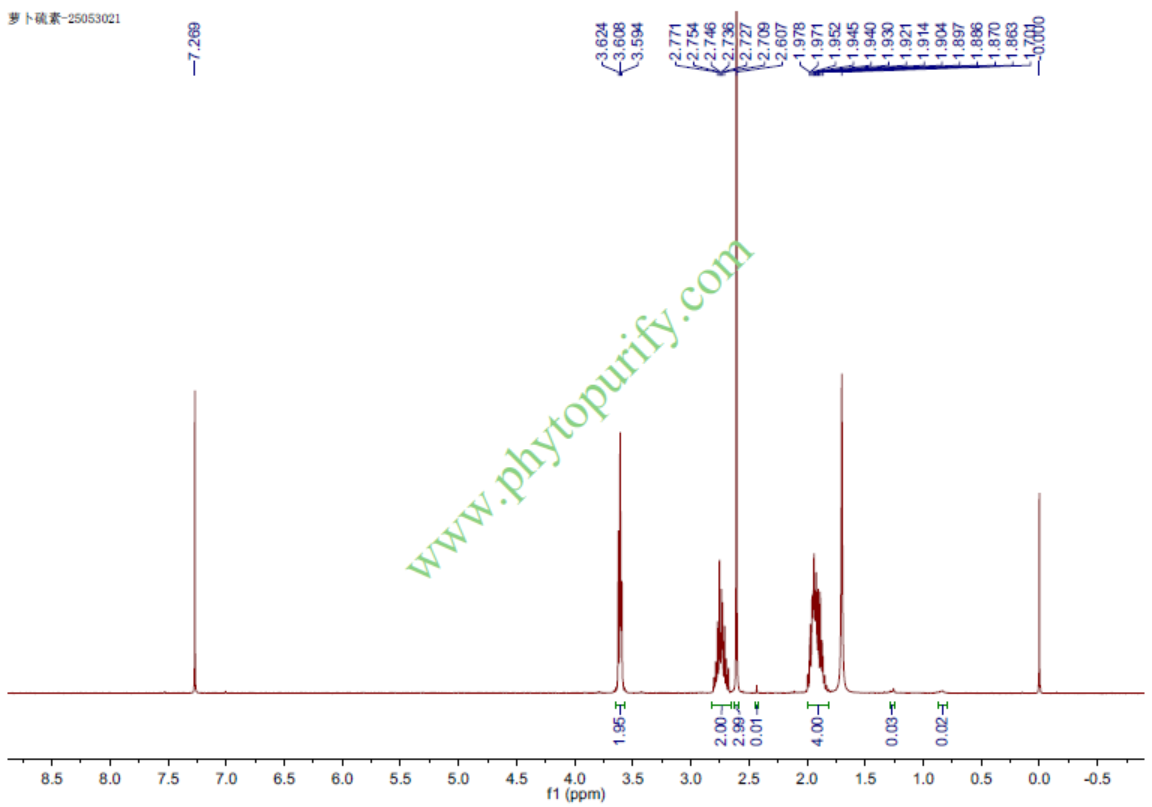
Identification Method: Mass, NMR
Packing: On customer's requirements
Can be supplied from milligrams to grams, up to kilograms.
The purity(assay) of 5%, 10%, 90%, 98% is available for food, nutrition and cosmetics request, except for R&D and reference standard.
HPLC of L-Sulforaphane
HNMR of Sulforaphane
Storage conditions:Short-term storage at 2~8℃, long-term storage at -20 ~ -80℃
35.4200
.9088
.9041
1.3805
5.4376
9.7616
High
43.3471
4.0784
Yes
Yes
Yes
No
Yes
No
1.5
Yes
No
No
No
In the field of natural product chemistry and pharmacology research, isothiocyanate compounds have attracted much attention due to their extensive biological activities. Among them, sulforaphane (SFN), as a star molecule discovered from cruciferous vegetables, has become an important bridge connecting nutrition, preventive medicine, and therapy since its anti-cancer activity was systematically revealed by Paul Talalay's team in the 1990s. Its chemical name is 1-isothiocyanate-4-methylsulfonylbutane, and its CAS number is 142825-10-3. Radish sulforaphane is not directly present in plants, but is hydrolyzed by its inactive precursor, glucosinolate, under the action of myrosinase. This process endows it with "prodrug" properties and explains why eating raw or properly handling cruciferous vegetables is more beneficial to health.
Modern pharmacological research has surpassed its initial role in chemoprevention, revealing in depth the multidimensional and multi-target pharmacological network of sulforaphane. Its core mechanism lies in acting as an efficient inducer of the Keap1/Nrf2/ARE signaling pathway, activating the cell's own antioxidant and detoxification defense system. In addition, it can exhibit strong anti-cancer, anti-inflammatory, neuroprotective, cardiovascular protective, and metabolic regulatory activities by inhibiting histone deacetylases (HDACs), regulating various key proteins related to cell proliferation, apoptosis, inflammation, and metabolism. This article aims to systematically review the chemical properties, sources, pharmacological activities, molecular mechanisms of action, pharmacological evaluation, and clinical application prospects of sulforaphane, in order to provide a comprehensive academic perspective for the in-depth development and transformation research of this natural product.
Radish sulforaphane is an aliphatic isothiocyanate with a molecular formula of C6H11NoS2 and a molecular weight of 177.2940. Its chemical structure is characterized by a highly reactive isothiocyanate group (- N=C=S) at one end and a relatively stable methylsulfonyl group (- SO2-CH3) at the other end, connected by a carbon chain consisting of four methylene groups in the middle. This unique structure is the chemical basis of its biological activity: the isothiocyanate group is an electrophilic center that can covalently bind with nucleophilic groups such as thiol and amino groups in proteins, thereby modifying the function of the target protein; And the methylsulfonyl group contributes to its hydrophilicity and specific molecular recognition properties.
From the perspective of physicochemical parameters related to drug properties, the lipid water partition coefficient (LogP) of sulforaphane is approximately 0.91, indicating its moderate lipophilicity and favorable transmembrane transport. Its topological polar surface area (TPSA) is 35.42 Å ², which is a relatively small value and also indicates good membrane permeability. The water solubility data is about 1.38 mg/mL, belonging to the range of slightly soluble to soluble, which has a significant impact on its absorption and distribution in organisms. It is worth noting that both computational and experimental data indicate that sulforaphane has a high blood-brain barrier permeability, which provides the possibility for its application in central nervous system diseases. Preliminary safety screening shows that it has no significant inhibitory effect on hERG potassium channels (hERG inhibition: No), reducing the risk of causing QT interval prolongation in the heart. The Ames test result is 1.5, indicating a low risk of mutagenicity under the testing conditions, but it needs to be comprehensively evaluated in conjunction with more in vivo genetic toxicity data.
Radish sulforaphane mainly comes from cruciferous plants, among which broccoli (especially broccoli sprouts), cauliflower, kale, cabbage, mustard greens, etc. are the most abundant. Plants do not directly store sulforaphane, but exist in the form of its glucoside derivative - sulforaphane. Radish glucosinolates themselves are stable and biologically inactive, and are physically separated from myrosinase and stored in different compartments of plant cells. When plant tissues are damaged due to chewing, cutting, or crushing, myrosinase is released and comes into contact with glucosinolates, rapidly hydrolyzing the latter to produce glucosinolates, glucose, and sulfates.
This biotransformation process is crucial for the acquisition of sulforaphane and determines its extraction and preparation methods. The current main methods include:
1. Natural plant extraction method Extract glucosinolates from plant materials rich in glucosinolates (such as broccoli seeds or tender shoots) using solvents (such as methanol, ethanol/water mixtures), and then use exogenous myrosinase (available from mustard seeds, etc.) or specific conditions (such as endogenous enzyme activation) for enzymatic hydrolysis to produce glucosinolates, which are then separated and purified by chromatography and other techniques.
2. Chemical Synthesis There are mature organic synthesis routes that can prepare high-purity sulforaphane. The commonly used method is to use 1,4-dibromobutane or 1,4-butanedithiol as starting materials, and introduce isothiocyanates and methylsulfonyl groups through multiple reactions. The synthesis method can be scaled up for production, ensuring product purity and stability, and is the main source of commercial formulations.
3. Biosynthetic and Fermentation Engineering The use of microbial or plant cell culture systems and the introduction of relevant synthetic enzyme genes through genetic engineering to achieve the biosynthesis of glucosinolates or sulforaphanes has become a research direction for green and sustainable production in recent years.
Regardless of the method used, the chemical instability of sulforaphane must be considered. It is sensitive to heat, light, and especially alkaline conditions, and is prone to degradation or molecular rearrangement. Therefore, strict control of conditions such as low temperature, light avoidance, acidic environment, etc. is required during the extraction, storage, and formulation process to maintain its activity.
Numerous in vitro and in vivo studies have confirmed that sulforaphane has broad and powerful pharmacological activities, and its application potential has expanded from cancer prevention to intervention in various diseases.
The core of the multifunctional pharmacological effects of sulforaphane lies in its precise regulation of multiple key signaling pathways and molecular targets within cells, forming a complex network.
Keap1/Nrf2/ARE pathway - the core of antioxidant defense This is the most classic mechanism of action of sulforaphane. In the resting state, the transcription factor Nrf2 (encoded by the NFE2L2 gene) binds to its cytoplasmic inhibitory protein Keap1 and is degraded by ubiquitination. The isothiocyanate group in sulforaphane can directly modify specific cysteine residues on Keap1 protein, causing conformational changes in Keap1 and losing its inhibitory effect on Nrf2. Nrf2 is stabilized and translocated to the nucleus, where it binds to antioxidant response elements (ARE) and initiates transcription of a series of cell protective genes, including glutathione S-transferase (GST), quinone oxidoreductase 1 (NQO1), HO-1, etc. These enzymes collectively enhance the cell's detoxification ability against oxidative stress and electrophilic toxins.
Inhibition of histone deacetylases (HDACs) - epigenetic regulation Radish sulforaphane is a naturally occurring HDAC inhibitor. It can increase the acetylation level of histones in cells, relax chromatin structure, and promote the transcription of specific genes (such as tumor suppressor genes and cell cycle regulatory genes). This epigenetic regulation is an important mechanism for inducing cancer cell differentiation, apoptosis, and inhibiting tumor growth.
Multiple regulation of cancer-related targets Radish sulforaphane can affect multiple cancer-related targets listed in the question:
Other important pathways Including activating the energy receptor AMP activated protein kinase (AMPK), regulating cellular metabolism and autophagy; Inhibit the activation of nuclear factor kappa B (NF - κ B) and exert anti-inflammatory effects.
These mechanisms are not isolated, but intertwined with each other. For example, activation of Nrf2 can inhibit the activity of NF - κ B, while HDAC inhibition may also affect the expression of Nrf2 target genes. This multi-target and networked mode of action enables sulforaphane to synergistically intervene in multiple pathological stages of the disease.
Although sulforaphane is a natural source, its pharmacological properties as a therapeutic molecule still require systematic evaluation.
Pharmacokinetic characteristics Radish sulforaphane is rapidly absorbed after oral administration, and its bioavailability is greatly affected by food and stomach acid (as stomach acid may disrupt myrosinase activity). In the body, it is mainly metabolized through two pathways: one is by binding with glutathione (GSH), metabolized through the mercaptoacetate pathway, and finally excreted from urine in the form of N-acetylcysteine conjugates (SFN-NAC), which is its main metabolic pathway; The second is the generation of relatively stable metabolites through cyclization. Its plasma half-life is relatively short, about 2-4 hours, but it is widely distributed in tissues and can accumulate in specific tissues such as the prostate and liver. Its metabolites, especially SFN-NAC, are also considered to have certain biological activity.
Pharmaceutical advantages:
* Clear activity and multi-target effect。
* Good security Long term consumption of vegetables rich in radish sulfur precursors in the human body has been proven to have good tolerance. In clinical trials, the main adverse reaction at high doses (such as hundreds of milligrams per day) is mild gastrointestinal discomfort.
* Moderate physical and chemical properties LogP and TPSA values indicate that it has good membrane permeability and oral absorption potential.
* High blood-brain barrier permeability Suitable for central nervous system diseases.
challenges faced:
* Chemical instability Sensitivity to heat, light, and alkali poses challenges to formulation processes and storage.
* Poor pharmacokinetics Oral bioavailability varies greatly and has a short half-life, requiring frequent administration or development of sustained-release formulations to maintain effective blood drug concentrations.
* The relationship between dose and effect is complex As a multi-target regulator, its effect may exhibit bidirectionality with different doses (such as low-dose activation of adaptive response, and extremely high doses may trigger stress), and the optimal treatment window needs to be precisely defined.
* Lack of highly specific targets Although multi-target therapy is its advantage, it may also bring unpredictable off target effects, especially in high-dose treatment.
At present, sulforaphane or extracts of broccoli flower buds rich in sulforaphane have been marketed as dietary supplements. In response to its instability and pharmacokinetic deficiencies, researchers are developing novel delivery systems such as liposomes, nanoparticles, cyclodextrin inclusion complexes, phospholipid complexes, etc., to improve its stability, bioavailability, and targeting.
The research on sulforaphane is rapidly expanding from basic science and nutritional intervention to clinical treatment applications.
Current clinical research stage: At present, there are more than 100 clinical studies related to sulforaphane, covering many fields such as cancer prevention and adjuvant treatment (such as prostate cancer, breast cancer, lung cancer), autism spectrum disorder, chronic obstructive pulmonary disease (COPD), type 2 diabetes, cardiovascular disease risk factors, etc. Most studies are in phase I or II, mainly evaluating its safety, tolerability, biomarker regulatory effects, and preliminary efficacy. For example, in individuals with autism, sulforaphane has shown potential to improve social interaction and abnormal behavior; In prostate cancer patients, positive signals such as slowing down the rate of increase of prostate-specific antigen (PSA) can be observed.
Future development direction:
1. Precision and personalized applications Future research needs to clarify the optimal response population of sulforaphane in different diseases and populations (such as different genotypes and gut microbiota composition). For example, polymorphisms in genes related to pathways such as Nrf2 and GST may affect an individual's response to sulforaphane.
2. Combination therapy strategy Given its multi-target nature and good safety, the combination of sulforaphane with conventional chemotherapy, radiotherapy, or targeted drugs is a highly promising direction. It may improve the efficacy and safety of existing therapies through mechanisms such as sensitization, attenuation (such as protecting normal tissues), and reversal of drug resistance.
3. Development of new formulations and delivery technologies Continuous development of advanced drug delivery systems that can overcome the disadvantages of poor stability and short half-life of sulforaphane is the key to realizing its therapeutic potential. Targeted agents, such as tumor targeting and inflammation site targeting, will further enhance their efficacy and reduce the risk of systemic exposure.
4. Deep exploration of the mechanism of action By utilizing systems biology, chemical proteomics, and other technologies, a comprehensive mapping of the intracellular interactions of sulforaphane was conducted to discover new targets and signaling networks, providing a theoretical basis for the development of its new indications.
5. Conversion from dietary supplementation to prescription medication Promoting high-quality, large-scale Phase III clinical trials and accumulating conclusive evidence of therapeutic effects is the only way for sulforaphane to move from a "health ingredient" to a "prescription drug".
Radish sulforaphane, a natural small molecule derived from common vegetables, occupies a unique and important position in contemporary pharmacological research due to its unique chemical structure and multi-target, networked pharmacological mechanism of action. It is not only a model for explaining the concept of "medicine and food sharing the same origin", but also a powerful molecular tool for connecting nutritional intervention and disease treatment. From activating the endogenous defense system Nrf2 pathway, to regulating epigenetic enzymes HDACs, and then finely regulating multiple disease-related targets such as BCL2, STAT3, MMP2, etc., sulforaphane has demonstrated broad potential in addressing complex diseases such as cancer, neurodegenerative diseases, and metabolic syndrome.
Despite facing challenges such as stability and pharmacokinetics in drug development, these obstacles are gradually being overcome through continuous formulation technology innovation and in-depth clinical research. In the future, with a deeper understanding of the mechanism of action of sulforaphane and the advancement of personalized medicine and combination therapy strategies, we have reason to expect that this ancient phytochemical will contribute its unique and powerful power to human health, especially in the prevention and treatment of chronic diseases, in a more precise and effective way. The research process of sulforaphane fully reflects the infinite possibilities of exploring modern medical value from traditional wisdom.
