Introduction/Overview
Natural products, as an important source of drug discovery, play an irreplaceable role in the history of human disease treatment. Among them, medicinal fungi have attracted much attention due to their rich bioactive secondary metabolites. Ganoderma lucidum(Ganoderma lucidum)As a traditional precious medicinal herb with thousands of years of application history, its fruiting body, mycelium, and spores have been proven to contain various pharmacological active ingredients, such as polysaccharides, triterpenoids, sterols, etc. In recent years, with the advancement of separation and identification technology, compounds with unique skeletons and significant activities discovered from Ganoderma spores have continuously emerged, providing new chemical entities for modern innovative drug development. Ganospororic acid A (CAS: 135357-25-4) is one of the representative triterpenoid acid compounds. This compound was initially isolated from the ether soluble portion of Ganoderma lucidum spores, and its unique chemical structure has aroused widespread interest among natural product chemists and pharmacologists. Preliminary research suggests that Ganoderma spore forming acid A has potential application value in liver injury protection. More noteworthy is that subsequent studies have revealed its ability to regulate multiple key targets related to cell proliferation, apoptosis, and inflammation, particularly in the field of malignant tumors such as lymphoma, demonstrating potential multi-target anti-tumor activity. This article aims to systematically review the chemical properties, plant sources, pharmacological activities, mechanisms of action, medicinal properties, and clinical application prospects of Ganoderma lucidum spore acid A, in order to provide comprehensive scientific references for the in-depth research and development of this compound.
Chemical structure and physicochemical properties
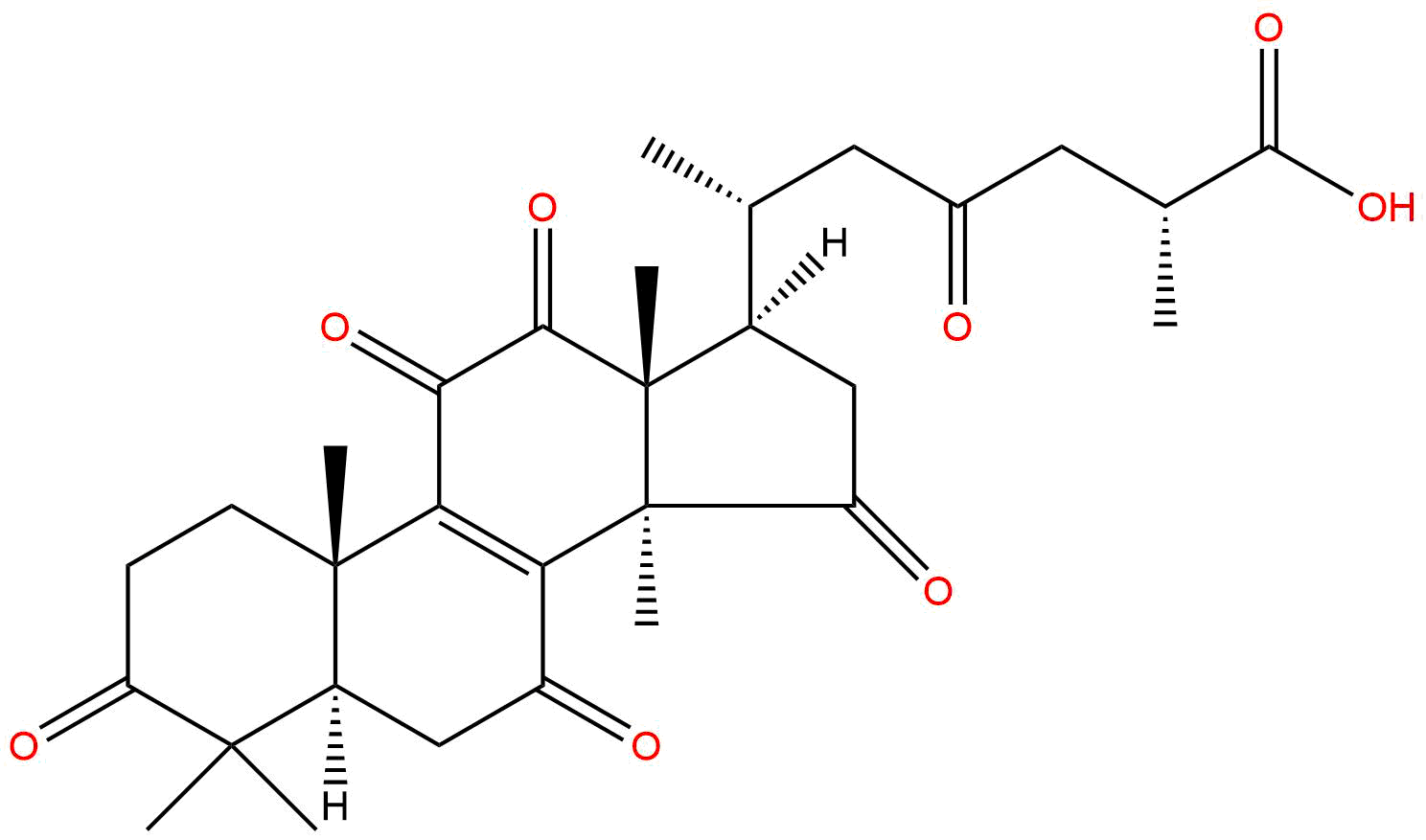
Ganoderma spore acid A is a highly oxidized lanostane triterpenoid acid. Its molecular formula is C30H38O8 and its molecular weight is 526.6260. The core structure of this compound is a tetracyclic triterpenoid skeleton (cyclopentane and perfluorophenanthrene), which is connected to multiple oxygen-containing functional groups, including carboxyl, hydroxyl, and carbonyl groups. These functional groups have a decisive impact on its physicochemical properties and biological activity.
From the analysis of physical and chemical properties, the calculated value of the lipid water partition coefficient (LogP) of Ganoderma lucidum spore acid A is about 2.9584, indicating that the compound has a certain lipophilicity, but is not highly hydrophobic, which is beneficial for its penetration of cell membranes, but may also affect its dispersion in aqueous media. Its topological polar surface area (TPSA) is as high as 139.7200 Å ², mainly attributed to the presence of multiple hydrogen bond acceptors (oxygen atoms) in the molecule, indicating its strong ability to form intermolecular hydrogen bonds, which may affect its binding mode and solubility with target proteins. The calculated water solubility value is relatively low (about 0.0128 mg/mL), indicating that Gibberellic acid A belongs to insoluble compounds, which is a key challenge to overcome in formulation development. Based on its high polarity and molecular weight, it is predicted that its ability to cross the blood-brain barrier (BBB) is low, suggesting that its main pharmacological effects may be concentrated in the peripheral system. In early safety screening, the compound did not show significant hERG potassium channel inhibitory activity (hERG inhibition: No), reducing the likelihood of inducing QT interval prolongation in the heart; At the same time, the actual measured or predicted Ames test result is 0.0, which preliminarily indicates that there is no direct genetic toxicity mutagenic risk, providing preliminary safety basis for its further development.
Plant sources and extraction methods
Ganoderma spore acid A is specifically derived from the precious medicinal fungus Ganoderma lucidum(Ganoderma lucidum)The spores. Ganoderma spores are the reproductive cells of Ganoderma lucidum, surrounded by a double layered wall composed of hard chitin and cellulose. They are rich in active ingredients such as oil, polysaccharides, alkaloids, and triterpenoids, and their composition spectrum differs significantly from that of fruiting bodies and mycelia. Some components, such as ganoderic acid A, are unique to spores.
Extracting Ganoderma spore acid A usually involves the following key steps: first, pure Ganoderma spore powder needs to be collected. Due to the dense structure of spore walls, direct extraction efficiency is low. Therefore, physical or chemical methods such as ultra-low temperature physical grinding and enzymatic hydrolysis are often used for wall breaking treatment to release intracellular active substances. Subsequently, extraction and separation were carried out using its equal polarity and acidic properties. The initial extraction reported in literature often uses organic solvents such as ether, ethyl acetate, or alcohol water mixed solvents in different proportions to leach or reflux extract the broken spore powder. Among them, the "ether soluble part" is the key site for the discovery of Ganoderma spore acid A. After obtaining the crude extract, a series of complex chromatographic separation and purification processes are required. We often use various techniques such as silica gel column chromatography, reverse phase C18 column chromatography, preparative thin-layer chromatography, and high-performance liquid chromatography (HPLC) to gradually separate and enrich compounds based on their polarity and solubility differences. Finally, its planar structure and stereoconfiguration were identified using spectroscopic techniques such as nuclear magnetic resonance (NMR, including 1H-NMR, 13C-NMR, 2D-NMR), mass spectrometry (MS), and X-ray single crystal diffraction. Optimizing the extraction solvent system and developing efficient directional separation and purification processes are the basis for improving the yield of Ganoderma spore acid A and promoting its subsequent research.
Pharmacological activity research
The pharmacological activity research of Ganoderma lucidum spore acid A is currently in the preclinical stage, but it has shown multiple potential biological activities, especially in the fields of liver protection and anti-tumor.
-
Liver protective activity As its initial activity of interest, research has shown that Ganoderma spore forming acid A has a protective effect against chemical liver injury. In experimental liver injury animal models or liver cell models induced by liver toxins such as carbon tetrachloride (CCl4), acetaminophen (APAP), or D-galactosamine, pretreatment with gibberellic acid A can significantly reduce serum transaminase (ALT, AST) levels, alleviate liver tissue pathological damage such as necrosis, inflammatory infiltration, and steatosis. Its protective mechanism may be related to anti-inflammatory, antioxidant stress, and inhibition of liver cell apoptosis.
-
Anti lymphoma activity This is the most prominent direction in the pharmacological research of Ganoderma lucidum spore acid A. In vitro experiments have confirmed that the compound has a significant concentration dependent inhibitory effect on the proliferation of various human lymphoma cell lines (such as U937, Raji, Jurkat, etc.), and can induce cell cycle arrest and apoptosis. Its anti lymphoma activity is not achieved through a single cytotoxicity, but involves the regulation of multiple signaling pathways. It is worth noting that its target network differs from classical chemotherapy drugs, suggesting that it may be used to overcome certain types of resistance or as a candidate for combination therapy.
-
Other potential activities Based on the activity of its structural analogues (other triterpenoids of Ganoderma lucidum), it is speculated that Ganoderma spore acid A may also have anti-inflammatory and immune regulatory effects, but further experimental evidence is needed to support this. Its multi-target nature also suggests potential value in the treatment of other proliferative or inflammatory related diseases.
Mechanism of action and molecular targets
The pharmacological effects of Ganoderma lucidum spore acid A on lymphoma and other diseases are closely related to its ability to interact and regulate a complex protein target network. Existing research (including computational simulations and partial experimental validation) suggests that it may exert its effects through the following key targets:
-
Regulating the balance of cell apoptosis This compound may directly or indirectly affect the balance between pro apoptotic and anti apoptotic proteins. It has been predicted or confirmed to inhibit the expression or function of anti apoptotic proteins B cell lymphoma 2 (BCL2) and myeloid leukemia 1 (MCL1), while possibly promoting the activation of tumor protein P53 (TP53), thereby relieving the inhibition of apoptosis and initiating mitochondrial pathway cell apoptosis.
-
Intervention in cell cycle progression By inhibiting the activity of cyclin 25B (CDC25B, a phosphatase that is a key positive regulator of G2/M phase transition in the cell cycle), gibberellic acid A may cause cell cycle arrest in the G2/M phase, preventing tumor cells from mitosis.
-
Inhibition of survival signaling pathway Signal transduction and transcription activator 3 (STAT3) and nuclear factor kappa B (NFKB1) are two important core transcription factors in the pro survival and pro-inflammatory signaling pathways. Gibberellic acid A may inhibit its phosphorylation activation or nuclear translocation, thereby downregulating the expression of downstream target genes related to proliferation, apoptosis resistance, and inflammation (such as Cyclin D1, Bcl xL, COX-2, etc.).
-
Affects cell differentiation and immune recognition Protein tyrosine phosphatase receptor type C (PTPRC, CD45) is a key regulatory molecule for lymphocyte activation and signal transduction. Interference with its function may affect the survival and immune response of lymphoma cells. In addition, the retinoid X receptor beta (RXRB), as a nuclear receptor, participates in cell differentiation and metabolic regulation, and may also be one of its targets of action.
-
Other targets The abnormality of microtubule associated protein tau (MAPT) is associated with the progression of certain tumors, and cyclin dependent kinase inhibitor 2A (CDKN2A, such as p16INK4a) is an important tumor suppressor. Ganoderma spore acid A may indirectly exert anti-tumor effects by affecting these targets.
In summary, Ganoderma lucidum spore A synergistically induces cell cycle arrest and apoptosis in lymphoma cells through a "multi-target, multi pathway" mode of action, while inhibiting their survival and inflammatory signals. This provides potential advantages for its treatment of complex and heterogeneous tumors.
Evaluation of drug properties and pharmacokinetics
Although Ganoderma lucidum spore acid A shows promising in vitro pharmacological activity, its successful development as a drug largely depends on its drug like and in vivo pharmacokinetic (PK) properties. Based on existing computational data and preliminary research, a preliminary evaluation of its pharmacological properties can be conducted
-
Absorption and solubility As mentioned earlier, its low water solubility (0.0128 mg/mL) is the main limiting factor for oral absorption. Although its LogP value (~2.96) is generally considered to be within the range favorable for permeation (0-3), high TPSA (>140 Å ²) and molecular weight (>500 Da) may not be conducive to its passive diffusion across membranes. Developing appropriate formulation technologies, such as nanocrystals, solid dispersions, liposomes, or cyclodextrin inclusion complexes, to improve their dissolution and bioavailability is the focus of subsequent research.
-
distribution It is predicted that its blood-brain barrier permeability is low, which limits its effect on central nervous system tumors, but may also reduce potential central nervous system side effects. The tissue distribution characteristics of it in the body, especially the enrichment in lymphoid tissue or tumor sites, still need to be empirically studied through methods such as radioactive labeling or LC-MS/MS.
-
Metabolism and excretion As a triterpenoid compound containing multiple metabolic sites (hydroxyl, carboxyl), Gibberellic acid A is likely to undergo extensive phase I (such as oxidation and reduction) and phase II (such as glucuronidation and sulfation) metabolism in the liver. Identifying its main metabolic enzymes (such as CYP450 isoenzymes) and metabolites is crucial for evaluating drug drug interaction risks and designing prodrugs. Its excretion pathway (bile or kidney) also needs to be clarified.
-
Early safety Preliminary computer predictions indicate that there is no risk of hERG inhibition and Ames mutagenicity, which is a positive signal. However, a comprehensive preclinical safety evaluation is still needed, including in vitro cytotoxicity selectivity index (for normal cells vs. tumor cells), acute toxicity, subchronic toxicity, reproductive toxicity, and other studies, to comprehensively evaluate its therapeutic window.
At present, there is a lack of public reports on the complete in vivo pharmacokinetic studies (such as oral bioavailability, half-life, clearance rate, etc.) of Ganoderma lucidum spore A system, which is a key data gap that must be filled to advance it to the preclinical development stage.
Clinical application prospects and prospects
As a novel and multi-target natural small molecule, the clinical application prospects of Ganoderma spore A mainly focus on the field of cancer, especially the treatment of lymphoma, and may also be expanded to liver disease and other fields.
-
Anti lymphoma treatment Given its ability to simultaneously act on key targets in the development of multiple lymphomas such as MCL1, BCL2, STAT3, etc., Gibberellic acid A has the potential to be developed as a novel multi-target anti lymphoma candidate drug. It may be used for: (a) monotherapy for certain specific subtypes of lymphoma; (b) Combined use with existing chemotherapy drugs (such as CHOP regimen drugs) or targeted drugs (such as BTK inhibitors, BCL2 inhibitors) to generate synergistic effects and overcome drug resistance; (c) As a treatment option for maintenance therapy or relapsed/refractory patients. Its multi-target characteristics may help reduce drug resistance issues that are prone to occur due to single target inhibition.
-
Adjuvant therapy for liver injury Based on its liver protective activity, it can be explored to develop drugs or health supplements for the treatment or adjuvant therapy of chemical liver injury, drug-induced liver injury, and even early liver fibrosis. Further validation of its efficacy is needed in animal models that are closer to human diseases, such as chronic liver injury models.
-
Outlook and Challenges Future research should focus on the following aspects:
- In depth mechanism research Using chemical biology methods such as affinity fishing and molecular probes to confirm its direct target and elucidate its precise molecular mechanism for regulating downstream signaling networks.
- structural optimization Based on its pharmacophore and structure-activity relationship (SAR) studies, chemical modifications or synthetic derivatives can be used to improve its water solubility and pharmacokinetic properties while retaining or enhancing its activity.
- Formulation development Actively develop new drug delivery systems to address the bottleneck of poor solubility.
- System preclinical evaluation Complete standardized pharmacological (in vivo tumor model), pharmacokinetic, and toxicological studies to provide a solid data package for its application for clinical research (IND).
- Explore combination therapy Systematically evaluate its potential and mechanism for combination therapy with existing standard therapies.
Conclusion
Chizhi spore acid A is a lanostane type triterpenoid acid with a unique chemical structure and multiple pharmacological activities isolated from the traditional medicinal fungus Ganoderma spores. It not only inherits the traditional medicinal value connotation of "strengthening the body and consolidating the foundation" of Ganoderma lucidum, but also reveals from a modern scientific perspective the molecular basis of its anti lymphoma and liver protective effects by acting on key targets such as MCL1, BCL2, STAT3, NF - κ B, regulating cell apoptosis, cycle and survival signaling pathways. Despite facing challenges such as poor water solubility and unknown pharmacokinetic properties in drug development, its multi-target mode of action, good early safety prediction, and advantages derived from natural products make it a lead compound worthy of further exploration. With the cross integration and in-depth research of multiple disciplines such as chemical biology, medicinal chemistry, and pharmacy, Ganoderma lucidum spore acid A is expected to achieve a leap from a natural product to a potential new drug in the development of anti-tumor and liver disease drugs, providing new treatment options for patients with related diseases and also providing an example for further exploring the value of traditional Chinese medicine treasure trove.