


Synonym name: Glycoside L-G3; Tauroside G3; Nigelloside C
Catalogue No.: BP0510
Cas No.: 33289-85-9; 942997-00-4
Formula: C53H86O22
Mol Weight: 1075.25
Botanical Source: Hedera taurica, Hedera canariensis and Dipsacus aureus
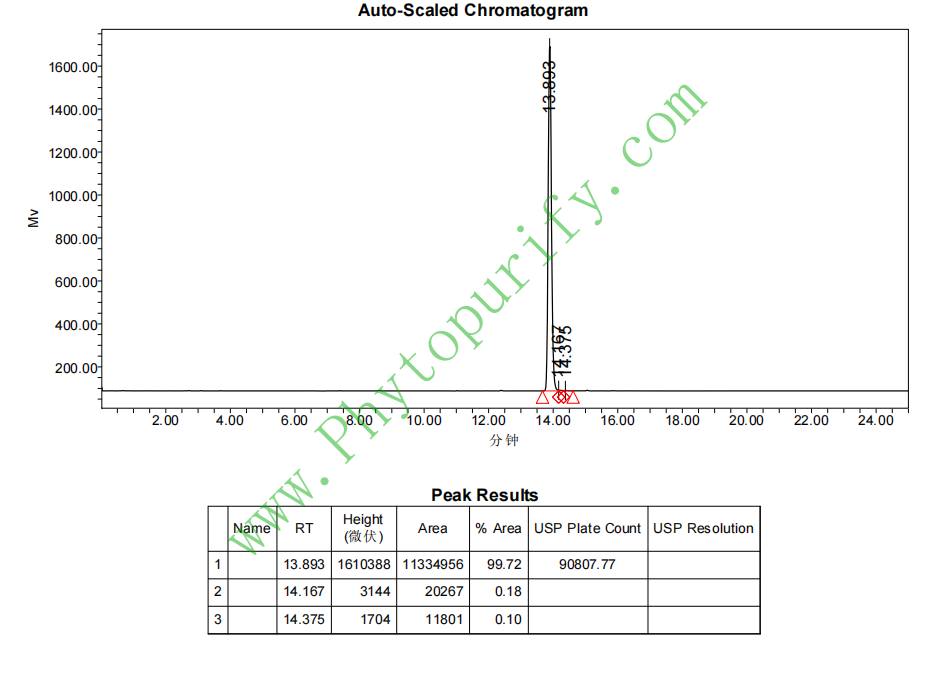
Purity: 95%~99%
Analysis Method: HPLC-DAD or/and HPLC-ELSD
Identification Method: Mass, NMR
Packing: Brown vial or HDPE plastic bottle
Can be supplied from milligrams to grams.
For Reference Standard and R&D, Not for Human Use Directly.
Inquire for bulk scale.
HPLC of Dipsacoside B
Storage conditions:Short-term storage at 2~8℃, long-term storage at -20 ~ -80℃
Dipsacoside B is a major active ingredient derived from the traditional Chinese medicine material Dipsacus asper Wall, and belongs to the saponin class of natural products. Chuanxuduan, as a traditional Chinese medicine, has always been widely used in the treatment of orthopedic diseases. It has the effects of promoting blood circulation, removing blood stasis, nourishing liver and kidney, and strengthening muscles and bones. With the development of modern pharmacology and molecular biology techniques, the biological activity and mechanism of action of Chuanxuduan saponin B have gradually been revealed, especially in the field of anti-tumor, showing significant potential. This article aims to provide a systematic review of the chemical structure, physicochemical properties, plant sources, and extraction methods of saponins from Panax notoginseng, with a focus on analyzing its pharmacological activity and mechanism of action, evaluating its pharmacological parameters, exploring its clinical application prospects, and providing theoretical basis and research directions for subsequent drug development and clinical research.
Chuanxuduan saponin B (CAS number: 33289-85-9) is a natural saponin with a relatively large molecular weight of 1075.2490. It has a complex chemical structure and contains a triterpenoid or diterpenoid skeleton connected by multiple glycosidic groups. Its LogP value is 1.9292, indicating that it has moderate hydrophobicity and can penetrate cell membranes to a certain extent in a lipid environment, but its low water solubility (0.2115) limits its solubility in aqueous phase. Its polar surface area (TPSA) is as high as 353.9, reflecting the presence of a large number of polar groups on the molecular surface, such as hydroxyl and glycosidic groups, which are of great significance for its binding with biomolecules. The low blood-brain barrier permeability of Chuanxuduan saponin B suggests its limited distribution in the central nervous system. In terms of safety, it does not inhibit the hERG channel, and the Ames mutagenicity test result is 0, indicating good safety and low mutagenicity risk.
Saponin B in Dipsacus asper Wall is mainly found in the roots of Dipsacus asper Wall, a perennial herbaceous plant in the family Araliaceae, widely distributed in central and southwestern China. Traditionally, Chuanxuduan has been used for the treatment of fracture healing, rheumatoid arthritis, kidney deficiency, and lower back pain. Chuanxuduan saponin B, as one of its main active ingredients, is usually extracted and isolated through the following steps:
In recent years, the application of supercritical fluid extraction and membrane separation technology has also provided new ideas for the efficient extraction of saponins from Panax notoginseng.
Chuanxuduan saponin B exhibits significant anti-tumor effects in various pharmacological activities. Both in vitro cell experiments and in vivo animal models have confirmed its inhibitory effect on a variety of tumor cells, including breast cancer, lung cancer, liver cancer, etc. Its anti-tumor activity is mainly manifested as:
In addition, Chuanxuduan saponin B also exhibits certain anti-inflammatory, antioxidant, and immune regulatory effects, providing multi-target support for its comprehensive treatment of tumors and related diseases.
The anti-tumor mechanism of Chuanxuduan saponin B involves multiple signaling pathways and key molecular targets, mainly including:
The synergistic effect of multiple targets and pathways mentioned above makes Chuanxuduan saponin B have good potential and wide indications in anti-tumor therapy.
The pharmacological parameters of Chuanxuduan saponin B show that it has certain advantages and challenges in drug development:
In terms of pharmacokinetics, existing research is relatively limited, but it is speculated that Chuanxuduan saponin B may undergo liver metabolism and intestinal microbiota transformation in vivo, and the activity and toxicity of metabolites need further systematic study. Its low water solubility and high polarity suggest the need for formulation improvements (such as nanocarriers, liposomes, etc.) to enhance bioavailability.
As a natural product with multi-target anti-tumor activity, Chuanxuduan saponin B has shown broad application prospects in the field of tumor therapy. Its multiple mechanisms of action not only inhibit tumor cell proliferation and metastasis, but also regulate the tumor microenvironment, enhance immune response, and have the potential to become a new anti-tumor drug. In addition, the safety of Chuanxuduan saponin B is good, providing a basic guarantee for clinical application.
Future research should focus on the following aspects:
As an important active ingredient in Chuanxuduan, Chuanxuduan saponin B has become a hot topic in natural product pharmacology research due to its unique chemical structure and multi-target anti-tumor effects. Its significant pharmacological activity and good safety demonstrated in the field of anti-tumor provide valuable natural resources and theoretical basis for the development of new anti-cancer drugs. Although there are certain challenges in developing its pharmacological properties, with the continuous advancement of modern drug formulation technology and molecular biology research, Chuanxuduan saponin B is expected to become an important candidate drug for future anti-tumor therapy. Further in-depth pharmacological mechanism research, pharmacokinetic evaluation, and clinical validation will further promote its clinical application and benefit the vast number of patients.
