Introduction/Overview
Natural products, as an important source of drug discovery, play an irreplaceable role in the history of human disease treatment. Among them, the medicinal fungus Ganoderma lucidum(Ganoderma lucidum)As a treasure of traditional Chinese medicine, its pharmacological activity has attracted much attention. The pharmacological substance basis of Ganoderma lucidum mainly lies in its triterpenoids, polysaccharides, sterols, and other components. Ganoderma triterpenoids, especially ganoderic acid compounds, are considered one of the core components of its anti-tumor activity. Ganoderic acid LM2 (GA-LM2) is a lanostane type triterpenoid acid with significant biological activity isolated and identified from Ganoderma lucidum in recent years. With the advancement of modern separation and identification techniques and the deepening of molecular pharmacology research, GA-LM2 has demonstrated multi-target and multi pathway regulatory potential in various disease models such as prostate cancer, making it an emerging hotspot in the field of natural anti-tumor drug development. This article aims to systematically review the chemical structure, sources, pharmacological activities, molecular mechanisms of action, drug properties, and clinical application prospects of GA-LM2, in order to provide comprehensive scientific references for the in-depth research and development of this compound.
Chemical structure and physicochemical properties
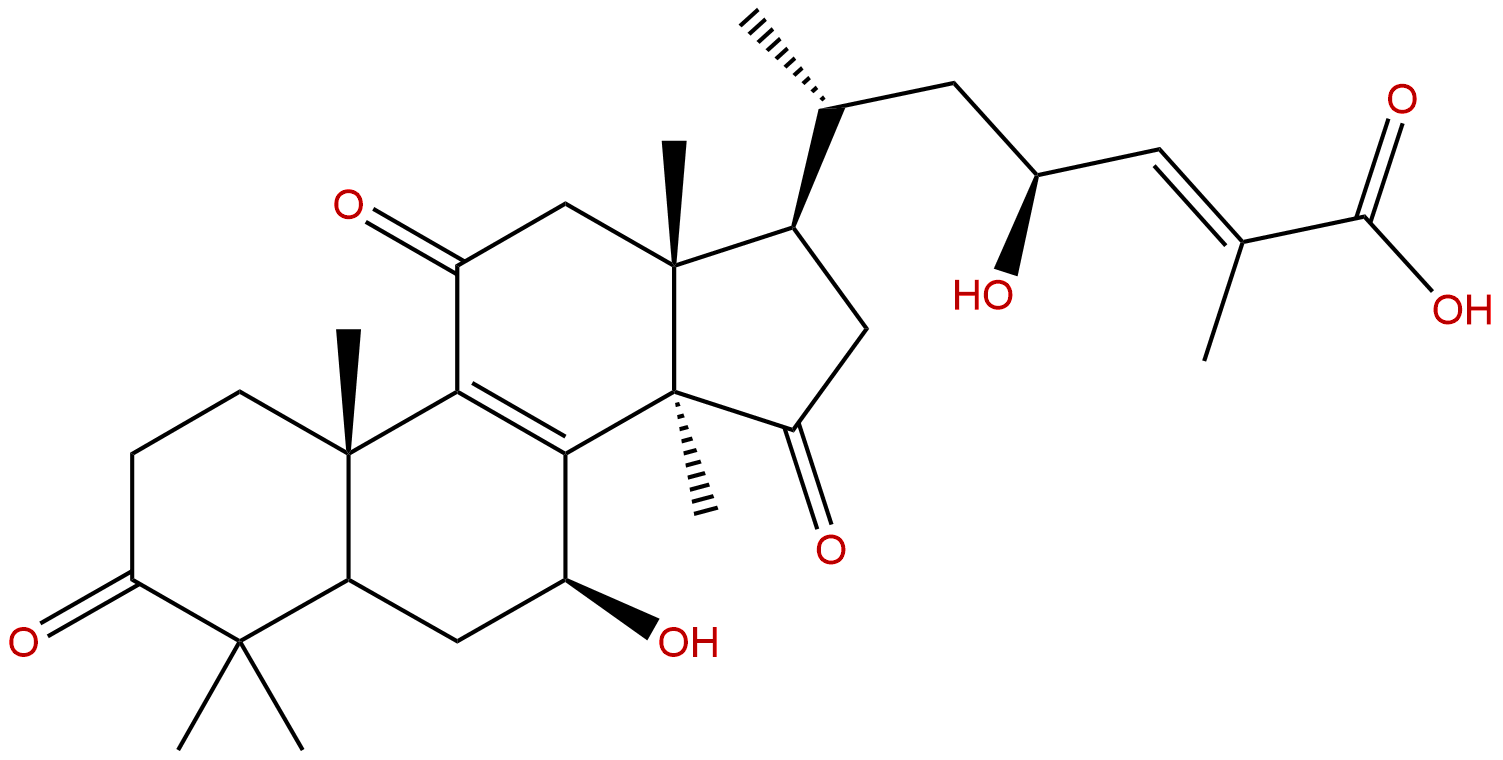
The chemical name of ganoderic acid LM2 is (4 β, 5 α, 6 β, 24E) -6,25-dihydroxy-3,4-cyclo-4-5,5-branch lanostane-7,9 (11), 24-triene-3,26-dioic acid, and its CAS number is 508182-41-0. Structurally, GA-LM2 belongs to the highly oxidized tetracyclic triterpenoid (lanostane type) with a molecular formula of C30H42O7 and a molecular weight of 514.6590. Its structural features include a typical open-loop A ring (3,4-open-loop), with carboxyl groups formed at C-3 and C-26 positions, hydroxyl groups at C-6 and C-25 positions, and double bonds at C-7, C-9 (11), and C-24 positions (with E configuration at position 24). These structural modifications, especially the presence of multiple oxygen-containing functional groups (carboxyl, hydroxyl), have a decisive impact on their biological activity and physicochemical properties.
In terms of physical and chemical properties, the theoretical lipid water partition coefficient (LogP) of GA-LM2 is 2.9354, indicating that it has a certain degree of lipophilicity, but not highly hydrophobic. Its topological polar surface area (TPSA) is 128.9700 Å ², reflecting the larger surface area occupied by polar atoms (oxygen atoms) in the molecule, which is consistent with its structure containing multiple hydroxyl and carboxyl groups. The predicted value of water solubility is 0.0455 mg/mL, which belongs to the category of slightly soluble to poorly soluble. This is a common feature of most triterpenoid acid compounds and one of the key challenges that need to be overcome in their formulation development. Preliminary pharmacological risk assessment shows that GA-LM2 has no significant inhibitory potential on hERG potassium channels (hERG inhibition: No), indicating a low risk of cardiac toxicity; The Ames test predicted a value of 0.0, indicating that it may not have direct genetic toxicity. However, its blood-brain barrier permeability is predicted to be "low", which means it may have difficulty entering the central nervous system to exert its effects. However, for the treatment of peripheral tumors such as prostate cancer, this may reduce the risk of central nervous system side effects.
Plant sources and extraction methods
Lingzhi acid LM2 mainly comes from the porous fungal family Ganoderma lucidum(Ganoderma lucidum The fruiting body, mycelium, or spore powder of (Leyss. ex Fr.) Karst. There are significant differences in the content of GA-LM2 among different varieties, origins, growth stages, and parts of Ganoderma lucidum. Usually, modern chromatographic techniques are used to separate ethanol or methanol extracts from Ganoderma lucidum.
The extraction and separation process generally includes the following steps:
1. Extract Crush the dried Ganoderma lucidum fruiting body and use organic solvents (such as 95% ethanol, methanol) for reflux extraction or ultrasound assisted extraction. Sometimes supercritical CO ₂ extraction technology is also used to obtain initial extracts with fewer impurities and enriched triterpenoids.
2. Rough classification The extract obtained by concentrating the extract is subjected to gradient extraction using solvents such as petroleum ether, ethyl acetate, n-butanol, etc. GA-LM2 is mainly enriched in the ethyl acetate extraction site.
3. Separation and purification The ethyl acetate fraction is initially separated by silica gel column chromatography, often using gradient elution systems such as chloroform methanol or petroleum ether ethyl acetate. Subsequently, by combining reverse phase silica gel column chromatography (such as ODS, using methanol water as the mobile phase), preparative high-performance liquid chromatography (Prep HPLC), and recrystallization techniques, the target fraction was further purified to obtain high-purity GA-LM2 monomer compounds.
In recent years, in order to address the issue of limited natural sources, researchers have also begun to explore strategies for targeted production of specific ganoderic acids (including GA-LM2) through liquid fermentation of Ganoderma lucidum mycelium. By optimizing the composition of the culture medium, fermentation conditions (pH, temperature, dissolved oxygen), and adding inducers (such as methyl jasmonate), it is expected to achieve efficient and sustainable production of the target components.
Pharmacological activity research
Numerous in vitro and in vivo pharmacological studies have shown that LM2 ganoderic acid has a wide range of biological activities, with the most prominent being its anti-tumor activity, particularly demonstrating strong potential in prostate cancer models.
1. Antitumor activity
* prostate cancer GA-LM2 exhibits significant proliferation inhibition and pro apoptotic effects on various prostate cancer cell lines, such as LNCaP, PC-3, DU145. Its activity is stronger than many other known ganoderic acid compounds.
* Other cancers In addition to prostate cancer, research also suggests that GA-LM2 has inhibitory effect on the growth of breast cancer, lung cancer, colon cancer, liver cancer and other cell lines, indicating that its anti-tumor spectrum is broad.
* Function characteristics GA-LM2 not only directly inhibits tumor cell proliferation, induces apoptosis, and cell cycle arrest (often blocking cells in G0/G1 or G2/M phases), but also inhibits tumor cell migration and invasion, demonstrating potential anti metastatic ability.
2. Other potential activities
Based on its multi-target properties, GA-LM2 may also have auxiliary pharmacological effects such as anti-inflammatory and antioxidant effects. For example, regulating the NFE2L2 (NRF2) pathway may enhance the antioxidant stress resistance of cells; By inhibiting inflammation related signaling pathways such as STAT3, it may indirectly alter the tumor microenvironment. These effects complement their core anti-tumor effects.
Mechanism of action and molecular targets
The anti-tumor effect of Lingzhi acid LM2 is not achieved through a single pathway, but exhibits the characteristics of multi-target and multi pathway synergistic intervention, which is particularly evident in its complex mechanism of combating prostate cancer. Existing research has revealed its interactions with multiple key target proteins:
-
Inducing apoptosis and regulating BCL2 family GA-LM2 can significantly downregulate the expression of anti apoptotic protein BCL2, while possibly upregulating the expression of pro apoptotic proteins such as BAX, disrupting mitochondrial membrane potential, leading to the release of cytochrome C, and activating the CASPASE cascade reaction (such as CASP1), ultimately triggering the intrinsic apoptotic pathway of tumor cells.
-
Inhibition of survival signaling pathway:
- STAT3 signaling pathway STAT3 is an important transcription factor, and its sustained activation is closely related to tumor cell proliferation, survival, and immune escape. GA-LM2 can effectively inhibit the phosphorylation (activated form) of STAT3, block its nuclear translocation, and inhibit the transcription of downstream target genes (such as Cyclin D1, BCL2).
- PRKCA (PKC α) signal The role of protein kinase C α in tumor progression is complex. GA-LM2 has been shown to inhibit the activity of PRKCA and interfere with its downstream pro survival and proliferation signals.
- HIF1A signaling pathway In the hypoxic microenvironment of tumors, hypoxia inducible factor-1 alpha (HIF1A) is activated, promoting angiogenesis and tumor adaptation. GA-LM2 can inhibit the accumulation of HIF1A and its downstream gene expression, which may have anti angiogenic effects.
-
Affects hormone and growth factor signaling:
- ESR2 (estrogen receptor beta)In prostate cancer, ER β is believed to have an inhibitory effect on tumor growth. GA-LM2 may exert its growth inhibitory effect by regulating the activity or expression of ER β.
- PTPN1(PTP1B)Protein tyrosine phosphatase 1B is a negative regulator of the insulin and leptin signaling pathways and is also associated with cancer. The inhibition of PTPN1 by GA-LM2 may affect multiple cellular growth and metabolic pathways.
-
Overcoming drug resistance and affecting drug transport GA-LM2 has been identified as a substrate and/or regulator of multidrug resistance protein ABCB1 (P-gp). This means that it may have the potential to act as a chemotherapy sensitizer by competitively inhibiting the efflux pump function of ABCB1, reversing the multidrug resistance of tumor cells to certain chemotherapy drugs.
-
Causing DNA damage and topoisomerase inhibition Research suggests that GA-LM2 may interfere with DNA replication and repair by inhibiting the activity of topoisomerase I (TOP1), leading to the accumulation of DNA damage and triggering cell cycle checkpoint activation and apoptosis.
-
Activate cell protection and antioxidant pathways By activating the transcription factor NFE2L2 (NRF2), GA-LM2 may upregulate the expression of a series of phase II detoxifying enzymes and antioxidant proteins. On the one hand, this may protect normal cells, and on the other hand, in tumor cells, excessive activation of NRF2 is sometimes associated with drug resistance, and its dual role needs to be analyzed in specific contexts.
In summary, GA-LM2 acts as a versatile tool, intervening in multiple aspects of tumor cell apoptosis threshold, survival signaling, stress adaptation, and drug resistance, collectively leading to tumor cell death and functional inhibition.
Evaluation of drug properties and pharmacokinetics
Although LM2 ganoderic acid exhibits excellent pharmacological activity in vitro, its drug like and pharmacokinetic (PK) properties are key factors determining its successful development as a drug.
Drugability assessment:
As mentioned earlier, the molecular weight of GA-LM2 is moderate, but the LogP value indicates strong lipophilicity, while the TPSA value suggests significant polarity. This "amphiphilic" characteristic may affect its membrane permeability. Its extremely low water solubility is the primary obstacle faced by oral administration, which may result in poor absorption and low bioavailability. Therefore, formulation strategies are crucial, such as making it into nanocrystals, liposomes, micelles, or cyclodextrin inclusion complexes to improve its solubility and dissolution rate. Its lack of hERG inhibition and Ames mutagenicity risk prediction is a good safety starting point.
Pharmacokinetic study (based on inference and preliminary research of similar compounds):
At present, there is insufficient public data on the PK research of GA-LM2 system, but reasonable speculation can be made by referring to other studies on ganoderic acid:
* absorb After oral administration, its absolute bioavailability may be low due to low solubility and potential first pass effects in the gut, including metabolism and P-gp efflux. Formulation optimization can significantly improve this situation.
* distribution Its LogP value suggests that its tissue distribution may be widespread, but its blood-brain barrier permeability is poor, mainly distributed in peripheral tissues. The binding rate with plasma proteins (such as albumin) may be an important factor affecting its free drug concentration.
* Metabolism As a triterpenoid acid, GA-LM2 is likely to undergo extensive phase I metabolism (such as oxidation and reduction by cytochrome P450 enzymes) and phase II binding metabolism (such as glucuronidation and sulfation) in the liver. It is crucial to clarify the main metabolic enzymes and metabolites for evaluating the risk of drug drug interactions.
* excretion Metabolites may be mainly excreted through bile and kidneys.
In the future, it is necessary to conduct systematic preclinical pharmacokinetic studies, including ADME (absorption, distribution, metabolism, excretion) processes in different animal models, to comprehensively evaluate its potential as a drug.
Clinical application prospects and prospects
Lingzhi acid LM2, as a multi-target anti-tumor natural small molecule, has broad clinical application prospects, but also faces challenges.
prospect:
1. New candidate drugs for the treatment of prostate cancer Given its effectiveness in both androgen dependent and non androgen dependent prostate cancer, and targeting multiple key targets beyond the AR signaling pathway, GA-LM2 has the potential to be developed as a novel drug for the treatment of castration resistant prostate cancer (CRPC), or combined with existing therapies such as chemotherapy and endocrine therapy to enhance efficacy and overcome drug resistance.
2. Chemosensitizer Due to its potential to inhibit efflux pumps such as ABCB1, GA-LM2 may be used as an adjuvant drug in combination with chemotherapy drugs such as paclitaxel and doxorubicin to reverse tumor multidrug resistance and improve chemotherapy efficacy.
3. Example of multi-target therapy based on natural products The multi-target mode of action of GA-LM2 is in line with the current concept of "multi-target therapy" for complex diseases, especially suitable for tumors with high heterogeneity and easy drug resistance. Its research can provide a template for developing drugs with similar modes of action.
4. Combined immunotherapy By inhibiting pathways such as STAT3, GA-LM2 may improve the immunosuppressive tumor microenvironment and theoretically has the potential to be used in combination with immune checkpoint inhibitors and other immunotherapies.
Challenges and Prospects:
1. Optimization of drug properties The primary task is to address its water solubility and bioavailability issues. Advanced drug delivery systems such as nanotechnology and prodrug strategies are needed for formulation innovation.
2. In depth mechanism research More precise clarification is needed on its direct binding mode, affinity, and dominant pathways with various targets in different tumor contexts. Systems biology and chemical biology methods, such as chemical proteomics, will play an important role.
3. Comprehensive preclinical evaluation Standardized preclinical pharmacodynamics (validated in PDX models that are closer to clinical practice), pharmacokinetics, and toxicology studies need to be completed to clarify their therapeutic window and potential toxicity.
4. Source and synthesis Ensure a stable and sustainable supply of pharmaceutical substances. In addition to optimizing the cultivation and fermentation process of Ganoderma lucidum, exploring its total or semi synthetic routes is also a long-term solution.
5. clinical translation Ultimately, it is necessary to design a reasonable clinical trial plan to explore its safety, pharmacokinetic characteristics, and preliminary efficacy in prostate cancer patients at different stages.
Conclusion
Lingzhi acid LM2 is a brilliant new star in the active triterpenoid family of Ganoderma lucidum. It exhibits strong multi-target anti-tumor potential by intervening in multiple key targets closely related to the occurrence and development of prostate cancer, such as BCL2, STAT3, PTPN1, ABCB1, etc. Although significant progress has been made in the study of its chemical structure and pharmacological mechanisms, revealing its scientific basis as a candidate anti-tumor drug, its low solubility and unclear pharmacokinetic properties are the main bottlenecks for its translation into clinical applications. Future research should focus on using modern pharmaceutical technology to improve its drug properties, combined with in-depth mechanism exploration and standardized preclinical development processes, to promote this natural molecule with a long history of medicinal use to the modern pharmaceutical stage. It is expected to provide a new treatment option for patients with malignant tumors such as prostate cancer. The continuous research on GA-LM2 is not only the development of a specific compound, but also a deep validation of the value of multi-target therapeutic strategies for natural products.