| Catalog No | Package | Original Price | Price | Inventory | Quantity | Operating |
|---|---|---|---|---|---|---|
| BP2290-2mg | 2mg | $850.00 | Sign in |
|


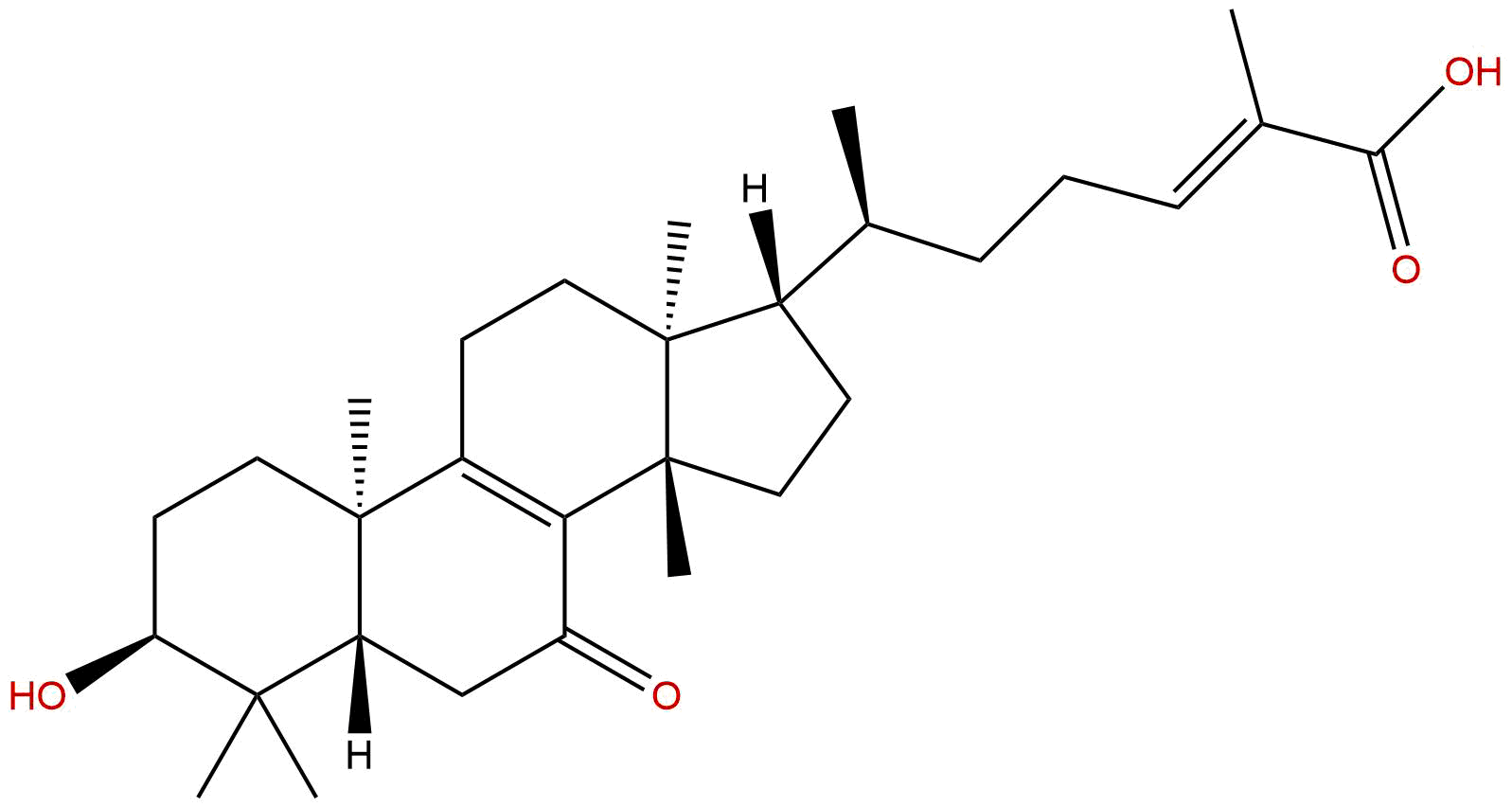
Product name: 7-Oxoganoderic acid Z
Synonym name:
Catalogue No.: BP2290
Cas No.: 929248-72-6
Formula: C30H46O4
Mol Weight: 470.694
Botanical Source: Ganoderma
Type of Compound: Triterpenoids
Purity: 95%~99%
Analysis Method: HPLC-DAD or/and HPLC-ELSD
Identification Method: Mass, NMR
Packing: Brown vial or HDPE plastic bottle
Storage: Store in a well closed container, protected from air and light. Put into refrigerate or freeze for long term storage.
Whenever possible, you should prepare and use solutions on the same day. However, if you need to make up stock solutions in advance, we recommend that you store the solution as aliquots in tightly sealed vials at -20℃. Generally, these will be useable for up to two weeks.
The product could be supplied from milligrams to grams
Inquire for bulk scale.
For Reference Standard and R&D, Not for Human Use Directly.
Storage conditions:Short-term storage at 2~8℃, long-term storage at -20 ~ -80℃
7-Oxoganoderic acid Z (CAS number: 929248-72-6) is a triterpenoid natural product derived from Ganoderma lucidum. Lingzhi, as a traditional Chinese medicinal herb, has attracted much attention due to its various biological activities, especially showing significant potential in anti-tumor, immune regulation, and anti-inflammatory aspects. In recent years, with the advancement of natural product pharmacology and molecular biology techniques, 7-carbonyl-ganoderic acid Z has become a research hotspot in the field of tumor therapy due to its regulatory ability on lung cancer-related molecular targets. This article aims to systematically review the chemical structure and physicochemical properties, plant sources and extraction methods, pharmacological activity and mechanism of action, pharmacological evaluation and pharmacokinetic characteristics of 7-carbonyl-ganoderic acid Z, and explore its clinical application prospects and development directions.
7-carbonyl-ganoderic acid Z belongs to triterpenoid compounds of ganoderic acid, with a molecular formula of C30H46O6 and a molecular weight of 470.6940. Its structural features include a polycyclic triterpenoid skeleton and carbonyl modification, endowing it with unique biological activity. The LogP value of this compound is 5.7588, indicating strong lipid solubility, which is beneficial for penetrating cell membranes, but may limit its water solubility (solubility is only 0.0037 mg/mL), posing a challenge to its bioavailability. The topological polar surface area (TPSA) is 74.6 Å ², indicating that its molecules have moderate polarity and are conducive to binding with biomolecules. The low permeability of the blood-brain barrier suggests that it mainly acts on peripheral tissues, reducing the risk of central nervous system side effects. The negative result of hERG channel inhibition experiment indicates a low risk of cardiac toxicity. The Ames mutagenicity test result was 0, indicating good genotoxicity safety.
7-carbonyl-ganoderic acid Z mainly comes from Ganoderma fungi, especially the fruiting bodies and mycelium of Ganoderma lucidum. Lingzhi is widely distributed in temperate and subtropical regions of Asia, traditionally used for enhancing immunity and anti-tumor treatment. The common methods for extracting this compound include:
The optimization of extraction process is of great significance for improving yield and purity, further promoting its pharmacological research and industrial application.
The pharmacological activity of 7-carbonyl-ganoderic acid Z mainly focuses on the field of anti-tumor, especially its inhibitory effect on lung cancer cells. Multiple in vitro and in vivo studies have shown that this compound can significantly inhibit the proliferation, migration, and invasion of lung cancer cells, while inducing cell apoptosis. Its anti-tumor activity involves the regulation of multiple signaling pathways, specifically manifested as:
In addition, 7-carbonyl-ganoderic acid Z has also shown certain protective effects in other disease models, such as antioxidant and anti fibrotic effects, but related research is still in the preliminary stage.
The molecular mechanism of 7-carbonyl-ganoderic acid Z acting on lung cancer is complex, involving multiple key targets and signaling pathways:
The synergistic regulation of these targets endows 7-carbonyl-ganoderic acid Z with multi-target and multi pathway anti-tumor properties, laying a solid foundation for its use as a candidate drug for lung cancer treatment.
From the perspective of medicinal properties, 7-carbonyl-ganoderic acid Z exhibits the following characteristics:
At present, there is limited pharmacokinetic data on 7-carbonyl-ganoderic acid Z. Current research indicates that its metabolism in the body is mainly carried out through the liver enzyme system, and the metabolites have not been systematically identified. After oral administration, due to poor water solubility and low bioavailability, further research is needed on plasma half-life and distribution volume. In the future, systematic pharmacokinetic and toxicological evaluations are needed to provide a basis for clinical development.
Given the significant regulatory effect and good safety characteristics of 7-carbonyl-ganoderic acid Z on lung cancer-related multi-target, its potential as a new drug candidate for anti lung cancer is enormous. The key areas for future clinical applications include:
In addition, further pharmacological research is needed on Ganoderma lucidum and its active ingredients. 7-carbonyl-ganoderic acid Z, as a representative triterpenoid compound, its structural modification and derivative development also provide broad space for new drug research and development.
7-carbonyl-ganoderic acid Z, as an important triterpenoid active ingredient in Ganoderma lucidum, exhibits excellent pharmacological activity and safety due to its unique chemical structure and multi-target anti lung cancer mechanism. Despite certain limitations in its water solubility and bioavailability, improvements in modern pharmaceutical formulation technology have the potential to overcome these bottlenecks and achieve clinical translation. In the future, combined with systematic pharmacokinetic research and clinical trial verification, 7-carbonyl-ganoderic acid Z is expected to become a new natural medicine for the treatment of lung cancer and related diseases, contributing an important force to the development of natural product pharmacology.
