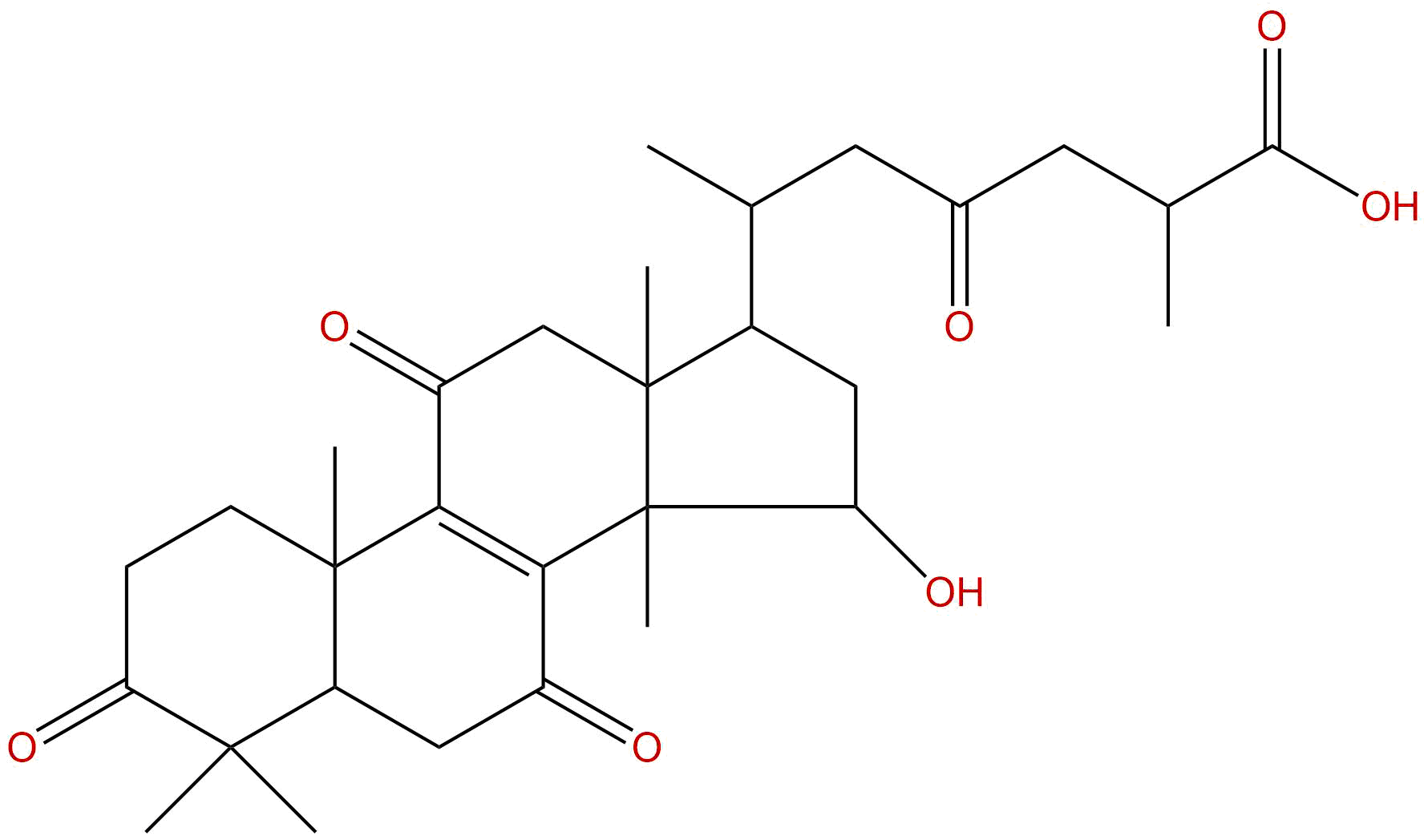


Product name: Ganoderic acid J
Synonym name: 1910062-69-9
Catalogue No.: BP2171
Cas No.: 100440-26-4
Formula: C30H42O7
Mol Weight: 514.659
Botanical Source:
Type of Compound:
Purity: 95%~99%
Analysis Method: HPLC-DAD or/and HPLC-ELSD
Identification Method: Mass, NMR
Packing: Brown vial or HDPE plastic bottle
Storage: Store in a well closed container, protected from air and light. Put into refrigerate or freeze for long term storage.
Whenever possible, you should prepare and use solutions on the same day. However, if you need to make up stock solutions in advance, we recommend that you store the solution as aliquots in tightly sealed vials at -20℃. Generally, these will be useable for up to two weeks.
The product could be supplied from milligrams to grams
Inquire for bulk scale.
For Reference Standard and R&D, Not for Human Use Directly.
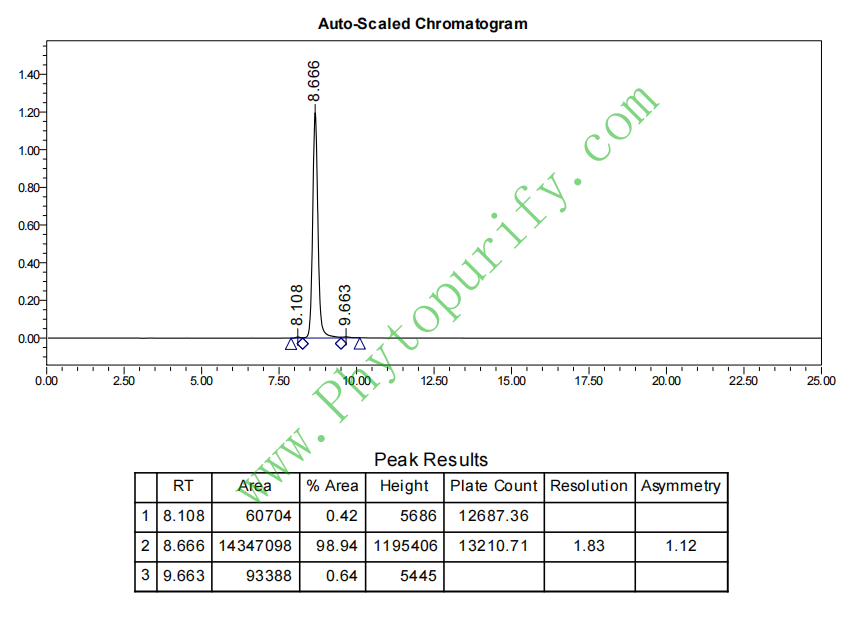
HPLC of Ganoderic acid J
Storage conditions:Short-term storage at 2~8℃, long-term storage at -20 ~ -80℃
125.8100
3.1597
.7775
.0136
2.3526
5.5399
Low
84.0135
5.0454
Yes
No
Yes
No
No
No
0.0
Yes
No
No
No
Natural products, as an important source of drug discovery, play an irreplaceable role in the history of human disease treatment. Among them, the medicinal fungus Ganoderma lucidum, as a treasure of traditional Chinese medicine, has a history of more than two thousand years of application and is known as the "fairy grass". Its effects of strengthening the body and promoting longevity are widely known. Modern pharmacological research has revealed that the many biological activities of Ganoderma lucidum are closely related to the triterpenoids it is rich in. Ganoderma triterpenoids, especially ganoderic acid compounds, have become a hot topic in research fields such as anti-tumor, anti-inflammatory, and hepatoprotective effects.
Ganoderic acid J (GA-J) is a tetracyclic triterpenoid compound with significant biological activity among many members of the Ganoderic acid family, with a CAS number of 100440-26-4. Early research has found that it has clear anti-inflammatory activity. In recent years, with the deepening of research, especially the gradual exploration of its potential value in the treatment of malignant tumors such as ovarian cancer, ganoderic acid J has attracted more and more attention from pharmacology and oncology researchers. Ovarian cancer is the deadliest gynecological malignancy, and its treatment often faces significant challenges due to chemotherapy resistance and recurrence. Therefore, it is crucial to search for novel, efficient, and low toxicity lead compounds for ovarian cancer treatment. Existing research has shown that ganoderic acid J exhibits unique potential in inhibiting ovarian cancer cell proliferation, inducing apoptosis, and reversing multidrug resistance by acting on multiple key targets such as BCL2, STAT3, ABCB1, etc.
This article aims to systematically review the chemical characteristics, plant sources, extraction methods, pharmacological activities of ganoderic acid J, and focus on its mechanism of action and molecular target network in ovarian cancer for in-depth analysis. At the same time, based on its pharmacological parameters, the pharmacokinetic characteristics, challenges faced, and future clinical application prospects of this natural product are discussed, in order to provide comprehensive academic references for the in-depth development and transformation research of this natural product.
Lingzhi acid J belongs to highly oxidized lanostane type tetracyclic triterpenoids. Its basic skeleton consists of four fused rings (A, B, C, D), exhibiting typical steroid like structural characteristics. Similar to many ganoderic acids, its structural characteristics are that the C-3 position is usually a carbonyl or hydroxyl group, the C-7 position is often a carbonyl group, the C-11 position is often a carbonyl group, the C-12 position is often a double bond, and there are multiple oxygen-containing functional groups (such as hydroxyl and carboxyl groups) and double bonds on the side chain. These structural modifications are important material basis for its biological activity.
Its molecular formula is C30H42O7 and its molecular weight is 514.6590 g/mol. Based on the analysis of physicochemical parameters related to drug properties, the logarithmic partition coefficient (LogP) of ganoderic acid J is 3.1597, indicating that the compound has moderate lipophilic properties, which are beneficial for its penetration of cell membranes but may also affect its water solubility and in vivo distribution. Its topological polar surface area (TPSA) is 125.81 Å ², which is relatively large, mainly due to the presence of multiple polar oxygen atoms (from carboxyl, carbonyl, and possibly hydroxyl groups) in the molecule. The high TPSA and lipophilicity together determine its low water solubility, with a calculated value of approximately 0.0136 mg/mL, which may be a major limiting factor for its oral bioavailability.
In the preliminary screening of drug safety, existing computational models predict that ganoderic acid J has no significant inhibitory risk on hERG potassium channels (predicted as "no"), indicating a low potential risk of inducing QT interval prolongation in the heart. In addition, its Ames test predicted a value of 0.0, indicating that at the computer simulation level, its mutagenic risk is extremely low and has a good genetic toxicity safety prospect. However, these are all theoretical predictions that need to be verified through subsequent experiments.
It is worth noting that the blood-brain barrier permeability of ganoderic acid J is predicted to be "low". This is not beneficial for treating central nervous system diseases, but for diseases that mainly affect the peripheral system (such as ovaries, liver, etc.), it may help reduce central nervous system side effects.
Lingzhi acid J mainly comes from the fruiting bodies, mycelium, or spore powder of the porous fungus Ganoderma lucidum (Leyss. ex Fr.) Karst. There are significant differences in the content of ganoderic acid J among different varieties, origins, growth environments (such as temperature, humidity, light, medium composition), and growth stages of Ganoderma lucidum. Usually, mycelium cultured using liquid deep fermentation technology has become one of the main industrial ways to obtain ganoderic acid compounds on a large scale due to its controllable growth cycle and stable production of active ingredients.
Extracting ganoderic acid J from Ganoderma lucidum materials requires following the conventional process of natural product chemistry, which mainly includes the following steps:
Preprocessing and Extraction Crush the dried fruiting body or mycelium of Ganoderma lucidum. Taking advantage of the moderate polarity and lipophilicity of Ganoderma lucidum acid J, high concentration ethanol (such as 95% ethanol) or methanol is often used for reflux extraction or ultrasound assisted extraction to efficiently dissolve triterpenoid components. In recent years, supercritical CO2 extraction technology has also been applied to the extraction of ganoderic acid due to its green, efficient, and selective advantages. It can avoid residual organic solvents and optimize the extraction rate by adjusting pressure and temperature.
Separation and enrichment After the crude extract is concentrated under reduced pressure, the resulting paste is usually subjected to gradient extraction using solvents such as petroleum ether and ethyl acetate to enrich ganoderic acid J in the ethyl acetate fraction. Subsequently, silica gel column chromatography, reverse phase silica gel column chromatography (such as ODS), dextran gel column chromatography (such as Sephadex LH-20) and other chromatographic techniques were used for preliminary separation.
Purification and identification To further obtain high-purity ganoderic acid J, it is often necessary to use high-performance liquid chromatography for final purification, especially preparative high-performance liquid chromatography. The obtained monomeric compounds need to be structurally identified through modern spectroscopic techniques, including nuclear magnetic resonance (NMR, such as 1H-NMR, 13C-NMR, 2D-NMR), mass spectrometry (MS, such as ESI-MS, HR-ESI-MS), infrared spectroscopy (IR), and ultraviolet spectroscopy (UV), to ultimately determine their chemical structure.
Optimizing extraction process parameters (such as solvent, temperature, time, solid-liquid ratio) and separation and purification strategies are key to improving the yield and purity of ganoderic acid J.
The pharmacological activity research of Ganoderma lucidum acid J has expanded from the initial anti-inflammatory field to a wider range of anti-tumor, antioxidant and other aspects, among which the anti ovarian cancer activity is the most prominent.
anti-inflammatory activity As the earliest reported activity of ganoderic acid J, research has shown that it can significantly inhibit the excessive production of nitric oxide (NO) and prostaglandin E2 (PGE2) in macrophages induced by lipopolysaccharides (LPS) and other factors. Its function is related to the inhibition of inducible nitric oxide synthase (iNOS) and cyclooxygenase-2 (COX-2) expression, suggesting its potential therapeutic value for acute and chronic inflammation.
Anti ovarian cancer activity This is the core focus of current pharmacological research on Ganoderma lucidum acid J. Numerous in vitro experiments have confirmed that ganoderic acid J can effectively inhibit the proliferation of various human ovarian cancer cell lines (such as SKOV3, A2780, OVCAR-3), and its inhibitory effect is concentration - and time-dependent. More importantly, ganoderic acid J can significantly induce apoptosis in ovarian cancer cells, leading to cell cycle arrest (commonly in G1 or G2/M phase). It has been validated in the morphological changes and biochemical indicators that induce cell apoptosis, such as phosphatidylserine eversion and caspase-3 activation.
Reverse multidrug resistance One of the main causes of chemotherapy failure in ovarian cancer is the development of multidrug resistance (MDR), in which overexpression of P-glycoprotein (P-gp, encoded by ABCB1 gene) is a key mechanism. Research has shown that ganoderic acid J can downregulate the expression of ABCB1 or inhibit the efflux pump function of P-gp, thereby increasing the accumulation of chemotherapy drugs (such as paclitaxel and doxorubicin) in drug-resistant ovarian cancer cells, restoring their sensitivity to chemotherapy, and has the potential to be a "chemotherapy sensitizer".
Other activities In addition to the core activities mentioned above, research also suggests that ganoderic acid J may have certain antioxidant effects (possibly related to activating the NFE2L2/Nrf2 pathway), as well as potential whitening effects by inhibiting tyrosinase (TYR). Its potential impact on topoisomerases (TOP1, TOP2A) also suggests that it may interfere with DNA replication and repair processes.
The anti ovarian cancer effect of Ganoderma lucidum acid J is not achieved through a single pathway, but through a complex multi-target signaling network, synergistically exerting its anti-cancer effect. Based on the provided target information, its mechanism of action can be summarized as follows:
Inducing apoptosis and regulating BCL2 family Lingzhi acid J can downregulate the expression of anti apoptotic protein BCL2. BCL2 is a key negative regulatory factor in the mitochondrial apoptosis pathway, and its downregulation can promote an increase in mitochondrial outer membrane permeability, leading to the release of cytochrome C, which in turn activates the caspase cascade reaction and ultimately triggers cell apoptosis.
Inhibition of STAT3 signaling pathway Signal transducer and activator of transcription factor 3 (STAT3) is an important oncogenic transcription factor that is continuously activated in most ovarian cancers. After the activated STAT3 enters the nucleus, it regulates a variety of genes related to cell proliferation, survival and angiogenesis (such as Cyclin D1, BCL2, MCL-1, VEGF). Lingzhi acid J has been proven to inhibit the phosphorylation (activation) of STAT3, block its nuclear translocation and transcriptional activity, thereby inhibiting tumor growth from multiple levels.
Inhibition of MAPK/ERK pathway Mitogen activated protein kinase 1 (MAPK1, ERK2) is a core member of the MAPK/ERK signaling pathway, which is abnormally activated to promote cell proliferation and survival. Lingzhi acid J may reduce the phosphorylation level of ERK through upstream inhibition or direct action, thereby inhibiting the signal transduction of this survival promoting pathway.
Reversal of drug resistance and inhibition of ABCB1/P-gp As mentioned earlier, ganoderic acid J reduces chemotherapy drug efflux by downregulating ABCB1 gene expression or directly inhibiting its encoded P-gp protein function, which is the core molecular mechanism for reversing multidrug resistance in ovarian cancer.
Affects DNA damage repair Lingzhi acid J may cause DNA replication fork arrest and DNA damage by affecting the activity of topoisomerases I (TOP1) and II α (TOP2A). Meanwhile, its potential role in tyrosine DNA phosphodiesterase 1 (TDP1) is also worth noting. TDP1 is a key enzyme in repairing DNA damage caused by TOP1 inhibitors, and inhibiting TDP1 may enhance the cytotoxicity of TOP1 inhibitors.
Regulating oxidative stress and estrogen signaling By activating nuclear factor E2 related factor 2 (NFE2L2/Nrf2), ganoderic acid J may enhance the antioxidant defense ability of cells, but its role in anti-tumor treatment is complex and requires specific analysis. In addition, its potential regulatory effect on estrogen receptor alpha (ESR1) may affect the growth of estrogen dependent ovarian cancer.
In summary, ganoderic acid J forms a multi-target and multi pathway anti ovarian cancer network by synergistically acting on key nodes in multiple pathways such as apoptosis (BCL2, STAT3), proliferation (STAT3, MAPK1), drug resistance (ABCB1), and DNA damage repair (TOP1/2A, TDP1). This may be the structural basis for its high efficacy and low toxicity potential.
Based on the physical and chemical properties and predicted parameters mentioned earlier, a preliminary evaluation of the pharmacological properties of Ganoderma lucidum acid J is conducted
Advantage:
1. Clear activity and multi-target mechanism The in vitro and partially in vivo activity of ovarian cancer is clear, and the mechanism of action is relatively clear. The multi-target characteristics may reduce the risk of clinical drug resistance.
2. Good preliminary safety prediction The prediction results of hERG inhibition and Ames mutagenicity risk are good, providing a favorable safe starting point for subsequent development.
3. Natural product sources As a component of Ganoderma lucidum, it has a long history of consumption, high public acceptance, and may have low potential toxicity.
Challenges and limitations:
1. Poor water solubility The extremely low water solubility (0.0136 mg/mL) is the primary obstacle to its drug development, seriously affecting the formulation design for oral absorption and intravenous administration.
2. Pharmacokinetic properties unknown Currently, there is a severe lack of publicly available pharmacokinetic research data on the J system of ganoderic acid, including absorption, distribution, metabolism, and excretion. Its lipophilicity suggests that it may be orally absorbed, but key parameters such as first pass effect, bioavailability, plasma protein binding rate, major metabolic organs and metabolites, and in vivo half-life are unknown.
3. Low blood-brain barrier permeability Although beneficial for central side effects, it also limits its application in the treatment of brain metastases.
4. chemical stability Triterpenoids may be sensitive to light, heat, and pH values, and their chemical stability in solid and solution states needs to be carefully investigated.
5. Pharmaceutical Science Challenge To improve solubility and bioavailability, advanced formulation technologies such as nanocrystals, liposomes, micelles, cyclodextrin inclusion complexes, solid dispersions, etc. may be required.
Future pharmacokinetic studies need to first establish sensitive and specific biological analysis methods (such as LC-MS/MS), conduct single and multiple dose ADME studies in animal models (mice, rats), clarify their in vivo fate, and provide a basis for dosage form optimization and dosing regimen design.
Lingzhi acid J has shown unique application prospects in the field of anti ovarian cancer, but its clinical application still faces a long and arduous path of translational research.
Potential application directions:
1. Adjuvant therapy and reversal of drug resistance in ovarian cancer As a sensitizer for chemotherapy (such as platinum and paclitaxel), combined treatment for platinum resistant or recurrent ovarian cancer is an attractive development strategy. Its multi-target properties may lead to a more extensive inhibition of heterogeneous tumor cell populations.
2. Anti inflammatory related diseases Based on its clear anti-inflammatory mechanism, its potential application in chronic inflammatory diseases such as arthritis and colitis can be explored.
3. Functional cosmetic ingredients Its potential tyrosinase inhibitory activity can provide scientific basis for its development in high-end whitening and spot removing cosmetics.
Future research focus and prospects:
1. In depth preclinical research:
* In vivo pharmacodynamics It is necessary to comprehensively evaluate the anti-tumor effects of monotherapy and combination therapy in animal models that are closer to human diseases, such as human derived tumor xenograft models and patient derived tumor xenograft models.
* Systemic pharmacokinetics and toxicology Complete systematic ADME research and standardized GLP toxicology evaluation (acute toxicity, long-term toxicity, reproductive toxicity, etc.) to clarify their safety window.
2. Pharmaceutical Strategy Innovation To address the bottleneck of poor water solubility, resources must be invested in developing new delivery systems. Nano drug delivery systems, such as albumin nanoparticles and polymer micelles, can not only improve solubility and stability, but may also passively target tumor tissues by enhancing permeability and retention effects, improving efficacy and reducing systemic toxicity.
3. Structural optimization and derivative development Based on the parent nucleus structure of Ganoderma lucidum acid J, reasonable chemical modifications (such as salt formation, esterification, and synthesis of prodrugs) are carried out to improve its water solubility, metabolic stability, targeting, and potency, thereby obtaining more valuable candidate drugs for development.
4. Deepening mechanism research and exploration of biomarkers Further elucidate its global mechanism of action using omics techniques (proteomics, metabolomics). Finding biomarkers to predict its therapeutic efficacy can help achieve precision medicine in the future.
5. Exploring new strategies for combination therapy In addition to combining with traditional chemotherapy, exploring the combined application of targeted therapy, immune checkpoint inhibitors and other new therapies may produce synergistic effects and open up broader treatment space.
Lingzhi acid J, as an important bioactive triterpenoid component in Ganoderma lucidum, has become a promising lead compound in natural anti-tumor drug research due to its multi-target anti ovarian cancer mechanism, especially inducing apoptosis, inhibiting STAT3 signaling, and reversing multidrug resistance. Its clear in vitro activity and good preliminary safety prediction lay the foundation for its further development. However, its inherent physical and chemical property defects (such as poor water solubility) and the current lack of in vivo pharmacokinetic and toxicological data are the main obstacles on its transformation path.
Future research requires a multidisciplinary collaborative strategy that integrates the strengths of natural product chemistry, pharmacology, pharmacy, toxicology, and clinical medicine. On the one hand, overcoming the bottleneck of drug formation through advanced formulation technology or reasonable structural modification; On the other hand, it is necessary to complete the preclinical evaluation data of the system to provide a solid scientific basis for whether it can enter clinical trials. Only in this way can ganoderic acid J be truly transformed from an active molecule in the laboratory into a potential therapeutic drug that may benefit a large number of ovarian cancer patients, continuing and enhancing the immortal value of natural products in human health.
