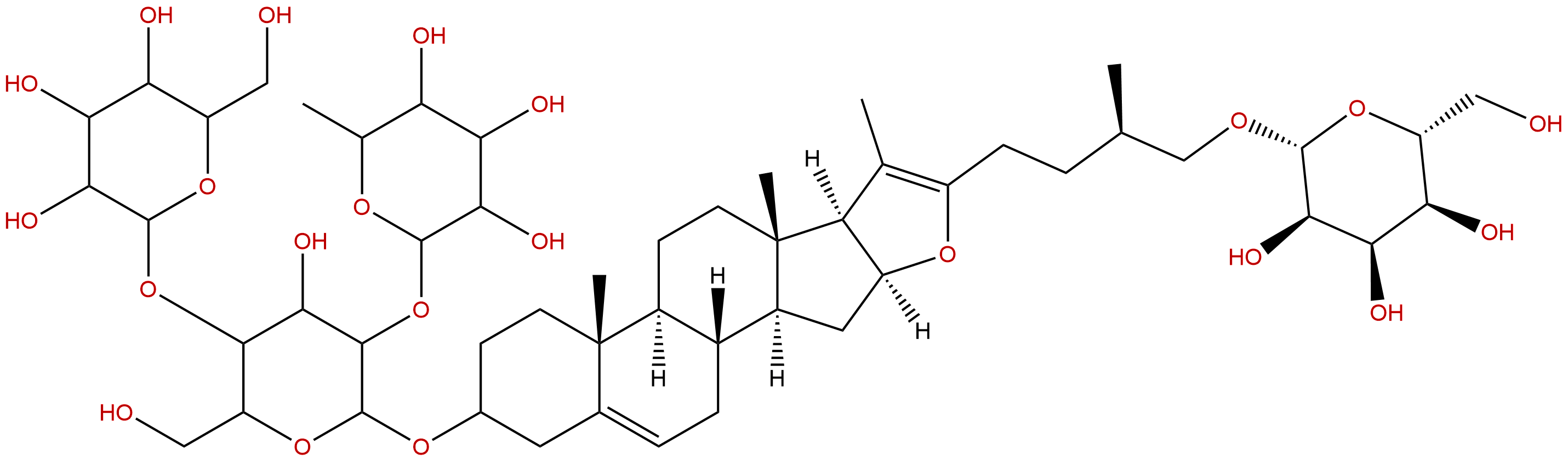
Huangjiangsu A: a multi-target natural anti-tumor candidate molecule derived from turmeric
1. Overview
HuangjiangSu A, CAS number 1026020-27-8, is a traditional medicinal plant Curcuma longa Natural products obtained through separation. Its chemical essence is Original Triceratops Saponin Element The compound has a molecular formula of C51H82O22 and a molecular weight of up to 1047.2000 g/mol. It belongs to the complex structure of large molecule saponins. Existing research indicates that turmeric A not only exhibits significant antioxidant and Liver protection Activity - capable of combating hydrogen peroxide (H2O2) - induced cytotoxicity and reactive oxygen species (ROS) generation, and more importantly, by acting on multiple key cellular signaling targets, it can colorectal cancer The intervention shows potential therapeutic prospects. As an active molecule discovered from ancient medicinal and edible plants, the study of turmeric A closely combines traditional medical wisdom with modern molecular pharmacology, providing valuable lead compounds for the development of new multi-target anti-tumor drugs.
2. Chemical structure and physicochemical properties
The chemical structure of Huangjiangsu A is accurately described through its SMILES string and molecular formula. Its molecular formula is C51H82O22, with a molecular weight of approximately 1047.2 g/mol, which clearly indicates that it is a High molecular weight and structurally complex steroidal saponins From the numerous chiral center markers (such as @, @ @) in its SMILES string, it can be inferred that the molecule has a complex stereochemical configuration, which is crucial for its biological activity.
From the analysis of drug parameters, it can be concluded that Topological Polarity Surface Area (TPSA) up to 346.06 Å ²This is mainly attributed to the presence of 22 oxygen atoms in the molecule, which form multiple glycosidic bonds and hydroxyl groups, resulting in strong polarity and high hydrophilicity of the molecule. its The LogP value is approximately 1.28 This indicates that the molecule as a whole is at a balance point between lipophilicity and hydrophilicity, but is more inclined towards hydrophilicity. This characteristic is consistent with what was actually measured Water solubility (0.4285, unit needs to be combined with database context, usually in the order of mg/mL or log mol/L) Matching indicates that it has a certain degree of water solubility, which is beneficial for its distribution in body fluids.
However, high TPSA and high molecular weight also pose challenges.The permeability (0.5676) and predicted effective permeability (Peff, 0.3861) values of Caco-2 cells are both low It suggests that oral absorption may be poor and intestinal permeability may be limited. In addition, it The blood-brain barrier (BBB) penetration is predicted to be 'low'This means that it is unlikely to enter the central nervous system to exert its effects or produce related side effects.The plasma protein binding rate (PPB) is approximately 62.42%Belonging to a moderate level, it means that some drugs may bind to plasma proteins, which may affect their free concentration and efficacy. Overall, Huangjiangsu A is a complex natural product with high polarity, decent water solubility, but poor membrane permeability.
3. Plant sources and traditional applications
Huangjiangsu A is directly derived from Curcuma longa L This is a perennial herbaceous plant of the Zingiberaceae family. The orange yellow powder obtained by drying and grinding the rhizome of turmeric is one of the main components of the world-renowned spice curry and the source of the traditional Chinese medicine "turmeric".
The medicinal history of turmeric has a long and rich history, recorded in ancient Indian Ayurvedic medicine, traditional Chinese medicine, and many Asian traditional medical systems. Traditionally, turmeric is believed to have Promote blood circulation and qi circulation, unblock meridians and relieve pain, dispel wind and dampness Its efficacy is commonly used to treat chest and rib pain, rheumatoid arthritis, menstrual disorders, and injuries caused by falls. The core active ingredients are curcumin compounds (such as curcumin, demethoxycurcumin, etc.), which have been widely studied for their powerful anti-inflammatory and antioxidant properties.
The discovery of turmeric A reveals another important class of active substances in turmeric besides curcumin——Steroidal saponins The presence of such compounds enriches the material basis of turmeric's pharmacological effects and explains the molecular mechanisms underlying some of its traditional effects, such as liver protection. The discovery of Huangjiangsu A, from traditional "promoting blood circulation and dispersing nodules" to modern research on "anti-tumor" activity, is a typical case of deep exploration and interpretation of traditional medicinal materials using modern scientific technology, reflecting the enormous value of natural product research.
4. Pharmacological activity and mechanism of action
The pharmacological activity research of Huangjiangsu A currently focuses on two main aspects:Antioxidant/hepatoprotective effects and Anti colorectal cancer activity Its mechanism of action is closely related to the regulation of multiple key cellular signaling pathway targets.
1. Antioxidant and liver protective effects:
The existing description clearly states that turmeric A can Resist H2O2 induced cytotoxicity and reactive oxygen species (ROS) generation H2O2 is a common oxidative stressor in cells, and excessive amounts can cause oxidative damage to lipids, proteins, and DNA, ultimately leading to cell apoptosis or necrosis, which is particularly common in liver injury models. Huangjiangsu A reduces oxidative stress and protects liver cells from damage by clearing ROS or enhancing the activity of endogenous antioxidant systems such as glutathione and superoxide dismutase, demonstrating clear liver protective potential.
2. Anti colorectal cancer effect and multi-target mechanism:
This is the most promising research direction for turmeric extract A. According to database information, turmeric A is associated with five key targets:CTNNB1 (β - catenin), CCND1 (cyclin D1), MYC (oncogene c-Myc), APC (adenomatous polyposis protein), and CDKN1A (p21)These targets do not exist in isolation, but together form the core network that regulates cell proliferation, differentiation, and apoptosis——Wnt/β - catenin signaling pathway The abnormal activation of this pathway is a key driving factor in the occurrence and development of colorectal cancer.
- Core pathway: Wnt/β - catenin signaling pathway
In normal cells, APC protein forms a "disruption complex" with CTNNB1 (β - catenin) and other proteins, promoting the phosphorylation and degradation of β - catenin and maintaining low levels in the cytoplasm. When Wnt signaling is activated or APC gene mutations occur (in approximately 80% of colorectal cancers), the complex becomes ineffective, leading to stable accumulation of β - catenin in the cytoplasm and translocation into the nucleus.
- Mechanism deduction of Huangjiangsu A:
- Targeting CTNNB1/APC axis Huangjiangsu A may inhibit the abnormal stability and nuclear translocation of β - catenin by directly or indirectly acting on β - catenin (CTNNB1) or its upstream regulatory factor APC. This is the most direct strategy for intervening in the Wnt pathway.
- Inhibition of transcription of downstream oncogenesβ - catenin entering the nucleus binds to TCF/LEF transcription factors, activating the transcription of a series of oncogenes, the two most important of which are CCND1 and MYC。
- CCND1 The encoded cyclin D1 is a key protein that drives cells from the G1 phase to the S phase. Its overexpression leads to uncontrolled cell cycle proliferation.
- MYC It is a powerful oncogene that regulates approximately 15% of global gene expression, promoting cell growth, metabolic reprogramming, and proliferation.
Huangjiangsu A inhibits the activity of β - catenin, thereby Downregulate the expression of CCND1 and MYC Block the disordered proliferation signal of cancer cells.
- Activate cell cycle inhibitory factors:CDKN1A(p21) It is an important cyclin dependent kinase inhibitor downstream of the p53 pathway, which can block the cell cycle in the G1 phase, promote cell differentiation or aging. Some studies have shown that certain natural products can upregulate p21 expression through p53 dependent or non dependent pathways. The association between Huangjiangsu A and CDKN1A suggests that it may simultaneously possess Activate the cell cycle 'brake' system The ability to inhibit the "throttle" effect of CCND1 synergizes with its ability to suppress the cancer cell cycle progression.
Summary Huangjiangsu A may serve as a Multi target Wnt signaling pathway regulator Make an impact. It inhibits the activity of the oncogenic transcription factor β - catenin by intervening in the CTNNB1/APC axis, thereby downregulating the expression of its key downstream effector molecules CCND1 and MYC. At the same time, it may upregulate the cell cycle inhibitor CDKN1A, synergistically inhibiting the proliferation of colorectal cancer cells and promoting their cycle arrest from both the "inhibition drive" and "activation brake" levels, ultimately exerting anti-tumor effects. This multi-target mode of action may have advantages in inhibiting highly heterogeneous and drug-resistant tumors.
5. Evaluation of drug properties
Based on the provided pharmacological parameters, we can conduct a preliminary evaluation of the development potential of turmeric A as an oral drug, and refer to the famous Lipinski's Rule of Five (Ro5)Conduct comparative analysis. Ro5 is an empirical rule for evaluating the oral absorption potential of small molecule drugs, and meeting all five criteria (molecular weight<500, hydrogen bond donor<5, hydrogen bond acceptor<10, LogP<5) results in better drug efficacy.
-
Compliance with Lipinski's Five Rules:
- Molecular weight (MW):1047.2 g/mol,Serious Exceeding The upper limit of 500 Da recommended by Ro5. This is one of the biggest challenges for it as an oral medication.
- Hydrogen bond donor (HBD) and acceptor (HBA)Based on the molecular formula (C51H82O22) and structure, it is inferred that there are a large number of hydroxyl groups (- OH) and oxygen on the sugar ring, and the number of hydrogen bond donors and acceptors is inevitable far exceed The limit of Ro5 (HBD<5, HBA<10).
- Lipid water partition coefficient (LogP):1.28,Comply with The requirement of Ro5 (<5) indicates that its lipophilicity is within an acceptable range.
- Conclusion Huangjiangsu A Severe violation Out of the three terms in Lipinski's Five Rules (molecular weight, hydrogen bond donor, hydrogen bond acceptor), only LogP is met. This strongly indicates its Oral bioavailability is likely to be extremely low。
-
Analysis of other key pharmacological parameters:
- Absorption and penetration Extremely low Caco-2 permeability and Peff value, consistent with predictions that violate Ro5, confirm its difficulty in intestinal absorption. High TPSA (346.06) is the main reason for poor permeability.
- distribution BBB has low penetrability, which means it cannot effectively enter the brain and is ineffective in treating brain diseases, but it also reduces the potential risk of central neurotoxicity. The moderate plasma protein binding rate (62.42%) requires attention to its free drug concentration in subsequent pharmacokinetic studies.
- Metabolism and toxicity: Preliminary Ames test, chromosomal aberration, hERG inhibition, phototoxicity, etc. are all negative or "none/no"This is a very positive signal indicating that turmeric A may have lower key safety risks such as genotoxicity and cardiotoxicity.Elevated serum alkaline phosphatase (Ser_LK) indicates' yes'This requires caution and may indicate potential liver cell or bile duct effects, which need to be further validated in animal experiments.
- Feasibility of synthesis The SyneAccess score is 6.7267 (usually the lower the score, the easier it is to synthesize), combined with its complex steroidal saponin structure, indicating that its full chemical synthesis route is extremely challenging. Currently, the more feasible source is extracted and isolated from plants or obtained through biosynthetic technology.
Summary of Drug Evaluation Huangjiangsu A is a Clear activity and preliminary safety assessment are good, but drug development (especially oral absorption) faces significant challenges The lead compound. Its characteristics of large molecules, high polarity, and low permeability make it difficult to meet the standards of traditional small molecule oral drugs. Future development strategies may need to shift towards Injection administration route(such as intravenous injection, bypassing absorption barriers), or using it as a template Simplification and optimization of structure On the premise of retaining the core pharmacophore, significantly reduce molecular weight and polarity, and improve the properties of similar drugs. In addition, exploration can also be conducted New drug delivery system(such as nanoparticles, liposomes, prodrugs, etc.) to improve their solubility, stability, and targeting.
6. Research Status and Application Prospects
At present, research on Huangjiangsu A is still in progress Early discovery and mechanism exploration stage The existing data mainly comes from the chemical separation and identification of natural products and preliminary in vitro activity screening. The liver protective effect against H2O2 induced damage and the mechanism of anti colorectal cancer by regulating key targets of the Wnt/β - catenin pathway have shown clear research value, but there is still a lot of work to be done urgently.
Research status:
1. Basic research needs to be further deepened The current mechanism of action is mostly based on target association speculation, and more direct experimental evidence is needed, such as verifying the direct binding ability of turmeric extract A to targets such as β - catenin and APC, and clarifying its specific effects on downstream CCND1, MYC, CDKN1A gene and protein expression.
2. Lack of in vivo pharmacodynamics It is urgent to validate its in vivo anti-tumor activity and dose-response in animal models of colorectal cancer, such as APCmin/+mice or human derived tumor xenograft models.
3. Blank space in pharmacokinetic research Its absorption, distribution, metabolism, and excretion (ADME) characteristics are completely unknown, which is the key to evaluating its development feasibility.
Application prospects and future directions:
1. As a multi-target anti-tumor lead compound The regulatory potential of Huangjiangsu A on multiple nodes of the Wnt pathway makes it an excellent starting point for the development of new drugs for the treatment of colorectal cancer, especially APC mutant types. Future pharmaceutical chemistry work will focus on Structural modification and optimization Intended to obtain derivatives with comparable or superior activity, but with smaller molecular weight and higher oral bioavailability.
2. Exploring new drug delivery methods Given its inherent physicochemical properties, developing injectable formulations or advanced targeted delivery systems (such as colon targeted delivery for colorectal cancer) may be a more realistic pathway for transformation.
3. Expand indication research Abnormal Wnt signaling pathway is also widely found in liver cancer, gastric cancer, breast cancer and other tumors. The anti-tumor spectrum of Huangjiangsu A is worth further exploration. In addition, its antioxidant and liver protective effects also suggest its potential application value in diseases such as non-alcoholic fatty liver disease and drug-induced liver injury.
4. Clarify the connotation of traditional pharmacological science In depth research on turmeric extract A can help elucidate the molecular basis of its traditional functions such as promoting blood circulation, dispersing nodules, and relieving pain from a modern scientific perspective, and promote the modernization and international recognition of traditional Chinese medicine.
In summary, turmeric A is a precious gem extracted from the traditional medicinal herb turmeric, and its unique chemical structure and multi-target anti-tumor mechanism endow it with important research value. Although there are significant barriers to drug development on the path to clinical use, it undoubtedly provides an attractive starting point for medicinal chemists and pharmacologists. Through continuous scientific innovation, it is expected to eventually be developed into a new weapon against major diseases such as colorectal cancer.