Research progress on saponin B from Lonicera japonica: a natural triterpenoid saponin with antiviral potential
Introduction/Overview
Natural products, as an important source of drug discovery, play an irreplaceable role in the long history of human fight against diseases. Saponins, as a class of secondary metabolites widely present in the plant kingdom, have attracted much attention due to their structural diversity and significant biological activity. Macranthoidin B (CAS number: 136849-88-2) is a traditional Chinese medicinal herb derived from Lonicera japonica(Lonicera macranthoides The oleanane type triterpenoid saponins isolated from Hand. - Mazz. belong to the pentacyclic triterpenoid class. Lonicera macranthoides, as a plant of the genus Lonicera in the honeysuckle family, its dry flower buds or newly opened flowers are widely used in the clinical treatment of traditional Chinese medicine for wind heat, cold, sore throat, hot blood dysentery and other diseases. It is one of the important ingredients of the famous traditional Chinese patent medicines and simple preparations "Yinqiao Jiedu Tablet" and "Shuanghuanglian Oral Liquid".
Since its first isolation and identification from Lonicera japonica, saponin B from Lonicera japonica has gradually become a hot molecule in natural product chemistry and pharmacology research. Research has shown that this compound not only possesses the common activities of traditional saponin compounds such as anti-inflammatory, antioxidant, and hepatoprotective effects, but also exhibits significant antiviral potential, especially in the treatment of human cytomegalovirus (HCMV), herpes simplex virus (HSV), and human immunodeficiency virus (HIV), showing remarkable effects. With the increasing threat of viral infectious diseases to human health, especially the emergence of drug-resistant virus strains, developing antiviral drugs with novel mechanisms of action has become an urgent task. The unique chemical structure and multi-target action characteristics of Lonicera japonica saponins provide new lead compound candidates for the development of antiviral drugs.
This article will provide a systematic review of the research progress of Lonicera japonica saponin B from the aspects of chemical structure and physicochemical properties, plant sources and extraction methods, pharmacological activity, mechanism of action and molecular targets, drug evaluation and pharmacokinetic characteristics, as well as clinical application prospects, in order to provide reference for the in-depth development and utilization of this natural product.
Chemical structure and physicochemical properties
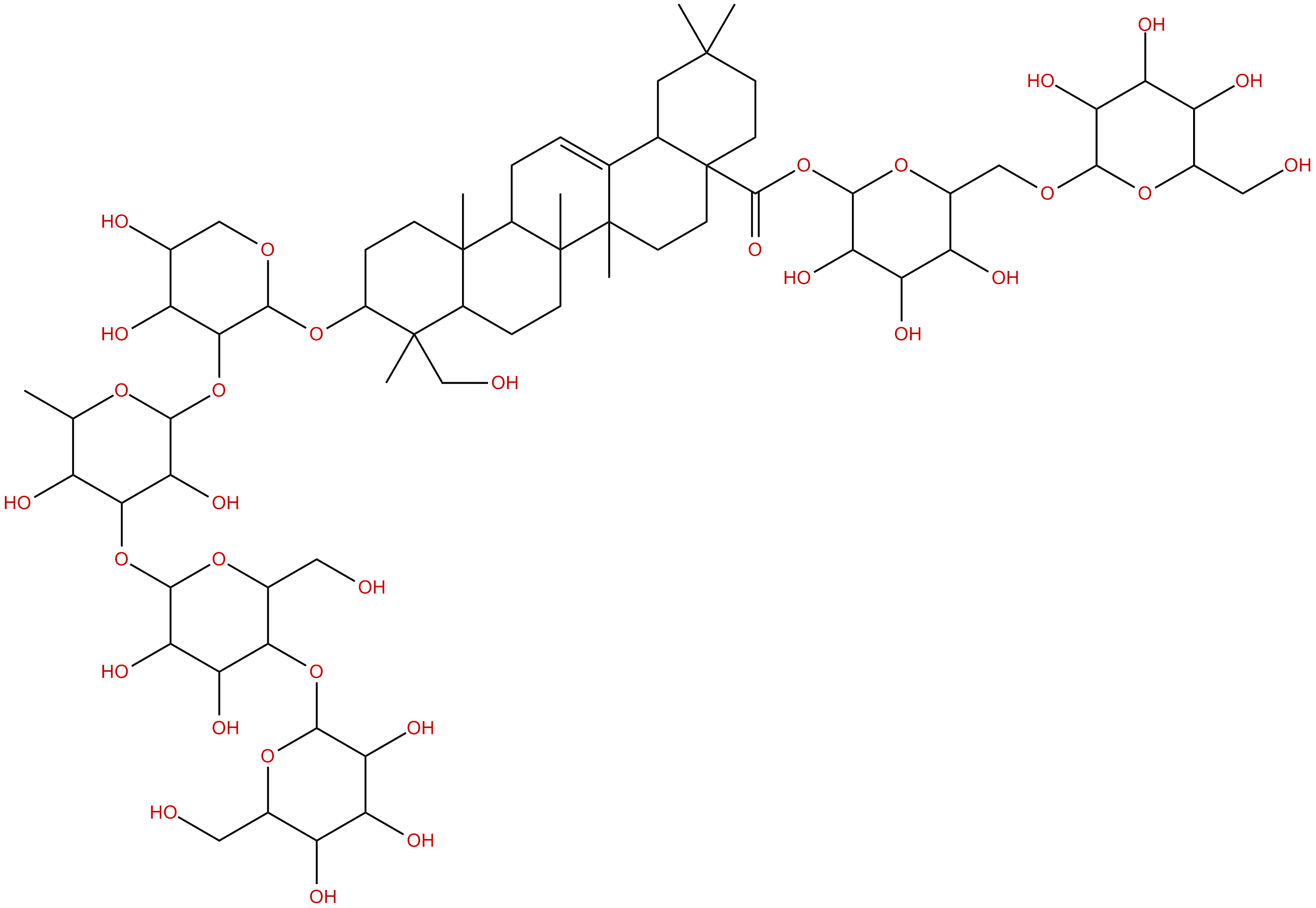
Gray felt honeysuckle saponin B belongs to the oleanane type pentacyclic triterpenoid saponin, and its glycoside is oleanolic acid. The complete chemical name of this compound is 3-O - β - D-glucopyranosyl - (1 → 3) - α - L-rhamnopyranosyl - (1 → 2) - α - L-arabinopyranosyl oleanolic acid-28-O - β - D-glucopyranosyl - (1 → 6) - β - D-glucopyranosyl. Structurally, Lonicera japonica saponin B exhibits typical disaccharide chain saponin characteristics: a trisaccharide chain consisting of glucose, rhamnose, and arabinose is connected to the C-3 position of the glycoside, while a disaccharide chain consisting of two glucose molecules is connected to the C-28 position. This dual sugar chain structure endows the molecule with unique hydrophilic lipophilic balance properties, which have a significant impact on its biological activity and pharmacokinetic behavior.
From the perspective of physical and chemical properties, the molecular weight of Lonicera japonica saponin B is as high as 1399.5310 Da, which belongs to the category of large molecule natural products. The LogP value of its lipid water partition coefficient is 1.0982, indicating that the compound has a certain hydrophilicity, which is consistent with the structural feature of containing multiple sugar units in the molecule. The topological polar surface area (TPSA) is 512.2000 Å ², which is much higher than the upper limit of 140 Å ² typically required for oral medications, indicating that the compound may have oral absorption barriers. The water solubility parameter is 1.1927, belonging to a moderately water-soluble compound, which is related to the presence of a large number of hydroxyl groups in its molecule. It is worth noting that the blood-brain barrier permeability of this compound is evaluated as "low", which to some extent limits its application in the treatment of central nervous system diseases, but also reduces the risk of central nervous system toxicity. In addition, the hERG inhibition evaluation was negative, indicating that the compound has a low risk of causing QT interval prolongation in the heart; The Ames test result is 0.0, indicating that it does not have significant mutagenicity. These safety features provide favorable conditions for its subsequent development.
The UV absorption characteristics of Lonicera japonica saponins B mainly come from the conjugated double bond system of its glycoside moiety, with strong absorption at 200-210 nm. Characteristic absorption peaks of hydroxyl (around 3400 cm ⁻¹), carbonyl (around 1700 cm ⁻¹), and glycosidic bonds (1000-1100 cm ⁻¹) can be observed in the infrared spectrum. In nuclear magnetic resonance spectroscopy, the methyl proton signal (δ 0.7-1.2 ppm) and glycosyl end proton signal (δ 4.5-6.0 ppm) of the glycoside moiety are important criteria for structural identification.
Plant sources and extraction methods
The main plant source of saponin B in Lonicera japonica var. mongolica is Lonicera japonica var. mongolica(Lonicera macranthoides Hand.-Mazz.), This plant is mainly distributed in central and southern provinces such as Hunan, Hubei, Sichuan, Guizhou, and Yunnan in China, and often grows on mountain slopes or forest edges at elevations of 500-1500 meters. In addition, plants of the same genus such as honeysuckle(Lonicera japonica Thunb. and Mountain Silver Flower(Lonicera confusa DC. also contains this compound, but the content is usually lower than that of honeysuckle. Research has shown that the content of saponin B in Lonicera japonica var. mongolica buds is the highest, reaching 1.5% -3.0% of dry weight, while the content in stems and leaves is relatively low.
Traditional extraction methods often use ethanol or methanol as solvents and obtain crude extracts by heating and refluxing. Specifically, soak the dried and crushed honeysuckle flower buds in 70% -95% ethanol, reflux and extract 2-3 times at 60-80 ℃ for 2-3 hours each time, combine the extraction solutions, and concentrate under reduced pressure to obtain the extract. Subsequently, the extract was dispersed in water and subjected to liquid-liquid extraction using petroleum ether, ethyl acetate, and n-butanol in sequence. Saponin B from Lonicera japonica was mainly enriched in the n-butanol extraction layer.
Modern extraction techniques provide more options for improving extraction efficiency and purity. The ultrasound assisted extraction method utilizes the cavitation effect of ultrasound to destroy plant cell walls, which can significantly shorten extraction time and improve yield. Research has shown that under the conditions of ultrasound power of 300 W, temperature of 50 ℃, and ethanol concentration of 75% for 30 minutes, the extraction rate of Lonicera japonica saponins can be increased by about 30% compared to traditional reflux method. The microwave-assisted extraction method utilizes the penetrating heating effect of microwaves to rapidly increase the temperature inside cells, promote the dissolution of target components, and shorten the extraction time to 10-15 minutes.
In terms of separation and purification, macroporous adsorption resin column chromatography is a commonly used method for separating saponin compounds. The n-butanol extract was loaded onto D101 or AB-8 macroporous adsorption resin columns and eluted with a gradient of water, 30% ethanol, 50% ethanol, 70% ethanol, and 95% ethanol in sequence. Saponin B from Lonicera japonica was mainly enriched in the 70% ethanol elution site. Further separation using silica gel column chromatography with chloroform methanol water (65:35:10, lower layer) as the mobile phase can yield crude products with higher purity. Finally, by reverse phase C18 column chromatography with methanol water (60:40-70:30) gradient elution, combined with preparative high performance liquid chromatography (HPLC) for purification, the pure product of Lonicera japonica saponins with a purity of over 98% can be obtained.
In recent years, high-speed countercurrent chromatography (HSCCC) technology has also been applied to the separation of this compound. A two-phase solvent system of n-butanol ethyl acetate water (4:1:5, with the upper layer as the stationary phase and the lower layer as the mobile phase) was used to achieve effective separation of Lonicera japonica saponin B from other similar saponins in a short period of time, with high sample recovery and avoiding losses caused by irreversible adsorption.
Pharmacological activity research
Antiviral activity
The most notable pharmacological activity of Lonicera japonica saponins B is its broad-spectrum antiviral effect. In vitro experiments have shown that the compound exhibits inhibitory activity against various DNA and RNA viruses. In the human cytomegalovirus (HCMV) infection model, Lonicera japonica saponins B can dose dependently inhibit virus replication in MRC-5 human embryonic lung fibroblasts, with a half maximal inhibitory concentration (IC ₅₀) of approximately 12.5 μ M and a therapeutic index (TI) greater than 20. It is worth noting that this compound is also effective against clinical strains of HCMV resistant to ganciclovir, indicating that its mechanism of action is different from existing anti HCMV drugs.
In the research of anti herpes simplex virus (HSV), Lonicera japonica saponins B have inhibitory effects on both HSV-1 and HSV-2. In the Vero cell model, the compound significantly reduced viral plaque formation within the concentration range of 25-100 μ M and showed slightly higher sensitivity to HSV-2 than HSV-1. The time addition experiment showed that the compound mainly acts on the early stage of viral infection, and may exert antiviral effects by interfering with the virus adsorption or penetration process.
More importantly, Lonicera japonica saponins B also showed inhibitory activity against HIV-1. In MT-4 cells, the compound can inhibit the replication of HIV-1 IIIB strain, with an IC ₅₀ of 8.3 μ M and a selectivity index (SI) of 15.6. Further research has found that the compound has inhibitory effects on HIV-1 reverse transcriptase and integrase, suggesting that it may exert anti HIV activity through a multi-target mechanism.
anti-inflammatory activity
Gray felt honeysuckle saponin B exhibits significant anti-inflammatory effects in various inflammatory models. In the RAW264.7 macrophage model stimulated by lipopolysaccharide (LPS), this compound (10-50 μ M) can significantly inhibit the production of nitric oxide (NO), prostaglandin E ₂ (PGE ₂), as well as pro-inflammatory factors such as tumor necrosis factor - α (TNF - α) and interleukin-6 (IL-6). Mechanism studies have shown that this effect is related to its inhibition of the activation of the nuclear factor kappa B (NF - κ B) signaling pathway. In vivo experiments, Lonicera japonica saponin B (20-80 mg/kg, intraperitoneal injection) can alleviate carrageenan induced paw swelling in rats, with an inhibition rate of 45% -68%, comparable to the positive control drug indomethacin.
Hepatoprotective activity
Based on the hepatoprotective effects of traditional Chinese medicine honeysuckle, researchers have systematically evaluated the hepatoprotective effects of Lonicera japonica saponins. In a mouse model of acute liver injury induced by carbon tetrachloride (CCl ₄), pre administration of Lonicera japonica saponins B (50-200 mg/kg, gavage) significantly reduced serum alanine aminotransferase (ALT) and aspartate aminotransferase (AST) levels, and alleviated liver tissue pathological damage. Further research has found that the compound can enhance the activity of liver superoxide dismutase (SOD) and glutathione peroxidase (GSH Px), reduce the content of malondialdehyde (MDA), indicating that its hepatoprotective effect is closely related to antioxidant stress.
Other activities
In addition to the main activities mentioned above, Lonicera japonica saponin B also exhibits certain anti-tumor activity. In vitro, the compound has inhibitory effect on the proliferation of HepG2 cells, A549 cells of lung cancer and MCF-7 cells of breast cancer, and the IC ₀ value is within the range of 20-50 μ M. In addition, the compound also exhibits immunomodulatory activity, promoting ConA induced proliferation of mouse splenic lymphocytes and enhancing the killing activity of natural killer (NK) cells.
Mechanism of action and molecular targets
The pharmacological effects of Lonicera japonica saponin B involve multiple molecular targets and signaling pathways, and this multi-target action is the molecular basis for its broad-spectrum biological activity.
Mechanism of antiviral action
Molecular docking and enzyme activity assays targeting antiviral activity revealed the interaction between Lonicera japonica saponins B and multiple viral target proteins. In terms of anti HCMV activity, this compound can bind to the catalytic subunit UL54 and helper protein UL42 of viral DNA polymerase, interfering with the assembly and function of viral DNA replication complexes. Specifically, the sugar chain portion of Lonicera japonica saponins B forms a hydrogen bond network with the DNA binding domain of UL54, hindering the binding of template DNA to polymerase and thereby inhibiting the extension of viral DNA chains. Meanwhile, the compound can also interact with the C-terminal domain of UL42, disrupting the interaction between UL42 and UL54, further weakening the efficiency of viral DNA replication.
In terms of anti HSV effects, the targets of Lonicera japonica saponins B include viral thymidine kinase (TK) and envelope glycoprotein D (gD). TK is a key enzyme necessary for the activation of HSV nucleoside analogue drugs (such as acyclovir), and Lonicera japonica saponin B can competitively inhibit the phosphorylation of nucleoside analogues by binding to TK's substrate binding site. This seemingly contradictory effect actually suggests that the compound may exert anti HSV effects through non nucleoside analogue mechanisms. More importantly, the binding of this compound to gD can block the recognition and adsorption process of virus and host cell surface receptors, which is one of the main mechanisms of its anti HSV effect. In addition, Lonicera japonica saponin B can also inhibit the expression of the early protein ICP27 in HSV and interfere with the transcriptional regulation of viral genes.
In terms of anti HIV, the target of this compound is more diverse. Firstly, saponin B from Lonicera japonica can bind to the active site of HIV-1 protease (HIV1-PR), inhibiting the processing and maturation of viral precursor proteins. Molecular simulation shows that the triterpenoid glycoside portion of the compound can be embedded in the hydrophobic pocket of the protease, while the sugar chain interacts with the dimer interface of the protease, stabilizing the inactive conformation of the enzyme. Secondly, the compound also has an inhibitory effect on HIV-1 integrase (INT), which can interfere with the integration of viral cDNA into the host genome. In addition, Lonicera japonica saponin B can also interact with the chemokine receptors CCR5 and CXCR4 on the surface of host cells, blocking the binding of HIV-1 to target cells. This mechanism of action gives it inhibitory activity against both R5 and X4 types of HIV-1.
Anti inflammatory mechanism
The anti-inflammatory effect of Lonicera japonica saponin B is mainly related to its inhibition of NF - κ B and MAPK signaling pathways. This compound can inhibit the phosphorylation and degradation of I κ B α, prevent the translocation of NF - κ B p65 subunit to the nucleus, and thus reduce the transcription of pro-inflammatory genes. Meanwhile, the compound can also inhibit the phosphorylation of p38 MAPK and JNK, but has a relatively small effect on the phosphorylation of ERK. In addition, saponin B from Lonicera japonica can upregulate the expression of heme oxygenase-1 (HO-1) and exert anti-inflammatory effects by enhancing the antioxidant defense ability of cells.
Target Network Analysis
Based on the above research results, the target network of Lonicera japonica saponins B exhibits a "multi-target, multi pathway" characteristic. This compound not only directly acts on viral proteins (UL54, UL42, TK, gD, HIV1-PR, INT), but also exerts indirect antiviral and anti-inflammatory effects by regulating host cell functions (CCR5, CXCR4, NF - κ B, MAPK, HO-1). This multi-target mode of action endows the compound with broad-spectrum antiviral activity and lower risk of drug resistance, but also increases the complexity of its mechanism of action research.
Evaluation of drug properties and pharmacokinetics
Analysis of drug properties parameters
Based on Lipinski's "Five Rules" for oral drug screening criteria, the molecular weight of Lonicera japonica saponin B (1399.53 Da) far exceeds the limit of 500 Da, and the LogP value (1.0982) meets the requirements. However, the number of hydrogen bond donors (about 20 hydroxyl groups) and hydrogen bond acceptors (about 30 oxygen atoms) far exceed the threshold of the "Five Rules" (not exceeding 5 and 10, respectively). Therefore, from the perspective of traditional oral drug standards, the pharmacological properties of this compound face challenges, especially its oral bioavailability may be low.
However, the modern perspective of medicinal chemistry holds that natural products, especially saponin compounds, often have structures that exceed the limitations of the "five rules", but can still be clinically applied through non oral routes of administration (such as injection, transdermal administration) or structural modifications. The TPSA value of Lonicera japonica saponin B (512.20 Å ²) is much higher than the ideal range for oral medication, indicating its limited transmembrane transport ability. However, this also means that the compound is not easily able to pass through the blood-brain barrier, reducing the risk of central nervous system toxicity. The negative inhibition of hERG indicates a low risk of cardiac toxicity, while a negative Ames test excludes the risk of genetic toxicity. These safety features provide favorable conditions for the further development of this compound.
Pharmacokinetic properties
At present, there is insufficient systematic research on the pharmacokinetics of Lonicera japonica saponins B, but some studies have provided preliminary information. After intravenous injection of Lonicera japonica saponin B (10 mg/kg) into rats, its plasma elimination half-life (t ₁/₂) was approximately 3.5 hours, and its distribution volume (Vd) was approximately 0.8 L/kg, indicating that the compound is mainly distributed in extracellular fluid. After oral administration (50 mg/kg), its absolute bioavailability was only 2.3%, confirming the expected poor oral absorption. This compound is mainly metabolized by the liver in vivo, with some metabolites being deglycosylated products (such as Lonicera japonica saponin A and oleanolic acid), which may retain some biological activity.
In terms of tissue distribution, radiolabeled studies have shown that after intravenous injection, Lonicera japonica saponins B are mainly distributed in the liver, kidneys, and lungs, while the detected radioactivity in brain tissue is extremely low, consistent with its low blood-brain barrier permeability. The main excretion pathway is bile excretion, with about 60% of the administered dose excreted through feces within 24 hours, and only about 15% excreted through urine.
Structural modification strategy
To enhance the medicinal properties of Lonicera japonica saponins B, researchers have attempted various structural modification strategies. One strategy is to prepare its prodrug, such as acetylating or phosphorylating the hydroxyl groups on the sugar chain, to improve lipid solubility and promote oral absorption. Another strategy is to prepare it into novel drug delivery systems such as liposomes or nanoparticles to improve its pharmacokinetic properties. Research has shown that liposomes of Lonicera japonica saponins can significantly improve their bioavailability in rats and prolong their retention time in the bloodstream. In addition, targeted sugar chain modification guided by molecular docking is expected to reduce molecular weight and improve drug resistance while maintaining antiviral activity.
Clinical application prospects and prospects
Development of antiviral drugs
As a natural product with broad-spectrum antiviral activity, Lonicera japonica saponin B has shown broad prospects in the development of antiviral drugs. Especially its effectiveness against ganciclovir resistant HCMV strains and acyclovir resistant HSV strains makes it a candidate drug for treating drug-resistant viral infections. Considering the lack of effective anti HCMV drugs in clinical practice, especially for HCMV infection in patients with low immune function (such as organ transplant recipients, AIDS patients), Lonicera macranthoides saponin B or its derivatives are expected to fill this therapeutic gap.
In terms of anti HIV, the multi-target action characteristics of this compound (simultaneously inhibiting HIV protease, integrase, and virus entry) make it have the potential to be developed into a multi-target anti HIV drug, which may reduce the common resistance problem of single target drugs. However, the problem of low oral bioavailability needs to be addressed through formulation technology or structural modification in order to meet the demand for long-term medication.
Anti inflammatory and hepatoprotective applications
Based on its significant anti-inflammatory and hepatoprotective activities, Lonicera japonica saponin B also has potential applications in the treatment of inflammatory diseases and liver injury. Especially its mechanism of inhibiting inflammatory response through multiple pathways may have therapeutic value for chronic inflammatory diseases such as rheumatoid arthritis and inflammatory bowel disease. In terms of liver protection, the protective effect of this compound on chemical liver injury suggests that it can be used for the prevention and treatment of drug-induced liver injury.
Combination therapy strategy
Considering the multi-target action characteristics of Lonicera japonica saponins B, the combination therapy strategy may become an important direction for its clinical application. For example, the combination of this compound and ganciclovir can produce a synergistic anti HCMV effect, reducing the dosage and toxicity of ganciclovir. Combined use with acyclovir can enhance the anti HSV effect and may overcome the problem of acyclovir resistance. In terms of anti HIV, the combination of this compound with reverse transcriptase inhibitors or protease inhibitors is worth exploring.
Challenges and Prospects
Despite exhibiting various pharmacological activities and good safety features, the development of Lonicera japonica saponins B still faces many challenges. Firstly, low oral bioavailability is the main obstacle limiting its clinical application, requiring the development of appropriate drug delivery systems or structural modifications. Secondly, the mechanism of action of this compound is not yet fully studied, especially whether its metabolites in vivo are active and whether there are potential drug drug interactions that need to be clarified. In addition, the process for large-scale production of high-purity Lonicera japonica saponins needs to be further optimized to meet the needs of preclinical and clinical research.
Future research should focus on the following aspects: firstly, through the study of structure-activity relationships, to find derivatives with stronger activity and better drug like properties; The second is to develop new drug delivery systems to improve their bioavailability and targeting; Thirdly, conduct in-depth pharmacological and toxicological research to provide sufficient basis for clinical trials; The fourth is to explore its synergistic effects with other drugs and develop combination therapy plans.
Conclusion
As an oleane type triterpenoid saponin isolated from the traditional Chinese medicine Lonicera japonica, Lonicera japonica saponins B has shown significant pharmacological activities in antiviral, anti-inflammatory, and hepatoprotective fields due to its unique chemical structure and multi-target action characteristics. The inhibitory effect of this compound on various viruses such as HCMV, HSV, and HIV, especially its effectiveness against drug-resistant virus strains, makes it an important lead compound for antiviral drug development. Although the issues of low oral bioavailability and drug formation need to be addressed, these problems are expected to be improved through structural modification and formulation technology optimization. With a deeper understanding of its pharmacological mechanisms and further clarification of its pharmacokinetic properties, Lonicera japonica saponins and their derivatives are expected to play an important role in the field of antiviral drugs and contribute to human health.