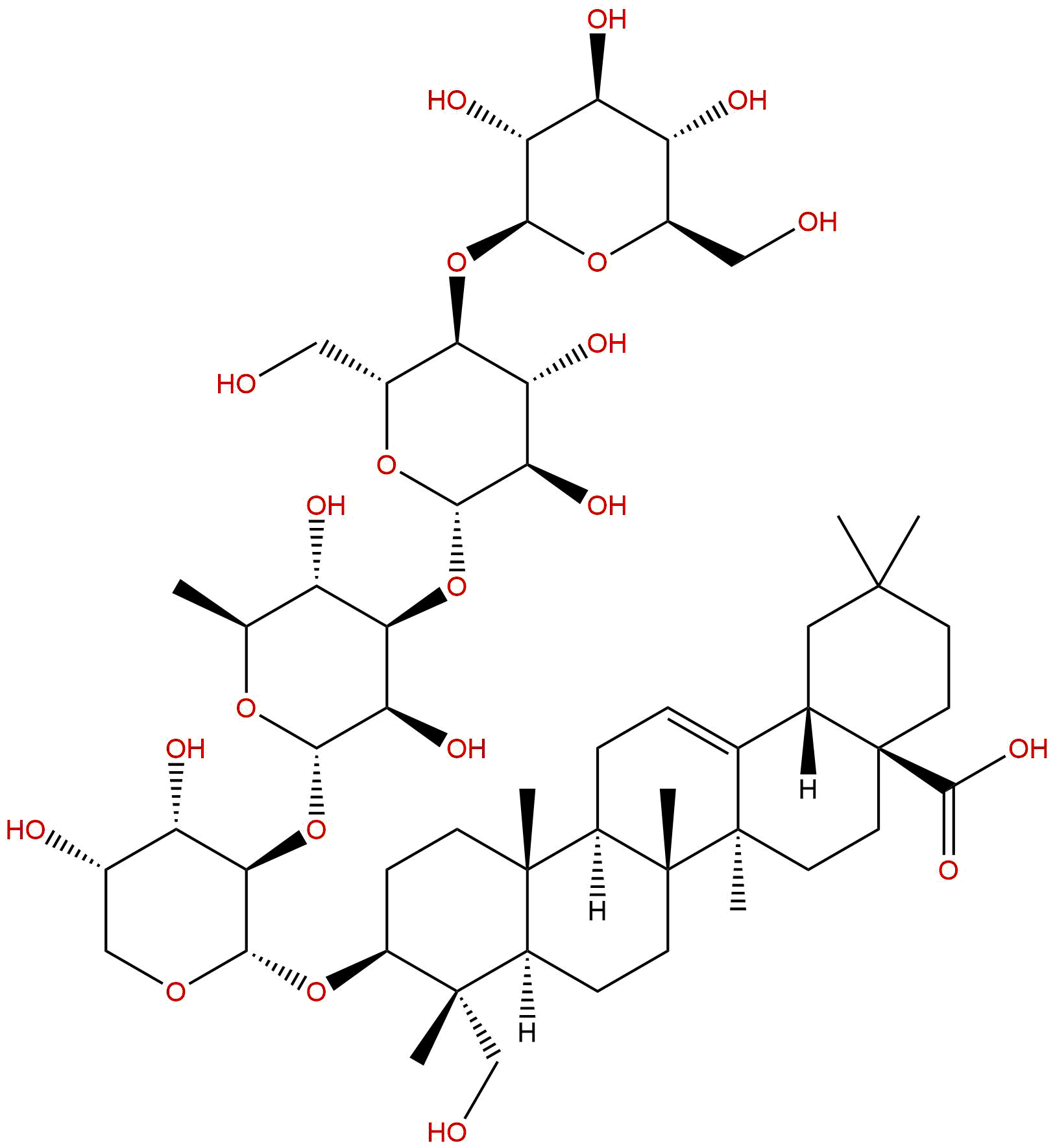


Product Name: Macranthoside B
Synonym name: Pulchinenoside E1
Catalogue No.: BP4018
Cas No.: 146100-02-9
Formula: C53H86O22
Mol Weight: 1,075.25
Botanical Source: Lonicera japonica and Lonicera macranthoides
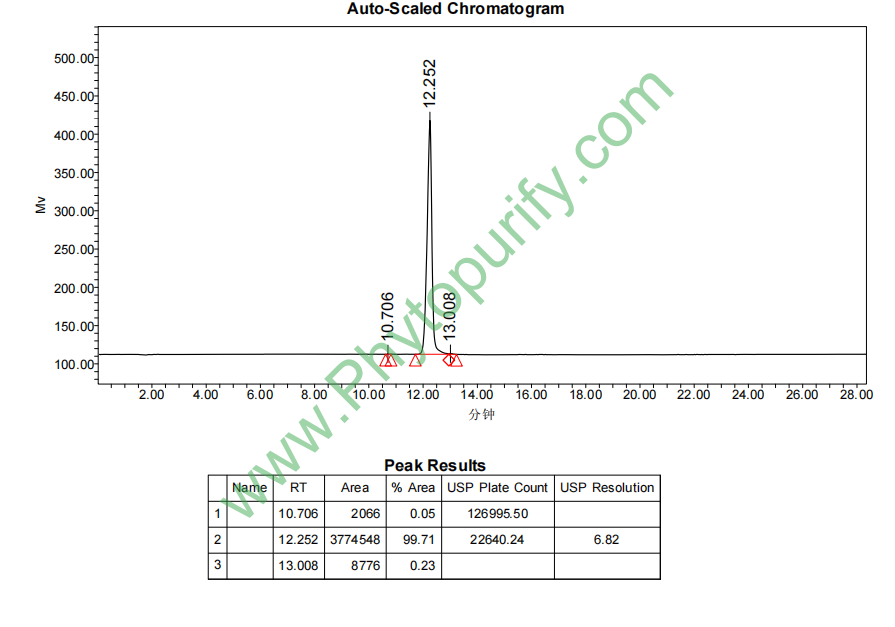
Purity: 95%~99%
Analysis Method: HPLC-DAD or/and HPLC-ELSD
Identification Method: Mass, NMR
Packing: Brown vial or HDPE plastic bottle
Can be supplied from milligrams to grams.
For Reference Standard and R&D, Not for Human Use Directly.
Inquire for bulk scale.
HPLC of Macranthoside B
Storage conditions:Short-term storage at 2~8℃, long-term storage at -20 ~ -80℃
353.9000
1.7573
-.0126
.3263
.5058
.1833
Low
76.5260
6.7797
No
No
No
No
No
No
0.0
Yes
No
No
No
Macranthoside B, CAS number 146100-02-9, is an important secondary metabolite isolated from the traditional Chinese medicinal herb Flos Lonicerae. As a natural product with significant biological activity, Lonicera japonica saponins have received widespread attention in the fields of pharmacology and natural product chemistry in recent years due to their unique chemical structure and diverse pharmacological effects. Especially in the fields of antibacterial and anti-inflammatory, this compound exhibits good activity and potential clinical application value.
Flos Lonicerae, as a commonly used heat clearing and detoxifying herb in traditional Chinese medicine, has always been used to treat various infectious and inflammatory diseases. Its active ingredients are complex, including various flavonoids, saponins, and organic acids. As one of the sub saponin components in Lonicera japonica Thunb., the secondary saponin of Lonicera japonica Thunb. has a high molecular weight and complex sugar structure, endowing it with unique pharmacological properties. This article aims to systematically review the chemical structure, sources, extraction process, pharmacological activity, and mechanism of action of Lonicera japonica saponins B, and explore its future clinical application prospects based on its pharmacological parameters.
Gray felt honeysuckle saponin B is a high molecular weight triterpenoid saponin compound with a molecular weight of 1075.2490. Its structural features include a polycyclic triterpenoid parent nucleus that connects multiple sugar residues to form complex glycosidic bonds. The LogP value of this compound is 1.7573, indicating that it has moderate hydrophobicity, which is beneficial for cell membrane penetration but not too hydrophobic to affect bioavailability. The TPSA (topological polar surface area) is 353.9 Å ², indicating good solubility in aqueous phase with a water solubility of 0.3263, making it a moderately water-soluble compound.
From a molecular structure perspective, the polysaccharide chain structure of Lonicera japonica saponins B endows it with strong hydrophilicity, while the hydrophobic part of the triterpenoid core facilitates binding to biofilms and protein targets. Its blood-brain barrier permeability is low, indicating that it mainly acts on peripheral targets and reduces the risk of central nervous system related side effects. The hERG channel inhibition experiment was negative, indicating that the compound has a low risk of cardiac toxicity. The Ames mutagenicity test result was 0.0, indicating no significant genetic toxicity and high safety.
The secondary saponin B of Lonicera macranthoeides Hand. Mazz. is mainly present in the Flos Lonicerae plant of the Lonicera genus, especially in the flower buds and flowers of Lonicera macranthoeides Hand. Mazz., where the content is relatively abundant. Flos Lonicerae is widely used in traditional Chinese medicine and has the effects of clearing heat, detoxifying, antibacterial and anti-inflammatory.
The process of extracting saponin B from Lonicera japonica var. mongolica usually includes the following steps:
Ingredient Preparation Collect fresh or dry honeysuckle flower buds and crush them into fine powder to increase surface area.
Solvent extraction Ethanol aqueous solution (usually 70% ethanol) is used for reflux or ultrasound assisted extraction. Ethanol aqueous solution can effectively dissolve saponin compounds while reducing the co extraction of polar impurities.
Crude extract concentration After filtration, the extract is concentrated under reduced pressure to an appropriate volume to obtain a concentrated crude saponin extract.
Separation and purification: Adopt multi-stage column chromatography technology, such as silica gel column, reverse phase C18 column and gel permeation chromatography, and combine with high performance liquid chromatography (HPLC) for purification to finally obtain high-purity Lonicera macranthoides saponin B.
Structural Identification Confirm its chemical structure through modern analytical techniques such as nuclear magnetic resonance (NMR), mass spectrometry (MS), and infrared spectroscopy (IR).
In recent years, with the advancement of extraction technology, green and environmentally friendly methods such as supercritical CO2 extraction and membrane separation technology have gradually been applied to the extraction of this compound, improving extraction efficiency and purity, and reducing environmental pollution.
The pharmacological activities of Lonicera japonica saponins B mainly focus on antibacterial and anti-inflammatory directions. It exhibits good biological activity in various models both in vitro and in vivo.
Multiple studies have shown that Lonicera japonica saponins B have inhibitory effects on various Gram positive and Gram negative bacteria. Its mechanism of action may involve disrupting the integrity of bacterial cell membranes, inhibiting bacterial protein synthesis, and interfering with bacterial metabolic pathways. Especially in the inhibition experiments against drug-resistant strains such as Staphylococcus aureus (MRSA) and Pseudomonas aeruginosa, it showed good activity, indicating its potential as a novel antibacterial agent.
Inflammatory response is the pathological basis of various diseases, and Lonicera japonica saponins B have shown significant anti-inflammatory effects through multi-target regulation of inflammatory signaling pathways. In vitro cell models and animal inflammation models have shown that this compound can significantly inhibit the expression of pro-inflammatory cytokines such as IL-6 and TNF - α, and alleviate pathological damage to inflammatory tissues.
In addition, Lonicera japonica saponins B have inhibitory effects on inflammatory mediator synthases such as PTGS1 (COX-1), PTGS2 (COX-2), and inducible nitric oxide synthase (NOS2), reducing the release of inflammatory mediators and alleviating inflammatory reactions. Its regulation of inflammation related signaling molecules STAT3 and NFKB1 further reveals the molecular basis of its anti-inflammatory effect.
Preliminary studies have also found that saponins from Lonicera japonica var. mongolica may have multiple biological activities such as analgesic, antioxidant, and immune regulation, but the relevant mechanisms and clinical significance still need further exploration.
The pharmacological effects of Lonicera japonica saponins B involve multiple signaling pathways and molecular targets, mainly including:
IL-6 (interleukin-6)As an important pro-inflammatory cytokine, IL-6 plays a crucial role in the inflammatory response. Gray felt honeysuckle saponin B reduces inflammation by inhibiting the expression and secretion of IL-6.
STAT3 (Signal Transduction and Transcription Activation Factor 3)STAT3 is a downstream key transcription factor in the IL-6 signaling pathway, regulating the expression of various inflammation related genes. This compound can inhibit the phosphorylation and activation of STAT3, and block inflammatory signaling.
CASP1 (caspase 1)CASP1 participates in the activation of inflammasomes, promoting the maturation and release of pro-inflammatory cytokines. The inhibitory effect of Lonicera japonica saponins on CASP1 can help block the inflammatory cascade reaction.
TRPV1 and TRPA1 (transient receptor potential channels)These two ion channels are involved in the transmission of inflammatory pain, and Lonicera japonica saponins B regulate their activity to exert analgesic and anti-inflammatory effects.
PTGS1 (COX-1) and PTGS2 (COX-2)These two cyclooxygenases catalyze the synthesis of prostaglandins and are key enzymes in inflammatory reactions. Gray felt honeysuckle saponin B inhibits it and reduces the production of inflammatory mediators.
TNF (tumor necrosis factor alpha)As an important pro-inflammatory factor, the inhibition of TNF helps alleviate inflammatory damage.
NOS2 (inducible nitric oxide synthase)NOS2 produces a large amount of NO to promote inflammatory response, while Lonicera japonica saponins inhibit NOS2 expression and reduce NO levels.
NFKB1 (nuclear factor kappa B)The NFKB signaling pathway is the core regulatory pathway of inflammatory response, and Lonicera japonica saponins B inhibit the activation of NFKB and block the transcription of pro-inflammatory genes.
In summary, the saponin B from Lonicera japonica var. mongolica exhibits excellent anti-inflammatory and antibacterial activity by synergistically regulating multiple stages of inflammatory response through multi-target and multi pathway mechanisms.
The pharmacological parameters of Lonicera japonica saponins B from Lonicera japonica indicate that it has certain potential for development. The molecular weight of 1075.2490 is relatively large, which may limit its oral absorption and bioavailability, but its LogP value of 1.7573 is moderate, which is conducive to cell membrane penetration. A high TPSA indicates strong polarity, which may affect membrane permeability and oral absorption.
The water solubility is 0.3263, which is at a moderate level and beneficial for the development and in vivo distribution of the formulation. The low permeability of the blood-brain barrier suggests that it mainly acts on peripheral targets, reducing the risk of central nervous system side effects. The hERG channel inhibition test was negative, reducing the potential risk of cardiac toxicity. The Ames mutagenicity test result is 0, indicating a low risk of genetic toxicity.
At present, there is limited pharmacokinetic research on the saponins of Lonicera japonica var. mongolica var. mongolica. Preliminary in vivo experiments have shown that the compound is absorbed slowly after oral administration, with a moderate plasma half-life. It is mainly metabolized through the liver, and the metabolites need further identification. In the future, it is necessary to strengthen its pharmacokinetic and toxicological research, optimize the dosing regimen and dosage form design.
Based on the antibacterial and anti-inflammatory activities of Lonicera macranthoides saponin B, it has broad application prospects in the treatment of a variety of inflammatory diseases and infectious diseases in the future. Especially in the fields of anti drug resistant bacterial infections, chronic inflammatory diseases (such as rheumatoid arthritis and inflammatory bowel disease), and pain management, Lonicera japonica saponins have shown unique advantages as natural drug candidate molecules.
In addition, by combining modern medicinal chemistry and formulation technology, its pharmacokinetic properties can be improved, bioavailability and targeting can be enhanced, and its clinical translation can be promoted through structural modification, nanocarrier encapsulation, and other means.
Future research directions should focus on:
Systematic pharmacokinetic and toxicological evaluation to ensure safety and efficacy.
Thoroughly analyze its molecular mechanism, especially its interaction with inflammatory signaling pathways.
Preclinical animal models and early clinical trials to validate its therapeutic efficacy and dosage range.
Exploring synergistic effects in combination with other anti-inflammatory or antibacterial drugs.
As a natural triterpenoid saponin derived from the traditional Chinese medicine Flos Lonicerae, Lonicera japonica saponins have shown great potential for drug development due to their unique chemical structure and multi-target anti-inflammatory and antibacterial activities. Its pharmacological parameters show good safety and moderate physicochemical properties, laying the foundation for subsequent drug design and clinical application.
Although the systematic pharmacology research on this compound is still in its infancy, its multiple mechanisms of action in anti-inflammatory and antibacterial fields provide valuable examples for natural product pharmacology research. In the future, through interdisciplinary cooperation and modern drug research and development technology, it is expected to promote the development of Lonicera japonica saponins into a new natural medicine, benefiting clinical treatment practice.
