Pharmacological research progress of ganoderma aldehyde A: from chemical structure to anticancer potential
Introduction/Overview
Natural products have always been an important source of innovative drug discovery, among which the medicinal fungus Ganoderma lucidum(Ganoderma lucidum)Due to its long medicinal history and extensive biological activity, it has attracted much attention. Ganoderma lucidum contains various active ingredients such as triterpenoids, polysaccharides, and sterols, which have shown great potential in regulating immunity, anti-tumor, and liver protection. Ganoderma A (CAS number: 104700-98-3) is a unique structure of an oxidized sterol compound isolated from Ganoderma lucidum. Early research found that it has the activity of inhibiting cholesterol synthesis, suggesting that it may be involved in regulating lipid metabolism. In recent years, with the deepening of research, the pharmacological activity of Ganoderma lucidum aldehyde A in anti-tumor, especially in the field of lung cancer prevention and treatment, has gradually become prominent. Its role involves regulating multiple key biological processes such as cell apoptosis, inflammation, oxidative stress, and metastasis, targeting multiple key signaling molecules including BCL2, STAT3, TLR4, and NFE2L2. The purpose of this article is to systematically review the chemical properties, plant sources, pharmacological activities, molecular mechanisms of action, and pharmacological properties of Ganoderma lucidum aldehyde A, and to explore its potential as a candidate drug for lung cancer. The aim is to provide comprehensive academic references for the in-depth research, development, and utilization of this compound.
Chemical structure and physicochemical properties
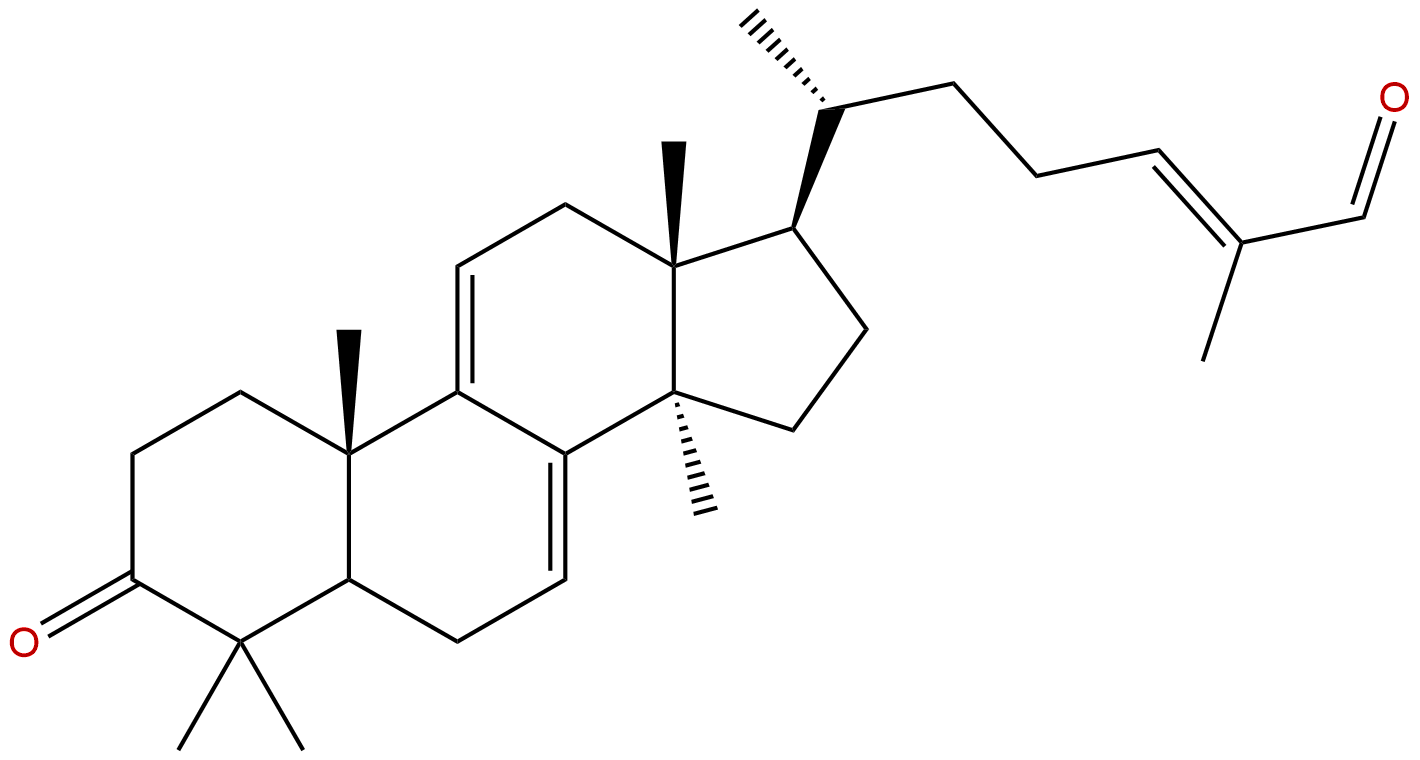
The chemical name of Lingzhi aldehyde A is (3 β, 5 α, 6 β, 22E) -3,6-dihydroxyergosterol-7,22-dien-15-one, with a molecular formula of C28H44O4 and a molecular weight of 436.6800. Its structure belongs to the class of oxidized ergosterol derivatives, with a steroid skeleton as its core. It has the following characteristics: A/B rings are trans fused (5 α - H), with one β - configured hydroxyl group at C-3 and C-6 positions, double bonds at C-7 and C-22 positions (22E configuration), and a ketone carbonyl group formed at C-15 position. These structural features, especially the ketone group at C-15 and the hydroxyl groups at C-3 and C-6, are crucial for their biological activity.
From the analysis of parameters related to medicinal properties, the lipid water partition coefficient (LogP) of Ganoderma lucidum aldehyde A is as high as 7.2488, indicating its strong lipophilicity. Its topological polar surface area (TPSA) is relatively low, at 34.14 Å ². The extremely high LogP value and extremely low TPSA together determine its poor water solubility (approximately 0.0004 mg/mL). This strong hydrophobicity makes it easy to penetrate cell membranes, but also poses significant challenges for its formulation development. In addition, computational predictions show that it has high blood-brain barrier permeability, which provides a potential for its use in the treatment of central nervous system related diseases (such as Alzheimer's disease associated with its target MAPT), but attention should also be paid to the risk of central side effects. It is gratifying that the preliminary toxicity prediction shows that the hERG inhibition risk is "no", and the Ames test result is 0.0 (indicating no mutagenicity), which provides preliminary positive signals for its safety evaluation.
Plant sources and extraction methods
Lingzhi aldehyde A is mainly derived from the porous fungal family Ganoderma lucidum(Ganoderma lucidum The fruiting body, mycelium, or spore powder of (Leyss. ex Fr.) Karst. The content of Ganoderma lucidum varies in different regions, varieties, and growth parts. Usually, organic solvents are used to extract total sterols or total triterpenoids/sterol fractions from dried Ganoderma lucidum materials, and then purified through a series of chromatographic separation techniques.
The conventional extraction process is as follows: first, the Ganoderma lucidum material is crushed and subjected to reflux or ultrasonic extraction with high concentration ethanol (such as 95% ethanol) or mixed organic solvents (such as chloroform methanol) to obtain the crude extract. After vacuum concentration, the crude extract was extracted and segmented using solvents such as petroleum ether and ethyl acetate. Lingzhi aldehyde A is mainly enriched in the moderately polar ethyl acetate fraction. Subsequently, the site was repeatedly separated and purified using methods such as normal phase silica gel column chromatography, reverse phase ODS column chromatography, high performance liquid chromatography (HPLC), and preparative thin layer chromatography (PTLC). Structural identification was carried out through techniques such as nuclear magnetic resonance (NMR), mass spectrometry (MS), and single crystal X-ray diffraction. In order to improve extraction efficiency and achieve standardization, modern technologies such as supercritical CO2 extraction and high-speed countercurrent chromatography have also been attempted to be applied in the separation and purification of such compounds.
Pharmacological activity research
The pharmacological activity research of Ganoderma lucidum aldehyde A has expanded from the initial metabolic regulation to multiple fields such as anti-tumor, anti-inflammatory, and neuroprotective effects, among which the anti lung cancer activity is the most prominent.
-
Antitumor activity Numerous in vitro studies have shown that Ganoderma lucidum aldehyde A has significant inhibitory effects on proliferation and induces apoptosis in various lung cancer cell lines, such as A549, NCI-H460, NCI-H292, etc. The intensity of its action is usually time-dependent and dose-dependent. In addition to directly killing cancer cells, research has also found that ganoderma aldehyde A can effectively inhibit the migration and invasion ability of lung cancer cells, indicating its potential for anti metastasis. In animal models, the administration of Ganoderma lucidum aldehyde A (usually by intraperitoneal injection or gavage, with the help of appropriate solubilizers) can inhibit the growth of transplanted tumors in nude mice, reduce the formation of lung metastases, and have little effect on mouse body weight, showing a certain therapeutic window.
-
Regulating cholesterol synthesis As the initial activity discovery, Ganoderma lucidum aldehyde A has been confirmed to be an effective inhibitor of squalene cyclooxygenase in the cholesterol biosynthesis pathway. By inhibiting this key enzyme, the production of lanosterol is blocked, thereby downregulating intracellular cholesterol levels. This activity is not only related to lowering blood lipids, but may also indirectly affect the signal transduction of various membrane receptors (such as TLR4) by altering the composition and function of tumor cell membrane lipid rafts, thereby exerting anti-tumor effects.
-
Anti inflammatory and antioxidant activity Lingzhi aldehyde A can inhibit the excessive production of nitric oxide (NO) and prostaglandin E2 (PGE2) in macrophages induced by stimuli such as lipopolysaccharide (LPS), downregulate the expression of inducible nitric oxide synthase (iNOS) and cyclooxygenase-2 (COX-2), and exhibit anti-inflammatory effects. At the same time, it can activate the cellular defense system, upregulate gene expression driven by antioxidant response elements (ARE), and protect cells from oxidative stress damage.
-
Potential neuroprotective activity Based on its high blood-brain barrier permeability and potential regulatory effect on microtubule associated protein tau (MAPT) (MAPT abnormal phosphorylation is associated with Alzheimer's disease), ganoderma aldehyde A has also attracted research interest in the field of neurodegenerative diseases, but the relevant experimental data is still insufficient and needs further exploration.
Mechanism of action and molecular targets
The anti lung cancer effect of Ganoderma lucidum aldehyde A involves synergistic regulation of multiple targets and pathways, and its core mechanism can be summarized as follows:
-
Inducing cell apoptosis This is one of the main mechanisms of its anti-tumor effect. Lingzhi aldehyde A can Downregulation of anti apoptotic protein BCL2 The expression of BCL2/BAX disrupts the balance of BCL2/BAX ratio, leading to a decrease in mitochondrial membrane potential, release of cytochrome C, and activation of Caspase cascade reaction, ultimately triggering cell apoptosis. At the same time, it can also inhibit STAT3 Phosphorylation and activation. STAT3 is an important oncogenic transcription factor that continuously activates to promote cell proliferation, survival, and inhibit apoptosis. Lingzhi aldehyde A inhibits the STAT3 signal, downregulates the expression of downstream target genes such as Cyclin D1 and Survivors, thereby suppressing the cell cycle and promoting apoptosis.
-
Inhibit cell invasion and metastasis Lingzhi aldehyde A can significantly enhance Downregulation of matrix metalloproteinase-2 (MMP2) Expression and activity. MMP2 is the main enzyme that degrades the extracellular matrix and plays a crucial role in tumor invasion and metastasis. By inhibiting MMP2, ganoderma aldehyde A effectively reduces the migration and invasion ability of lung cancer cells.
-
Regulating inflammation and immune microenvironment Lingzhi aldehyde A is Toll like receptor 4 (TLR4) Inhibitors of signaling pathways. TLR4 is highly expressed on tumor associated macrophages and certain cancer cells, and its activation promotes inflammatory pathways such as NF - κ B, creating a favorable microenvironment for tumor growth. Lingzhi aldehyde A may help improve the tumor immune suppressive microenvironment by interfering with TLR4 signaling and reducing the release of pro-inflammatory factors.
-
Activate cellular protective antioxidant pathways Lingzhi aldehyde A can activate Nuclear factor E2 related factor 2 (NFE2L2/Nrf2) The pathway. Nrf2 is the central regulator of cellular antioxidant stress response. Lingzhi aldehyde A may enhance cell resistance to oxidative and chemical damage by dissociating Nrf2 from Keap1 and translocating it to the nucleus, initiating the expression of a series of phase II detoxifying enzymes, including HO-1, and antioxidant genes. This may have positive implications in protecting normal cells from damage caused by chemotherapy drugs.
-
Affects lipid metabolism and transport Lingzhi aldehyde A ATP binding cassette transporter A1 (ABCA1) May have a regulatory effect. ABCA1 mediates cholesterol reverse transport and plays a central role in cellular cholesterol efflux. In addition, its inhibition of squalene cyclooxygenase directly affects cholesterol synthesis. These regulations on lipid metabolism may alter the membrane fluidity, signal transduction, and energy metabolism of tumor cells.
-
Potential interactions with other targets The targets suggested in the literature also include Estrogen receptor beta (ESR2)、Phosphatidylinositol-3-kinase catalytic subunit gamma (PIK3CG) Wait. The interaction with ESR2 may involve the regulation of hormone related tumors; The potential impact on PI3K γ may be associated with immune regulation and tumor inflammatory pathways. The specific mode of action of these targets with Ganoderma lucidum aldehyde A still needs experimental verification.
Evaluation of drug properties and pharmacokinetics
Although Lingzhi aldehyde A has significant in vitro biological activity, its medicinal properties face severe challenges, mainly due to its extremely poor performance Water solubility and extremely high lipophilicity(LogP >7)。 This can lead to poor oral absorption, low bioavailability, highly tissue selective distribution in the body (prone to accumulation in adipose tissue), and difficulty in formulating suitable dosage forms for administration.
At present, there is very limited publicly available data on the pharmacokinetics of Ganoderma lucidum aldehyde A system. Based on its physical and chemical properties, it can be inferred that:
- absorb After oral administration, absorption in the gastrointestinal tract may be slow and incomplete, and the first pass effect may be significant.
- distribution Due to its high lipid solubility and predicted high blood-brain barrier permeability, it may be widely distributed in lipid rich tissues, including the brain, fat, and liver, exhibiting a larger apparent distribution volume.
- Metabolism As a steroid derivative, it is likely to undergo extensive phase I (such as CYP450 enzyme catalyzed oxidation and reduction) and phase II (such as glucuronidation and sulfation) metabolism in the liver. The hydroxyl groups at positions C-3 and C-6 are potential binding reaction sites.
- excretion Metabolites may be mainly excreted through bile and feces.
In order to overcome its drug defects, modern pharmaceutical strategies are crucial:
1. Formulation technology Developing nano formulations is a highly promising direction. For example, preparing it into nanocrystal、liposome、polymeric micelle or Solid lipid nanoparticles It can significantly increase its solubility and dissolution rate, improve bioavailability, and potentially target tumor tissues through enhanced permeability and retention (EPR) effects.
2. Prodrug strategy Chemical modification of the hydroxyl groups at positions C-3 or C-6 to prepare more water-soluble prodrugs (such as phosphate esters and amino acid esters), which release the original drug through enzymatic interpretation in vivo.
3. route of administration In the local treatment or research phase, consider using inhalation administration (for lung cancer) or injection administration (with the use of safe solubilization systems).
Clinical application prospects and prospects
Lingzhi aldehyde A, as a natural sterol with multi-target effects, has shown unique application prospects in the prevention and treatment of lung cancer:
- As an adjuvant chemotherapy drug Its anti-inflammatory and antioxidant properties (through Nrf2) may help alleviate normal tissue damage caused by chemotherapy (such as pneumonia and liver injury), while its anti-tumor activity can have a synergistic effect with chemotherapy drugs.
- Lung cancer targeting specific molecular subtypes Lingzhi aldehyde A may have specific therapeutic potential for subtypes of lung cancer with sustained activation of STAT3 or overexpression of the TLR4/NF - κ B inflammatory pathway.
- Combined immunotherapy By regulating the tumor immune microenvironment (such as inhibiting TLR4 mediated pro-inflammatory responses), the efficacy of immune checkpoint inhibitors and other immunotherapies may be enhanced.
- Chemoprevention of lung cancer Given its natural origin, good initial toxicity prediction, and its ability to regulate metabolism and anti-inflammatory effects, it is worth exploring its chemoprevention in high-risk populations for lung cancer, such as smokers and chronic lung disease patients.
However, pushing it into clinical practice still faces many challenges: 1)Lack of in-depth preclinical research in the system, including comprehensive pharmacokinetic and toxicological (acute toxicity, chronic toxicity, reproductive toxicity, etc.) evaluations; 2)The mechanism of action network has not been fully elucidated yet The primary and secondary relationships between each target and their contribution to the overall efficacy need to be clearly defined; 3)Efficient, stable, and industrializable preparation process To be established to ensure the quality and supply of active pharmaceutical ingredients; 4) Ultimately, a reasonable design is required Clinical research protocol Verify its safety and effectiveness in the human body.
Future research should focus on: utilizing Nanotechnology or prodrug strategies Significantly improve its pharmaceutical properties; adopt Systems pharmacology and chemical biology methods(such as chemical proteomics) to comprehensively map its target of action; In Humanized tumor model or organoid model Verify its therapeutic effect; And actively explore its combination therapy strategy with other anti lung cancer drugs (targeted drugs, immune drugs).
Conclusion
Lingzhi aldehyde A is an oxidative sterol with important biological activity contained in Ganoderma lucidum. From the initial cholesterol synthesis inhibitors to the potential for multi-target regulation in the field of anti lung cancer, their research value is increasingly prominent. It plays a comprehensive role in inducing tumor cell apoptosis, inhibiting invasion and metastasis, and regulating the tumor microenvironment by regulating key targets such as BCL2, STAT3, TLR4, MMP2, and NFE2L2. Although its strong hydrophobicity poses significant challenges for new drug development, modern pharmaceutical and medicinal chemistry technologies provide the possibility to overcome these obstacles. By delving into the molecular network of Ganoderma lucidum aldehyde A and optimizing its in vivo fate through advanced delivery systems, it is expected to promote the natural molecule from the laboratory to clinical practice, providing a new multi-target treatment option for lung cancer patients and setting an example for exploring modern drugs from traditional medicinal fungi.