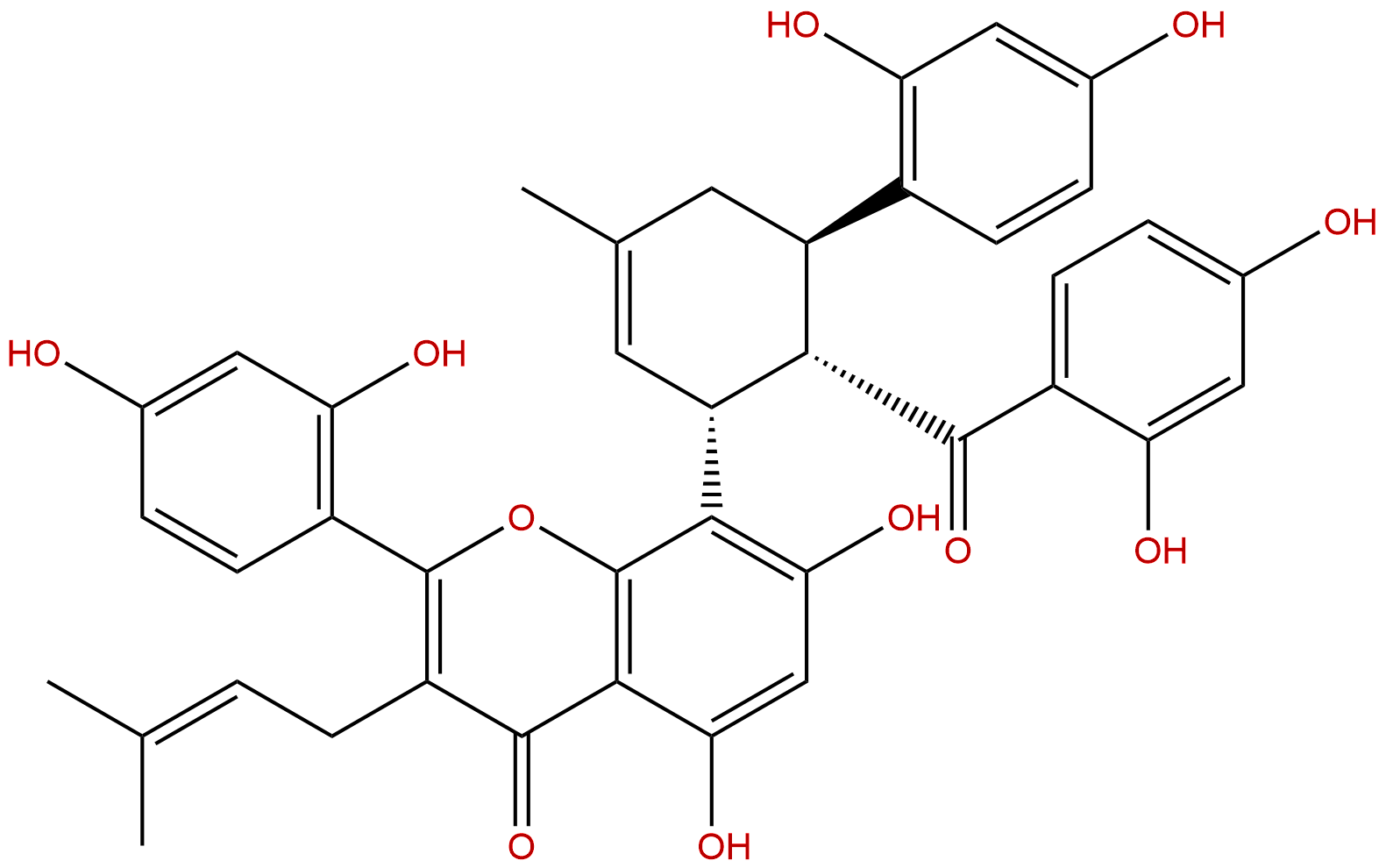


Product name: kuwanon G
Synonym name: Albanin F
Catalogue No.: BP3665
Cas No.: 75629-19-5
Formula: C40H36O11
Mol Weight: 692.717
Botanical Source:
Physical Description:
Type of Compound: Flavonoids
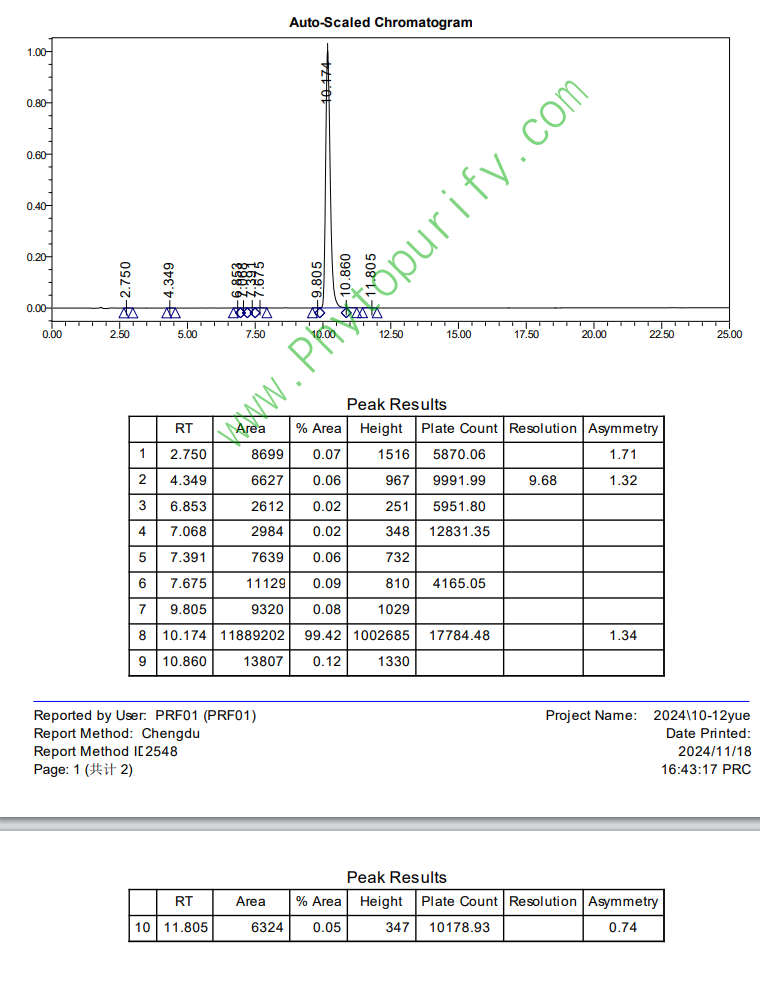
Purity: 95%~99%
Analysis Method: HPLC-DAD or/and HPLC-ELSD
Identification Method: Mass, NMR
Packing: Brown vial or HDPE plastic bottle
The product could be supplied from milligrams to grams. Inquire for bulk scale.
We provide solution to improve the water-solubility of compounds, thereby facilitating the variety of activity tests and clinic uses.
For Reference Standard and R&D, Not for Human Use Directly.
HPLC of kuwanon G
Storage conditions:Short-term storage at 2~8℃, long-term storage at -20 ~ -80℃
209.1200
4.9344
4.4705
.0169
3.4639
4.9093
Low
93.8502
4.6160
No
No
No
No
Yes
Yes
0.0
Yes
No
Yes
No
Kuwanon G, also known as mulberry bark ketone G, is a traditional medicinal plant derived from the mulberry tree(Morus alba L. Flavonoids isolated from the root bark. Its CAS number is 75629-19-5, molecular formula is C40H36O11, and molecular weight is approximately 692.72 g/mol. As a structurally unique tetrahydroxyflavone derivative, mulberry flavonoids G has received continuous attention in the field of natural product pharmacy research due to its extensive biological activity since its identification. Early research revealed that it has basic activities such as antibacterial, anti-inflammatory, and antioxidant properties. With the deepening of molecular pharmacology research, mulberry flavonoids G have shown more remarkable anti-tumor potential and have been proven to be an antagonist of the frog skin hormone receptor (a preferred receptor for gastrin releasing peptides). It can induce tumor cell apoptosis, inhibit proliferation and migration by regulating multiple key tumor related targets, including TP53, CASP3, MYC. In addition, the study also suggests that it has potential application value in anti atherosclerosis, neuroprotection and treatment of diabetes. This article will systematically summarize the scientific connotation of this star natural product from its chemical essence, source, pharmacological mechanism, medicinal properties, and prospects.
The chemical structure of mulberry flavonoids G is complex and belongs to diphenylpropane flavonoids (also known as chalcone dimers). Its SMILES string accurately describes its stereoconfiguration and substitution mode. The molecule contains multiple phenolic hydroxyl groups and benzene ring structures, which determine its basic physicochemical and biological properties.
From the analysis of pharmacological parameters:
- Molecular weight (MW):692.72 g/mol, Significantly exceeding the empirical upper limit of 500 Da for conventional small molecule drugs (one of Lipinski's five rules), this may pose challenges for their oral absorption and transmembrane transport.
- Lipid water partition coefficient (LogP/LogD)The calculated LogP is 4.93 and LogD is 4.47, indicating that the compound has high lipophilicity. High lipophilicity is beneficial for its penetration through cell membranes, but it may also lead to poor water solubility and accelerated metabolism.
- Water solubility The extremely low value (0.0169 mg/mL) confirms the solubility issue caused by high LogP, which is the primary obstacle that needs to be overcome in the development of its formulation.
- Polarized surface area (TPSA)Up to 209.12 Å ², far exceeding the threshold typically considered easy to penetrate cell membranes (below approximately 140 Å ²). High TPSA originates from numerous hydroxyl and carbonyl groups in the molecule, which may hinder its passive transmembrane diffusion (as predicted by low blood-brain barrier penetration), but is beneficial for forming hydrogen bonding interactions with target proteins.
- Membrane permeability The permeability data of Caco-2 cells (4.91 × 10 ⁻⁶ cm/s) and effective permeability coefficient (Peff: 3.46) suggest that it has moderate intestinal absorption potential, which may be attributed to its partial lipophilicity, but high molecular weight and high TPSA are limiting factors.
In summary, mulberry flavonoids G is a typical natural product that exceeds the rules, and its high activity often coexists with poor pharmacological parameters, which provides direction for subsequent structural optimization and formulation research.
Mulberry flavonoids G mainly come from mulberry plants in the mulberry family(Morus alba L. The root bark. Mulberry trees have a long history of cultivation and application in China and even East Asia. Their leaves feed silkworms, their fruits are edible, and their root bark (mulberry bark), branches, leaves, etc. can all be used as medicine.
In the traditional medical system, mulberry bark is an important traditional Chinese medicine, first recorded in the "Shennong Bencao Jing" and classified as a medium grade, with a sweet and cold nature, and belongs to the lung meridian. Its main efficacy is to clear the lungs and relieve asthma, promote diuresis and reduce swelling. It is commonly used to treat symptoms such as lung heat, cough and asthma, edema and fullness, and difficulty urinating. Modern plant chemistry research has confirmed that mulberry bark is rich in various flavonoids, alkaloids, and polysaccharides, among which mulberry flavonoids G are one of the flavonoids with significant biological activity. Although traditional applications do not directly target tumors, their historical records of treating "pathological accumulation" (a description of certain tumor diseases in ancient times) and inflammatory diseases coincide with the discovery of anti-tumor and anti-inflammatory activities of mulberry flavonoids G in modern research, reflecting the inheritance and verification relationship between traditional experience and modern science.
The pharmacological activity of mulberry flavonoids G is extensive, among which its anti-tumor effect is the most concerned. Its function is not through a single pathway, but presents the characteristics of multiple targets and pathways, which can be seen from the provided target information:
Regulation of tumor cell apoptosis:
Inhibition of tumor cell proliferation and survival:
Comprehensive mechanism model of action Mulberry flavonoids G may activate p53 through certain initial signals, such as inducing oxidative stress, antagonizing frog skin hormone receptors, etc. Activated p53 upregulates p21, leading to cell cycle arrest, and upregulates pro apoptotic factors such as BAX, while downregulating anti apoptotic factors, resulting in the initiation of mitochondrial pathway apoptosis. Ultimately, effector proteases such as Caspase-3 are activated, leading to programmed cell death. In addition, inhibition of MYC further weakens the proliferation drive of tumor cells. This synergistic attack on apoptosis, cycle, and proliferation forms the molecular basis for the potent anti-tumor activity of mulberry flavonoids G.
Other important pharmacological activities:
- Antibacterial activity It has a strong inhibitory effect on oral caries causing bacteria and periodontal pathogens, indicating its potential in the development of oral care products.
- Anti atherosclerosis It can intervene the development of atherosclerotic plaque by inhibiting the formation of macrophage foam and inflammatory reaction.
- Neuroprotection and anti diabetes potential Its acetylcholinesterase inhibitory activity is associated with the treatment of Alzheimer's disease; The double inhibitory activities of protein tyrosine phosphatase 1B (PTP1B) and α - glucosidase provide a new mechanism for its treatment of type 2 diabetes.
Based on the provided pharmacological parameters, we conducted a preliminary evaluation of the development potential of mulberry flavonoids G as a candidate drug:
Lipinski Five Rule Compliance This rule is an empirical rule for evaluating the pharmacological properties of oral medications. Mulberry flavonoids G (MW>500, LogP>5, hydrogen bond donor>5, hydrogen bond acceptor>10) clearly violate multiple of them (usually considered to comply with at least four of them). This suggests that its oral bioavailability may be low, and the development into traditional oral tablets or capsules faces challenges.
Absorption and distribution:
Metabolism and toxicity:
Overall evaluation Mulberry flavonoids G is a High activity but poor pharmacological parameters Natural lead compounds. Its powerful multi-target anti-tumor pharmacological effects are its biggest advantage. However, its high molecular weight, low solubility, high protein binding rate, and potential risks of chromosome damage and liver toxicity are obstacles that must be taken seriously on the road to drug development. The future research focus should be on: 1) Through Structural modification On the premise of retaining the core pharmacophore, improve its solubility, reduce molecular weight and LogP; 2) Develop advanced Drug delivery system Targeting nanomaterials to enhance their bioavailability and reduce systemic toxicity; 3) Carry out the system Preclinical pharmacokinetic and toxicological studies Clearly define its safety window.
At present, research on mulberry flavonoids G mainly focuses on Preclinical stage A large number of in vitro studies have confirmed its activity in anti-tumor, antibacterial, anti-inflammatory and other aspects, and preliminarily elucidated its molecular mechanism of action on key targets such as p53 and Caspase-3. A few in vivo animal experiments have also shown certain therapeutic effects. However, there is still a relative lack of research on the pharmacokinetic characteristics, in vivo metabolic pathways, long-term toxicity, and formulation studies of its system.
Application Prospects Mainly reflected in the following aspects:
1. Lead compounds of anti-tumor drugs As a multi-target anti-tumor lead, structural optimization of it is expected to develop new highly efficient and low toxicity chemotherapy or targeted drugs, especially suitable for tumor types that are resistant to existing drugs.
2. Oral disease treatment agents: Based on its strong anti oral pathogenic activity, it can be developed as a mouthwash, toothpaste or topical gel for the treatment of dental caries and periodontitis.
3. Functional food or health supplement additives Mulberry tree resources are abundant, and mulberry flavonoids G can be used in synergy with other active ingredients of mulberry trees to develop health products that can assist in regulating blood sugar, blood lipids, or have antioxidant and anti-inflammatory functions.
4. Chemical Biology Tool Molecules As a frog skin hormone receptor antagonist and inhibitor of enzymes such as PTP1B, it can be used to study the roles of related receptors and enzymes in physiological and pathological processes.
Future research directions:
- In depth mechanism research Using omics techniques (proteomics, metabolomics) to comprehensively reveal its functional network and signaling pathways.
- Study on Structure Activity Relationship (SAR)Systematically synthesize its derivatives or analogues and search for candidate molecules with better activity and drug properties.
- Innovation in Pharmaceutical Science Actively exploring new delivery systems such as nanoparticles, liposomes, and cyclodextrin inclusion complexes to solve their delivery challenges.
- Combination therapy research Exploring whether the combination of mulberry flavonoids G with existing clinical drugs has a synergistic effect and reversal of drug resistance.
In summary, mulberry flavonoids G is a valuable chemical template bestowed by nature, and its rich biological activity reveals the modern scientific value of mulberry trees as a traditional medicinal source. Despite the challenges of transforming it into clinical drugs, through continuous interdisciplinary research, the active molecules in this ancient plant are expected to contribute new strength to human health, especially in the field of tumor treatment, in the future.
