Mulberry root bark alcohol: a natural anti thrombotic and antioxidant new star derived from mulberry trees
1. Overview
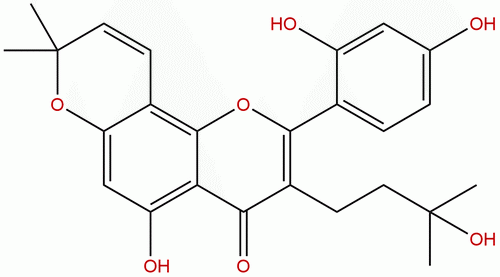
Morusinol is a traditional medicinal plant derived from the mulberry tree(Morus alba L. Natural flavonoid compounds isolated from the root bark. Its CAS number is 62949-93-3, molecular formula is C25H26O7, and molecular weight is 438.4760 g/mol. Since its discovery, mulberry bark alcohol has gradually become a hot topic in the field of natural product pharmacy research due to its unique chemical structure and significant biological activity. Existing research clearly indicates that mulberry bark alcohol has Significant anti platelet aggregation activity And it can effectively inhibit the formation of arterial thrombosis in animal models. This characteristic enables it to prevent and treat cardiovascular and cerebrovascular diseases, such as Transient ischemic attack (TIA) and stroke In terms of aspect, it demonstrates enormous potential application value. Its function is believed to be achieved by regulating the platelet activation pathway. In addition, the latest target studies have revealed that mulberry bark alcohol can also act on multiple key proteins related to oxidative stress, such as NFE2L2, SOD1, etc., suggesting that it has both Powerful antioxidant properties Potential This article will provide a systematic professional popularization of this promising natural active molecule from the aspects of its chemical nature, origin, pharmacological mechanism, drug properties, and prospects.
2. Chemical structure and physicochemical properties
The molecular structure of mulberry bark alcohol is relatively complex and belongs to the isopentenyl flavonoid compounds in the flavonoid family. The SMILES string (CC (C) (O) CCc1c (- c2cc (O) cc2O) oc2c3c (cc (O) c2c1=O) OC (C) (C) C=C3) depicts a Benzopyranone core skeleton The structure of multiple phenolic hydroxyl groups and isopentenyl side chains. This structure is the material basis of its biological activity: phenolic hydroxyl is a potent antioxidant group, and the introduction of isopentenyl significantly enhances its lipid solubility and ability to interact with biofilms, which may be closely related to its antiplatelet and other activities.
Analyzing its physicochemical properties from the parameters of drug properties:
- Molecular weight (MW):438.4760 g/mol, Slightly higher than conventional small molecule drugs (usually<500 Da), but still within an acceptable range.
- Lipid water partition coefficient (LogP/LogD): 4.1415 and 4.0327 respectively, indicating that the compound Strong lipid solubility This is beneficial for its penetration through the cell membrane, but excessively high LogP values may also lead to poor water solubility, affecting its oral absorption and in vivo distribution.
- Water solubility Only 0.0287 mg/mL, it belongs to insoluble compounds, which is consistent with its high LogP value and is a key issue that needs to be addressed in its formulation development.
- Topological Polarity Surface Area (TPSA)120.360 Å ², which reflects the surface area of polar atoms (such as O, N) in the molecule. Generally, compounds with TPSA>140 Å ² have poor transmembrane permeability. The TPSA value of mulberry bark alcohol is moderate, indicating its potential for membrane permeation.
- Caco-2 permeability: 4.6202 × 10 ⁻⁶ cm/s, which indicates that it has Moderate to good intestinal epithelial cell permeability It indicates that it may have good oral absorption potential.
Overall, mulberry bark alcohol is a medium-sized, strongly lipophilic, and low water soluble flavonoid molecule, and its structural characteristics determine its specific biological activity and pharmacokinetic properties.
3. Plant sources and traditional applications
The plant source of mulberry root bark alcohol is single and clear, that is Mulberry trees in the Moraceae family, belonging to the genus Morus(Morus alba L. The root bark of)Mulberry trees have a long history of cultivation and application in China and even East Asia. Their leaves feed silkworms, their fruits are edible, and their root bark (mulberry bark) is an important traditional Chinese medicinal herb.
In traditional Chinese medicine theory, mulberry bark has a sweet and cold nature, belongs to the lung meridian, and has Purging the lungs, relieving asthma, promoting diuresis, and reducing swelling The efficacy. Commonly used for treating symptoms such as pulmonary fever, cough and asthma, edema and fullness, and difficulty urinating. Throughout history, there have been records in classic Chinese herbal books such as the "Shennong Bencao Jing" and the "Compendium of Materia Medica". Modern pharmacological research has confirmed that the extract of mulberry bark has various activities such as cough suppressant, expectorant, diuretic, antihypertensive, anti-inflammatory, and hypoglycemic effects. As one of the active ingredients isolated from mulberry bark, the discovery of mulberry root bark alcohol's anti thrombotic and antioxidant activities provides a modern scientific molecular interpretation of the traditional efficacy of mulberry bark in promoting blood circulation and water retention. The research pathway from mulberry bark to mulberry root bark alcohol is From traditional empirical medicine to modern precision drug development The typical example reflects the value of deeply exploring the treasure trove of traditional Chinese medicine.
4. Pharmacological activity and mechanism of action
The pharmacological activity of mulberry root bark alcohol mainly revolves around two core aspects:Antiplatelet/Antithrombotic and antioxidant There is a close physiological and pathological relationship between the two, as oxidative stress is an important trigger for endothelial damage, platelet activation, and thrombosis.
(1) Antiplatelet and Antithrombotic Activities
The existing description clearly states that sangentriol has antiplatelet activity and significantly inhibits arterial thrombosis formation in vivo. Arterial thrombosis is the main pathological basis of acute cardiovascular and cerebrovascular events such as myocardial infarction and ischemic stroke, and its formation begins with the activation, adhesion, and aggregation of platelets. Sangenpitol may intervene in signal transduction pathways within platelets, such as inhibiting the production of thromboxane A2 (TXA2), blocking ADP or collagen receptor pathways, and increasing the level of cyclic adenosine monophosphate (cAMP) in platelets, thereby Inhibit excessive activation of platelets This regulatory effect on platelet function makes it promising for preventing transient ischemic attacks (TIA) or stroke by maintaining blood flow and preventing pathological thrombosis from blocking cerebral blood vessels.
(2) Antioxidant activity and its molecular target mechanism
The antioxidant activity of mulberry bark alcohol is directly related to the multiple phenolic hydroxyl groups on its flavonoid parent nucleus, which can effectively scavenge free radicals and chelate metal ions. The deeper mechanism of action is reflected in its regulation of the endogenous antioxidant defense system in cells. The target information provided by the database reveals potential key nodes of its function:
- NFE2L2 (Nuclear Factor E2 Related Factor 2)This is a regulation of cellular antioxidant stress response Core transcription factors Under oxidative stress, NFE2L2 is activated and translocated into the nucleus, binding to antioxidant response elements (ARE) and initiating gene transcription of downstream antioxidant enzymes and phase II detoxifying enzymes. Mulberry bark alcohol is likely to act as an activator of Nrf2, upregulating this defense pathway.
- SOD1 (superoxide dismutase 1), CAT (catalase), GPX1 (glutathione peroxidase 1)These three are the most important within the cell Antioxidant enzyme system SOD1 converts superoxide anions (O ₂•⁻) into hydrogen peroxide (H ₂ O ₂), while CAT and GPX1 are responsible for further decomposing H ₂ O ₂ into harmless water. Mulberry bark alcohol can promote the synthesis of these enzymes by activating Nrf2, thereby systematically enhancing the ability of cells to clear reactive oxygen species (ROS).
- HMOX1 (Heme Oxygenase 1)This is also a key stress protein regulated by Nrf2, which can catalyze the breakdown of hemoglobin and produce products with anti-inflammatory, antioxidant, and cell protective effects (such as carbon monoxide, biliverdin/bilirubin).
Therefore, the antioxidant mechanism of mulberry bark alcohol is not simply a "one-to-one" clearance of free radicals, but rather through Targeted activation of Nrf2 signaling axis Like a 'master switch', it coordinates and enhances the overall antioxidant defense network of cells. This multi-target, systematic regulatory approach has advantages over a single antioxidant and can more effectively combat persistent oxidative damage in chronic diseases.
5. Evaluation of drug properties
Based on the provided pharmacological parameters, we can conduct a preliminary evaluation of the potential for developing mulberry root bark alcohol into an oral medication, combined with the well-known Lipinski's Five Rules Conduct analysis:
The Lipinski Rule of Five is commonly used to predict the likelihood of oral absorption of compounds:
1. Molecular weight<500 Da: Mulberry bark alcohol MW is 438.5,Comply with。
2. LogP<5: Its LogP is 4.14,Comply with。
3. Hydrogen bond donor (HBD) numbers<5: Depending on the structure, there are approximately 4-5 phenolic and alcohol hydroxyl groups,Critical or slightly exceeded。
4. The number of hydrogen bond acceptors (HBA) is less than 10: there are 7 oxygen atoms in the molecule,Comply with。
5. Number of rotatable keys: not directly provided, but there is a certain number in the structure, which is usually not the main limitation.
Mulberry root bark alcohol basically conforms to or only slightly deviates from Lipinski's rule, indicating its potential to become Oral active drugs The chemical foundation.
Specific parameter analysis:
- Absorption and distribution Good Caco-2 permeability (4.62) and moderate Peff value (2.79) support its intestinal absorption potential. However,The extremely low water solubility (0.0287 mg/mL) is the main limiting factor for oral bioavailability It may require improvement through formulation techniques such as making nanocrystals, solid dispersions, cyclodextrin inclusion complexes, etc. Its plasma protein binding rate (PPB) is as high as 89.36%, indicating that most of it binds to proteins in the blood, which may affect its free drug concentration and tissue distribution.
- Blood-brain barrier (BBB) penetrability Annotated as' low '. This may pose a challenge for its central direct protective effect in preventing stroke, but its antiplatelet effect mainly occurs in the bloodstream and can still indirectly exert neuroprotective benefits by improving systemic oxidative stress and vascular function.
- Toxicity risk:
- Genotoxicity The Ames test result is 0.6 (usually<1.5 is considered negative), but Chromosome aberration test shows positive This is something that requires high vigilance Potential genotoxic signals It is a "red line" issue in drug development that must be validated and evaluated for risks through deeper mechanism research and subsequent trials.
- Organ toxicity The data shows sensitization to the respiratory system (Resp_Sens: Yes) and phototoxicity (Photo_tox: Yes). Elevated serum biochemical indicators (ALK, GGT, AST, ALT) indicate Potential liver toxicity Risk, which is consistent with the phenomenon that many flavonoid compounds may experience when used in high doses or long-term.
- Cardiac safety HERG inhibition as' no 'is a positive signal indicating a lower risk of causing QT interval prolongation in the heart.
Conclusion Mulberry bark alcohol has certain medicinal properties in chemical space, but its Low solubility, potential genetic toxicity, and liver toxicity risks It is a major challenge that must be faced and addressed in pushing it towards preclinical and clinical research. In the early stages of drug discovery, these data suggest the need for systematic structural optimization (such as preparing water-soluble prodrugs, modifying toxic groups) and comprehensive safety evaluation.
6. Research Status and Application Prospects
At present, research on mulberry root bark alcohol is still in progress Preclinical stage Mainly focused on activity discovery, preliminary mechanism exploration, and compound separation and purification. The mechanism of its antithrombotic and antioxidant effects through the Nrf2 pathway has been preliminarily elucidated, demonstrating its unique value in the prevention of cardiovascular and cerebrovascular diseases.
The future research and application prospects may focus on the following directions:
1. In depth study on the mechanism of action Further clarify the specific molecular targets of its antiplatelet activity (which receptor or enzyme is it?), and whether its activation of the Nrf2 pathway directly binds to Keap1 protein or through other indirect means. Meanwhile, it is necessary to investigate the intrinsic relationship between its antioxidant and antithrombotic activities.
2. Structural optimization and derivative development In response to its poor water solubility and potential toxicity issues, medicinal chemists can use it as the parent nucleus to conduct experiments Structural modification For example, introducing hydrophilic groups to improve solubility, or changing the side chain structure to eliminate genetic toxicity risks while retaining or enhancing its core pharmacological activity, in order to obtain candidate drug molecules with better properties.
3. Pharmaceutical research Develop new drug delivery systems suitable for mulberry bark alcohol, such as liposomes, polymer micelles, etc., to improve its bioavailability and potentially achieve targeted delivery.
4. Expand indication research Based on its powerful antioxidant and Nrf2 activation properties, its potential applications may not be limited to cardiovascular and cerebrovascular diseases. Oxidative stress is closely related to neurodegenerative diseases (such as Alzheimer's disease), metabolic diseases (such as diabetes and its complications), inflammatory diseases and other chronic diseases. The role of mulberry bark alcohol in these fields is worth exploring.
5. As a dietary supplement or functional food ingredient Under the premise of ensuring safety, mulberry root bark extract with high content of mulberry root bark alcohol may be developed as a health product to assist in regulating blood pressure, blood lipids, and preventing blood clots.
In summary, as a natural active molecule derived from traditional Chinese medicine, mulberry bark alcohol provides us with a valuable lead compound for combating cardiovascular and cerebrovascular diseases as well as oxidative stress-related diseases. Despite the challenges ahead, especially in terms of safety considerations, its unique dual function (anti thrombotic+antioxidant) properties and clear target pathways continue to attract the attention of researchers. With the continuous advancement of modern pharmaceutical technology, mulberry bark alcohol and its derivatives are expected to bring new contributions to human health in the future.