Introduction/Overview
Cardiovascular disease and malignant tumors are the main factors leading to death and disease burden worldwide. In the process of exploring new therapeutic strategies, natural products have always been an important treasure trove for drug discovery due to their structural diversity and rich biological activity. Sanggenon C, an isopentenyl flavonoid compound isolated from mulberry plants, has attracted high attention from pharmacological researchers in recent years due to its extensive and significant pharmacological activities, especially in the fields of cardiovascular protection and anti-tumor effects. Early research revealed its antioxidant and anti-inflammatory properties, and with the advancement of molecular biology techniques, its targets and signaling pathway network have gradually become clearer. Research has shown that Sangenone C has the potential to combat cardiac hypertrophy, fibrosis, and inhibit the proliferation of various tumor cells in cellular and animal models by intervening in multiple key signaling pathways such as calcineurin/NFAT, ERK/MAPK, and NF - κ B. This article aims to systematically review the chemical properties, plant sources, pharmacological activities, molecular mechanisms of action, pharmacological characteristics, and clinical application prospects of Sangenone C, in order to provide comprehensive academic references for the deep development and transformation research of this natural product.
Chemical structure and physicochemical properties
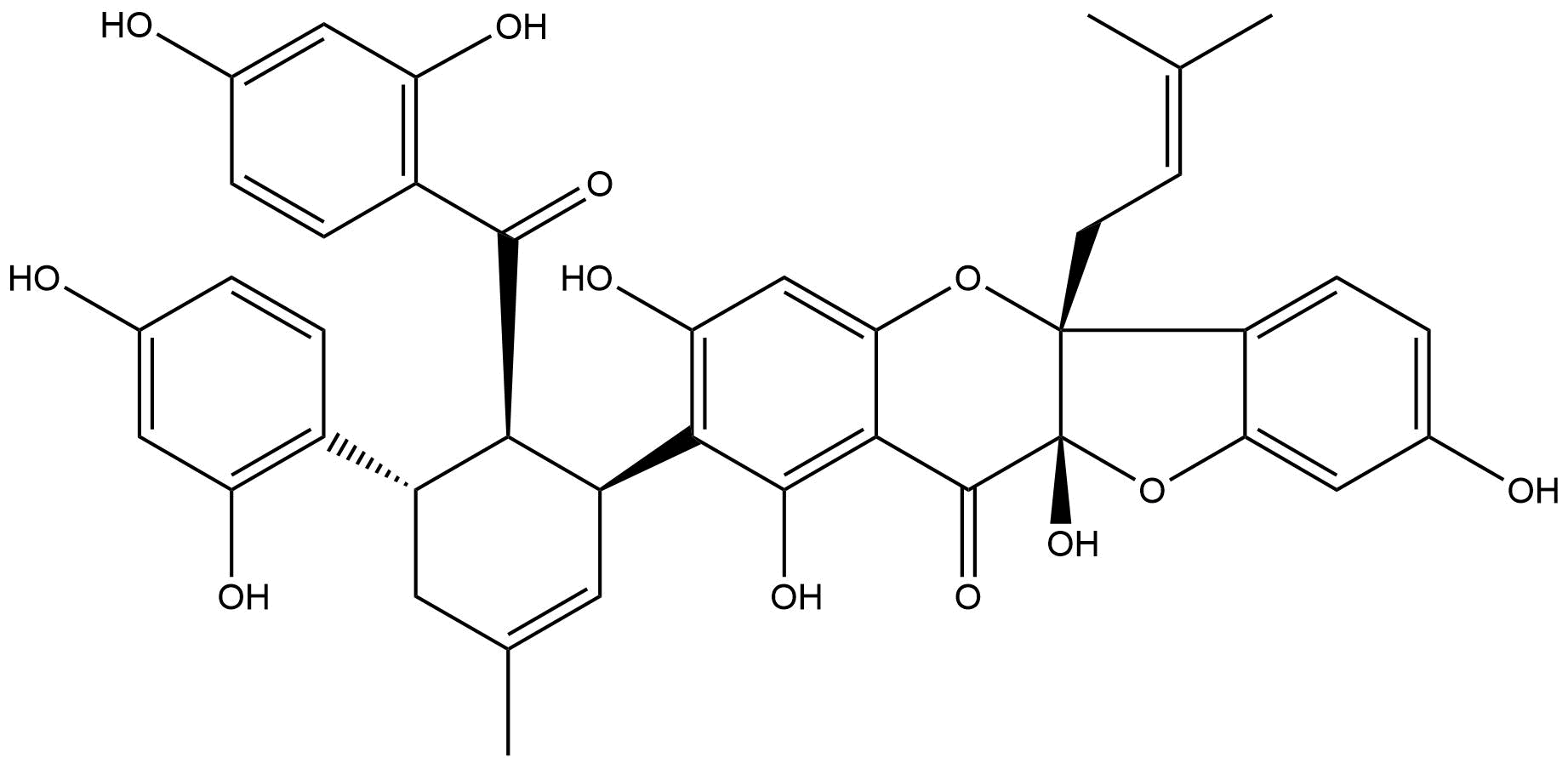
The chemical name of Sangenone C is (2R, 3R) -3,5,7-trihydroxy-2- (4-hydroxyphenyl) -8,8-dimethyl-10- (3-methylbut-2-en-1-yl) -2,3,9,10-tetrahydropyrano [2,3-f] chromene-4-one, with a CAS number of 80651-76-9. Structurally, Sangenone C belongs to the class of flavonoids substituted with isopentenyl groups, with a molecular formula of C ₄₀ H ₄₄ O ₁₂ and a molecular weight of 708.7160. Its core structure is the flavonoid nucleus, which is connected to an isopentenyl side chain at specific positions (such as C-8). This structural feature is often closely related to its enhanced lipid solubility and unique biological activity.
The analysis of its physicochemical properties shows that the lipid water partition coefficient (LogP) of Sangenone C is 4.5747, indicating that the compound has high lipophilicity. The topological polar surface area (TPSA) is 214.4400 Å ², reflecting the presence of multiple polar groups (such as hydroxyl groups) in the molecule. The water solubility is relatively low, about 0.0282 mg/mL, which is consistent with its high LogP value, indicating that it may need to be improved in formulation development through techniques such as salt formation, cyclodextrin inclusion, or nanomaterialization. The preliminary drug risk assessment showed that its ability to cross the blood-brain barrier was low, and there was no significant inhibition of hERG potassium channels (indicating a low potential risk of arrhythmia). The Ames test result was negative (0.0), indicating no mutagenicity under the experimental conditions, laying the foundation for further safety evaluation.
Plant sources and extraction methods
Mulberry root ketone C mainly comes from Morus plants in the Moraceae family, especially from the root bark, branches, and white bark of Morus alba L. In addition, it also exists in other plants of the same genus, such as Morus mongolica. In plants, mulberry root ketone C is a secondary metabolite and an important component of the plant defense system.
Its extraction and separation usually use organic solvent extraction combined with modern chromatographic techniques. The classic process is as follows: first, the dried mulberry bark or branches are crushed, and then subjected to reflux extraction or ultrasound assisted extraction using polar organic solvents such as methanol, ethanol, or acetone. The crude extract was obtained by vacuum concentration of the extraction solution. Subsequently, gradient extraction was performed using solvents such as petroleum ether, ethyl acetate, and n-butanol, and Sangenone C was enriched in the ethyl acetate fraction. Further purification relies on column chromatography technology, often using silica gel column chromatography with gradient elution using chloroform methanol or petroleum ether ethyl acetate systems in different ratios. High performance liquid chromatography (HPLC), especially preparative HPLC, is a key step in obtaining high-purity Sangenone C monomer, typically using a reverse phase C18 column with methanol water or acetonitrile water as the mobile phase. In recent years, liquid-liquid distribution chromatography techniques such as high-speed counter current chromatography (HSCCC) have also been applied to the efficient preparation and separation of Sangenone C due to their high recovery rate and avoidance of irreversible adsorption.
Pharmacological activity research
A large number of in vitro and in vivo studies have confirmed that Sangenone C has various pharmacological activities, mainly covering cardiovascular protection, anti-inflammatory, antioxidant, and anti-tumor fields.
- Cardiovascular protective effect In a mouse model of cardiac hypertrophy induced by stress load, Sangenone C can significantly reduce the heart weight/body weight ratio, improve heart function, and inhibit myocardial fibrosis. Its core mechanism is related to the inhibition of pathological myocardial cell hypertrophy and fibroblast activation.
- Anti inflammatory and antioxidant effects Sangenone C can effectively inhibit the expression of inducible nitric oxide synthase (iNOS) and excessive production of nitric oxide (NO) in macrophages RAW264.7 stimulated by lipopolysaccharide (LPS). At the same time, it can clear free radicals, alleviate oxidative stress damage, and inhibit the expression of vascular cell adhesion molecule-1 (VCAM-1) induced by tumor necrosis factor - α (TNF - α), which may interfere with the early inflammatory process of atherosclerosis.
- antitumor activity The research on the anti-tumor activity of Sangenone C is particularly in-depth, especially in the field of liver cancer. Research has shown that it can significantly inhibit the proliferation, migration, and invasion of various liver cancer cell lines (such as HepG2, Huh7, SMMC-7721), and induce cell apoptosis and cell cycle arrest. In addition, it also showed growth inhibitory activity on breast cancer, colon cancer, lung cancer and other cell lines.
Mechanism of action and molecular targets
The multiple pharmacological effects of Sangenone C stem from its diverse regulation of the complex intracellular signaling network. The mechanism of action and molecular targets can be summarized as follows:
-
Mechanism of inhibiting cardiac hypertrophy and fibrosis The core function of Sangenone C is to inhibit Calcinurin/NFAT (activated T cell nuclear factor) signaling pathway Calcium regulated phosphatase is abnormally activated in pathological cardiac remodeling, dephosphorylating NFAT to enter the nucleus and initiating transcription of genes related to hypertrophy and fibrosis. Sangenone C exerts cardioprotective effects by inhibiting this pathway, particularly downregulating the activity of NFAT2.
-
Mechanisms of inducing tumor cell apoptosis and inhibiting growth In the field of anti-tumor, especially anti liver cancer, the mechanism of action of Sangenone C involves multiple pathways:
- Mitochondrial apoptosis pathway Sangenone C can downregulate anti apoptotic proteins BCL2 The expression of BCL2 may also affect other BCL2 family proteins, leading to loss of mitochondrial membrane potential, release of cytochrome C, and ultimately activation of caspase cascade reaction, inducing cell apoptosis.
- MAPK/ERK signaling pathway Sangenone C can block ERK(MAPK1) Phosphorylation and activation. ERK signaling typically promotes cell survival and proliferation, and its inhibition can lead to pro apoptotic effects. Research has also shown that it inhibits excessive mitochondrial fission and maintains mitochondrial homeostasis by suppressing ERK signaling, thereby promoting apoptosis.
- STAT3 signaling pathway:STAT3 It is an important oncogenic transcription factor that is continuously activated in liver cancer. Sangenone C can inhibit the phosphorylation (Tyr705 site) and nuclear translocation of STAT3, thereby downregulating the expression of its target genes (such as Cyclin D1, Bcl xL, MMP9), inhibiting cell proliferation, survival, and invasion.
- PI3K/Akt pathway By inhibiting PIK3CA The activity of PI3K catalytic subunit or its downstream signals can be inhibited by Sangenone C, which can inhibit the activation of Akt and thus suppress the growth and metabolism of tumor cells.
- NF - κ B pathway As a classic pathway for inflammation and survival, NF - κ B is often constitutively activated in tumors. Sangenone C can inhibit the degradation of I κ B α and nuclear translocation of NF - κ B p65 subunit, reduce its transcriptional activity, and thereby decrease the expression of inflammatory factors (such as TNF - α, IL-6) and pro survival genes.
- Other related targets Sangenone C can also inhibit Cyclooxygenase-2 (PTGS2/COX-2) Reduce the expression of prostaglandin pro-inflammatory mediators and decrease their production; Inhibition of matrix metalloproteinases MMP9 The activity weakens the invasion and metastasis ability of tumor cells; and Epidermal growth factor receptor (EGFR)、Telomerase reverse transcriptase (TERT) Waiting also has a certain regulatory effect. It pairs Topoisomerase I (TOP1) The potential inhibitory activity also suggests the possibility of interfering with DNA replication.
-
Anti inflammatory mechanism Its anti-inflammatory effect is mainly related to inhibition NF-κB and MAPK Signal pathway related, thereby downregulating the gene expression of inflammatory mediators such as iNOS, COX-2, VCAM-1, etc.
Evaluation of drug properties and pharmacokinetics
Despite the significant pharmacological activity of Sangenone C, its pharmacological development still faces challenges, and related research is still in its early stages.
- Absorption, distribution, metabolism, excretion (ADME)Due to its low solubility and high LogP value, the oral bioavailability of Sangenone C may be limited. Limited pharmacokinetic studies suggest that it may undergo extensive metabolism in animal bodies, including phase I metabolism (such as oxidation and reduction) and phase II binding reactions (such as glucuronidation and sulfation). The presence of isopentenyl groups may make it susceptible to metabolism such as epoxidation. Detailed parameters such as its internal distribution, plasma protein binding rate, half-life, and main excretion pathways (bile or urine) need to be elucidated through more systematic research.
- Formulation strategy To improve its bioavailability, exploratory formulation technologies include nanocrystals, liposomes, solid dispersions, self microemulsion delivery systems, etc. These techniques can effectively increase its solubility and dissolution rate, promoting intestinal absorption.
- Preliminary evaluation of safety Based on existing data, the absence of hERG inhibition and mutagenicity (Ames test negative) of Sangenone C is a positive early safety signal. However, comprehensive preclinical safety evaluations, including acute toxicity, chronic toxicity, reproductive toxicity, etc., have not been systematically reported yet, which is a necessary step for its conversion into drugs.
Clinical application prospects and prospects
Sangenone C, as a multi-target and multifunctional natural lead compound, has shown broad development prospects, but there are also clear challenges.
-
Potential application directions:
- cardiovascular disease Develop candidate drugs or health products for the prevention or treatment of stress-induced heart disease, myocardial fibrosis, and even heart failure.
- Antitumor therapy Especially in adjuvant therapy or combination therapy for liver cancer, it has potential. Combination therapy with existing chemotherapy drugs (such as sorafenib) can be considered to enhance efficacy, reduce resistance, or alleviate side effects. Its inhibition of pathways such as STAT3 and NF - κ B is also applicable to other inflammation related tumors.
- Chronic inflammatory diseases As an anti-inflammatory agent, it may be used to treat chronic inflammatory diseases such as atherosclerosis and arthritis.
-
Challenges faced and future research directions:
- Optimization of drug properties The primary task is to solve the problem of low water solubility and oral bioavailability, which requires optimization through systematic drug chemical modification (such as synthesizing water-soluble prodrugs) or advanced pharmaceutical methods.
- Systematic pharmacokinetics and toxicology research Pre clinical ADME and comprehensive toxicology studies that comply with Good Laboratory Practice (GLP) standards must be conducted to clarify their safety window.
- Deep exploration of the mechanism of action Using techniques such as chemical proteomics (such as drug affinity target stability technology), systematically discover its direct target and draw a more accurate "compound target pathway phenotype" network diagram.
- Collaborative effect research Explore the combination therapy of Sangenone C with existing clinical drugs, evaluate its synergistic effect, and provide theoretical basis for clinical combination therapy.
- Clinical translational research After completing sufficient preclinical research, gradually advance clinical trials to verify its safety, efficacy, and pharmacokinetic characteristics in humans.
Conclusion
Sangenone C is a brilliant gem hidden in the mulberry genus plants. It exhibits remarkable multi-target pharmacological activity in cardiovascular protection and anti-tumor fields by regulating key signaling nodes such as calcineurin/NFAT, ERK, STAT3, NF - κ B. Although significant research progress has been made in its chemical structure, active mechanism, and other aspects, its low solubility and incompletely elucidated pharmacokinetic properties are the main bottlenecks for its transformation into innovative drugs. Future research should focus on optimizing drug properties through interdisciplinary strategies, integrating medicinal chemistry, pharmacy, and pharmacology methods, and conducting systematic preclinical and clinical studies. The research and development process of Sangenone C not only has the potential to provide new candidate molecules for the treatment of cardiovascular and cerebrovascular diseases and tumors, but also provides a model for further exploring the scientific value of traditional medicinal plants.