Introduction/Overview
Natural products have long been an important source of innovative drug discovery, among which flavonoids have attracted much attention due to their wide range of biological activities. Sanggenone D is an isopentenyl flavonoid compound isolated from plants of the Morus genus, with a CAS number of 81422-93-7. In recent years, with a deeper understanding of the molecular mechanisms of tumor occurrence and development, Sangenone D has shown great research potential in the field of anti-tumor, especially in the pharmacological activity against gastric cancer. Gastric cancer is a malignant tumor with the highest incidence rate and mortality worldwide, and its treatment faces many challenges such as chemotherapy resistance, metastasis and recurrence. Sangenone D exhibits unique advantages in multi-target and multi pathway intervention by acting on multiple key signaling pathways and molecular targets, such as BCL2, STAT3, PIK3CA, etc., providing a new candidate molecule for the development of novel gastric cancer treatment strategies. This article aims to systematically review the chemical properties, plant sources, pharmacological activities, mechanisms of action, and medicinal properties of Sangenone D, and to provide prospects for its clinical application.
Chemical structure and physicochemical properties
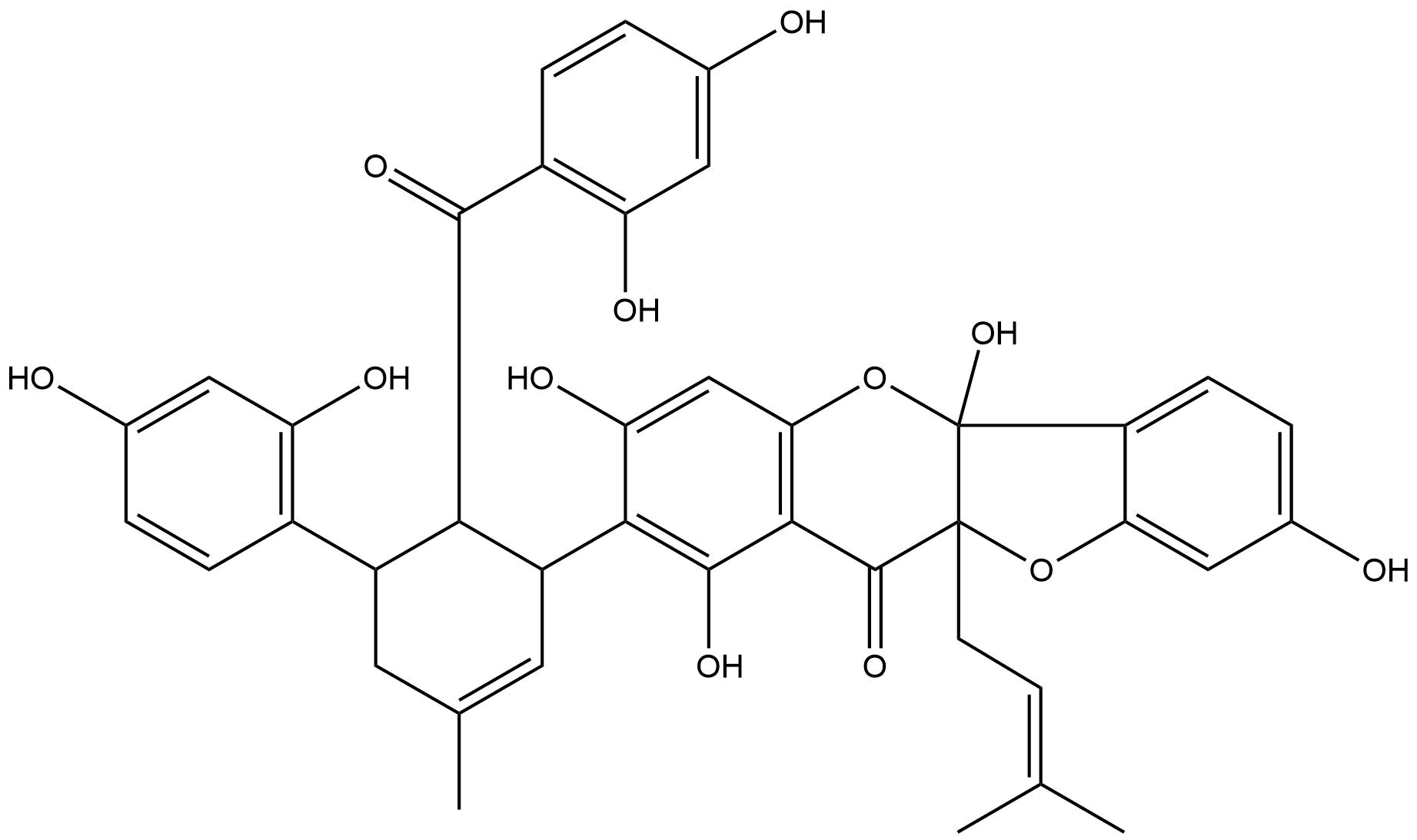
The molecular formula of Sangenone D is C40H36O12, with a molecular weight of 708.7160 Da. Its structure belongs to highly modified flavonoids, with a core of a flavanone skeleton connected to multiple isopentenyl and phenolic hydroxyl groups, forming a complex fused ring system. This unique structure is the material basis for its biological activity.
From the analysis of parameters related to drug properties, the lipid water partition coefficient (LogP) of Sangenone D is 4.6207, indicating its good lipophilicity. The topologically polar surface area (TPSA) is as high as 214.4400 Å ², mainly attributed to the presence of multiple hydrogen bond donors and acceptors (such as hydroxyl and carbonyl groups) in the molecule. Its water solubility is relatively low, about 0.0196 mg/mL, which is consistent with its high LogP and high TPSA characteristics, indicating that it may require formulation methods (such as nano formulations, cyclodextrin inclusion complexes, etc.) to improve solubility and bioavailability in the development process. In the preliminary safety screening, Sangenone D did not show significant hERG potassium channel inhibitory activity (hERG inhibition: No), which reduces its potential risk of inducing cardiac QT interval prolongation. The Ames test result is 0.0, indicating that it may not have direct genetic toxicity, but a more comprehensive assessment of genetic toxicity and long-term toxicity is still needed. In addition, its blood-brain barrier permeability is low, indicating that its main effect may be concentrated in the peripheral system, with limited therapeutic potential for central nervous system related diseases, but it may also reduce central side effects as a result.
Plant sources and extraction methods
Mulberry root ketone D mainly comes from the root bark of Morus plants in the Moraceae family, such as Morus alba L. Mulberry plants have a long history of application in traditional medicine, and their root bark (mulberry bark) is commonly used for relieving cough, asthma, diuresis, and reducing swelling. Modern plant chemistry research has isolated and identified a series of isopentenyl flavonoids, including mulberry root ketone D, from the root bark, branches, and fruits of mulberry plants.
Its extraction and separation usually use organic solvent extraction combined with various chromatographic techniques. The conventional process is as follows: first, the dried mulberry bark is crushed and subjected to reflux extraction or ultrasound assisted extraction using polar organic solvents such as methanol, ethanol, or acetone. After vacuum concentration, the crude extract was subjected to liquid-liquid extraction and segmentation using solvents such as petroleum ether, ethyl acetate, and n-butanol. Sangenone D is mainly enriched in the ethyl acetate extraction site. Subsequently, silica gel column chromatography, Sephadex LH-20 gel column chromatography, reverse phase ODS column chromatography and high performance liquid chromatography (HPLC) were used for repeated separation and purification, and finally the high-purity Sangunone D monomer was obtained. In recent years, modern separation techniques such as high-speed countercurrent chromatography have also been applied to the efficient preparation of such compounds. The optimization of extraction process, such as the control of extraction solvent, temperature, and time, is crucial for improving the yield of mulberry root ketone D.
Pharmacological activity research
The pharmacological activity research of Sangenone D mainly focuses on the field of anti-tumor, especially showing significant activity in the treatment of gastric cancer. Numerous in vitro studies have shown that Sangenone D can effectively inhibit the proliferation of various human gastric cancer cell lines (such as SGC-7901, MKN-45, AGS, etc.), and its inhibitory effect is concentration - and time-dependent. In addition to direct cytotoxicity, Sangenone D can also induce cell cycle arrest (such as G2/M phase arrest) and apoptosis in gastric cancer cells.
In addition, the study suggests that Sangenone D may have auxiliary pharmacological effects such as anti-inflammatory and antioxidant effects. Its antioxidant activity may be related to the activation of the nuclear factor E2 related factor 2 (NFE2L2/Nrf2) pathway, which is a key regulator of the cellular antioxidant stress defense system. These multifaceted activities collectively form the pharmacological basis for the anti-tumor effect of Sangenone D, particularly its potential benefits in combating inflammation and oxidative stress in the tumor microenvironment.
Mechanism of action and molecular targets
The mechanism of action of Sangenone D against gastric cancer is complex, involving the regulation of multiple key signaling pathways and molecular targets, reflecting the multi-target nature of natural products. According to existing research, its main mechanism of action and targets include:
-
Inducing apoptosis and regulating BCL2 family proteins Sangenone D can significantly downregulate the expression of anti apoptotic proteins BCL2 and BCL2L1 (Bcl xL), while possibly upregulating the expression of pro apoptotic proteins such as BAX, thereby disrupting mitochondrial membrane potential, promoting cytochrome C release, activating caspase cascade reaction, and ultimately inducing apoptosis in gastric cancer cells.
-
Inhibition of STAT3 signaling pathway Signal transducer and activator of transcription factor 3 (STAT3) is a core molecule involved in tumorigenesis, proliferation, survival, and immune escape. Sangenone D can inhibit the phosphorylation (activation) of STAT3, prevent its nuclear translocation and the transcription of downstream target genes (such as Cyclin D1, Survivor, MMP9), thereby inhibiting gastric cancer cell proliferation, promoting apoptosis, and reducing invasion and metastasis ability.
-
Regulating the PI3K/AKT and MAPK pathways Sangenone D can inhibit the activity of phosphatidylinositol 3-kinase catalytic subunit alpha (PIK3CA) and its downstream protein kinase B (AKT) phosphorylation, while affecting the activity of mitogen activated protein kinase 1 (MAPK1/ERK). These two pathways play a central role in cell growth, metabolism, and survival, and their inhibition can synergistically promote anti-tumor effects.
-
Inhibit tumor invasion and metastasis Sangenone D can downregulate the expression and activity of matrix metalloproteinase 9 (MMP9). MMP9 is a key enzyme that degrades extracellular matrix and promotes tumor invasion and metastasis. By inhibiting MMP9, Sangenone D can weaken the migration and invasion ability of gastric cancer cells.
-
Reverse multidrug resistance (MDR)Research has shown that Sangenone D may reduce the efflux of chemotherapy drugs (such as doxorubicin) from gastric cancer cells by inhibiting the function of ATP binding cassette transporter B1 (ABCB1/P-gp), thereby reversing tumor multidrug resistance and enhancing the efficacy of chemotherapy drugs.
-
Affects DNA topoisomerase and oxidative stress Sangenone D may act as an inhibitor of topoisomerase I (TOP1), interfering with DNA replication and repair. Meanwhile, by activating the NFE2L2 pathway, the antioxidant capacity of cells can be enhanced, which may help protect normal cells from oxidative damage caused by chemotherapy drugs or affect their survival by regulating the redox balance of tumor cells.
In summary, Sangenone D forms a multidimensional anti gastric cancer network by synergistically acting on multiple targets related to apoptosis, proliferation, survival, invasion, and drug resistance.
Evaluation of drug properties and pharmacokinetics
Although Sangenone D has shown excellent pharmacological activity in vitro, its pharmacological development still faces challenges, and related pharmacokinetic studies are currently relatively limited.
According to its physicochemical properties, Sangenone D belongs to the Biopharmaceutical Classification System (BCS) Class II or IV compounds (low solubility, low or high permeability), and oral absorption may be poor and irregular. High TPSA and molecular weight also suggest that membrane permeability may be limited. Existing computer simulations and preliminary in vitro ADME (absorption, distribution, metabolism, excretion) studies suggest that Sangenone D may undergo extensive metabolism in vivo, particularly through II phase metabolic reactions such as glucuronidation and sulfation, as well as oxidative metabolism by the cytochrome P450 enzyme system. This may result in lower oral bioavailability.
In terms of distribution, it has low blood-brain barrier permeability and is mainly distributed in peripheral tissues and organs. The main excretion pathway may be bile excretion. At present, there are few systematic research reports on the pharmacokinetic parameters of Sangenone D in vivo, such as half-life, clearance rate, absolute bioavailability, etc. This is a key data gap that must be filled in the process of advancing its drug development. In the future, it is necessary to establish sensitive and reliable analytical methods (such as LC-MS/MS) for systematic pharmacokinetic studies in animal models such as mice and rats, and to investigate their tissue distribution characteristics.
Clinical application prospects and prospects
Sangenone D, as a natural lead compound with multi-target anti gastric cancer activity, has broad clinical application prospects, but the road ahead is long. Future development directions may include:
-
Structural optimization and derivative development To address the drawbacks of poor water solubility and fast metabolism of Sangenone D, structural modification can be carried out through medicinal chemical methods. For example, esterification, etherification, or preparation of its phenolic hydroxyl group into prodrugs, or modification of its isopentenyl group in order to improve its pharmacokinetic properties while maintaining or enhancing its activity.
-
Research on a new drug delivery system Using nanotechnology to develop nano formulations of Sangenone D, such as liposomes, polymer nanoparticles, solid lipid nanoparticles, etc., can significantly improve its solubility and stability, achieve targeted delivery (such as targeting tumor tissues through EPR effect), and may reduce systemic toxicity.
-
Exploration of Combination Medication Strategy Given the potential of Sangenone D to reverse multidrug resistance, its combination with first-line gastric cancer chemotherapy drugs such as cisplatin, 5-fluorouracil, paclitaxel, etc. is an attractive research direction. Combination therapy may produce synergistic effects, reduce the dosage of chemotherapy drugs, minimize toxic side effects, and overcome drug resistance.
-
Deep exploration of the mechanism of action Using omics technologies (proteomics, metabolomics) and gene editing techniques, further comprehensively and systematically elucidate the target network and signaling pathway cross-talk mechanism of Sangenone D, and discover its new pharmacological effects (such as immune regulation, regulation of tumor stem cells, etc.).
-
Preclinical and clinical research After completing preclinical studies such as pharmacodynamics, pharmacokinetics, and safety evaluation (GLP toxicology research) of the system, it gradually advances to the clinical trial stage to verify its safety and efficacy in gastric cancer patients.
Conclusion
Sangenone D is a natural product of isopentenyl flavonoids derived from mulberry plants. With its unique chemical structure and multi-target mechanism of action, it has shown remarkable potential in the study of anti gastric cancer. It effectively inhibits gastric cancer cell proliferation, induces apoptosis, suppresses invasion and metastasis, and may reverse multidrug resistance by regulating multiple key targets such as BCL2 family, STAT3, PI3K/AKT, MAPK, MMP9, ABCB1, etc. However, its poor solubility and unclear pharmacokinetic properties in vivo are the main bottlenecks restricting its development. Future research should focus on improving its drug properties through structural modifications and novel drug delivery systems, conducting systematic preclinical evaluations, and actively exploring its combination therapy regimens. The study of Sangenone D not only provides new candidate molecules for the treatment of gastric cancer, but also once again confirms the important significance of exploring multi-target natural lead compounds from traditional medicinal plants in modern drug development. With the continuous deepening of research, Sangenone D is expected to achieve the transformation from laboratory to clinical use in the field of anti-tumor drugs.