


Product name: Senkyunolide I
Synonym name:
Catalogue No.: BP1289
Cas No.: 94596-28-8
Formula: C12H16O4
Mol Weight: 224.256
Botanical Source: Ligusticum chuanxiong Hort.
Physical Description:
Type of Compound: Miscellaneous
Purity: 95%~99%
Analysis Method: HPLC-DAD or/and HPLC-ELSD
Identification Method: Mass, NMR
Packing: Brown vial or HDPE plastic bottle
Storage: Store in a well closed container, protected from air and light. Put into refrigerate or freeze for long term storage.
Whenever possible, you should prepare and use solutions on the same day. However, if you need to make up stock solutions in advance, we recommend that you store the solution as aliquots in tightly sealed vials at -20℃. Generally, these will be useable for up to two weeks.
The product could be supplied from milligrams to grams
Inquire for bulk scale.
Chengdu Biopurify Phytochemicals Ltd. is a leading company in the research, development, manufacture and marketing of High Quality Phytochemicals and Extracts(especially Active Ingredients from Traditional Chinese Medicine,TCM), Natural Active Pharmaceutical Ingredients worldwide.
The main services:
A. Supply active ingredients and reference standards of TCM, from mgs to kgs scale
B. Custom extraction and purification, target Herb Active Ingredients
C. Custom synthesis and semi-synthesis for Natural Active Ingredients
D. CR(contract research), CM(contract manufacture) and PD(process development) services from lab scale, pilot scale to commercial scale(GMP is also available)
E. TCM compounds library for drug screen,more than 3000 compounds available, many of them are rare and unique.
HPLC of Senkyunolide I
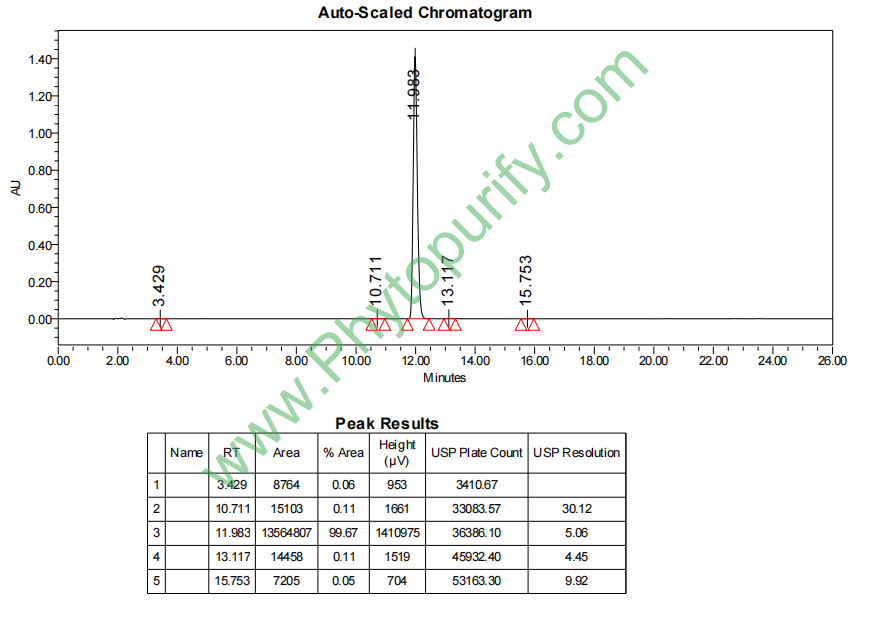
Storage conditions:Short-term storage at 2~8℃, long-term storage at -20 ~ -80℃
66.7600
1.0773
1.0772
6.1009
1.5249
4.1034
High
60.2414
4.1158
Yes
No
No
No
Yes
No
0.0
Yes
Yes
Yes
Yes
Cerebrovascular disease is one of the major causes of death and disability worldwide. Ischemic stroke poses a serious challenge to public health because of its high incidence rate, high disability rate and high recurrence rate. The reperfusion process after ischemic stroke, although aimed at restoring blood flow, is often accompanied by complex pathophysiological cascade reactions, namely ischemia/reperfusion injury, leading to oxidative stress, intensified inflammatory response, and cell apoptosis, ultimately expanding the scope of brain damage. Therefore, finding neuroprotective agents that can effectively alleviate cerebral ischemia/reperfusion injury is an important direction in current drug development. In the treasure trove of traditional Chinese medicine, Chuanxiong(Ligusticum chuanxiong Hort., as an essential medicine for promoting blood circulation and removing blood stasis, has a long history and proven efficacy in treating headaches, dizziness, and cerebrovascular related diseases. Modern pharmacological research has confirmed that the active ingredients of Ligusticum chuanxiong mainly include phthalein compounds, among which Senkyunolide I, as one of its characteristic components, has attracted much attention in recent years due to its significant neuroprotective, antiplatelet aggregation and other multiple pharmacological activities. This article aims to systematically review the chemical properties, plant sources, pharmacological activities, mechanisms of action, medicinal properties, and application prospects of ligustilide I in the treatment of cerebrovascular diseases, in order to provide comprehensive scientific references for the in-depth research and development of this compound.
Yangchuan ligustilide I, chemical name (3Z) -3-butenyl-4,5-dihydro-7-hydroxy-6-methyl-1 (3H) - isobenzofuranone, CAS number 94596-28-8. Its molecular formula is C12H16O3 and its molecular weight is 224.2560. Structurally, it belongs to the benzophenone class of compounds, with a core skeleton of benzofuranone, connected to the butenyl side chain through a double bond at position 3, and substituted with methyl and hydroxyl groups at positions 6 and 7, respectively. This unique structure is the material basis for its biological activity.
The physicochemical properties parameters show that the lipid water partition coefficient (LogP) of ligustilide I is 1.0773, indicating its moderate lipophilicity and favorable transmembrane transport. The topologically polar surface area (TPSA) is 66.7600 Å ², which is relatively low, consistent with its structure containing only polar groups such as hydroxyl and ester carbonyl groups. The water solubility value is 6.1009 (usually measured in mg/L or log mol/L, indicating moderate to low water solubility but good solubility in organic solvents). Of particular importance is that its blood-brain barrier (BBB) permeability is predicted to be "high", providing a key pharmacokinetic advantage for its direct action on the central nervous system and exerting neuroprotective effects against cerebral ischemia. In addition, preliminary pharmacological risk assessment shows that the hERG inhibition risk is "no", and the Ames test result is 0.0 (negative), indicating that its potential risk of arrhythmia and genetic toxicity is low, and its safety prospects are good.
Yangchuan ligustilide I mainly comes from Ligusticum chuanxiong, a plant in the Umbelliferae family and Ligusticum genus(Ligusticum chuanxiong Dry rhizomes of Hort. Chuanxiong, as a famous authentic Sichuan medicinal herb, has a complex chemical composition. Phthalide compounds are recognized as the main active ingredient group, including various homologs such as ligustilide A, H, I, Z, etc.
The extraction and separation of ligustilide I from Ligusticum chuanxiong is usually achieved by combining organic solvent extraction with modern chromatographic separation techniques. The conventional process is as follows: first, the Chuanxiong medicinal herb is crushed and subjected to reflux extraction or ultrasound assisted extraction using solvents such as ethanol, methanol, or aqueous ethanol. After vacuum concentration, the obtained crude extract was subjected to segmented extraction using different polar solvents such as petroleum ether, ethyl acetate, and n-butanol. Yangchuan ligustilide I is mainly enriched in the ethyl acetate extraction site. Subsequently, the site was further separated and purified using techniques such as silica gel column chromatography, reverse phase silica gel column chromatography (such as ODS), and preparative high-performance liquid chromatography (HPLC). Structural identification was carried out through spectroscopic methods such as nuclear magnetic resonance (NMR) and mass spectrometry (MS). In recent years, new technologies such as high-speed countercurrent chromatography and supercritical fluid extraction have also been applied to the efficient separation of phthalein compounds, in order to improve the yield and purity of target compounds. Optimizing the extraction process (such as solvent ratio, temperature, time) is crucial for obtaining ligustilide I on a large scale.
A large number of in vitro and in vivo pharmacological studies have revealed the extensive and significant biological activities of ligustilide I, mainly focusing on two aspects: nervous system protection and cardiovascular system regulation.
1. Neuroprotective effect:
This is the activity of ligustilide I that has received the most attention. In the classic rat model of middle cerebral artery occlusion/reperfusion, pretreatment with ligustilide I can significantly reduce cerebral infarction volume, alleviate brain edema, and improve neurological deficit scores. Its protective effect involves multiple core components in combating ischemia/reperfusion injury: reducing oxidative stress damage, inhibiting neuroinflammatory responses, and resisting neuronal apoptosis.
2. Antiplatelet aggregation and antithrombotic effects:
The traditional efficacy of Chuanxiong in promoting blood circulation and removing blood stasis has been scientifically elucidated in the study of ligustilide I. Research has shown that ligustilide I can effectively inhibit platelet aggregation caused by various inducers such as adenosine diphosphate, collagen, arachidonic acid, etc. In animal thrombus models, it also showed anti thrombotic effects. This provides a direct basis for its application in the prevention and treatment of ischemic cardiovascular and cerebrovascular diseases.
3. Other pharmacological activities:
In addition, studies have reported that ligustilide I has anti migraine activity, which may be related to its regulation of cerebral vasomotor function and inhibition of neurogenic inflammation. There are also studies indicating that it has certain anti-inflammatory and antioxidant activities, which complement its core neuroprotective mechanisms.
The pharmacological effects of ligustilide I are achieved by regulating multiple signaling pathways and molecular targets, forming a multi-target, multi pathway network mode of action.
1. Core mechanism of cerebral ischemia protection:
* Activate Nrf2/HO-1 antioxidant pathway: Nuclear factor E2 related factor 2 (Nrf2) is a key transcription factor in the cellular antioxidant defense system. Yangchuan ligustilide I can promote Nrf2 nuclear translocation and upregulate the expression of its downstream target gene heme oxygenase-1 (HO-1). HO-1 degrades hemoglobin to produce bilirubin and carbon monoxide, which have antioxidant and anti-inflammatory effects, effectively clearing excess reactive oxygen species generated during reperfusion and reducing oxidative stress damage.
* Regulating the MAPK/Erk1/2 survival signaling pathway: Extracellular signal regulated kinase 1/2 (Erk1/2) is an important kinase that promotes cell survival. Research has confirmed that ligustilide I can upregulate the level of phosphorylated Erk1/2 (p-Erk1/2). The activated Erk1/2 pathway can promote cell proliferation, survival, and cross communicate with other pathways (such as PI3K/Akt) to jointly inhibit apoptosis.
* Inhibition of mitochondrial apoptosis pathway: Caspase-3 is the ultimate executor of cell apoptosis. Yangchuan ligustilide I can significantly inhibit the activation of Caspase-3 in ischemic brain tissue, and may regulate the Bcl-2/Bax protein ratio, inhibit the release of cytochrome C, and thus block the mitochondrial dependent apoptosis pathway.
2. Target network for antiplatelet aggregation:
The antiplatelet effect of ligustilide I involves the regulation of multiple key platelet activation targets, reflecting multi-target characteristics:
* Inhibition of cyclooxygenase (PTGS1/COX-1 and PTGS2/COX-2): May reduce the production of potent aggregation promoting substances such as thromboxane A2 (TXA2) by inhibiting arachidonic acid metabolism.
* Affects platelet membrane receptors: May antagonize thromboxane A2 receptor (TBXA2R), adenosine diphosphate receptor (P2RY12/P2Y12), and may affect the activation of integrin α IIb β 3 (encoded by ITGA2B and ITGB3), which is the ultimate common pathway for platelet aggregation.
* Intervention of intracellular signaling: It is possible to inhibit platelet activation by suppressing phosphodiesterase 3A (PDE3A) and increasing the level of cyclic adenosine monophosphate (cAMP) in platelets. It may also have a regulatory effect on glycoprotein Ib α (GP1BA, involved in platelet adhesion).
These targets work together to inhibit platelet activation, adhesion, and aggregation at different stages, exerting antithrombotic effects.
Based on its physicochemical parameters and preliminary biological data, ligustilide I from Yangchuan has shown good potential as a drug.
Pharmacodynamics: Existing research is mostly focused on pharmacodynamics, and systematic pharmacokinetic studies are relatively limited. But its high blood-brain barrier permeability prediction is its outstanding advantage as a neuroprotective agent, which means that after oral or injection administration, it can effectively enter the target site of brain tissue. Its moderate LogP value is beneficial for its absorption and distribution in the body. Subsequent research needs to clarify its absolute bioavailability, distribution volume, elimination half-life, main metabolic pathways (presumably involving glucuronidation or sulfation of hydroxyl groups), and excretion mode in rats, dogs, and even humans.
Security: The preliminary toxicology screening results are positive. The absence of hERG inhibition suggests a low risk of cardiac toxicity, while a negative Ames test indicates no mutagenicity. However, comprehensive preclinical safety evaluations, including acute toxicity, long-term repeated administration toxicity, reproductive toxicity, and other studies, still need to be conducted to assess their safety window.
Formulation development: Considering its general water solubility, in order to improve its oral bioavailability, it may be necessary to use pharmaceutical methods such as preparing nanocrystals, liposomes, cyclodextrin inclusion complexes, or solid dispersions.
As an active monomer compound derived from traditional Chinese medicine, ligustilide I has a clinical application prospect mainly focused on the field of cerebrovascular diseases.
1. Adjuvant treatment for acute ischemic stroke: Its strong ability to resist ischemia/reperfusion injury makes it a promising new neuroprotective agent, which can be used in combination with thrombolysis (such as rt PA) or thrombectomy to alleviate reperfusion injury, protect ischemic penumbra neurons, and improve long-term patient prognosis. Its antiplatelet activity may also help prevent early recurrence of stroke.
2. Prevention and treatment of migraine: Its anti migraine activity provides a candidate molecule for the development of new migraine treatment drugs, especially suitable for patients who are intolerant to existing drugs or have poor efficacy.
3. Prevention of thrombotic diseases: As a multi target antiplatelet drug, it can be used for secondary prevention of atherosclerotic cardiovascular diseases (such as coronary heart disease, cerebral infarction), and may have the advantage of relatively low bleeding risk.
However, there are still challenges and future research directions for clinical application:
* In depth mechanism research: Further precise verification of the upstream and downstream relationship between its target and pathway requires the use of gene knockout, specific inhibitors, and other methods.
* Systematic pharmacokinetic/toxicological studies: Complete preclinical pharmacokinetic and GLP toxicology studies must be completed to determine the safe and effective dosage range.
* Clinical research: Ultimately, it is necessary to conduct Phase I-III clinical trials to verify its safety, efficacy, and optimal medication regimen in humans.
* Structural optimization: Based on its lead compound structure, reasonable chemical modifications may further enhance its activity, selectivity, and pharmacokinetic properties.
* Exploration of compound application: Exploring its combination therapy with existing standard treatment drugs such as aspirin and clopidogrel may result in synergistic effects and reduced side effects.
Yangchuanxiong lactone I is a benzophenone compound with important biological activity isolated from traditional Chinese medicine Chuanxiong. Research has shown that it exerts significant neuroprotective effects against cerebral ischemia/reperfusion injury by upregulating p-Erk1/2, activating the Nrf2/HO-1 antioxidant pathway, and inhibiting Caspase-3-dependent apoptosis through multiple mechanisms. At the same time, it exhibits clear anti platelet aggregation activity by acting on multiple targets such as PTGS1/2, P2RY12, ITGA2B/ITGB3, etc. The excellent blood-brain barrier permeability and good preliminary safety prediction have laid a solid foundation for its drug development. Although there is still a lot of work to be done in fully elucidating its molecular network, completing systematic preclinical evaluation, and advancing clinical translation, ligustilide I is undoubtedly a highly valuable lead compound for development. It is not only a modern scientific carrier for explaining the traditional efficacy of Chuanxiong in promoting blood circulation, removing blood stasis, dispelling wind and relieving pain, but also provides new ideas and candidate molecules for the development of multi-target innovative drugs for the treatment of ischemic stroke, migraine and other diseases, reflecting the huge potential of exploring modern innovative drugs from traditional Chinese medicine.
