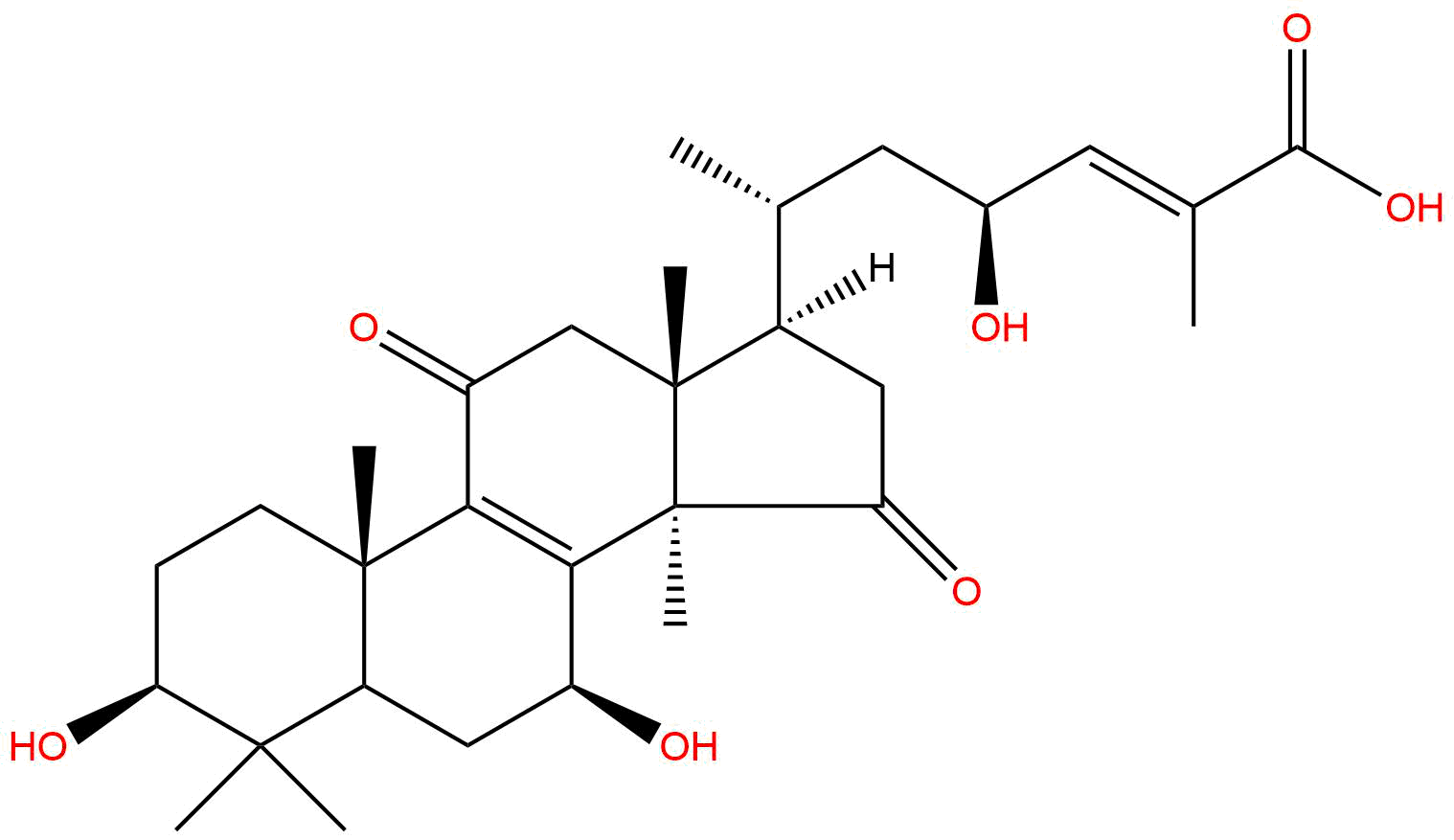


Product name: Ganoderic acid Epsilon
Synonym name: (+)-Ganoderic acid ε; Ganoderic acid ε
Catalogue No.: BP2173
Cas No.: 294674-05-8
Formula: C30H44O7
Mol Weight: 516.675
Botanical Source:
Type of Compound:
Purity: 95%~99%
Analysis Method: HPLC-DAD or/and HPLC-ELSD
Identification Method: Mass, NMR
Packing: Brown vial or HDPE plastic bottle
Storage: Store in a well closed container, protected from air and light. Put into refrigerate or freeze for long term storage.
Whenever possible, you should prepare and use solutions on the same day. However, if you need to make up stock solutions in advance, we recommend that you store the solution as aliquots in tightly sealed vials at -20℃. Generally, these will be useable for up to two weeks.
The product could be supplied from milligrams to grams
Inquire for bulk scale.
For Reference Standard and R&D, Not for Human Use Directly.
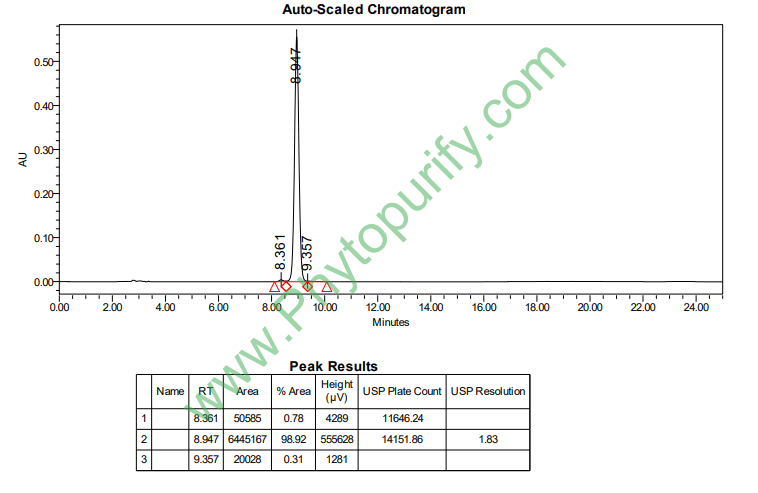
HPLC of Ganoderic acid Epsilon
Storage conditions:Short-term storage at 2~8℃, long-term storage at -20 ~ -80℃
132.1300
2.9157
.3321
.0659
1.5468
4.5654
Low
84.9798
5.2860
No
No
Yes
No
No
No
0.0
Yes
No
No
No
Aging is a complex biological process in which the physiological functions of an organism gradually decline over time, leading to increased susceptibility to diseases and increased risk of death. At the molecular level, aging involves nine major markers, including genomic instability, telomere depletion, epigenetic changes, loss of protein homeostasis, dysregulation of nutrient sensing, mitochondrial dysfunction, cellular aging, stem cell exhaustion, and changes in intercellular communication. Developing safe and effective anti-aging strategies targeting these targets has become a cutting-edge hotspot in modern medicine and pharmacology research. Among numerous candidate substances, natural products derived from traditional medicinal fungi have attracted much attention due to their multi-target and low toxicity characteristics. Ganoderma lucidum(Ganoderma lucidum)As a "fairy herb" with a history of more than two thousand years of application, modern research has confirmed that its rich triterpenoid compounds from Ganoderma lucidum are its core pharmacological active ingredients. Ganoderma acid Epsilon (GA - ε), as one of its members, has emerged in recent years due to its significant activity in anti-aging and related disease models. This article aims to systematically review the chemical properties, pharmacological activities, molecular mechanisms of action, and pharmacological potential of GA - ε, providing a scientific basis for its development as a new type of anti-aging intervention agent.
Lingzhi acid Epsilon is a highly oxidized lanostane triterpenoid compound with a CAS number of 294674-05-8. Its molecular formula is C ∝₀ H ₄₄ O ₇, with a molecular weight of 516.6750 Da. Structurally, GA - ε has a typical tetracyclic triterpenoid skeleton (A/B/C/D rings), and is substituted with hydroxyl or carbonyl groups at multiple positions such as C-3, C-7, C-15, C-22. C-26 is usually present in the form of carboxyl groups, which are important structural basis for its biological activity.
Its physicochemical properties directly affect its bioavailability and potential as a drug. The calculated lipid water partition coefficient (LogP) is 2.9157, indicating that the compound has moderate lipophilicity, which is beneficial for transmembrane transport. However, excessively high LogP may also lead to a decrease in water solubility. Its topological polar surface area (TPSA) is 132.1300 Å ², reflecting the presence of multiple polar groups (such as hydroxyl and carboxyl) in the molecule. The water solubility data (0.0659 mg/mL) confirms that it is a poorly soluble compound, which will be a key challenge to overcome in formulation development. Preliminary drug risk assessment shows that its blood-brain barrier permeability is low, suggesting that its direct effects on the central nervous system may be limited; HERG inhibition is negative, reducing the risk of inducing QT interval prolongation in the heart; The Ames test result is 0.0, indicating that it has no significant genetic toxicity and good safety characteristics.
GA - ε specifically originates from fungi of the Ganoderma genus, mainly Ganoderma lucidum(Ganoderma lucidum)And Zizhi(Ganoderma sinense). It is distributed in fruiting bodies, mycelium, and spore powder, but the content is usually low, and is significantly affected by factors such as strain variety, growth conditions (such as temperature, humidity, light, and medium composition), growth stage, and harvesting time.
At present, the extraction of GA - ε mainly relies on organic solvent extraction method. Common solvents include methanol, ethanol, chloroform, or mixed solvents of different proportions (such as chloroform: methanol). The typical extraction process is to soak or reflux the dried and crushed Ganoderma lucidum material in a solvent, combine the extraction solutions, and concentrate under reduced pressure to obtain the crude extract. Due to the complex composition of triterpenoids in Ganoderma lucidum and the minimal content of GA - ε in the crude extract, further efficient separation and purification techniques are needed. Methods such as silica gel column chromatography, reverse phase silica gel column chromatography (such as ODS), high performance liquid chromatography (HPLC), and preparative thin layer chromatography are commonly used for stepwise separation and purification. In recent years, supercritical CO ₂ extraction technology has also been attempted for the extraction of triterpenoids from Ganoderma lucidum due to its advantages of low operating temperature, low solvent residue, and adjustable selectivity. However, its extraction efficiency for highly polar triterpenoids such as GA - ε still needs to be optimized. In addition, utilizing fungal fermentation engineering technology to selectively increase the yield of GA - ε by optimizing fermentation parameters such as pH, dissolved oxygen, and inducer addition is a potential sustainable strategy to address the issue of limited natural sources.
A large number of in vitro and in vivo studies have revealed the extensive and profound anti-aging and related pharmacological activities of GA - ε.
Cellular Aging and Proliferation Regulation GA - ε can significantly inhibit the activity of aging related β - galactosidase (SA - β - gal) in cell aging models induced by various aging related stimuli, such as hydrogen peroxide and D-galactose. At the same time, it blocks the cell cycle in the G0/G1 phase by regulating the expression of cyclin and cyclin dependent kinase inhibitors, thereby inhibiting abnormal proliferation. However, it has low toxicity to normal cells and exhibits a certain degree of selectivity.
anti-oxidative stress GA - ε is a powerful antioxidant. In cell damage models induced by oxidants such as hydrogen peroxide and tert butyl hydroperoxide, it can effectively reduce intracellular reactive oxygen species (ROS) levels, inhibit the production of lipid peroxidation product malondialdehyde (MDA), and increase the content of endogenous antioxidants such as reduced glutathione (GSH), protecting cells from oxidative damage.
Telomere protection and mitochondrial function maintenance Preliminary studies suggest that GA - ε may indirectly affect telomerase activity or telomere stability, delaying replicative aging. More importantly, it can improve mitochondrial function, including stabilizing mitochondrial membrane potential, promoting ATP synthesis, enhancing mitochondrial biogenesis, and inhibiting cell apoptosis through the mitochondrial pathway.
anti-inflammatory effect Chronic low-grade inflammation is the core characteristic of aging ("inflammatory aging"). GA - ε can inhibit the excessive production of nitric oxide (NO), prostaglandin E2 (PGE2), and pro-inflammatory factors such as tumor necrosis factor - α (TNF - α) and interleukin-6 (IL-6) in macrophages stimulated by lipopolysaccharides, and its mechanism is related to the inhibition of nuclear factor kappa B (NF - κ B) and mitogen activated protein kinase (MAPK) signaling pathways.
Neuroprotection and improvement of cognitive function In Alzheimer's disease cell models and natural aging or D-galactose-induced aging mouse models, GA - ε treatment can alleviate neuronal apoptosis, reduce β - amyloid deposition, and improve the learning and memory abilities of experimental animals, suggesting its potential in combating neurodegenerative aging.
metabolic regulation In insulin resistance cell models or high-fat diet induced metabolic disorder animal models, GA - ε exhibits the effect of improving glucose tolerance and enhancing insulin sensitivity, which is highly consistent with the goal of maintaining metabolic homeostasis in anti-aging processes.
The anti-aging effect of GA - ε is not achieved through a single pathway, but acts on a complex network whose core targets are closely linked to the nine major markers of aging:
Activation of Energy and Metabolic Sensing Pathway - AMPK/SIRT1 Axis GA - ε has been confirmed to be an activator of AMP activated protein kinase (AMPK). AMPK, as a "sensor" of cellular energy status, can upregulate the activity of deacetylase SIRT1 upon activation. The co activation of AMPK/SIRT1 axis regulates a series of key transcription factors and proteins downstream.
Regulating Genomic Stability and Cell Destiny - TP53 and TERT The effect of GA - ε on tumor suppressor protein TP53 (p53) is context dependent. In normal or early stressed cells, it may moderately regulate p53 activity through indirect means, avoiding cell aging or apoptosis caused by excessive activation; In cells with severe genetic damage, it may cooperate with p53 to exert a protective effect. In addition, studies suggest that GA - ε may have a regulatory effect on telomerase reverse transcriptase (TERT), affecting telomere maintenance, but the specific mechanism remains to be elucidated.
Enhance endogenous antioxidant defense system In addition to the NRF2 pathway, GA - ε can directly or indirectly upregulate the activity and expression of classic antioxidant enzymes such as superoxide dismutase 1 (SOD1) and catalase (CAT), forming a multi-level antioxidant barrier.
Inhibiting inflammatory aging related pathways GA - ε alleviates chronic inflammation by inhibiting the overactivation of IKK/NF - κ B and MAPK (such as p38, JNK) signaling pathways, reducing the transcription and release of downstream pro-inflammatory mediators.
In summary, GA - ε integrates multiple aspects such as energy metabolism regulation (AMPK/SIRT1), oxidative stress defense (NRF2/SOD1/CAT), genome and cell homeostasis maintenance (TP53/TERT/CDKN1A), and inflammation inhibition through multi-target and multi pathway synergistic effects, forming the pharmacological basis for its anti-aging complex network system.
Despite the significant pharmacological activity of GA - ε, its pharmacological development still faces challenges, and related research is still in its early stages.
Absorption, distribution, metabolism, excretion (ADME):
Optimization strategy for drug properties:
The clinical application prospects of GA - ε are broad, but the road ahead is long.
Potential application directions:
Future research focus and challenges:
As the active ingredient of traditional medicinal fungus Ganoderma lucidum, Epsilon ganoderic acid is a model for modern natural product pharmacology to explore anti-aging treasures from traditional wisdom. It exhibits multifaceted anti-aging potential in cell and animal models by precisely regulating core aging related signaling nodes such as AMPK/SIRT1, NRF2, and TP53. Despite challenges in terms of chemical stability, water solubility, and bioavailability, these obstacles are expected to be gradually overcome with the application of modern pharmaceutical technologies such as structural optimization and nano delivery, as well as a deeper understanding of their ADME properties. In the future, through interdisciplinary collaboration and in-depth systematic preclinical and clinical research, Epsilon ganoderic acid is expected to move from the laboratory to clinical applications, providing a new, multi-target natural candidate drug for addressing the health challenges brought by global population aging and achieving the goal of "healthy aging".
