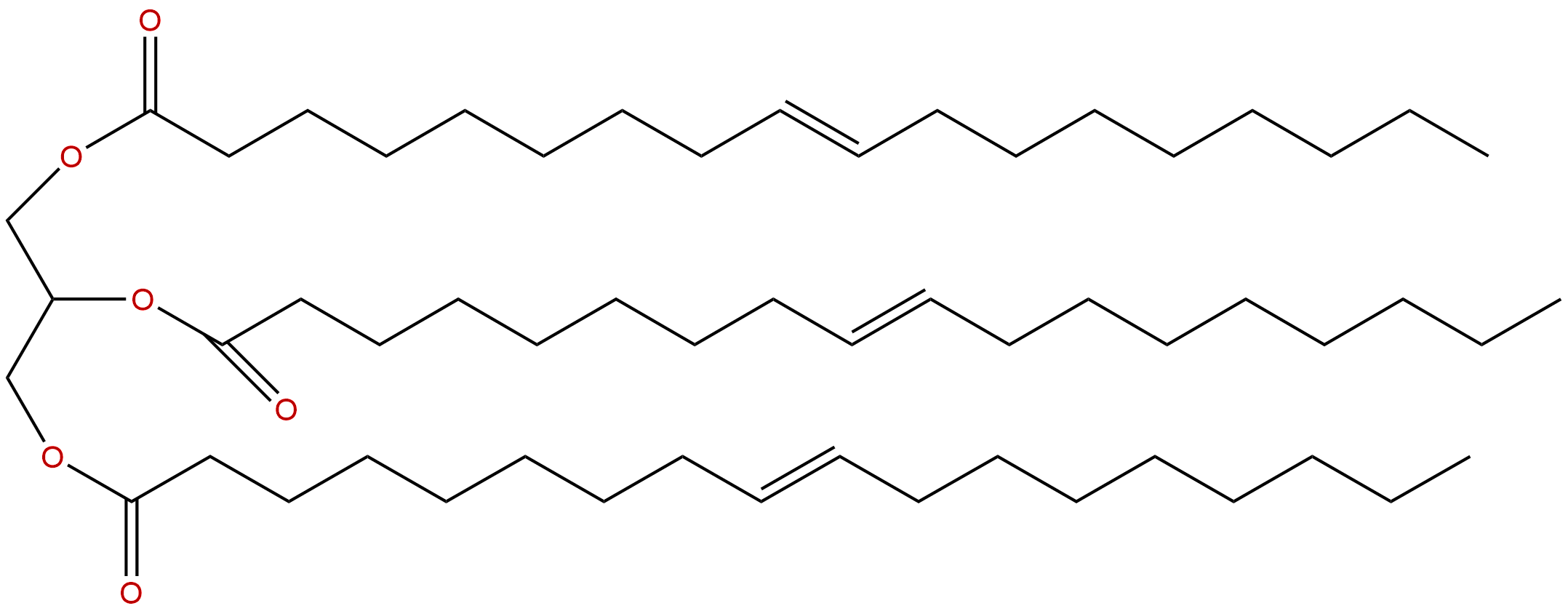


Synonym name: Triolein; Olein
Catalogue No.: BP0677
Cas No.: 122-32-7
Formula: C57H104O6
Mol Weight: 885.453
Botanical Source: olive oil and other vegetable oils
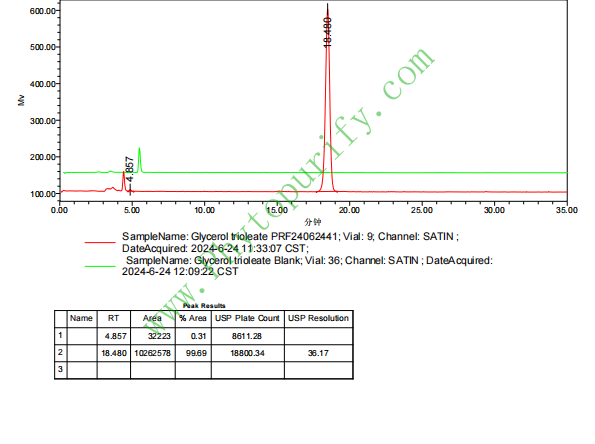
Purity: 95%~99%
Analysis Method: HPLC-DAD or/and HPLC-ELSD
Identification Method: Mass, NMR
Packing: Brown vial or HDPE plastic bottle
Can be supplied from milligrams to grams.
For Reference Standard and R&D, Not for Human Use Directly.
Inquire for bulk scale.
HPLC of Glycerol trioleate
Storage conditions:Short-term storage at 2~8℃, long-term storage at -20 ~ -80℃
Glycerol trioleate (CAS number: 122-32-7), also known as triglycerides, is a natural triglyceride formed by the ester bond between glycerol molecules and three molecules of oleic acid. As an important lipid molecule, glyceryl trioleate is not only widely present in plant oils, but also an important carrier for energy storage and signal transduction in organisms. In recent years, with the rapid development of natural product pharmacology, glyceryl trioleate has gradually attracted the attention of researchers in the fields of neurological diseases due to its unique biological activity and multi-target effects. Its potential role in neuroprotection, anti-inflammatory, and metabolic regulation, especially its interaction with targets related to neurodegenerative diseases, provides a theoretical basis and practical possibility for its development as a novel therapeutic drug.
This article reviews the chemical structure and physicochemical properties, plant sources, and extraction methods of glyceryl trioleate, systematically reviews its pharmacological activity research progress, deeply explores its mechanism of action and molecular targets, evaluates its pharmacokinetics and safety based on drug parameters, and finally looks forward to its clinical application prospects, providing scientific basis and reference for the subsequent research and development of glyceryl trioleate.
The molecular structure of glycerol trioleate consists of a glycerol skeleton connected to three oleic acid molecules through ester bonds. Oleic acid (cis-9-octadecenoic acid) is a monounsaturated fatty acid that contains a cis double bond in its molecule, giving the molecule a certain degree of flexibility and biological activity. The molecular formula of glycerol trioleate is C57H104O6, with a molecular weight of 885.4530. It has high hydrophobicity (LogP of about 14.0), indicating its extremely low water solubility (almost zero) and is more suitable for distribution in lipid environments.
Its topological polar surface area (TPSA) is 78.9 Å ², reflecting the exposed area of polar groups in the molecule. Although not high, it is sufficient to support its certain affinity in biofilms. Glycerol trioleate has a high blood-brain barrier permeability, which is of great significance for its application in neurological diseases. In addition, it has an inhibitory effect on hERG channels, indicating that the risk of cardiac toxicity should be given special attention in drug safety assessment. The Ames test result is 0, indicating no significant risk of genetic mutations causing cancer.
In the laboratory, triglyceride is often used as sample preparation and gel forming agent for polyacrylamide gel electrophoresis, showing its good physical and chemical stability and biocompatibility.
Glycerol trioleates are widely present in various plant oils, especially in vegetable oils rich in oleic acid such as olive oil, sunflower seed oil, and rapeseed oil. Its natural source mainly relies on the biosynthetic pathway of plant fatty acids. Oleic acid is synthesized through the catalytic action of fatty acid synthase and fatty acid desaturase, and further combined with glycerol to form glycerol trioleate.
The traditional methods for extracting triglycerides mainly include solvent extraction and supercritical fluid extraction. Solvent extraction generally uses organic solvents such as hexane and ethanol to obtain plant oils through steps such as extraction, filtration, and concentration. Subsequently, glycerol trioleate is purified through fractionation and chromatography techniques. In recent years, supercritical CO2 extraction technology has become an ideal method for extracting high-purity triglycerides due to its advantages of green environmental protection, strong selectivity, and mild operation.
In addition, enzymatic extraction and synthesis have gradually gained attention. The use of lipase catalyzed esterification reaction between glycerol and oleic acid not only improves the purity of the product, but also enables precise control of the product structure, making it suitable for the preparation of pharmaceutical grade glycerol trioleate.
The pharmacological activity research of glyceryl trioleate mainly focuses on its protective effect in neurological diseases and its potential to regulate lipid metabolism. As one of the two components of Lorenzo's oil, triglycerides play a crucial role in the treatment of X-linked leukodystrophy (X-ALD). Lorenzo oil slows down the progression of neurodegenerative diseases by regulating the metabolism of long-chain fatty acids in the nervous system. Glycerol trioleate, as an important component, participates in this metabolic regulation process.
In vitro and in vivo experiments, glyceryl trioleate exhibits anti-inflammatory, antioxidant, and neuroprotective activities. It affects the energy metabolism and membrane lipid composition of nerve cells by regulating enzymes and receptors related to fatty acid metabolism, promoting neuronal survival and functional recovery. In addition, glyceryl trioleate showed a regulatory effect on metabolism in the Caenorhabditis elegans model, suggesting that it may affect the health status of organisms through conserved lipid metabolism pathways.
Although there is limited research on the direct pharmacological effects of glycerol trioleate itself, its functional correlation with oleic acid provides theoretical support for its potential biological activity. Oleic acid has been proven to regulate inflammatory responses, improve neurological function, and protect cell membrane integrity. Glycerol trioleate, as a carrier and storage form of oleic acid, may exert similar biological effects by releasing oleic acid and its metabolites.
The mechanism of action of glyceryl trioleate in neurological diseases involves multiple molecular targets, reflecting its multi-target and multi pathway regulatory characteristics. The main related targets include:
BACE1 (β - secretase 1)BACE1 is a key enzyme involved in the cleavage of amyloid precursor protein (APP) to produce β - amyloid protein in Alzheimer's disease (AD). Glycerol trioleate may affect the activity of BACE1 by regulating the lipid environment, reducing the production of harmful β - amyloid proteins.
MAPT (microtubule associated protein Tau)Abnormal phosphorylation of Tau protein is a hallmark of neurodegenerative diseases. Glycerol trioleate may affect the stability and function of Tau protein by regulating the lipid composition of the cell membrane.
LPAR1 (Lysophosphatidic Acid Receptor 1)As a receptor for lipid signal transduction, LPAR1 is involved in neuroprotection and inflammatory response. The metabolites of glyceryl trioleate may activate or regulate the LPAR1 mediated signaling pathway.
ENPP2 (extracellular phospholipase D)Participate in the generation of lipophilic phospholipids, regulate neuronal cell proliferation and migration, and the metabolism of triglycerides may affect the activity of ENPP2.
FAAH (fatty acylethanolamine hydrolase)Regulating the endogenous cannabinoid system, participating in neuroprotection and anti-inflammatory effects, triglycerides may affect the function of FAAH by regulating lipid metabolism.
ACHE (Acetylcholinesterase)Regulating the degradation of neurotransmitter acetylcholine and affecting nerve signal transduction.
NFKB1 (nuclear factor kappa B1)The key inflammatory signaling factor, triglycerides, may inhibit the activation of NFKB1 and alleviate neuroinflammation by regulating lipid mediated signaling pathways.
MGLL (Monoacylglycerol Lipase)Participate in lipid metabolism and regulation of endogenous cannabinoids.
FABP3 (Fatty Acid Binding Protein 3)Regulating the transport and signal transduction of fatty acids in neurons.
GRIN1 (NMDA receptor subunit 1)Regulating glutamate mediated excitatory neurotransmission, affecting neural plasticity and survival.
Through the synergistic regulation of the above targets, glyceryl trioleate participates in lipid metabolism, signal transduction, inflammation regulation, and neuroprotection in the nervous system, demonstrating its biological value as a multifunctional lipid molecule.
The pharmacological evaluation of glycerol trioleate ester shows that it has certain advantages and challenges. Its high molecular weight (885.4530) and extremely high hydrophobicity (LogP=14) limit its water solubility, which may affect oral absorption and in vivo distribution. However, its high blood-brain barrier permeability provides the possibility for its application in central nervous system diseases.
In terms of safety, glyceryl trioleate has an inhibitory effect on hERG channels, indicating a potential risk of cardiac toxicity that requires strict cardiac safety monitoring during drug development. The Ames test result is negative, indicating no significant genetic toxicity risk.
Pharmacokinetic studies are not yet complete, and it is speculated that oleic acid and glycerol are mainly released through the hydrolysis of lipase in vivo, followed by oleic acid entering the lipid metabolism pathway. Its lipophilic characteristics may lead to enrichment in adipose tissue and cell membrane, affecting its distribution and clearance. In the future, it is necessary to evaluate its absorption, distribution, metabolism, and excretion (ADME) characteristics through in vitro and in vivo experimental systems to guide dosage form design and optimize dosing regimens.
Glycerol trioleate, as an important component of Lorenzo oil, has shown clinical value in the adjuvant therapy of X-ALD. It provides a new approach for the treatment of lipid metabolism related neurological diseases by regulating abnormal fatty acid metabolism in the nervous system, delaying disease progression.
In the future, with the in-depth analysis of its mechanism of action, triglycerides are expected to expand into the treatment of neurodegenerative diseases such as Alzheimer's disease and Parkinson's disease. Its multi-target action makes it an ideal candidate molecule for developing complex drugs that regulate lipid metabolism and neuroprotection.
In addition, the potential of glyceryl trioleate in regulating neuroinflammation and improving neurological dysfunction also provides possibilities for its application in neurological and psychiatric disorders, brain injury repair, and other fields. By combining nanotechnology with the development of liposome drug delivery systems, it is expected to overcome the limitations of poor water solubility and low bioavailability, and enhance its clinical application value.
Future research should focus on:
Glycerol trioleate, as a natural triglyceride molecule, has shown broad application prospects in the treatment of neurological diseases due to its unique chemical structure and biological functions. The mechanism of multi-target regulation of lipid metabolism and neuroprotection provides a theoretical basis for the development of new neuroprotective agents. Despite challenges such as poor water solubility and potential cardiac toxicity, with the development of drug delivery technology and molecular modification strategies, glyceryl trioleate is expected to become an important drug candidate for the treatment of neurodegenerative diseases in the future.
Thorough pharmacological mechanism research and clinical evaluation will be the key to promoting the transition of triglycerides from laboratory to clinical use. In the future, combined with interdisciplinary research, triglycerides are expected to bring new therapeutic hope to patients with neurological diseases.
