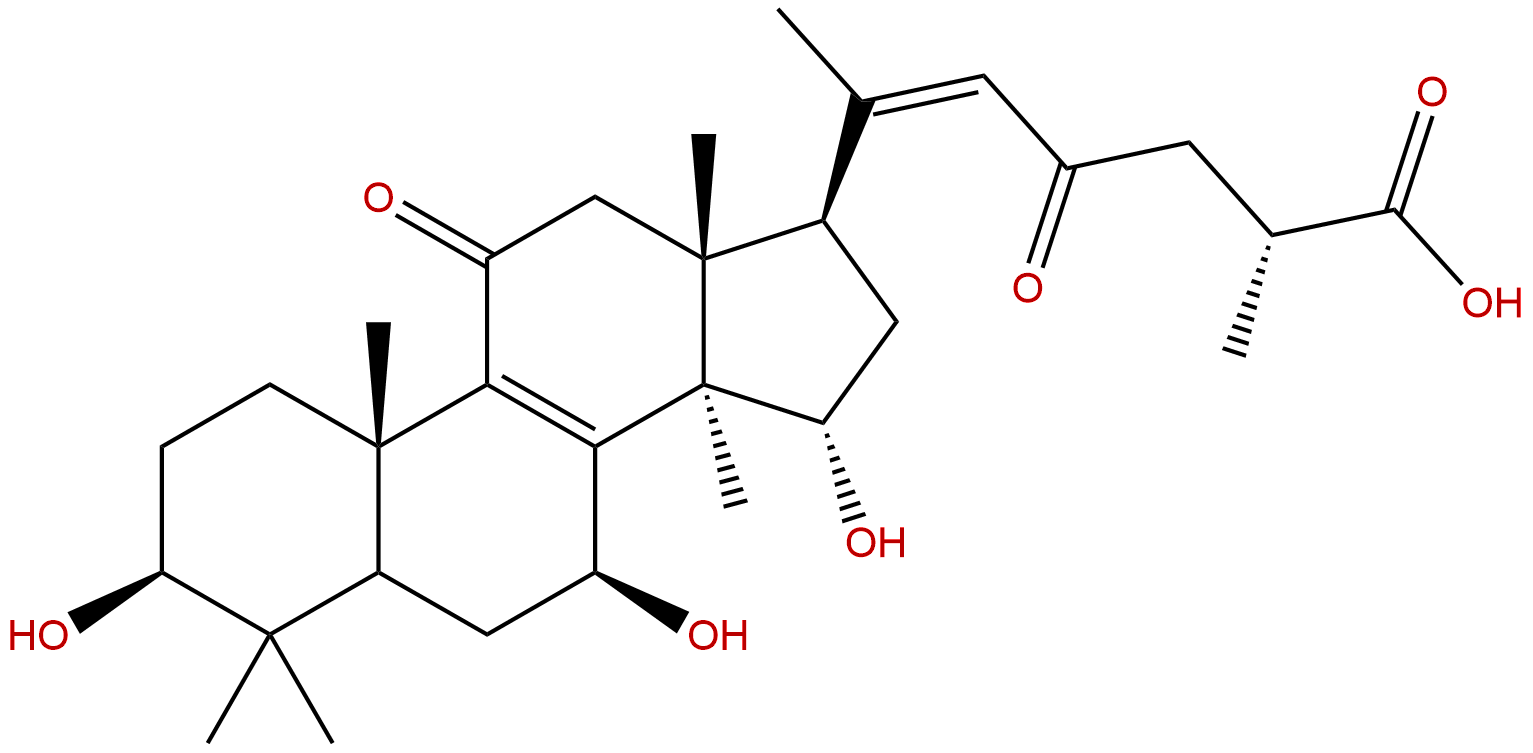


Product name: Ganoderenic acid C
Synonym name:
Catalogue No.: BP3152
Cas No.: 100665-42-7
Formula: C30H44O7
Mol Weight: 516.675
Botanical Source:
Physical Description: Powder
Type of Compound: Triterpenoids
Purity: 95%~99%
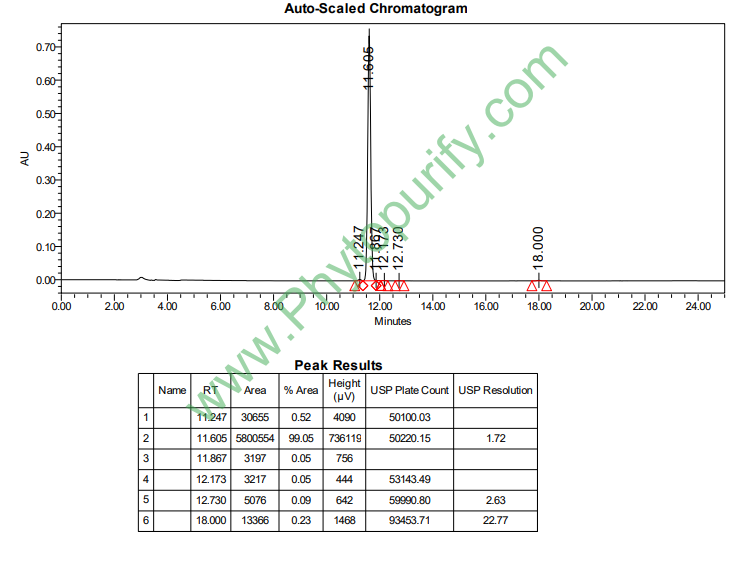
Analysis Method: HPLC-DAD or/and HPLC-ELSD
Identification Method: Mass, NMR
Packing: Brown vial or HDPE plastic bottle
The product could be supplied from milligrams to grams. Inquire for bulk scale.
We provide solution to improve the water-solubility of compounds, thereby facilitating the variety of activity tests and clinic uses.
For Reference Standard and R&D, Not for Human Use Directly.
HPLC of Ganoderenic acid C
Storage conditions:Short-term storage at 2~8℃, long-term storage at -20 ~ -80℃
132.1300
2.7840
.5048
.0558
1.2501
3.7232
Low
83.5403
5.3191
No
No
Yes
No
No
No
0.0
Yes
No
No
No
Natural products, as an important treasure trove for drug discovery and development, play an irreplaceable role in the history of human disease prevention and treatment. Among them, the fungus Ganoderma lucidum in the family Polyporus(Ganoderma lingzhi)As a treasure of traditional Chinese medicine, it has a history of more than two thousand years of application and is known as the "fairy grass". Its effects of strengthening the body and promoting longevity are widely known. Modern pharmacological research reveals that the various biological activities of Ganoderma lucidum are mainly attributed to its rich compounds such as triterpenoids, polysaccharides, sterols, etc. Among numerous triterpenoids in Ganoderma lucidum, ganoderic acid C (CAS: 100665-42-7) is a characteristic component, especially abundant in the early stages of Ganoderma lucidum fruiting body growth. In recent years, it has attracted much attention due to its significant immunomodulatory activity.
The immune system is the core of the body's defense against pathogens and maintenance of homeostasis in the internal environment. Immune disorders are closely related to the occurrence and development of many diseases, including autoimmune diseases, chronic inflammation, tumors and infectious diseases. Therefore, finding efficient and low toxicity immunomodulators is an important direction for current drug development. Lingzhi acid C, as a naturally derived compound, exhibits unique advantages in its multi-target and multi pathway immune regulatory properties. This article aims to systematically review the chemical structure, plant sources, pharmacological activities, especially its immunomodulatory effects and related molecular targets of Ganoderma lucidum acid C, and evaluate and prospect its medicinal properties and clinical application prospects, in order to provide comprehensive scientific references for the in-depth research and potential development of this compound.
Lingzhi acid C belongs to highly oxidized lanostane triterpenoids. Its molecular formula is C30H44O7 and its molecular weight is 516.6750. Its core structure is a tetracyclic triterpenoid skeleton (cyclopentane and polyhydrogen phenanthrene), and it has multiple oxygen-containing functional groups, including carboxyl, hydroxyl, and carbonyl groups, which have a decisive impact on its biological activity and physicochemical properties.
From the analysis of physical and chemical properties, the lipid water partition coefficient (LogP) of Ganoderma lucidum acid C is 2.7840, indicating that it has a certain lipophilicity, but not highly hydrophobic. Its topological polar surface area (TPSA) is 132.1300 Å ², reflecting the larger surface area occupied by polar atoms (such as oxygen atoms) in the molecule, which is consistent with its structural characteristics of containing multiple hydroxyl and carboxyl groups in the molecule. The water solubility data shows 0.0558 mg/mL, which belongs to the category of slightly soluble to poorly soluble in water. This is a common feature of many triterpenoid compounds and suggests that solubilization strategies may need to be considered in formulation development.
In the preliminary evaluation of the safety parameters of the drug, ganoderic acid C showed low blood-brain barrier permeability, which suggests that it may not easily produce central nervous system related side effects, but also limits its direct effects on central nervous system diseases. Importantly, in the in vitro toxicity screening, the compound did not show significant hERG potassium channel inhibitory activity (hERG inhibition: No), indicating a low risk of causing QT interval prolongation and apical torsion type ventricular tachycardia in the heart. In addition, its Ames test result was 0.0, which preliminarily indicates no mutagenicity under the test conditions used, providing a preliminary positive signal for its safety.
Lingzhi acid C mainly comes from the medicinal fungus Lingzhi(Ganoderma lingzhi)This is a species determined after taxonomic revision in 2012, which is different from the traditional Ganoderma lucidum(G. lucidum)There are differences in genetic and chemical composition. Research has shown that ganoderic acid C is relatively high in the fruiting bodies of Ganoderma lucidum, especially in its early growth stages such as the bud stage or juvenile fruiting bodies. As the fruiting body matures, the composition and proportion of some triterpenoid compounds may change, providing guidance on the timing of harvesting for targeted acquisition of high content ganoderic acid C raw materials.
The extraction of ganoderic acid C from Ganoderma lucidum matrix usually follows the conventional process of natural product chemistry. Due to the wide polarity range of triterpenoids and the carboxyl group content of ganoderic acid C in Ganoderma lucidum, its extraction and separation methods need to comprehensively consider its solubility.
1. Extract The most commonly used method is solvent extraction. Given the LogP value of ganoderic acid C, using moderately polar organic solvents or mixed solvent systems with higher efficiency, such as methanol, ethanol, ethyl acetate, or alcohol water mixed solvents in different proportions. Ultrasound assisted extraction and heating reflux extraction are commonly used physical aids to improve extraction efficiency. Supercritical CO2 extraction technology, as a green method, is also suitable for the extraction of lipophilic components, and can optimize the selectivity for triterpenoids by adjusting pressure and temperature.
2. Separation and Purification The crude extract has complex components and requires multiple steps of separation to obtain pure product. Silica gel column chromatography is often used as a preliminary separation method, using different polarity eluents (such as petroleum ether ethyl acetate, chloroform methanol gradient system) for elution. Subsequently, further purification can be performed using reverse phase silica gel column chromatography (such as C18 column, with methanol water or acetonitrile water as mobile phase), preparative high-performance liquid chromatography (HPLC), or medium pressure liquid chromatography (MPLC). The structural identification of ganoderic acid C relies on modern spectroscopic techniques, including nuclear magnetic resonance (1H-NMR, 13C-NMR, 2D-NMR), mass spectrometry (MS), and infrared spectroscopy (IR).
In addition, in order to meet the needs of in-depth research and large-scale application, the use of fungal fermentation technology (liquid deep fermentation) to produce Ganoderma triterpenoids, including ganoderic acid C, has become an important research direction. By optimizing the strain, medium composition, fermentation conditions (pH, temperature, dissolved oxygen, inducer addition, etc.), it is expected to achieve stable and improved yield of the target compound.
The pharmacological activity research of Ganoderma lucidum acid C mainly focuses on its powerful immune regulatory effect, which is also an important manifestation of Ganoderma lucidum's "strengthening the body and consolidating the foundation" effect in modern pharmacology. Its immune regulatory activity has multidirectionality, that is, it can exert a bidirectional regulatory effect of immune enhancement or immune suppression according to the different immune states of the body.
1. Immune enhancement effect Lingzhi acid C exhibits immunostimulatory potential in immunocompromised or suppressed states. Research has shown that it can promote the development or functional recovery of immune organs such as thymus and spleen, enhance the phagocytic activity of macrophages, and stimulate lymphocyte proliferation. For example, in animal models of immunosuppression induced by chemotherapy drugs such as cyclophosphamide, pre-treatment or treatment with ganoderic acid C can significantly increase peripheral blood leukocyte count, improve spleen index, and enhance the activity of natural killer (NK) cells and cytotoxic T lymphocytes (CTL), thereby improving the body's ability to fight against tumors and infections.
2. Immunosuppressive/anti-inflammatory effects Under excessive immune activation or autoimmune conditions, ganoderic acid C exhibits anti-inflammatory and immunosuppressive properties. In various acute and chronic inflammation models, such as mouse ear swelling, foot swelling, and colitis models, ganoderic acid C can effectively reduce tissue edema, inflammatory cell infiltration, and the production of pro-inflammatory mediators. Its anti-inflammatory effect is closely related to regulating the balance of immune cells, especially inhibiting the excessive activation of Th1 and Th17 cells, while possibly promoting the differentiation and function of regulatory T cells (Tregs).
3. Antitumor adjuvant effect Although the direct cytotoxic effect of ganoderic acid C may not be as strong as some other ganoderic triterpenoids (such as ganoderic acid), its anti-tumor effect mediated by immune regulation deserves attention. It may enhance the recognition and killing of tumor cells by immune cells by activating intrinsic and adaptive immune responses in the tumor microenvironment, or reverse tumor related immune suppression states, thereby producing synergistic effects with chemotherapy, radiotherapy, and other methods, improving tumor treatment efficacy and reducing side effects.
4. Other potential activities Based on the extensive activity spectrum of triterpenoids in Ganoderma lucidum, ganoderic acid C may also have hepatoprotective and antioxidant effects, but there are relatively few specialized research reports in these areas, which need further exploration.
The immunomodulatory effect of ganoderic acid C is not achieved through a single target, but involves a complex signaling network. Existing research (including the target information you provided) suggests that its mechanism of action is closely related to key signaling pathways and transcription factors that regulate innate and adaptive immunity.
1. Regulating innate immune signaling - TLR4/NF - κ B pathway Toll like receptor 4 (TLR4) is an important receptor that recognizes pathogen related molecular patterns and initiates innate immune responses. The overactivated TLR4/NF - κ B signaling pathway is at the core of many inflammatory diseases. Research has shown that ganoderic acid C can inhibit TLR4 mediated signaling, thereby suppressing the activation of nuclear factor kappa B (NF - κ B, encoded by the NFKB1 gene). NF - κ B is a key transcription factor that regulates the expression of numerous pro-inflammatory cytokines (such as TNF - α, IL-1 β, IL-6), chemokines, and enzymes (such as COX-2, iNOS). By inhibiting the nuclear translocation of NF - κ B and its binding activity with DNA, ganoderic acid C can effectively downregulate the expression of downstream inflammatory mediators, which is one of its core mechanisms for exerting anti-inflammatory effects.
2. Regulating cytokine network and JAK/STAT pathway Cytokines are the "language" of communication between immune cells. Lingzhi acid C has a regulatory effect on the production of various cytokines.
* Inhibit pro-inflammatory factors It can reduce the levels of Th1 cytokines such as interferon - γ (IFNG) and interleukin-2 (IL2), which are associated with cellular immunity and autoimmune pathology.
* Promote anti-inflammatory factors At the same time, it may upregulate the expression of interleukin-10 (IL10) and transforming growth factor - β 1 (TGFB1). IL-10 is an important anti-inflammatory cytokine, and TGF - β 1 plays a key role in inducing immune tolerance and Treg cell differentiation.
* Targeting STAT protein The Signal Transduction and Transcription Activation Factor (STAT) family is a downstream effector of the JAK/STAT pathway, mediating the transmission of cytokine signals from the membrane to the nucleus. Lingzhi acid C has been reported to inhibit the phosphorylation activation of STAT3 and STAT4. The sustained activation of STAT3 is associated with chronic inflammation and tumor immune escape; STAT4 is mainly involved in IL-12-mediated Th1 cell differentiation and IFN - γ production. Inhibiting both can help correct the imbalance of Th1/Th2 or Th17/Treg.
3. Affects the differentiation and function of adaptive immune cells:
* Regulating T cell subpopulations Lingzhi acid C may affect the differentiation of initial CD4+T cells through changes in the cytokine environment mentioned above. It inhibits key signals that lead to the differentiation of Th1 and Th17 cells (such as STAT4, pro-inflammatory environment), while potentially creating conditions favorable for Treg cell differentiation (via TGF - β 1). The core transcription factor of Treg cells is FOXP3, and its upregulation is a key marker of Treg cell functional maturation. The potential promoting effect of ganoderic acid C on FOXP3 expression is an important molecular basis for inducing immune tolerance and inhibiting excessive immune response.
* Regulating immune checkpoints Cytotoxic T lymphocyte associated antigen 4 (CTLA4) is an important negative immune checkpoint molecule on T cells, crucial for maintaining immune tolerance and preventing autoimmunity. Lingzhi acid C may participate in finely regulating the activation threshold of T cells and preventing excessive activation by regulating the expression of CTLA4 or related pathways.
In summary, ganoderic acid C forms a synergistic regulatory network through multi-target action, from inhibiting innate immune overactivation (TLR4/NF - κ B), to regulating key signaling nodes (STAT3/4), and then affecting adaptive immune cell differentiation (Th1/Th17/Treg) and function (cytokine secretion, checkpoint expression), thereby achieving bidirectional and steady-state regulation of the immune system.
Based on the aforementioned physicochemical properties and safety screening data, ganoderic acid C has shown certain potential as a drug, but also faces challenges common to typical triterpenoid compounds.
Pharmaceutical advantages:
1. The initial screening of safety is good The absence of hERG inhibition and Ames mutagenicity alert provides a good starting point for its preclinical safety assessment.
2. Clear activity and target Having clear immunomodulatory pharmacological activity and partially known targets of action is beneficial for mechanism oriented drug development.
3. Natural source, with a long history As a component of traditional medicinal fungi, it has a long-term (although not direct) history of human use, which may reduce some of the risks of early development.
challenges faced:
1. Solubility and permeability Low water solubility and moderate LogP value (belonging to the BCS class II or IV of the biopharmaceutical classification system) may lead to poor oral absorption and low bioavailability. This is one of the main obstacles to its conversion into drugs.
2. Pharmacokinetic properties unknown Currently, there is a severe lack of publicly available pharmacokinetic studies (including absorption, distribution, metabolism, and excretion, i.e. ADME) data on the Ganoderma lucidum C-system. The key parameters such as oral absorption degree, plasma protein binding rate, major metabolic organs, metabolites, and elimination half-life are still unclear.
3. Low blood-brain barrier permeability Although it reduces the risk of central side effects, it also means that its direct therapeutic effect on central nervous system related immune diseases may be limited.
improvement strategy:
To overcome these obstacles, future research can focus on:
* Prodrug design Chemical modifications such as esterification and salt formation are carried out on its carboxyl or hydroxyl groups to improve its solubility and membrane permeability.
* Formulation technology Develop nano formulations (such as liposomes, nanoparticles, micelles), solid dispersions, cyclodextrin inclusion complexes, or self microemulsion delivery systems to significantly improve their solubility and oral bioavailability.
* Research on System PK/PD Conduct comprehensive pharmacokinetic pharmacodynamic (PK/PD) studies in appropriate animal models to clarify the relationship between in vivo processes and drug efficacy, providing a basis for formulation design and optimization of dosing regimens.
* Metabolic stability assessment Study its metabolic stability in liver microsomes or liver cells, identify major metabolic enzymes (such as CYP450 isoenzymes), and predict potential drug drug interactions.
Lingzhi acid C, as a multi-target immune modulator, has broad application prospects in the prevention and treatment of various immune related diseases.
Potential clinical application directions:
1. Autoimmune diseases Such as rheumatoid arthritis, systemic lupus erythematosus, multiple sclerosis, inflammatory bowel disease (Crohn's disease, ulcerative colitis), etc. It may effectively control disease activity by inhibiting the Th1/Th17 pathway, promoting Treg function, and downregulating pro-inflammatory cytokines through multiple mechanisms, and the multi-target nature of natural products may bring better safety.
2. Chronic inflammatory diseases Such as chronic hepatitis, allergic asthma, atopic dermatitis, etc. Its anti-inflammatory and immunomodulatory effects help alleviate persistent tissue inflammatory damage.
3. Adjuvant drugs for tumor immunotherapy Combined with chemotherapy, radiotherapy, and immune checkpoint inhibitors (such as PD-1/PD-L1 antibodies). Lingzhi acid C may have a synergistic and detoxifying effect by improving the tumor immune microenvironment, enhancing anti-tumor immune response, and reducing immune suppression caused by radiotherapy and chemotherapy.
4. Infectious diseases and Immune Deficiency As an immune enhancer, it is used to assist in the treatment of chronic infections (such as chronic hepatitis B and tuberculosis), or to improve the immune dysfunction of cancer patients and the elderly population.
Future research prospects:
1. In depth mechanism exploration Using gene knockout CRISPR-Cas9、 Proteomics and other technologies are used to further validate its direct interactions with targets such as TLR4 and STAT3, and to create a more complete signal network map. Study its specific effects on different subgroups of immune cells, such as B cells, dendritic cells, and myeloid derived suppressor cells (MDSCs).
2. Preclinical development Complete the pharmacological evaluation of the system (validated in more animal models closer to human diseases), pharmacokinetic studies, toxicological evaluations (acute toxicity, long-term toxicity, reproductive toxicity, etc.), and provide sufficient data support for its entry into clinical trials.
3. Structural optimization and derivative development Using ganoderic acid C as the lead compound, structural modification and structure-activity relationship studies were conducted to obtain derivatives or analogues with stronger activity and better drug properties (such as high oral bioavailability and metabolic stability).
4. Translational Medicine Research Explore its potential as a functional food additive or health supplement for immune regulation in sub-health states. At the same time, conduct early exploratory clinical studies to evaluate its safety and initial effectiveness in specific populations.
Ganoderma lucidum acid C is a triterpenoid compound with important biological activity contained in Ganoderma lucidum, a traditional medicinal fungus. It inherits the core characteristics of Ganoderma lucidum as an "immune modulator" and regulates important transcription factors such as STAT3 and FOXP3 by acting on key signaling pathways such as TLR4/NF - κ B and JAK/STAT. It affects the differentiation and function of immune cell subsets such as Th1, Th17, and Treg, thereby achieving bidirectional and multi-target regulation of the immune system. Despite facing challenges in solubility, pharmacokinetics, and other aspects, its clear mechanism of action, good preliminary safety, and broad prospects for disease applications make it an extremely attractive candidate drug lead compound. With the continuous advancement of modern medicinal chemistry, pharmacy, and pharmacology technologies, through systematic structural optimization, formulation innovation, and in-depth preclinical research, ganoderic acid C is expected to transform from a traditional natural product component into a modern drug for treating autoimmune diseases, chronic inflammation, and assisting tumor immunotherapy, contributing new strength to human health. Future research needs to advance simultaneously in depth and breadth, accelerating its transition from laboratory to clinical use.
