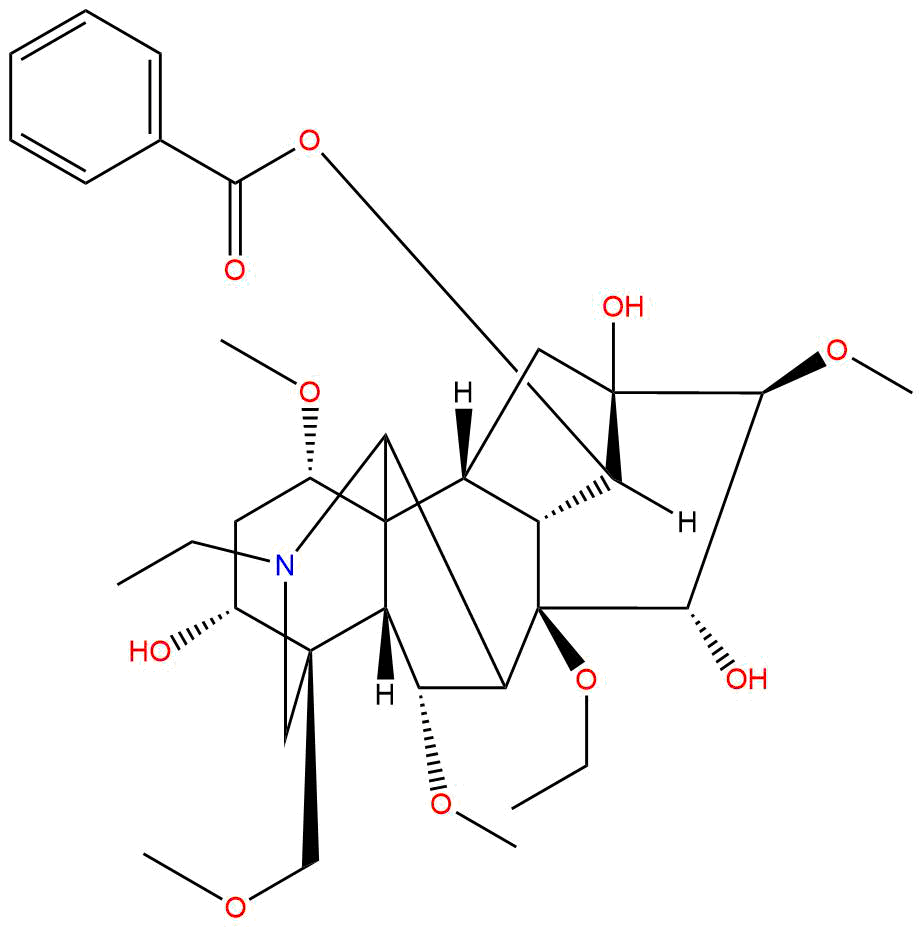


Product name: Spicatine A
Synonym name: 8-O-Ethylbenzoylaconine;8-O-Ethyl-14-benzoylaconine
Catalogue No.: BP5200
Cas No.: 124256-81-1
Formula: C34H49NO10
Mol Weight: 631.763
Botanical Source: Aconitum carmichaelii Debx.
Type of Compound: Alkaloids
Purity: 95%~99%
Analysis Method: HPLC-DAD or/and HPLC-ELSD
Identification Method: Mass, NMR
Packing: Brown vial or HDPE plastic bottle
Storage: Store in a well closed container, protected from air and light. Put into refrigerate or freeze for long term storage.
Whenever possible, you should prepare and use solutions on the same day. However, if you need to make up stock solutions in advance, we recommend that you store the solution as aliquots in tightly sealed vials at -20℃. Generally, these will be useable for up to two weeks.
The product could be supplied from milligrams to grams
Inquire for bulk scale.
For Reference Standard and R&D, Not for Human Use Directly.
Storage conditions:Short-term storage at 2~8℃, long-term storage at -20 ~ -80℃
8-O-ethyl-14-benzoyl aconitine A (CAS number: 124256-81-1) is a natural alkaloid derived from Aconitum plants, which has received widespread attention in the pharmacological community in recent years due to its significant analgesic activity. As a complex alkaloid derivative, Spicatine A has certain medicinal value in traditional Chinese medicinal materials, and its unique chemical structure endows it with the potential for multi-target action. Analgesia, as a common and complex clinical treatment requirement, involves the regulation of multiple receptors and pathways. Natural products have become important resources for the development of new analgesic drugs due to their structural diversity and biological activity complexity. This article systematically reviews the chemical structure and physicochemical properties, plant sources and extraction methods, pharmacological activity and mechanism of action, pharmacological evaluation and pharmacokinetic characteristics of Spicatine A, and looks forward to its clinical application potential, aiming to provide theoretical basis and reference for the in-depth research and drug development of this natural product.
Spicatine A is a alkaloid with a complex polycyclic structure, with a molecular weight of 631.7630 and a complex molecular formula, containing multiple aromatic rings and ester groups. Its chemical name "8-O-ethyl-14-benzoyl aconitine" reflects the key ethyl and benzoyl modifying groups in its molecule. These structural modifications not only affect its molecular hydrophobicity and polarity, but also play a decisive role in its binding affinity with biological targets.
In terms of physical and chemical properties, the LogP value of Spicatine A is 2.2721, indicating its moderate lipophilicity, which is beneficial for membrane penetration but not excessively hydrophobic, leading to a decrease in bioavailability. Its polar surface area (TPSA) is 136.38 Å ², indicating that the molecule has a high polarity region, which may affect its transmembrane transport and receptor binding. The low water solubility (0.1808 mg/mL) limits its solubility in aqueous phase, indicating the need to consider solubility enhancement strategies in drug formulation design. The low permeability of the blood-brain barrier suggests that its direct central nervous system effects may be limited, but there is a greater possibility of exerting analgesic effects through peripheral targets. The hERG channel inhibition experiment showed a negative result, indicating a low risk of cardiac toxicity. The Ames test value is 0.3, indicating a low risk of genetic toxicity and meeting safety requirements.
Spicatine A mainly comes from Aconitum spp. plants, especially in some traditional Chinese medicinal herbs such as Chuanwu and Caowu, where its content is relatively abundant. Aconitum plants are widely distributed in temperate and subtropical regions of Asia and have always been used for the treatment of diseases such as rheumatism and neuralgia. Due to the complexity and limited content of its alkaloid components, extraction and separation processes are crucial for obtaining high-purity Spicatine A.
The commonly used extraction methods include solvent extraction and liquid-liquid distribution, usually using ethanol or methanol as the extraction solvent to ensure sufficient dissolution of alkaloids. After concentration, impurities are removed by acid-base adjustment method, and then separated and purified by column chromatography (such as silica gel column, C18 reverse phase column) and high performance liquid chromatography (HPLC) technology. In recent years, the application of ultrasound assisted extraction and microwave-assisted extraction technologies has improved extraction efficiency and purity, reduced solvent usage and extraction time. In addition, the extract was structurally identified using mass spectrometry and nuclear magnetic resonance (NMR) techniques to ensure accurate separation and identification of Spicatine A.
Spicatine A, as a natural alkaloid, exhibits significant analgesic activity mainly through multi-target regulation. Both in vitro and in vivo experiments have confirmed that it has a relieving effect on various pain models, including inflammatory pain, neuropathic pain, and pain caused by mechanical stimulation.
Research has shown that Spicatine A can effectively inhibit the release of inflammatory mediators, alleviate inflammatory reactions, and thus alleviate inflammatory pain. In addition, it exhibits neuroprotective effects in neuropathic pain models, reducing pain hypersensitivity caused by nerve damage. In animal experiments, Spicatine A showed good analgesic effects with few adverse reactions, demonstrating high safety and tolerability.
Compared to traditional opioid analgesics, Spicatine A works through non opioid receptor pathways, reducing the risk of addiction and resistance. Its multi-target mechanism of action makes it more widely applicable in complex pain states.
The analgesic effect of Spicatine A involves multiple molecular targets, mainly including:
TRPV1 (Transient receptor potential vanillic acid subtype 1)TRPV1 is a key ion channel in pain perception, involved in pain transmission caused by inflammation and thermal stimulation. Spicatine A can exert analgesic effects by modulating TRPV1 activity, reducing the excitability of pain nerves.
CNR1 (cannabinoid receptor 1)As an important component of the endocannabinoid system, CNR1 plays a crucial role in pain regulation. Spicatine A may act as a regulator of CNR1, enhancing endogenous analgesic signaling.
OPRD1 (δ - opioid receptor), OPRM1 (μ - opioid receptor), OPRK1 (κ - opioid receptor)These opioid receptors are classic analgesic targets. Spicatine A has a certain affinity for these receptors and may alleviate pain by activating or regulating opioid receptor signaling pathways.
PTGS1 (cyclooxygenase-1) and PTGS2 (cyclooxygenase-2)These two enzymes catalyze the synthesis of prostaglandins, which participate in inflammatory responses and pain transmission. The inhibitory effect of Spicatine A on PTGS1/2 reduces the production of inflammatory mediators and exerts anti-inflammatory and analgesic effects.
TRPA1 (Transient receptor potential vanillic acid subtype A1)TRPA1 channel is involved in the perception of chemical stimulation and inflammatory pain. Spicatine A reduces pain sensation by regulating TRPA1 channel activity.
SLC6A4 (Serotonin Transporter)The serotonin system plays an important role in regulating central and peripheral pain. Spicatine A may improve pain status by affecting SLC6A4, regulating serotonin levels.
DRD2 (dopamine D2 receptor)The dopamine system is involved in the emotional and cognitive regulation of pain. The effect of Spicatine A on DRD2 may help alleviate pain related emotional disorders.
In summary, Spicatine A exhibits a unique and complex analgesic mechanism by synergistically regulating pain signal transduction and inflammatory response through multiple targets and pathways.
From the perspective of drug development, Spicatine A exhibits ideal drug properties. Its moderate molecular weight and LogP value comply with Lipinski's rule, which is beneficial for the oral absorption of the drug. A higher TPSA indicates a higher polarity, which may limit some cell membrane penetration but also contribute to target selectivity. Low water solubility is a major challenge in the development of its formulations, and its bioavailability needs to be improved through techniques such as salt formation, nanocarriers, or liposomes.
The low permeability of the blood-brain barrier suggests that its analgesic effect is mainly achieved at the peripheral or spinal cord level, reducing the risk of central nervous system side effects. The negative inhibition of hERG channel and low risk of genetic toxicity further support its safety.
Pharmacokinetic studies are still in the preliminary stage, and existing data indicate that Spicatine A is metabolically stable in vivo, mainly metabolized through the liver enzyme system, and excreted through bile and urine as the main pathways. Moderate half-life, supporting the design of daily dosing regimens. In the future, further research on in vivo absorption, distribution, metabolism, and excretion (ADME) and toxicological evaluation are needed to improve its pharmacokinetic characteristics.
Given the significant analgesic activity and good safety demonstrated by Spicatine A in various pain models, it has broad clinical application prospects. Its multi-target mechanism of action provides a new therapeutic approach for intractable pain, especially in cases of opioid resistance or limited side effects. Spicatine A may become an ideal candidate for alternative or adjuvant therapy.
Future research should focus on the following aspects:
Formulation optimization and administration route Improve water solubility and bioavailability, develop oral, topical, or injectable formulations to meet different clinical needs.
Systematic pharmacokinetic and toxicological studies Clarify its metabolic pathway, long-term safety, and potential toxicity in the body.
Preclinical and clinical trials Conduct multi center and multi-stage clinical trials to verify their effectiveness and safety, and determine the scope of indications.
Combination therapy research Explore synergistic effects with existing analgesics to reduce dosage and side effects.
In depth analysis of molecular mechanisms Using modern molecular biology techniques to analyze its binding mode with targets and signal regulatory network, guiding structural optimization and new drug design.
In summary, Spicatine A, as a potential natural analgesic drug, is expected to play an important role in the field of pain management in the future.
8-O-ethyl-14-benzoylaconitine A exhibits excellent pharmacological activity and safety due to its unique chemical structure and multi-target analgesic mechanism. Its potential in pain treatment has attracted widespread attention, especially in the context of the challenges of drug resistance and side effects faced by current analgesics. Through systematic chemical, pharmacological, and pharmacological studies, Spicatine A provides a valuable research paradigm for natural product pharmacology and the development of novel analgesics. In the future, combining modern drug development technology and clinical validation, it is expected to promote its clinical translation and benefit more pain patients.
