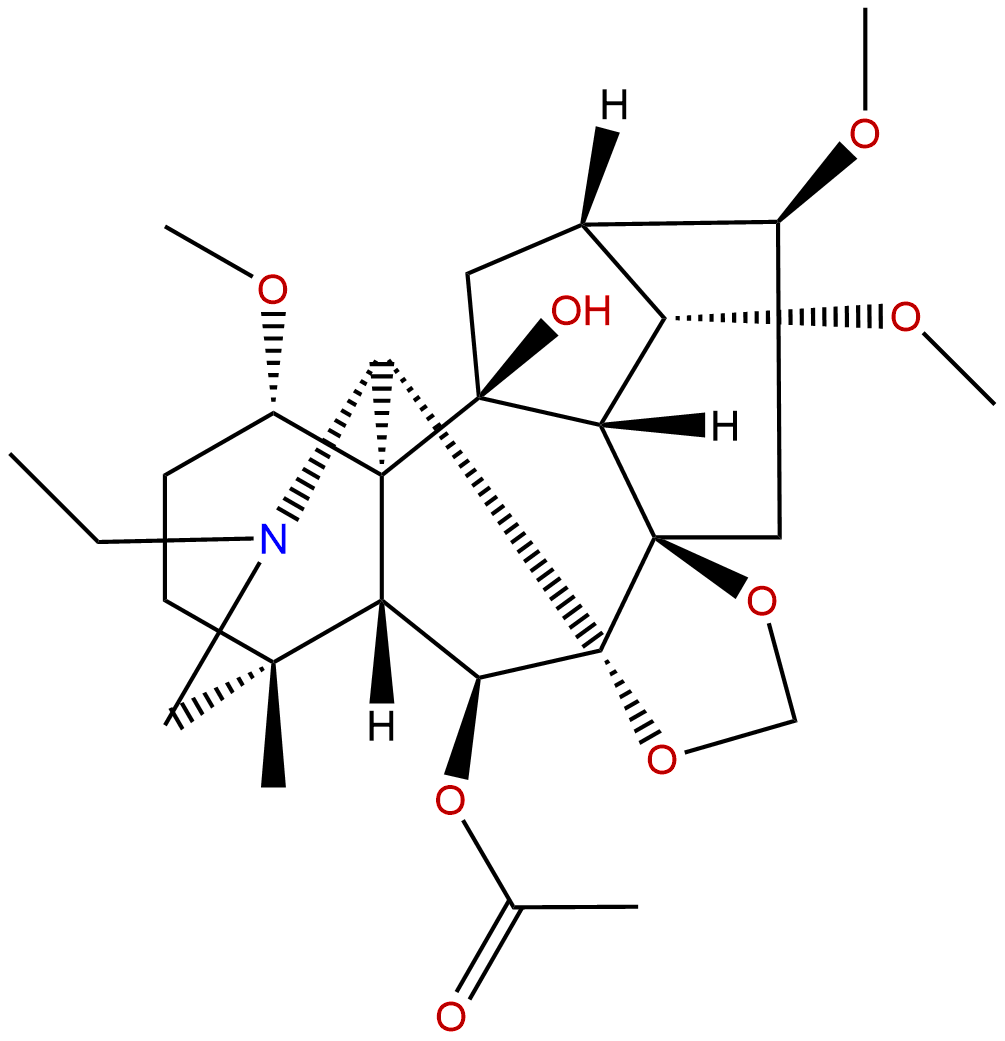


Synonym name: Delphelatine; Eldeline
Catalogue No.: BP0471
Cas No.: 6836-11-9
Formula: C27H41NO8
Mol Weight: 507.624
Botanical Source: Alkaloid from Delphinium occidentale, Delphinium elatum, Delphinium bonvalotii, Delphinium dictyocarpum, Delphinium glaucescens, Delphinium iliense and Aconitum columbianum ssp. columbianum (Ranunculaceae)
Purity: 95%~99%
Analysis Method: HPLC-DAD or/and HPLC-ELSD
Identification Method: Mass, NMR
Packing: Brown vial or HDPE plastic bottle
Can be supplied from milligrams to grams.
For Reference Standard and R&D, Not for Human Use Directly.
Inquire for bulk scale.
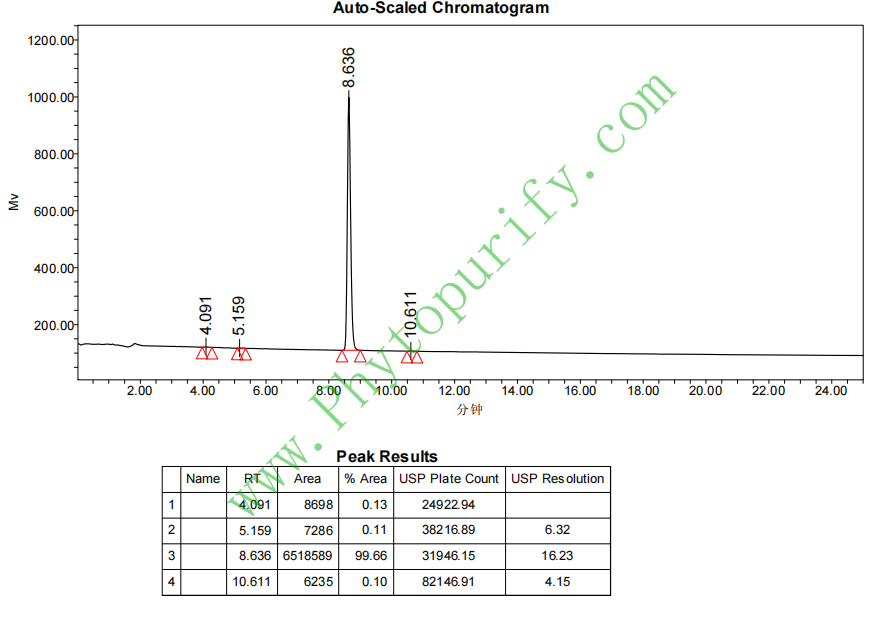
HPLC of Deltaline
Storage conditions:Short-term storage at 2~8℃, long-term storage at -20 ~ -80℃
95.9200
1.7138
1.6932
.3894
2.8003
3.2994
High
50.1981
7.8102
No
No
No
No
Yes
No
0.6
Yes
No
Yes
Yes
Diterpenoid alkaloids are a class of natural products with complex structures and diverse biological activities, widely distributed in the family Ranunculaceae and genus Quercus(Delphinium)And Aconitum genus(Aconitum)In plants. These compounds have attracted much attention due to their significant neuropharmacological activities, such as pain relief and muscle relaxation, and have also become a research hotspot due to their potential toxicity and complex mechanisms of action. Deltaline (CAS: 6836-11-9) is derived from the traditional medicinal plant Dian Chuan Cui Que Hua(Delphinium delavayi A C19 type diterpenoid alkaloid isolated from Franch. Traditionally, Dianchuan Cuiquehua plants have been used in folk medicine to treat rheumatic pain, stroke paralysis, and rheumatoid arthritis, indicating that they contain ingredients with analgesic and anti-inflammatory activities. In recent years, with the deepening of research on neurodegenerative diseases, the pharmacological activity research of Delitalin has expanded from the traditional field of analgesia to the field of complex neurological diseases such as cognitive impairment. This article aims to provide a systematic review of the chemical structure, plant origin, pharmacological activity, potential molecular targets, medicinal properties, and application prospects of Delitalin in diseases such as cognitive impairment, in order to provide scientific references for the in-depth research and development of this compound.
Deltalin is a typical C19 diterpenoid alkaloid (hetisine type) with a molecular formula of C27H41NO7 and a molecular weight of 507.6240. Its core structure consists of a six ring skeleton, including a hetisine type diterpene parent nucleus and one or more hydroxyl and methoxy substituents, as well as a tertiary amine structure formed by a nitrogen atom. This complex multi ring rigid structure is the basis for its interaction with multiple biological targets.
From the analysis of parameters related to drug properties, Deltalin exhibits certain drug like characteristics. Its lipid water partition coefficient (LogP) is 1.7138, indicating that it has moderate lipophilicity and is conducive to transmembrane transport. The topological polar surface area (TPSA) is 95.92 Å ², which is lower than the common high permeability threshold (~140 Å ²), consistent with its good membrane permeability prediction. The water solubility value is 0.3894 mg/mL, which belongs to the category of slight solubility. This may affect the development of its formulation, but it can be improved through salt formation or formulation technology. More importantly, its predicted blood-brain barrier (BBB) permeability is "high", which provides a prerequisite for its direct action on central nervous system targets and treatment of brain diseases such as cognitive impairment. Preliminary safety predictions indicate that the risk of hERG inhibition is "no", suggesting a low risk of cardiac toxicity; The Ames test value is 0.6, indicating a low risk of mutagenicity and potential for further development.
The main source of Delitalin comes from plants in the Ranunculaceae family, including the Dianchuan Cuique flower(Delphinium delavayi)As the main source. This plant is distributed in high-altitude areas of southwestern China and has a long history of medicinal use in folk culture. The content of alkaloids in plants is significantly affected by their place of origin, harvest season, and location, and is usually higher in the roots and aboveground parts before flowering.
The extraction of Del Talin usually follows the general process of natural alkaloids. Firstly, the dried plant material is crushed and moistened with a weakly alkaline aqueous solution (such as ammonia) to convert alkaloid salts into free bases. Subsequently, organic solvents such as chloroform, dichloromethane, or ethanol are used for percolation, reflux, or ultrasound assisted extraction. The crude extract is extracted with acidic water (such as dilute hydrochloric acid), and the alkaloids are salted and dissolved in the aqueous phase; After alkalization, free alkaloids are extracted again by organic solvents to achieve preliminary enrichment. Further purification relies on column chromatography techniques, often using silica gel, alumina, or reverse phase silica gel (such as C18) as the stationary phase, and gradient elution with solvent systems such as chloroform methanol or hexane ethyl acetate in different ratios. High performance liquid chromatography (HPLC), especially preparative HPLC, is the ultimate key step in obtaining high-purity Deltalin monomers. Structural identification involves the comprehensive use of mass spectrometry (MS), nuclear magnetic resonance (NMR, including 1H, 13C, 2D-NMR), and X-ray single crystal diffraction techniques.
The potential of Del Tallinn to improve cognitive impairment is closely related to its regulatory effects on multiple disease-related targets. According to the provided target information, its mechanism of action may involve the following networks:
In summary, Del Talin may alleviate A β and Tau pathology, inhibit neuroinflammation, protect synaptic function, and improve cognitive impairment through a synergistic network of multiple targets and pathways. This "multi-target" characteristic may have unique advantages in treating diseases with complex etiologies such as Alzheimer's disease.
The pharmacological evaluation based on calculations and preliminary experimental data shows that Delitalin has a good physical and chemical foundation for development as a central nervous system drug. Its moderate LogP, low TPSA, and predicted high BBB permeability are key factors in its ability to enter brain tissue and exert its effects. The absence of hERG inhibition risk reduces concerns about early development of arrhythmia, and negative Ames test results provide preliminary support for its safety.
However, comprehensive drug development still requires in-depth pharmacokinetic (PK) and toxicological studies. At present, there is a lack of PK data (such as absorption, distribution, metabolism, and excretion) on the Del Tallinn system in public literature. Future research needs to focus on: its oral bioavailability; The distribution characteristics in the body, especially the relationship between brain tissue concentration and time; Its main metabolic pathways, metabolic enzymes (such as CYP450 enzyme system), and metabolic product activities; And its elimination half-life and excretion pathway. Its moderate water solubility suggests that its bioavailability may need to be improved through prodrug design or formulation optimization (such as nano formulations, cyclodextrin inclusion). Although the preliminary prediction of safety is good, the potential neurotoxicity and therapeutic window of diterpenoid alkaloids need to be clarified through systematic acute and long-term toxicity experiments.
The clinical application prospects of Deltalin mainly revolve around neurological diseases:
The challenges faced mainly include: ① the difficulty of fully or semi synthesizing complex structures, which limits large-scale structure-activity relationship research; ② The multi-target characteristic is both an advantage and a challenge, and it is necessary to clarify the target correlation between its therapeutic effect and potential side effects; ③ A complete preclinical pharmacodynamic, pharmacokinetic, and toxicological evaluation system needs to be completed.
As a diterpenoid alkaloid discovered from traditional medicinal plants, the research on Del Talin has expanded from traditional analgesic applications to the global health challenge of cognitive impairment. Its unique chemical structure endows it with the potential for high blood-brain barrier permeability and multi-target action, involving multiple key links related to cognitive impairment such as A β generation, Tau pathology, neuroinflammation, and synaptic function. Although it has shown positive prospects in terms of pharmacological parameters, a lot of in-depth work is still needed to truly promote its clinical application, including precise analysis of the mechanism of action, systematic pharmacokinetic and safety evaluation, and possible drug chemistry optimization. The research conducted by Del Tallinn not only provides valuable lead compounds for the development of new neuroprotective drugs, but also demonstrates the enormous value of mining modern therapeutic drugs from traditional medical knowledge. With the continuous advancement of interdisciplinary research, Del Talin is expected to show broader application prospects in the field of neurological disease treatment.
