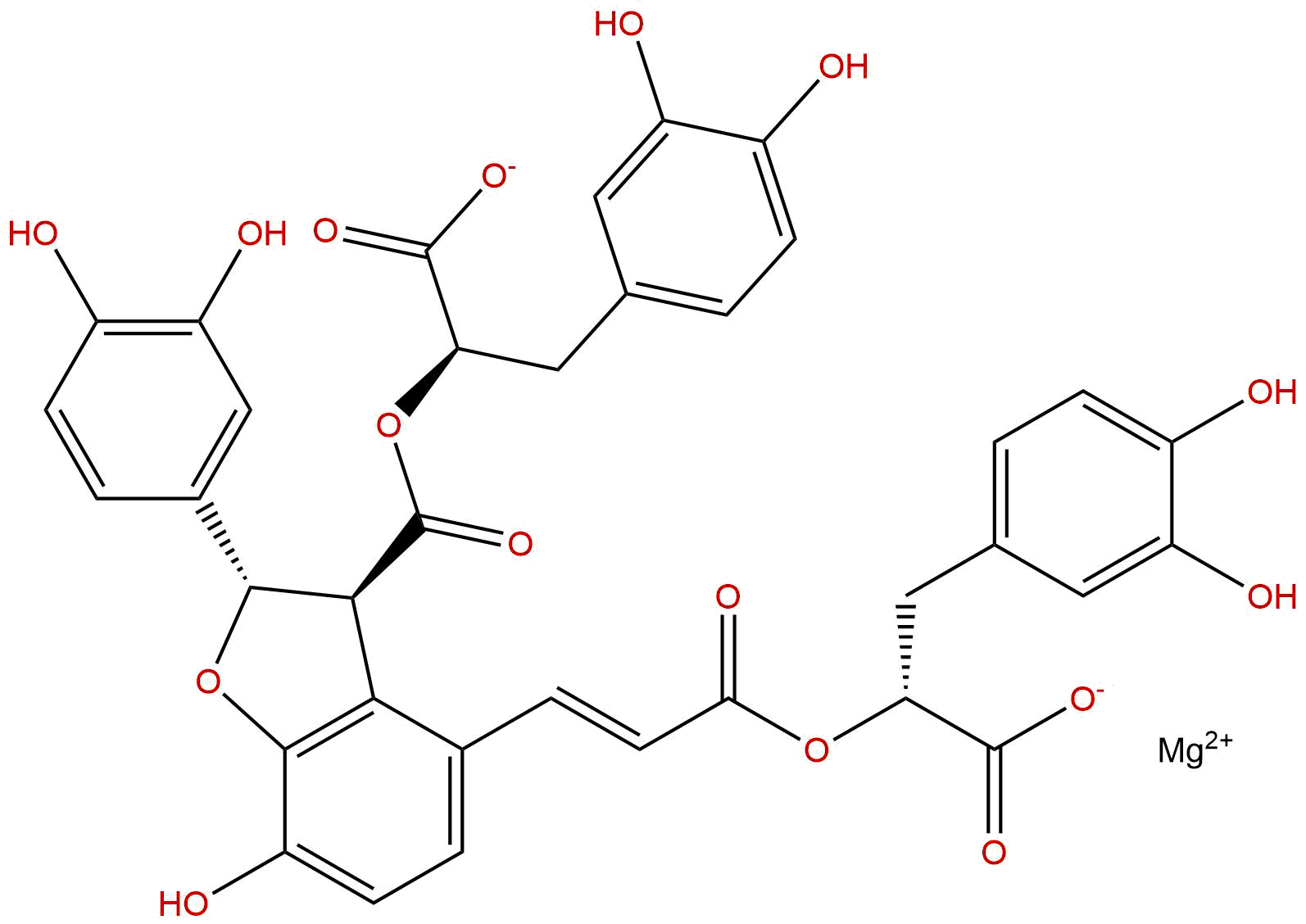


Product name: Magnesium Salvianolate B
Synonym name: Magnesium lithospermate B; 154334-65-3
Catalogue No.: BP1529
Cas No.: 122021-74-3
Formula: C36H28MgO16
Mol Weight: 740.909
Botanical Source:
Physical Description: Powder
Type of Compound: Phenylpropanoids
Purity: 95%~99%
Analysis Method: HPLC-DAD or/and HPLC-ELSD
Identification Method: Mass, NMR
Packing: Brown vial or HDPE plastic bottle
The product could be supplied from milligrams to grams. Inquire for bulk scale.
We provide solution to improve the water-solubility of compounds, thereby facilitating the variety of activity tests and clinic uses.
For Reference Standard and R&D, Not for Human Use Directly.
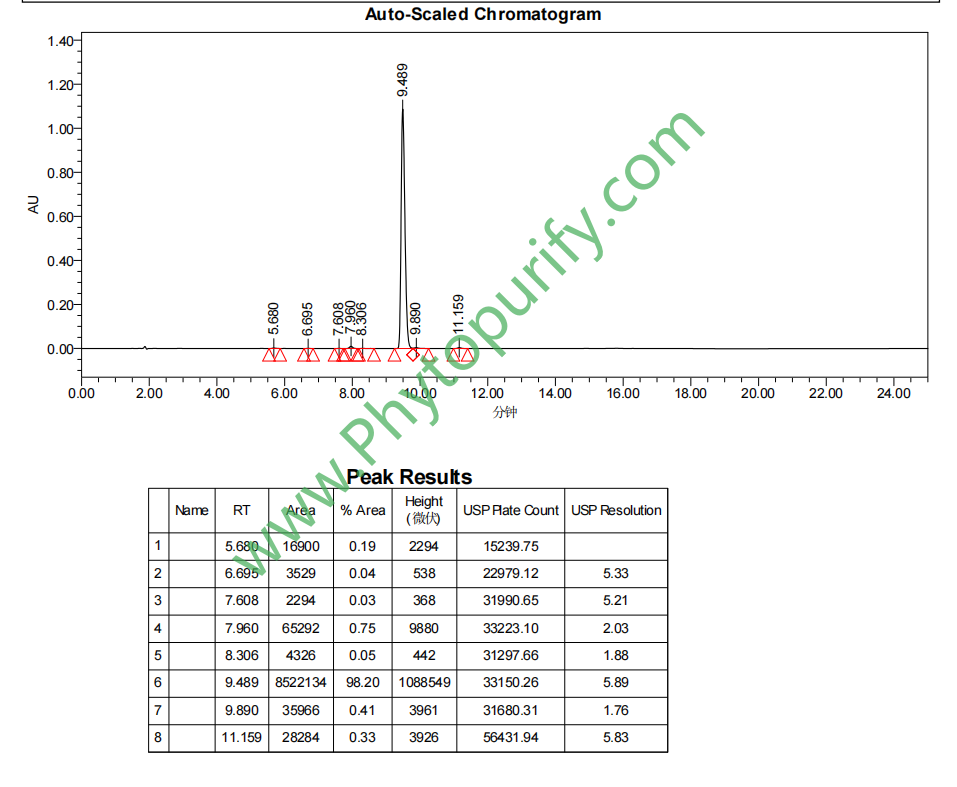
HPLC of Magnesium Salvianolate B
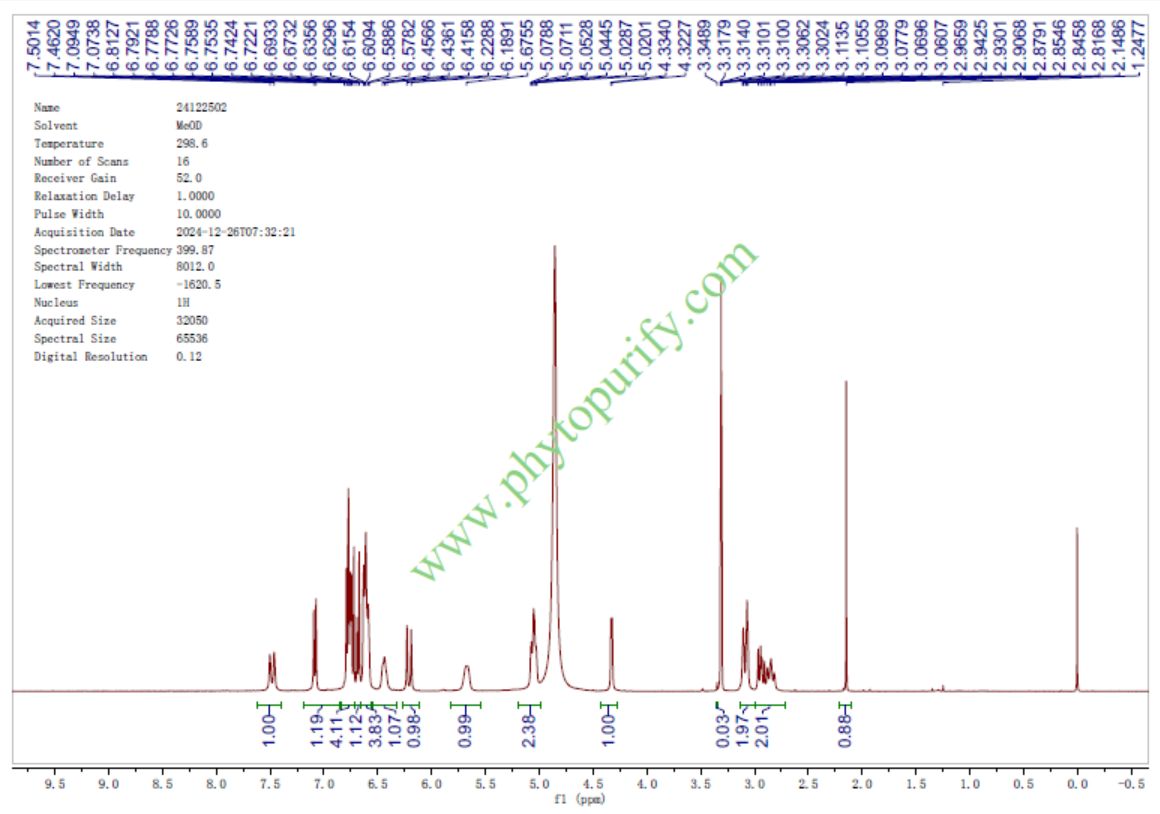
HNMR of Magnesium Salvianolate B
Storage conditions:Short-term storage at 2~8℃, long-term storage at -20 ~ -80℃
278.0400
2.4687
-.2180
.1268
1.0901
.1640
Low
92.5706
4.9615
Yes
No
No
No
Yes
No
0.0
Yes
Yes
Yes
No
Cardiovascular disease (CVD) is the leading cause of death and disability worldwide, with a complex pathogenesis involving multiple pathophysiological processes such as oxidative stress, inflammatory response, cell apoptosis, metabolic disorders, and endothelial dysfunction. Although modern medicine has made significant progress in the prevention and treatment of CVD, existing drugs still have problems such as side effects, drug resistance, and difficulty in fully intervening in multi-target therapy. Therefore, discovering efficient, multi-target, and low toxicity natural products from the treasure trove of traditional medicine has become an important strategy for new drug development. Danshen (Salvia miltiorrhiza)(Salvia miltiorrhiza Bunge, as a classic Chinese medicine for promoting blood circulation, removing blood stasis, and relieving pain, is considered one of the core substances that exert cardiovascular protective effects due to its water-soluble phenolic acid components. Salvianolic acid B (Sal B) is the most abundant and active representative component among them. However, the poor stability and low oral bioavailability of salvianolic acid B itself limit its clinical application. Magnesium Salvianolate B, as a magnesium ion chelate of salvianolic acid B, not only improves the stability and solubility of the original compound, but also exhibits unique and powerful pharmacological activity in multiple studies. This article aims to systematically review the chemical properties, pharmacological effects, molecular mechanisms, and pharmacological properties of magnesium salt of salvianolic acid B, providing scientific basis for its deep development and clinical application.
Danshensu B magnesium salt (CAS number: 122021-74-3) is a salt formed by Danshensu B and magnesium ions. Danshensu B itself is a polyphenolic acid compound composed of three molecules of danshensu and one molecule of caffeic acid connected by ester bonds. Its magnesium salt form has a molecular weight of 718.6200. This structure endows the molecule with abundant phenolic hydroxyl and carboxyl groups, resulting in a theoretical topological polar surface area (TPSA) of up to 278.0400 Å ², which explains its relatively hydrophilic properties. The calculated LogP value is 2.4687, indicating that it has a certain degree of lipophilicity, but overall it still belongs to amphiphilic molecules. The experimentally measured water solubility is approximately 0.1268 mg/mL. Compared to salvianolic acid B, the formation of magnesium salt significantly improves its solubility and chemical stability in physiological environments, which is crucial for its formulation development and in vivo absorption. Preliminary predictions of its pharmacological properties indicate that its ability to penetrate the blood-brain barrier is relatively low, suggesting that its direct action may be limited, but this may not necessarily be a disadvantage for its main effect on the peripheral cardiovascular system. Importantly, its hERG inhibition risk prediction was negative ("no"), and the Ames test predicted a value of 0.0 (indicating no mutagenicity), providing preliminary favorable evidence for its cardiovascular safety.
The direct plant source of magnesium salt of salvianolic acid B is Danshen(Salvia miltiorrhiza Bunge's roots and rhizomes, commonly known as "Danshen". The extraction of water-soluble phenolic acid components in Danshen is mainly carried out by reflux extraction or percolation extraction using water or different concentrations of alcohols (such as ethanol and methanol). In industry, in order to enrich salvianolic acid B and prepare its magnesium salt, the following process route is usually adopted: first, the raw material of Danshen is extracted by water or alcohol, and the extract is filtered and concentrated. Then, it is enriched and purified through macroporous adsorption resin columns (such as AB-8, HPD-100, etc.), and eluted with water and different concentrations of ethanol gradient to collect the fraction rich in salvianolic acid B. Subsequently, an appropriate amount of soluble magnesium salts (such as magnesium chloride and magnesium sulfate) are added to the purified solution of salvianolic acid B. The reaction is carried out under specific pH and temperature conditions to combine salvianolic acid B with magnesium ions to form a precipitate or complex. After filtration, washing, drying, and other steps, crude salvianolic acid B magnesium salt can be obtained. Further refinement can be achieved through recrystallization or preparative chromatography techniques. This process not only achieves standardization of active ingredients, but also improves the physicochemical properties of raw materials through salt formation.
Numerous preclinical studies have confirmed that magnesium salt of salvianolic acid B has broad and powerful cardiovascular protection and other related pharmacological activities.
The multiple pharmacological activities of magnesium salt of salvianolic acid B stem from its diverse regulation of cellular signaling networks, and its mechanism of action involves multiple key molecular targets:
In summary, magnesium salt of salvianolic acid B forms a synergistic network by simultaneously acting on multiple targets such as AMPK, TLR4, BCL2, PTPN1, etc., exerting cardiovascular protective effects from multiple dimensions including energy metabolism, inflammation, oxidation, apoptosis, fibrosis, etc.
Although the physicochemical properties of magnesium salt of salvianolic acid B have been improved compared to salvianolic acid B, it still faces challenges in terms of its medicinal properties as a polyphenolic acid compound.
The clinical application prospects of magnesium salt of salvianolic acid B are broad, but it needs to be promoted from multiple perspectives:
Danshensu B magnesium salt, as a modernized product of traditional Chinese medicine Danshen, has become a star molecule in the development of natural cardiovascular drugs due to its clear chemical structure, multi-target synergistic pharmacological effects, and relatively good safety characteristics. It intervenes in the process of cardiovascular disease from multiple core links such as energy metabolism, oxidative stress, inflammatory response, and cell apoptosis, reflecting the systemic treatment concept of "multi-component multi-target multi pathway". Although there are challenges in developing drug properties such as oral bioavailability, these obstacles are gradually being overcome through modern pharmaceutical technology and in-depth clinical research. In the future, with the continuous deepening of basic and translational research, magnesium salt of salvianolic acid B is expected to move from the laboratory to a wider range of clinical applications, not only providing a new combination of traditional Chinese and Western medicine treatment option for cardiovascular disease patients, but also providing a model for innovative drug development based on natural products.
