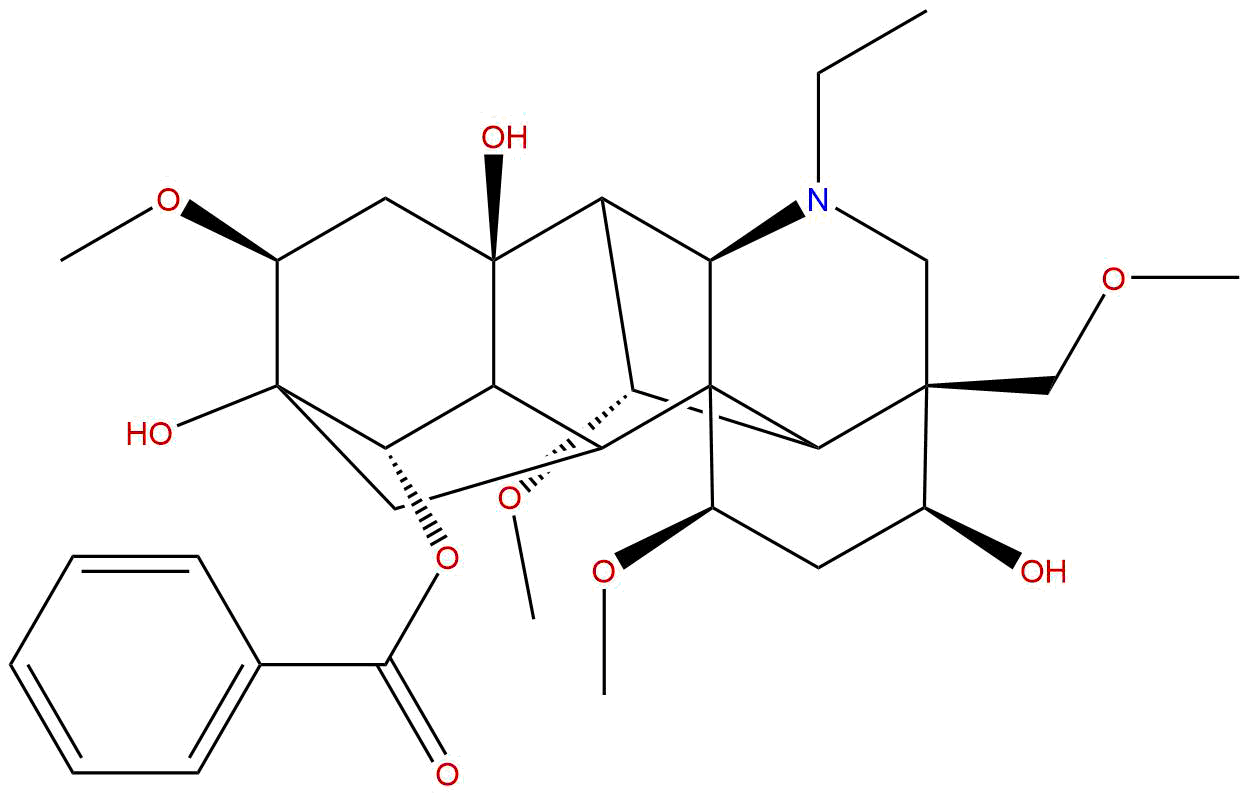
Introduction/Overview
14 benzoyl pseudoaconitine (Ludaconitine) is a natural product isolated from the Aconitum spicatum (Bruhl) Stapf plant in the Aconitum genus, belonging to the family of aconitine alkaloids. This type of compound has attracted much attention in the fields of anti-inflammatory, analgesic, and antiparasitic due to its unique structure and significant biological activity. In recent years, 14 benzoyl pseudo aconitine has attracted widespread interest among researchers due to its inhibitory effect on Leishmania parasites, with an IC50 value of 36.10 μ g/mL, demonstrating certain anti Leishmania activity. In addition, as the incidence rate of chronic pain diseases such as neuralgia increases year by year, the development of natural product drugs targeting related molecular targets has become a hot spot. 14 benzoyl pseudoaconitine shows potential therapeutic value in regulating a variety of pain related targets. This article will provide a systematic review of the chemical structure, sources, pharmacological activity, and mechanism of action of 14 benzoyl pseudo aconitine, and explore its clinical application prospects as a new candidate drug for the treatment of neuropathic pain through drug evaluation.
Chemical structure and physicochemical properties
The molecular formula of 14 benzoyl pseudo aconitine is C34H45NO9, with a molecular weight of 587.7100. Its structural feature is a typical aconitine skeleton, containing multiple cyclic structures and benzoyl groups, giving it high chemical complexity. The LogP value is 2.0915, indicating that it has moderate lipid solubility, which is beneficial for membrane penetration but not excessively hydrophobic. The polar surface area (TPSA) is 127-1500, indicating that the molecule has certain polar groups that facilitate binding to biomolecule targets. The water solubility is 0.2508, which belongs to low solubility compounds, posing certain challenges to the development of its pharmaceutical formulations. The low permeability of the blood-brain barrier suggests limited distribution within the central nervous system, but this may also reduce the risk of central side effects. The negative result of hERG channel inhibition experiment indicates a low risk of cardiac toxicity. The Ames test score is 0.6, indicating a low risk of genotoxicity and meeting safety requirements.
Plant sources and extraction methods
14 benzoyl pseudo aconitine is mainly derived from Aconitum spicatum (Bruhl) Stapf, a plant of the Aconitum genus. Aconitum plants are widely distributed in temperate and alpine regions of Asia and are important medicinal plants in traditional Chinese medicine. Aconitum spicatum has been widely studied due to its complex alkaloid composition. 14 benzoyl pseudo aconitine is usually extracted and separated through the following steps:
- Ingredient Preparation Collect the roots and stems of Aconitum spicatum, clean and dry them, and crush them into fine powder.
- Solvent extraction Using methanol or ethanol as solvents for reflux extraction, the extraction time is generally several hours to ensure sufficient dissolution of the active ingredients.
- Concentration and Separation After the extraction solution is concentrated under reduced pressure, impurities are removed using liquid-liquid distribution method.
- Chromatographic purification Using silica gel column chromatography or high-performance liquid chromatography (HPLC) technology for separation and purification, combined with UV detection and mass spectrometry to confirm the purity and structure of the target compound.
- Structural Identification The structure of 14 benzoyl pseudo aconitine was confirmed by nuclear magnetic resonance (NMR), mass spectrometry (MS), infrared spectroscopy (IR) and other methods.
Although the extraction process is relatively mature, due to the high toxicity of aconitine compounds, the extraction and purification processes need to be strictly controlled to ensure safety and product quality.
Pharmacological activity research
The pharmacological activities of 14 benzoyl pseudo aconitine mainly focus on anti leishmaniasis and neuropathic pain relief. Its inhibitory effect on Leishmania parasites has been validated through in vitro experiments, with an IC50 value of 36.10 μ g/mL, demonstrating certain anti parasitic potential. Leishmaniasis, as a tropical parasitic disease caused by Leishmania parasites, has limited treatment options, and the discovery of natural products provides an important direction for the development of new drugs.
In the field of neuropathic pain, 14 benzoyl pseudoaconitine exhibits potential analgesic activity through multi-target regulation. Neuralgia is a chronic pain state caused by damage or dysfunction of the nervous system, which is difficult to treat and has limited efficacy and significant side effects with existing drugs. 14 benzoyl pseudo aconitine targets multiple proteins and ion channels closely related to pain conduction and regulation, including TRPV1, GABRA1, SCN9A, P2RX3, PPP3CA, CalcA, GRIN1, GRIA2, OPRA1, and Nav1.8 (SCN10A), demonstrating the potential for multi mechanism synergistic analgesia.
In addition, some studies suggest that the compound may have anti-inflammatory and neuroprotective effects, further supporting its application value in pain management. Despite limited in vivo and clinical data, its multi-target mode of action provides new ideas for the development of natural product analgesics.
Mechanism of action and molecular targets
The mechanism of action of 14 benzoyl pseudo aconitine involves multiple molecular targets related to neuropathic pain, as follows:
-
TRPV1 (Transient receptor potential vanillic acid receptor 1)TRPV1 is an important ion channel for perceiving thermal pain and inflammatory pain. 14 benzoyl pseudo aconitine may reduce the transmission of pain signals by regulating the activity of TRPV1.
-
GABRA1 (gamma aminobutyric acid A receptor alpha 1 subunit)GABA receptors are the main inhibitory neurotransmitter receptors in the central nervous system, and activating GABRA1 can enhance neural inhibition and relieve pain. 14 benzoyl pseudo aconitine may exert analgesic effects by positively regulating GABRA1.
-
SCN9A (Nav1.7 voltage-gated sodium channel) and SCN10A (Nav1.8)These two sodium channels play a crucial role in the generation and transmission of pain signals. 14 benzoyl pseudo aconitine may reduce neural excitability and alleviate neuropathic pain by inhibiting the activity of these sodium channels.
-
P2RX3 (P2X3 receptor)The P2X3 receptor is an ATP dependent ion channel involved in pain perception. The regulation of 14 benzoyl pseudo aconitine can help alleviate pain.
-
PPP3CA (protein phosphatase 3 catalytic subunit alpha, also known as calcineurin)Participating in neuronal signal transduction and inflammatory response, regulating their activity can help alleviate neuropathic pain.
-
CalcA (calcitonin gene-related peptide)As a neuropeptide, CalcA plays a role in pain transmission and vasodilation, and 14 benzoyl pseudoaconitine may regulate pain response by affecting its expression or release.
-
GRIN1 and GRIA2 (NMDA and AMPA receptor subunits)These glutamate receptors are involved in excitatory transmission in the central nervous system and are key targets for the formation of chronic pain. 14 benzoyl pseudo aconitine can help inhibit central sensitization by regulating it.
-
OPRA1 (opioid receptor μ 1 subtype)Opioid receptors are classic analgesic targets, and natural products may enhance analgesic effects by regulating OPRA1 activity.
In summary, 14 benzoyl pseudo aconitine exhibits a complex and effective analgesic mechanism by synergistically regulating the balance of excitation and inhibition in the nervous system through multi-target and multi pathway interactions, inhibiting the generation and transmission of pain signals.
Evaluation of drug properties and pharmacokinetics
The evaluation of drug properties is an important step in the development of natural product drugs. The molecular weight of 14 benzoyl pseudo aconitine is 587.71, slightly higher than the ideal range of traditional small molecule drugs (generally<500), which may affect its oral bioavailability. The LogP value is 2.09, which is in the moderate range of lipophilicity and beneficial for cell membrane penetration. The TPSA is 127.15, slightly higher than the ideal range of 90-120, which may limit its ability to pass through the blood-brain barrier, consistent with experimental data of low blood-brain barrier permeability.
Low water solubility (0.2508) suggests the need for solubility enhancement techniques in formulation design, such as nanocarriers, solid dispersions, etc., to improve their bioavailability. The hERG channel inhibition is negative and the Ames test has a low mutagenicity rate, indicating its good safety and reducing the risk of cardiac toxicity and genotoxicity.
At present, there is a lack of pharmacokinetic data on 14 benzoyl pseudo aconitine. It is preliminarily speculated that its in vivo metabolism may involve the CYP450 enzyme system in the liver, and due to its complex structure, it may have a long half-life and multiple metabolites. In the future, systematic ADME (absorption, distribution, metabolism, excretion) research needs to be conducted to clarify its in vivo behavior and optimize the dosing regimen.
Clinical application prospects and prospects
14 benzoyl pseudo aconitine, as a natural product with multi-target effects, has shown potential application value in the field of neuropathic pain treatment. The complex pathological mechanism of neuropathic pain and the limitations of existing drugs have led to an increasing demand for new analgesic drugs. 14 benzoyl pseudoaconitine may provide more comprehensive pain relief effects by regulating multiple key targets such as TRPV1, sodium channels, GABA receptors, and its anti Leishmania activity opens up new possibilities for its use in the treatment of parasitic diseases.
However, the clinical translation of 14 benzoyl pseudo aconitine still faces many challenges, including pharmacokinetic limitations due to its high molecular weight and low water solubility, potential toxicity risks, and lack of systematic in vivo efficacy and safety data. Future research should focus on:
- Optimize extraction and purification processes to improve product purity and stability;
- Improve its pharmacokinetic properties through structural modification or drug carrier technology;
- Conduct systematic in vivo pharmacological and toxicological evaluations to clarify the safe dosage range;
- Explore its combined application with existing analgesic drugs and evaluate synergistic effects;
- Design preclinical and clinical trials to validate its effectiveness and safety in treating neuropathic pain and parasitic diseases.
With the development of natural product pharmacology and medicinal chemistry technology, 14 benzoyl pseudo aconitine is expected to become a candidate molecule for the new generation of multi-target analgesic drugs and antiparasitic drugs.
Conclusion
14 benzoyl pseudo aconitine, as a natural product of aconitine derived from Aconitum spicatum, has shown broad application prospects in the fields of anti leishmaniasis and neuropathic pain treatment due to its unique chemical structure and multi-target pharmacological activity. It exerts comprehensive analgesic effects by regulating multiple key targets such as TRPV1, sodium channels, GABA receptors, etc., which meets the current demand for multi mechanism therapy. Although there are certain challenges in its drug development, it has good safety and low toxicity risk, laying the foundation for subsequent drug development. In the future, it is necessary to strengthen systematic research on its pharmacokinetics, in vivo efficacy, and safety, combined with modern drug design strategies, to promote the clinical application of 14 benzoyl pseudo aconitine and meet the treatment needs of patients with neuropathic pain and parasitic diseases.