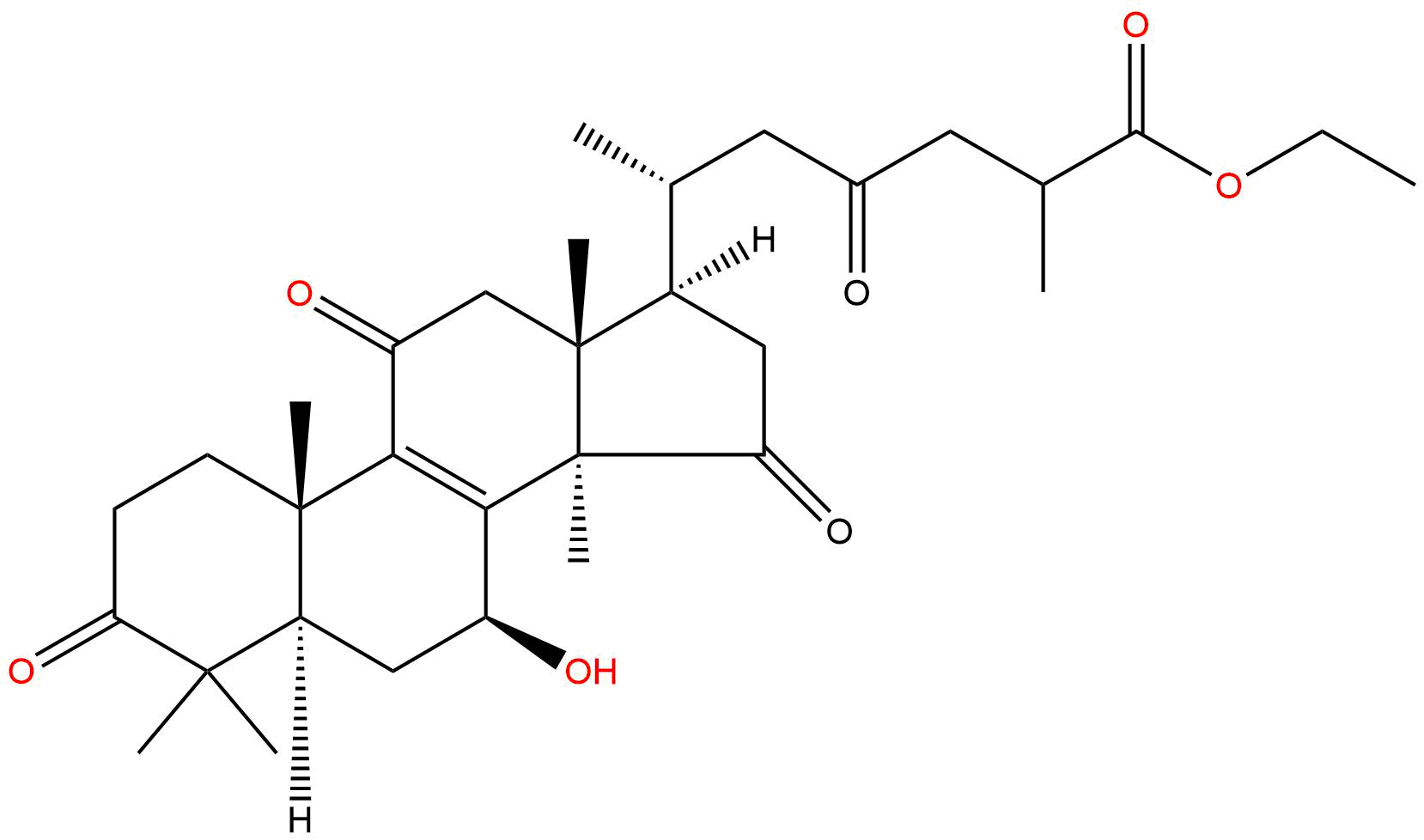


Product name: Ethyl ganoderate D
Synonym name:
Catalogue No.: BP2250
Cas No.:
Formula: C32H46O7
Mol Weight: 542.713
Botanical Source: Ganoderma
Type of Compound: Triterpenoids
Purity: 95%~99%
Analysis Method: HPLC-DAD or/and HPLC-ELSD
Identification Method: Mass, NMR
Packing: Brown vial or HDPE plastic bottle
Storage: Store in a well closed container, protected from air and light. Put into refrigerate or freeze for long term storage.
Whenever possible, you should prepare and use solutions on the same day. However, if you need to make up stock solutions in advance, we recommend that you store the solution as aliquots in tightly sealed vials at -20℃. Generally, these will be useable for up to two weeks.
The product could be supplied from milligrams to grams
Inquire for bulk scale.
For Reference Standard and R&D, Not for Human Use Directly.
Storage conditions:Short-term storage at 2~8℃, long-term storage at -20 ~ -80℃
133.5200
4.2000
3.8000
No
.9500
No
Negative
Ethyl ganoderite D is a traditional medicinal fungus derived from Ganoderma lucidum(Ganoderma lucidum)Natural triterpenoid compounds. As one of the significant bioactive derivatives of ganoderic acid in Ganoderma lucidum, D-ethyl ganoderic acid has attracted much attention in the fields of natural product chemistry and pharmacology research in recent years. Lingzhi, known as the "fairy grass" or "auspicious grass" since ancient times, has a history of over two thousand years of application in the Eastern medical system. It is widely used to enhance immunity, delay aging, and assist in the treatment of various chronic diseases. Modern scientific research has revealed that the many pharmacological activities of Ganoderma lucidum are closely related to its rich active ingredients, among which triterpenoids, especially ganoderic acid and its derivatives, are considered one of its core functional ingredients.
Lingzhi acid D ethyl ester is the product of esterification modification of Lingzhi acid D. This structural modification may alter its original physicochemical properties and biological activity, thereby affecting its absorption, distribution, metabolism, and excretion processes, and may even enhance or generate new pharmacological effects. Although there is currently insufficient public data on the compound, such as complete molecular formula, molecular weight, CAS number, and detailed target information, the study of its parent compound, ganoderic acid D, has provided important scientific background for it. Lingzhi acid D has been proven to have various activities such as anti-tumor, anti-inflammatory, hepatoprotective, and immune regulation. Therefore, as a derivative, the research value of D-ethyl ganoderic acid is self-evident. It represents an important pathway for exploring lead compounds from traditional herbs and developing new drugs through structural optimization. This article aims to systematically review the relevant scientific information on D-ethyl ganoderic acid, and provide a professional and comprehensive perspective for researchers by combining its plant sources, potential pharmacological mechanisms, and medicinal properties.
Lingzhi acid ethyl ester belongs to highly oxidized lanostane triterpenoids. Its basic skeleton is consistent with ganoderic acid D, which is a steroid like structure with four rings (A, B, C, D), and multiple oxygen-containing functional groups such as hydroxyl, carboxyl, and carbonyl groups are connected to the skeleton. The name "ethyl ester" specifically refers to the esterification reaction between the carboxyl group (- COOH) in its molecule and ethanol, forming the carboxylic acid ethyl ester (- COOCH ₂ CH ∝) group. This structural change is the core difference between it and ganoderic acid D.
Esterification modification has a direct impact on the properties of compounds:
1. Enhanced lipid solubility After the carboxyl group is esterified, the polarity of the molecule decreases and the lipophilicity (lipophilicity) significantly increases. This is usually reflected in LogP value (lipid water partition coefficient) Increase in size. LogP is a numerical value that measures the distribution ratio of a compound in n-octanol (oil phase) and water phase. The larger the value, the stronger the lipid solubility. Lingzhi acid D itself may have a relatively low LogP value due to the presence of multiple polar groups (such as hydroxyl and carboxyl), which limits its transmembrane absorption. After esterification, the LogP value of D-ethyl ganoderic acid is expected to increase, which may improve its ability to penetrate cell membranes through passive diffusion, thereby enhancing oral bioavailability.
2. Molecular Weight and Topological Polarity Surface Area (TPSA)Although the exact molecular formula and molecular weight are currently unknown, it can be inferred that the molecular weight of ethyl ester of ganoderic acid D has increased by about 28 (the mass of ethyl ester) compared to ganoderic acid D. Meanwhile, due to ester bonds replacing acidic carboxyl groups Topological Polarity Surface Area (TPSA) There will be slight changes. TPSA is related to the hydrogen bonding ability of molecules and is a key parameter affecting drug absorption and blood-brain barrier penetration. Esterification usually reduces TPSA, which is beneficial for the transmembrane transport of compounds.
3. Stability and Metabolism Ester bonds are easily hydrolyzed by esterases in the body, so D-ethyl ganoderic acid may be a Prodrug The prodrug itself may have weak or no activity, but it is metabolized and converted into an active form (such as ganoderic acid D) in the body to exert its effect. This design can optimize the pharmacokinetic properties of the original drug, such as improving oral absorption, enhancing targeting, and reducing local irritation.
In summary, the introduction of ethyl ester groups in Ganoderma lucidum acid D ethyl ester has optimized the chemical properties of the parent compound, aiming to solve the common problems of poor solubility and low bioavailability of natural triterpenoids, and lay the foundation for their medicinal development.
The direct plant source of ethyl ganoderic acid D is Ganoderma lucidum It belongs to the phylum Basidiomycota and the family Ganoderma in the fungal kingdom. Lingzhi mainly grows on the decaying wood of broad-leaved trees, and its fruiting body is lignified. The cap is kidney shaped or semi-circular, with a lacquer like luster on the surface, ranging in color from reddish brown to purple black, and the stem is lateral. In East Asian countries such as China, Japan, and South Korea, Ganoderma lucidum is revered as a precious delicacy for nourishing and strengthening the body.
In traditional medical literature, the record of Ganoderma lucidum has a long history:
- Shennong Bencao Jing During the Eastern Han Dynasty, Lingzhi was classified as a top-grade herb, known for its ability to alleviate hearing loss, promote joint health, protect the spirit, nourish essence and qi, strengthen muscles and bones, and promote good color. It was believed that long-term consumption could lighten the body, prevent aging, and prolong life.
- Compendium of Materia Medica In the middle, Li Shizhen described in detail the six types of Ganoderma lucidum (green, red, yellow, white, black, purple) and their effects, further consolidating its core position of "strengthening the body and consolidating the foundation".
Traditionally, Ganoderma lucidum is mainly used for:
1. Nourish qi and calm the mind The treatment of restlessness, insomnia, palpitations, palpitations, and forgetfulness is often regarded as a good medicine for "calming the mind and calming the mind".
2. Cough and asthma relief Used for treating cough caused by fatigue, excessive phlegm, and asthma.
3. Strengthening the foundation and enhancing resistance Used for post illness physical weakness, old age and frailty, as a tonic to enhance the body's non-specific resistance.
4. Adjuvant treatment for chronic diseases In folk culture, Ganoderma lucidum decoction or soaking in wine is commonly used to assist in regulating hypertension, hyperlipidemia, hepatitis, etc.
These traditional applications, although based on experience, provide valuable clues for modern research. As a member of the triterpenoid components in Ganoderma lucidum, D-ethyl ganoderic acid is one of the chemical substances that carry these traditional functions. Modern pharmacological research is committed to interpreting these ancient wisdom with scientific language, elucidating the molecular mechanisms behind their "qi tonifying," "calming," and "anti-aging" effects.
Although there is currently limited publicly available independent target research data on ethyl ganoderic acid D, we can infer its potential core pharmacological activity and possible mechanism of action from extensive studies on its parent compound, ganoderic acid D, and triterpenoids. Lingzhi acid D has been proven to be a natural product with multi-target and multi pathway effects.
Antitumor activity This is the most in-depth field of research on triterpenoids in Ganoderma lucidum. Lingzhi acid D has been reported to inhibit tumor cell proliferation and induce apoptosis through various mechanisms:
Anti inflammatory and immune regulatory activity:
Liver protective effect:
Other potential activities:
The effects of ganoderic acid D and its ethyl ester derivatives have Multi target and network regulation The characteristics. They do not act precisely on a single target like many synthetic drugs, but rather act like a "multi key" that can simultaneously affect multiple key nodes within the cell (signaling pathways, transcription factors, enzyme activity). For example, its anti-inflammatory and anti-tumor effects often intersect NF - κ B signaling pathway NF - κ B is a core transcription factor that regulates inflammation, cell survival, and proliferation. Lingzhi acid D can inhibit the activity of I κ B kinase (IKK), prevent the phosphorylation and degradation of I κ B protein, and thus retain NF - κ B dimers in the cytoplasm, preventing them from entering the nucleus to initiate the transcription of downstream pro-inflammatory and pro survival genes. This intervention on key upstream nodes can have a wide range of biological effects.
For ethyl ester of ganoderic acid D, its ethyl ester structure may bring Pharmacokinetic advantages Make it easier to be absorbed and distributed to target tissues. Inside the cell, it may be hydrolyzed by esterases to release the active form of ganoderic acid D, thereby exerting the aforementioned pharmacological effects. This' prodrug 'strategy may make it more effective in the body.
Association with diseases Based on the above activity, the potential application directions of D-ethyl ganoderic acid include:
- Adjuvant therapy and chemoprevention of tumors
- Chronic inflammatory diseases(such as arthritis, colitis)
- Metabolic diseases(such as non-alcoholic fatty liver, atherosclerosis)
- Neuroprotection of neurodegenerative diseases
Drug efficacy evaluation is a key step in determining whether a compound can be successfully developed into a drug, mainly examining its Absorption, distribution, metabolism, excretion, and toxicity (ADMET) Nature We conducted a preliminary evaluation of D-ethyl ganoderic acid using general standards such as Lipinski's Five Rules.
Lipinski's Rule of Five This is a set of empirical rules used to predict the oral absorption potential of compounds. Due to the lack of precise molecular weight, we conducted analysis based on the universal characteristics of triterpenoid compounds:
Other key pharmacological parameters:
Comprehensive Assessment Lingzhi acid D-ethyl ester, as a derivative of natural products, faces some challenges in oral absorption (possibly violating some Lipinski rules), but its structural modification (ethylation) is a step in the right direction towards improving drug properties. Its true potential as a drug depends on subsequent in-depth research Pharmacokinetic (PK) and Toxicological (Tox) Studies The development strategy may include further structural optimization (preparation of other esters or prodrugs), adoption of advanced drug delivery systems, or exploration of non oral administration routes.
Research status:
At present, there is relatively limited independent and publicly available scientific research literature on "D-ethyl ganoderic acid", and it is still a compound in the exploratory stage. Most of the research focus is still on its precursor, ganoderic acid D, as well as other more common ganoderic triterpenoids such as ganoderic acid A, B, C, F, etc. These studies have laid a solid foundation for the biological activity of D-ethyl ganoderic acid. Existing research may focus more on the chemical modification, semi synthesis, and preliminary activity screening of natural products. The lack of information about this compound in databases such as PubChem and SciFinder also reflects that it is still a "new star" at the forefront of research, and more systematic work is needed to fill its data gaps.
Application prospects and future directions:
1. As an anti-tumor lead compound Given the clear anti-tumor mechanism of ganoderic acid D, ganoderic acid D ethyl ester is expected to be developed as a novel anti-tumor drug or adjuvant therapy. Future research should focus on:
- Structure Activity Relationship (SAR) Study The system changes the ethyl ester group or other sites to search for derivatives with better activity and drug properties.
- Combination therapy research Explore its synergistic effect with existing chemotherapy drugs to reduce chemotherapy dosage, alleviate toxic side effects, and overcome drug resistance.
- Targeted delivery system Using nanotechnology (such as nanoparticles and extracellular vesicles) to encapsulate it, achieving targeted enrichment at the tumor site, improving therapeutic efficacy, and reducing systemic toxicity.
Application in inflammation and immune related diseases Its anti-inflammatory and immune regulatory properties make it potential for the management of autoimmune diseases, allergic diseases, and chronic inflammation. Further research is needed on the specific molecular targets that regulate immune cell differentiation and function.
Management of metabolic diseases To explore its therapeutic effect on nonalcoholic fatty liver disease (NAFLD), diabetes and its complications, and clarify its regulatory mechanism on the glucose and lipid metabolism pathway.
Neuroprotective agents Evaluate its ability to penetrate the blood-brain barrier and validate its neuroprotective effects in animal models such as Alzheimer's disease and Parkinson's disease.
Comprehensive development of medicinal properties This is the key to pushing laboratory discoveries to clinical applications. The system must complete:
Conclusion:
Ganoderma lucidum ethyl ester is a promising chemical entity derived from the traditional treasure Ganoderma lucidum. It carries the wisdom of thousands of years of traditional medicine, but also faces strict scrutiny from modern pharmaceutical science. Although extensive basic and translational research is still needed to verify its safety and effectiveness, as well as overcome challenges in drug development, its multi-target and multi efficacy characteristics perfectly meet the current demand for systematic treatment of complex chronic diseases such as cancer and metabolic syndrome. It is not only a bridge connecting tradition and modernity, but also represents an important strategy for mining simplified and optimized lead compounds from complex natural products. With the continuous advancement of natural product chemistry, pharmacology, and drug delivery technology, D-ethyl ganoderic acid and its analogues are expected to contribute to human health in the future by leveraging the power of ancient fungi.
Disclaimers This article is based on existing public data and scientific inference, aiming to conduct professional science popularization and academic exploration. Lingzhi acid D-ethyl ester is still in the research stage and is not an approved drug. The information in the article cannot be used as medical advice. Any decision regarding disease treatment must be consulted with qualified medical professionals.
Batch can search by a CAS number,one per line
