


Product name: Oxymatrine
Synonym name: Ammothamnine; Pachycarpidine
Catalogue No.: BP1049
Cas No.: 16837-52-8
Formula: C15H24N2O2
Mol Weight: 264.369
Botanical Source: Alkaloid from Sophora flavescens, Sophora macrocarpa, Sophora alopecuroides, Ammothamnus lehmannii (preferred genus name Sophora), Euchresta horsfeldii and other plants (Leguminosae)
Physical Description: Powder
Type of Compound: Alkaloids
Purity: 95%~99%
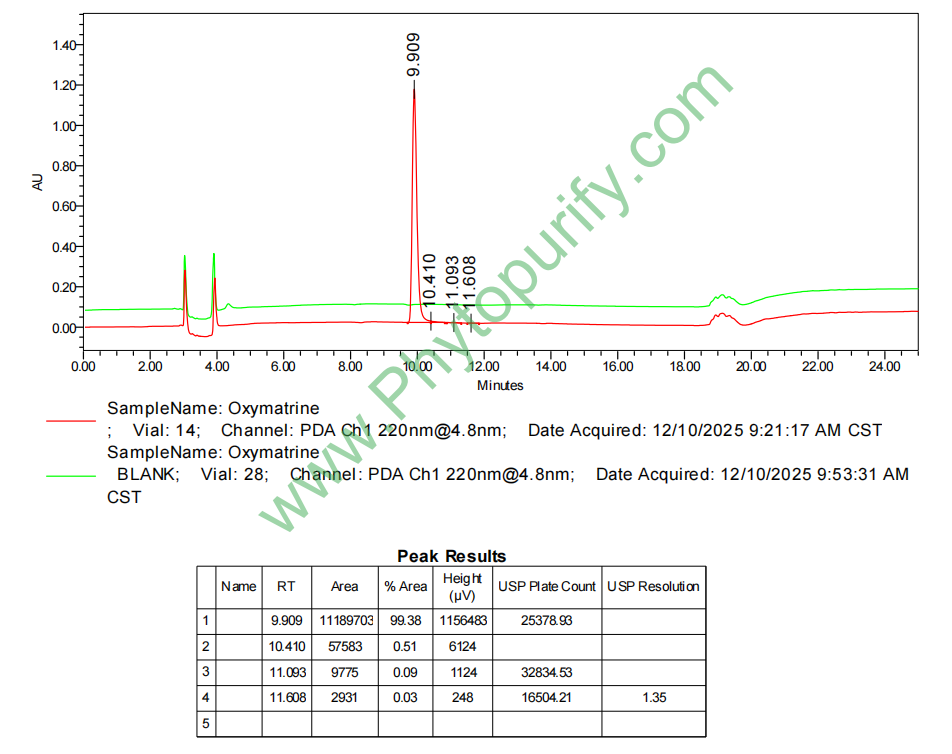
Analysis Method: HPLC-DAD or/and HPLC-ELSD
Identification Method: Mass, NMR
Packing: Brown vial or HDPE plastic bottle
Storage: Store in a well closed container, protected from air and light. Put into refrigerate or freeze for long term storage.
Whenever possible, you should prepare and use solutions on the same day. However, if you need to make up stock solutions in advance, we recommend that you store the solution as aliquots in tightly sealed vials at -20℃. Generally, these will be useable for up to two weeks.
The product could be supplied from milligrams to grams, up to kilograms
Inquire for bulk scale.
Descriptions:
Oxymatrine, one of the major components of Sophora flavescens ait, has exhibited anti-hepatitis virus infection, anti-hepatic fibrosis, anti-inflammation, anti-anaphylaxis and other immune-regulation, it induces human pancreatic cancer PANC-1 cells apoptosis via regulating expression of Bcl-2 and IAP families, and releasing of cytochrome C.[1]
Oxymatrine is proven to protect ischemic and reperfusion injury in liver, intestine and heart, this effect is via anti-inflammation and anti-apoptosis, it has protective effect applies to ischemic injury in brain to reduce infarct volume induced by pMCAO, this effect may be through the decreasing of NF-kappaB expression.[2]
Oxymatrine has anti-inflammatory activity, it can reduce the serum levels of TNF-α, IL-6, and the expression of NF-κB and ICAM-1 in colonic mucosa in dextran sulfate sodium (DSS)--induced colitis of rats, indicates that oxymatrine may ameliorate the colonic inflammation and thus alleviate diarrhea and bloody stool.[3]
Oxymatrine has a beneficial effect on acute lung injury induced by oleic acid in mice and may inhibit the production of proinflammatory cytokine, TNF-alpha, by means of the inhibition of p38 MAPK.[4]
Oxymatrine has inhibition of hepatitis B virus in vivo, it (200 mg/kg/d,20day )can reduce thecontents of HBsAg and HBcAg in transgenic miceliver, and longer treatment time and larger dosage do not yield better effects.[5]
Oxymatrine can attenuate diabetes-associated cognitive deficits in rats, which is associated with oxidative stress, inflammation and apoptotic cascades.[6]
Oxymatrine can induce cell cycle arrest and apoptosis, which makes it a potentially useful agent for targeting cancer cells; it causes a dose-dependent reduction in the proliferation of MCF-7 cells and a decrease in SP cells, the growth inhibitory effects of oxymatrine treatment on MCF-7 cells may be due to the inhibition of SP and Wnt/0205-catenin signaling pathway. [7]
Oxymatrine and astragalus polysaccharide can synergistically improve the immune efficacy of Newcastle disease vaccine in chicken, because of astragalus polysaccharide and oxymatrine possesses synergistical immunoenhancement.[8]
References:
[1] Qi L, Xiao X, Wei X, et al. J Exp Clin Cancer Res, 2011, 30(1):66-66.
[2] Zhang X J, Yang C H, Fan H G. Brain Res, 2009, 1268:174-80.
[3] Zheng P, Niu F L, Liu W Z, et al. World J Gastroenterol, 2005, 11(31):4912-5.
[4] Lao L, Rao S Y, Gong Z N, et al. J Ethnopharmacol, 2005, 98(1-2):177-83.
[5] Xiao, Song, Chen, et al. World J Gastroenterol, 2001, 7(1):49-52.
[6] Suo-bin, WANG, Jian-ping. Acta Pharmacol Sin, 2014, 35(3):331-8.
[7] Zhang Y, Piao B, Zhang Y, et al. Med Oncol, 2011, 28(1):99-107.
[8] Chen Y, Wang D, Hu Y, et al. Int J Biol Macromol, 2010, 46(4):425-8.
[9] Liu J, Yuan L M, Li-Qin H E, et al. Chemical World, 2009, 50(7):410-1.
HPLC of Oxymatrine
Storage conditions:Short-term storage at 2~8℃, long-term storage at -20 ~ -80℃
43.3700
.0461
.0461
201.5473
3.7387
4.5816
High
46.9992
4.6360
No
No
Yes
No
Yes
No
0.9
Yes
No
Yes
Yes
Oxymatrine (CAS number: 16837-52-8) is a traditional Chinese medicine derived from Sophora flavescens(Sophora flavescens The quinolone alkaloids extracted and isolated from Ait. are nitrogen oxides of matrine. As one of the main active ingredients of Sophora flavescens and its related preparations (such as Sophora flavescens injection and Sophora flavescens capsules), oxymatrine has the effects of clearing heat and dampness, dispelling wind and killing insects in traditional Chinese medicine theory. Modern pharmacological research has systematically revealed its extensive biological activities, including anti-inflammatory, antiviral, anti fibrotic, and particularly remarkable anti-tumor effects. Its mechanism of action involves the regulation of multiple key signaling pathways (such as TGF - β/Smad) and effector molecules (such as inducible nitric oxide synthase, iNOS). In recent years, with the deepening of molecular target research, the potential application of oxymatrine in the treatment of major diseases such as tumors, liver fibrosis, and viral myocarditis has become increasingly prominent. This article aims to systematically review the chemical properties, pharmacological activities, molecular mechanisms of action, pharmacological evaluation, and clinical application prospects of oxymatrine, in order to provide comprehensive scientific references for the deep development and clinical translation of this natural product.
The chemical name of oxymatrine is (7aS, 13aR, 13bR, 13cS) - dodecahydro-1H, 5H, 10H dipyrido [2,1-f:3 ', 2', 1 '- ij] [1,6] naphthyridin-10-one 4-oxide, with a molecular formula of C15H24N2O2 and a molecular weight of 264.3690. Its structure belongs to the tetracyclic quinolone alkaloids, with the core consisting of two quinolone rings fused together. One nitrogen atom is oxidized to an N-oxide, which is a key structural feature that distinguishes it from its precursor Matrine and significantly affects its physicochemical properties and biological activity.
From the perspective of pharmacological parameters, oxymatrine exhibits good drug like properties. Its lipid water partition coefficient (LogP) is 0.0461, indicating that it is a hydrophilic compound, which is consistent with its measured water solubility of 201.5473 mg/L, ensuring its good solubility in aqueous media and facilitating formulation development and in vivo absorption. Its topological polar surface area (TPSA) is 43.37 Å ², which is within an acceptable range. It is worth noting that its blood-brain barrier permeability is predicted to be "high", indicating its potential to act on central nervous system related diseases, which provides a structural basis for its application in brain tumors or neuroinflammatory diseases. In the preliminary safety screening, the risk of hERG inhibition was "no", reducing the potential risk of inducing QT interval prolongation in the heart; The Ames test value is 0.9 (usually considered to be potentially mutagenic positive if>1.0), indicating a low risk of genetic toxicity. These physicochemical and preliminary safety properties have laid a favorable foundation for its further drug development.
Oxymatrine is mainly derived from the leguminous plant Sophora flavescens(Sophora flavescens Dry roots of Ait. Sophora flavescens, as a traditional Chinese medicine, has a long history of application in China. Except for Sophora flavescens, in the same genus of plants, Sophora flavescens root(Sophora tonkinensis There is also a certain distribution of content in Gagnep. and mung bean roots.
The extraction of oxymatrine from plant materials usually follows the general extraction process of alkaloids and is continuously optimized to improve efficiency and purity. Traditional methods include solvent extraction (commonly using water, acidic aqueous solutions, ethanol, or methanol for reflux or percolation extraction), followed by separation and purification using the solubility differences of oxymatrine (such as the fact that free bases are difficult to dissolve in water, but their salts are easily soluble) and chromatographic properties. The specific steps are often as follows: soak or percolate the coarse powder of Sophora flavescens roots in an acidic aqueous solution (such as dilute hydrochloric acid) to dissolve the alkaloids into salts; Subsequently, alkalize the extraction solution (such as using ammonia or sodium hydroxide) to allow the alkaloids to precipitate freely; After extraction with organic solvents such as chloroform and ethyl acetate, the precipitate was repeatedly separated and purified using techniques such as silica gel column chromatography and preparative high-performance liquid chromatography (HPLC) to obtain high-purity oxymatrine monomer.
Modern extraction and separation technologies such as ultrasound assisted extraction, microwave-assisted extraction, and supercritical fluid extraction have also been applied to this process. These technologies can effectively shorten extraction time, improve extraction efficiency, and reduce solvent consumption. Industrial production requires comprehensive consideration of cost, environmental protection, and feasibility of scale. Usually, macroporous adsorption resin enrichment and refining processes are used, combined with crystallization technology, to obtain raw materials that meet pharmaceutical standards.
A large number of in vitro and in vivo studies have confirmed that oxymatrine has various pharmacological activities, and its application research has expanded from traditional anti-inflammatory and antiviral to major disease fields such as anti fibrosis and anti-tumor.
Anti inflammatory and immune regulatory effects Oxymatrine has shown significant inhibitory effects on various acute and chronic inflammation models. Its mechanism is closely related to inhibiting the production of pro-inflammatory mediators (such as TNF - α, IL-1 β, IL-6), reducing the expression of iNOS, and thus reducing the production of excessive nitric oxide (NO). In autoimmune disease models, it can also regulate the balance of T lymphocyte subsets and exhibit immunosuppressive activity.
Antiviral effect Research has confirmed that oxymatrine has broad-spectrum antiviral potential. In addition to its known anti hepatitis B virus activity, recent studies have shown that it can effectively inhibit the replication of bocavirus (MVC) by reducing viral gene expression and alleviating cell apoptosis induced by viral infection. This provides new ideas for its application in respiratory virus infections and other fields.
Anti organ fibrosis effect Oxymatrine has shown clear anti fibrotic effects in liver fibrosis, pulmonary fibrosis, and renal fibrosis models. The core mechanism is to inhibit the signal transduction of the key pro fibrotic cytokine, transforming growth factor - β 1 (TGF - β 1), thereby reducing the excessive deposition of extracellular matrix (such as collagen) and delaying or reversing the fibrotic process.
antitumor activity This is the most studied direction of oxymatrine in recent years. Studies have shown that it can inhibit the proliferation of many tumor cells, such as liver cancer, gastric cancer, colorectal cancer, breast cancer, lung cancer, etc., and can induce apoptosis of tumor cells, inhibit their migration, invasion and angiogenesis. Its anti-tumor effect has the characteristics of multi-target and multi pathway, and its toxicity to normal cells is relatively low, showing good selectivity.
The pharmacological effects of oxymatrine, especially its anti-tumor activity, are achieved by intervening in multiple key signaling pathways and acting on a series of molecular targets. According to the provided target information, its action network can be summarized as follows:
Inducing cell apoptosis pathway Oxymatrine can downregulate the expression of anti apoptotic proteins B cell lymphoma 2 (BCL2) and myeloid leukemia 1 (MCL1), disrupt mitochondrial membrane potential, promote cytochrome C release, activate Caspase cascade reaction, and induce intrinsic pathway apoptosis of tumor cells.
Inhibition of STAT3 signaling pathway Signal transduction and transcription activator 3 (STAT3) is an important oncogenic transcription factor. Oxymatrine can inhibit the phosphorylation (activation) of STAT3, prevent its nuclear translocation and binding to DNA, thereby downregulating the expression of downstream target genes related to cell proliferation (such as Cyclin D1), survival (such as Survivin), and angiogenesis (such as VEGF).
Intervention in MAPK/ERK pathway The inhibition of mitogen activated protein kinase 1 (MAPK1, ERK2) by oxymatrine affects key signals for cell proliferation and differentiation. By regulating the MAPK/ERK pathway, it can arrest the cell cycle in the G1 or G2/M phase.
Inhibit tumor invasion and metastasis Oxymatrine can significantly reduce the expression and activity of matrix metalloproteinase-2 (MMP2). MMP2 is a key enzyme that degrades extracellular matrix and promotes tumor cell invasion and metastasis. At the same time, it can also inhibit the stability and activation of hypoxia inducible factor-1 alpha (HIF1A), thereby weakening the adaptability and angiogenesis induction ability of tumor cells in a low oxygen microenvironment.
Interference with DNA metabolism and hormone signaling Oxymatrine has been reported to inhibit the activity of DNA topoisomerases I (TOP1) and II α (TOP2A), interfere with DNA replication and repair, and lead to the accumulation of DNA damage. In addition, it can also interfere with the growth signal of estrogen dependent tumors (such as some breast cancer) by affecting the activity or expression of estrogen receptor alpha (ESR1) and aromatase (CYP19A1).
Core pathway regulation As mentioned earlier,Inhibition of TGF - β/Smad pathway It is the core mechanism by which oxymatrine exerts anti fibrotic and partially anti-tumor effects, especially by inhibiting epithelial mesenchymal transition (EMT). By blocking this pathway, it can regulate the expression of multiple downstream effector molecules from upstream.
In summary, oxymatrine forms a synergistic network by acting on multiple targets such as MCL1, BCL2, STAT3, MMP2, TOP1/2A, HIF1A, MAPK1, ESR1, CYP19A1, etc., collectively contributing to its anti-tumor and other pharmacological effects.
Although oxymatrine has shown great potential in preclinical studies, its pharmacological properties and pharmacokinetic behavior in the human body are key factors determining its successful conversion into a drug.
Pharmacokinetic study(Mainly based on animal experiments): Oxymatrine is absorbed rapidly but incompletely after oral administration, and there is a certain first pass effect. It is widely distributed in the body and can reach effective concentrations in brain tissue due to its high blood-brain barrier permeability. The main metabolic pathway of oxymatrine in the body is reduction reaction, which can be metabolized into its active metabolite Matrine. The two may work together or undergo mutual transformation in the body. Other metabolic pathways include oxidation, demethylation, etc. The prototype drug and metabolites are mainly excreted through the kidneys and urine. Pharmacokinetic studies in the human body are relatively limited, and clinical trials have shown that its in vivo process after intravenous or oral administration conforms to a two or one compartment model, with a moderate half-life.
Advantages and challenges of pharmaceutical properties:
* Advantage Good water solubility is beneficial for the development of injectable and oral formulations; Preliminary safety evaluations (hERG, Ames) have low risks; Natural source, clear structure, easy to optimize through semi synthesis for structural modification.
* challenge:1) Oral bioavailability Although absorbable, the absolute bioavailability needs to be improved, which may require formulation techniques (such as liposomes, nanoparticles, phospholipid complexes) or structural modifications. 2) Metabolism in vivo Metabolism is fast and may require frequent administration or development of sustained-release formulations to maintain effective blood drug concentrations. 3) Complexity of mechanism of action The multi-target characteristic is both advantageous (synergistic efficacy, less prone to drug resistance) and may also bring unpredictable side effects, requiring strict clinical safety monitoring. 4) Depth of clinical data Although it has been used as a traditional Chinese medicine ingredient in clinical practice, there is still insufficient systematic and large-scale clinical trial data for single component chemical drugs, especially for phase III clinical trials that meet international standards.
At present, oxymatrine and its related preparations have been approved for clinical use in China, with main indications including chronic hepatitis B, liver fibrosis, and adjuvant therapy for tumors (often combined with chemotherapy to reduce toxicity and increase efficacy). However, its clinical application prospects go far beyond that.
Tumor treatment field As a natural anti-tumor candidate drug with multiple targets and low toxicity, oxymatrine has outstanding value in combination therapy. Future research can focus on: combining with conventional chemotherapy drugs or targeted drugs to enhance efficacy and reverse drug resistance; Develop precise therapeutic strategies for specific molecular subtyping tumors based on their clear molecular targets, such as STAT3 and BCL2; Utilize its anti angiogenic and immunomodulatory potential in combination with immunotherapy such as immune checkpoint inhibitors.
Fibrotic disease In the fields of non-alcoholic steatohepatitis (NASH) related liver fibrosis, idiopathic pulmonary fibrosis (IPF) and other areas lacking specific drugs, oxymatrine has important development value due to its clear anti TGF - β signaling effect.
Viral diseases In addition to hepatitis B, its research enlightenment on Boca virus and other viruses can expand its application research in viral infectious diseases such as viral myocarditis and viral pneumonia.
Neurological disorders Its high blood-brain barrier permeability provides the possibility for treating neuroinflammatory diseases (such as multiple sclerosis, Alzheimer's disease-related neuroinflammation) or brain tumors.
The future development direction should include:
* In depth mechanism research Using omics techniques (proteomics, metabolomics) and gene editing tools to more accurately depict its functional network and direct targets of action.
* structural optimization By modifying its structure through medicinal chemical means, the aim is to enhance activity, improve pharmacokinetic properties (such as increasing oral bioavailability, prolonging half-life), or enhance targeting.
* Development of a new delivery system Develop targeted nano formulations, long circulating liposomes, etc. to enhance the enrichment of tumor or lesion tissues and reduce systemic toxicity.
* Promote high-quality clinical research Design and implement large-scale, randomized, double-blind, placebo-controlled Phase III clinical trials to obtain high-level evidence-based medicine and promote their international application.
As a natural alkaloid derived from traditional Chinese medicine, oxymatrine has shown great potential in modern disease treatment, especially in the fields of anti-tumor and anti fibrosis, due to its unique chemical structure and multi-target pharmacological mechanism. The scientific significance of inhibiting key pathways such as TGF - β/Smad and STAT3, as well as regulating a series of specific targets such as MCL1, BCL2, and MMP2, has been gradually revealed. Despite facing challenges such as oral bioavailability in drug development, its good water solubility, preliminary safety, and clear multi effect activity have laid a solid foundation for its further development. In the future, through interdisciplinary cooperation and modern drug development technology, deep exploration and systematic development of oxymatrine are expected to transform it from a traditional active ingredient into a modern innovative drug for treating various major diseases, achieving a leap from "herbal medicine" to "precision medicine" and contributing more natural wisdom and solutions to human health.
