


Product name: Atractylodin
Synonym name:
Catalogue No.: BP0217
Cas No.: 55290-63-6
Formula: C13H10O
Mol Weight: 182.222
Botanical Source: rhizomes of Atractylodes sp.
Physical Description: Brown powder
Type of Compound: Miscellaneous
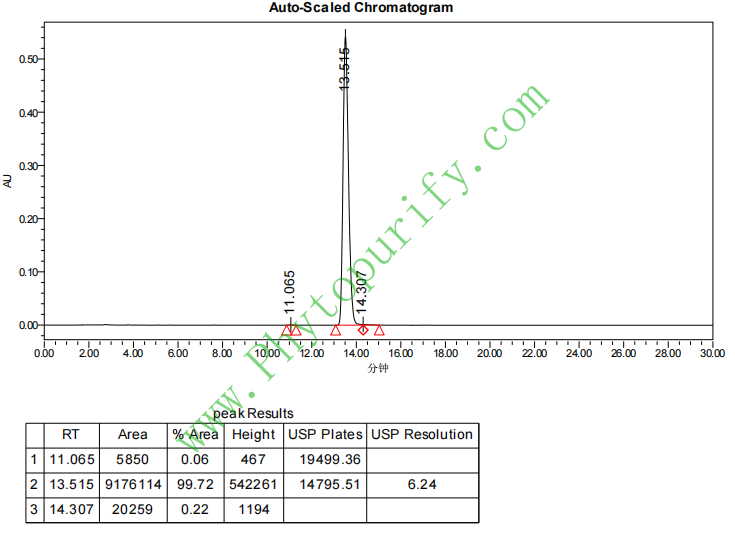
Purity: 95%~99%
Analysis Method: HPLC-DAD or/and HPLC-ELSD
Identification Method: Mass, NMR
Packing: Brown vial or HDPE plastic bottle
Storage: Store in a well closed container, protected from air and light. Put into refrigerate or freeze for long term storage.
Whenever possible, you should prepare and use solutions on the same day. However, if you need to make up stock solutions in advance, we recommend that you store the solution as aliquots in tightly sealed vials at -20℃. Generally, these will be useable for up to two weeks.
The product could be supplied from milligrams to grams, up to kilograms
Inquire for bulk scale.
Descriptions:
Atractyodin biosynthesis could be promoted by endophytic fungal elicitor mediated through NO followed by salicylic acid by activating ACC in A.lancea.[1]
Atractylodin and atractylenolide II have a good potential as a source for natural repellents, and atractylodin has the potential to be developed as natural insecticide.[2]
References:
[1] Tao J H, Wang D G, Xue-Lian P U, et al. Chinese Traditional & Herbal Drugs, 2014, 45(5):701-8.
[2] Chen H P, Zheng L S, Yang K, et al. Chem Biodivers, 2015, 12(4):593–8.
[3] Wang Z. J Liq Chromatogr R T, 2012, 35(6):778-87.
HPLC of Atractylodin
Storage conditions:Short-term storage at 2~8℃, long-term storage at -20 ~ -80℃
Atractylodin, CAS number 55290-63-6, is a natural active ingredient isolated from the roots and stems of the Chinese medicinal herbs Atractylodes lancea and Atractylodes chinensis. Atractylodes macrocephala, as an important medicinal plant in traditional Chinese medicine, has always been used for the treatment of various diseases such as invigorating the spleen and dampness, dispelling wind and dispelling cold. Atractylodes macrocephala, as one of its main bioactive components, has gradually attracted the attention of scholars at home and abroad in recent years due to its diverse pharmacological activities. Research has shown that Atractylodes macrocephala not only has significant anti-inflammatory effects, but also exhibits the activity of a natural insecticide, and demonstrates potential molecular target regulation ability in the treatment of viral diseases.
This article aims to systematically review the chemical structure and physicochemical properties, plant sources, and extraction methods of Atractylodes macrocephala, with a focus on its pharmacological activity and mechanism of action. Combining the latest pharmacological evaluation and pharmacokinetic data, it explores its clinical application prospects and future research directions, providing theoretical basis and reference for scientific research and drug development in the field of natural product pharmacology.
The molecular formula of Atractylodes macrocephala is C12H14O, with a molecular weight of 182.22. Its chemical structural characteristics are aromatic compounds containing one benzene ring and one alkynyl group, with a hydroxyl group as a hydrogen bond acceptor in the structure. The TPSA (topological polar surface area) is 13.14, indicating that its molecular polarity is low and conducive to membrane penetration. The LogP value is 3.25, indicating that it has moderate lipid solubility and is suitable for oral absorption.
The presence of alkynyl groups in the structure of Atractylodes macrocephala endows it with unique chemical reactivity, which may be an important basis for its biological activity. Its molecular weight is moderate, its molecular structure is relatively simple, and it is easy to chemically modify and synthesize. Atractylodes macrocephala can penetrate the blood-brain barrier (BBB), indicating its potential application value in central nervous system diseases. Toxicity assessment shows that Atractylodes macrocephala has no hepatotoxicity or cardiotoxicity, and does not inhibit hERG channels. The Ames mutagenicity test is negative, demonstrating good safety characteristics.
Atractylodes lancea (Atractylodes lancea) and Atractylodes chinensis (Atractylodes chinensis) are mainly found in the rhizomes of plants in the Atractylodes genus. These two plants are widely used in the traditional Chinese medicine market, with their rhizomes being the main medicinal parts. The content of Atractylodes macrocephala varies depending on the type of plant, place of origin, harvesting time, and processing method.
The traditional methods for extracting Atractylodes macrocephala mainly include solvent extraction and distillation extraction. Ethanol or methanol are usually used as extraction solvents to improve extraction efficiency through reflux extraction or ultrasound assisted extraction. After concentration, separation and purification of the extract, it is separated and purified using column chromatography (such as silica gel column, reverse phase C18 column) and high performance liquid chromatography (HPLC) techniques to obtain high-purity Atractylodes macrocephala extract.
In recent years, supercritical CO2 extraction technology and microwave-assisted extraction technology have been introduced into the extraction of Atractylodes macrocephala, significantly improving extraction efficiency and purity while reducing the use of organic solvents, in line with the concept of green chemistry. The optimization of extraction process is of great significance for ensuring the quality stability of Atractylodes macrocephala and subsequent pharmacological research.
The pharmacological activity research of Atractylodes macrocephala mainly focuses on its anti-inflammatory, antiviral, insecticidal, and neuroprotective properties.
Numerous in vitro and in vivo experiments have shown that Atractylodes macrocephala has significant anti-inflammatory effects. It can inhibit the production of inflammatory mediators such as tumor necrosis factor alpha (TNF - α), interleukin-6 (IL-6), and nitric oxide (NO), reducing the inflammatory response. Atractylodes macrocephala exerts anti-inflammatory effects by regulating the nuclear factor kappa B (NF - κ B) signaling pathway and inhibiting the expression of pro-inflammatory genes. In addition, it has a protective effect on inflammatory cell infiltration and tissue damage.
Atractylodes macrocephala, as a natural insecticide, exhibits excellent biological activity. Research has found that Atractylodes macrocephala has toxic effects on various agricultural pests, and has low toxicity to non target organisms, demonstrating good environmental friendliness. Its insecticidal mechanism may be related to interference with insect nerve conduction and metabolic processes, providing potential active ingredients for the development of new green pesticides.
The potential application of Atractylodes macrocephala extract in viral diseases is gradually being discovered. Through network pharmacology and molecular docking studies, it has been predicted that Atractylodes macrocephala can act on various virus related targets, including BLM, MCL1, IDO1, CDC25A/B, APEX1, WRN, USP1, TRPA1, and CBX1. These targets involve key processes such as virus replication, cell cycle regulation, DNA repair, and immune regulation, suggesting that Atractylodes macrocephala may inhibit virus infection and virus related pathological reactions through multi-target synergistic effects.
Atractylodes macrocephala also exhibits certain neuroprotective effects, which may be related to its ability to penetrate the blood-brain barrier. Some studies have indicated the regulatory effect of Atractylodes macrocephala on TRPA1 channel, suggesting its potential applications in pain regulation and neuroinflammation. In addition, the inhibitory effect of Atractylodes macrocephala on tumor cell proliferation has also begun to receive attention, but the relevant mechanism still needs further clarification.
The multi-target mechanism of action of Atractylodes macrocephala is the basis of its pharmacological activity. Combining molecular docking and cellular experimental data, Atractylodes macrocephala can bind to various key protein targets and regulate their functions.
Through the synergistic regulation of multiple targets mentioned above, Atractylodes macrocephala can exert multiple biological effects such as anti-inflammatory, antiviral, and immune regulation, reflecting its complex pharmacological network as a natural drug molecule.
The pharmacological evaluation of Atractylodes macrocephala shows that it has good potential for drug development. Its molecular weight is moderate, the LogP value is reasonable, and it conforms to Lipinski's rule, indicating good oral bioavailability. Low TPSA values and the number of hydrogen bond receptors are beneficial for cell membrane permeability and can effectively penetrate the blood-brain barrier, making them suitable for the treatment of central nervous system diseases.
In terms of safety, Atractylodes macrocephala has no hepatotoxicity or cardiotoxicity, does not inhibit hERG channels, and the Ames mutagenicity test is negative, indicating a low safety risk. In vitro and animal experiments have shown that Atractylodes macrocephala is well absorbed, widely distributed, and metabolically stable after oral administration. Its main excretion pathways are hepatic metabolism and renal excretion.
However, the current systematic pharmacokinetic research on Atractylodes macrocephala is still relatively limited, especially the key parameters such as its metabolic enzyme mediated conversion pathway, plasma protein binding rate, and in vivo half-life, which need to be further studied to guide clinical dose design and optimize dosing regimens.
As a natural product with multiple pharmacological activities, Atractylodes macrocephala has broad clinical application prospects. Its significant anti-inflammatory and antiviral activities make it potentially valuable in the treatment of viral diseases such as influenza, coronavirus infections, etc. The multi-target mechanism of action provides theoretical support for its antiviral effect, especially in the current context of frequent virus mutations and easy resistance to single target drugs. The multi-target regulatory advantages of Atractylodes macrocephala are particularly prominent.
In addition, the natural insecticidal activity of Atractylodes macrocephala provides new ideas for the development of green pesticides in the agricultural field, which meets the needs of sustainable development. Its ability to penetrate the blood-brain barrier also suggests its potential application in neurological diseases such as neuroinflammation and pain management.
Future research should focus on preclinical safety evaluation, pharmacokinetic optimization, and formulation development of Atractylodes macrocephala, while combining modern molecular biology techniques to deeply analyze its targets and signaling pathways. By modifying its structure and optimizing its medicinal chemistry, it is expected to enhance its activity and pharmacokinetic properties, and promote its clinical translation.
As a natural active ingredient derived from the traditional Chinese medicine Atractylodes macrocephala, Atractylodes macrocephala has shown great potential for drug development due to its unique chemical structure and diverse biological activities. Its multiple effects such as anti-inflammatory, antiviral, and insecticidal, combined with good pharmacological properties and safety, provide valuable resources for natural product pharmacology research and new drug development.
In the future, through systematic pharmacological mechanism research and preclinical evaluation, Atractylodes macrocephala is expected to become an important candidate drug in the fields of antiviral and anti-inflammatory. Meanwhile, its application in agriculture and neurological diseases also deserves further exploration. Overall, Atractylodes macrocephala represents a paradigm of combining natural product pharmacology with modern drug development, and deserves continuous attention and research.
