


Product name: Beta-Eudesmol
Synonym name: 4(15)-Selinen-11-ol
Catalogue No.: BP0263
Cas No.: 473-15-4
Formula: C15H26O
Mol Weight: 222.372
Botanical Source: eucalyptus oils. A widely distrib. essential oils, freq. not differentiated from α-Eudesmol
Physical Description: White cryst.
Type of Compound: Sesquiterpenoids
Purity: 95%~99%
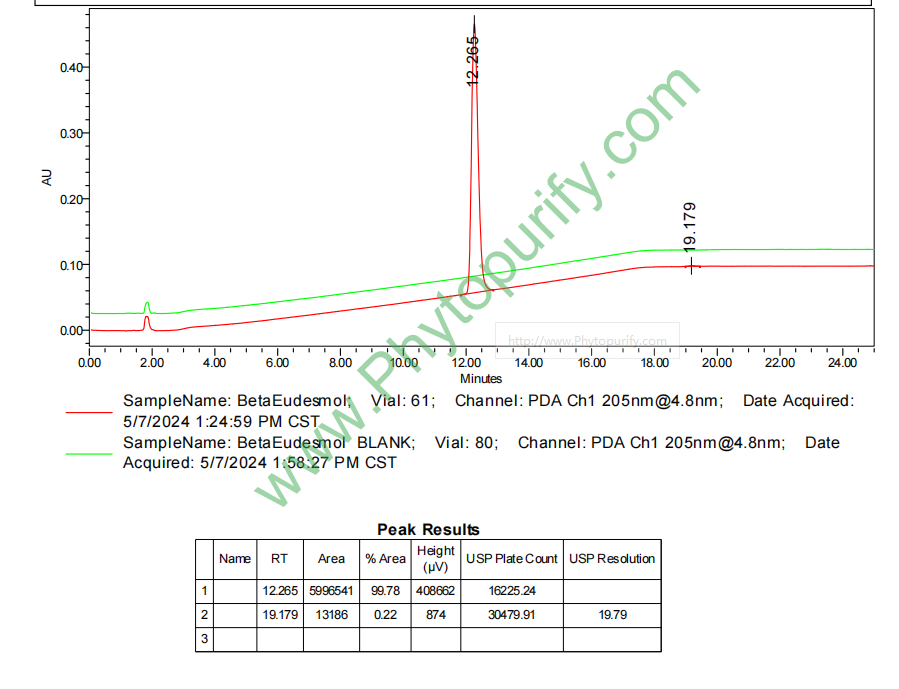
Analysis Method: HPLC-DAD or/and HPLC-ELSD
Identification Method: Mass, NMR
Packing: Brown vial or HDPE plastic bottle
Storage: Store in a well closed container, protected from air and light. Put into refrigerate or freeze for long term storage.
Whenever possible, you should prepare and use solutions on the same day. However, if you need to make up stock solutions in advance, we recommend that you store the solution as aliquots in tightly sealed vials at -20℃. Generally, these will be useable for up to two weeks.
The product could be supplied from milligrams to grams, up to kilograms
Inquire for bulk scale.
Descriptions:
Beta-eudesmol, a sesquiterpenoid alcohol isolated from Atractylodes lancea rhizome, can inhibit angiogenesis, at least in part, through the blockade of the ERK signaling pathway, suggests that it may aid the development of drugs to treat angiogenic diseases.[1]
Beta-eudesmol induces neurite outgrowth in rat pheochromocytoma cells accompanied by an activation of mitogen-activated protein kinase, it may be a promising lead compound for potentiating neuronal function, and the drug may be useful in helping to clarify the mechanisms underlying neuronal differentiation.[2]
Beta-eudesmol has potential anti-angiogenic and anti-tumour activities, it inhibits angiogenesis by suppressing CREB activation in growth factor signalling pathway, is an inhibitor of tumour growth.[3]
Beta-eudesmol induces apoptosis is accompanied by cleavage of caspase-3, caspase-9, and poly (ADP-ribose) polymerase; downregulation of Bcl-2 expression; release of cytochrome c from mitochondria; and decrease in mitochondrial membrane potential (MMP), suggests it induces apoptosis in HL60 cells via the mitochondrial apoptotic pathway, which is controlled through JNK signaling. [4]
References:
[1] Tsuneki H, Ma E L, Kobayashi S, et al. Eur J Pharmacol, 2005, 512(2-3):105-15.
[2] Obara Y, Aoki T, Kusano M, et al. J Pharmacol Exp Ther, 2002, 301(3):803-11.
[3] Tsuneki H. J Asian Nat Prod Res, 2008, 10(1-2):159-167.
[4] Li, Yanchun, Li, et al. Phytother Res, 2012, 27(3):338-43.
[5] Chen Y M, Chou G X, Wang Z T. China journal of Chinese materia medica, 2007, 32(21):2265-7.
HPLC of Beta-Eudesmol
Storage conditions:Short-term storage at 2~8℃, long-term storage at -20 ~ -80℃
20.2300
4.1000
3.8000
Unknown
No
No
No
No
No
No
No
Beta Eudesmol (CAS number: 473-15-4) is a naturally occurring sesquiterpene like compound mainly extracted from the rhizomes of Atractylodes lancea. As one of the important active ingredients in traditional Chinese medicinal materials, β - eucalyptol has attracted widespread attention in the field of natural product pharmacology in recent years due to its diverse biological activities, especially anti-cancer, anti-inflammatory, and neuroprotective effects. It can induce cell apoptosis and antagonize the neuromuscular failure induced by neostigmine, demonstrating potential therapeutic value in the study of sepsis, neuromuscular failure, and chronic obstructive pulmonary disease (COPD). This article provides a systematic review of the chemical structure and physicochemical properties, plant sources and extraction methods, pharmacological activity, mechanism of action, pharmacological evaluation, and clinical application prospects of β - eucalyptol, aiming to provide scientific basis for its further drug development and clinical application.
β - Eucalyptol is a typical sesquiterpene like compound with a molecular formula of C15H26O and a molecular weight of 222.37. Its structural features include a tricyclic skeleton and a hydroxyl substituent, endowing it with certain polarity and biological activity. The LogP value of β - eucalyptol is about 4.1, indicating that it has good lipid solubility and is beneficial for penetrating cell membranes and the blood-brain barrier (although the blood-brain barrier penetration is not yet clear). Its topological polar surface area (TPSA) is 20.23 Å ², and the number of hydrogen bond acceptors is 1, indicating that it has moderate polarity characteristics in intermolecular interactions.
In terms of physical and chemical properties, β - eucalyptol is a colorless to light yellow oily liquid with certain volatility and stability. Its high lipid solubility and moderate polarity give it good bioavailability and cell membrane permeability in vivo. In addition, toxicological evaluation showed that the LD50 of β - eucalyptol was approximately 2000 mg/kg, indicating its low acute toxicity and no significant hepatotoxicity, cardiotoxicity, or hERG channel inhibition. The Ames test result was negative, suggesting a low risk of genotoxicity.
β - Eucalyptol mainly exists in the rhizomes of Atractylodes lancea and is one of the main components of its volatile oil. Atractylodes macrocephala, as a traditional Chinese medicinal herb, is widely used in therapeutic fields such as dispelling dampness, strengthening the spleen, and stopping sweating. The extraction of β - eucalyptol is usually carried out by steam distillation or solvent extraction. The specific steps include:
In recent years, supercritical CO2 extraction technology has also been used for the extraction of β - eucalyptol due to its green environmental protection and high efficiency, showing good application prospects.
The pharmacological activity research of β - eucalyptol covers multiple aspects such as anti-cancer, anti-inflammatory, neuroprotective, and immune regulation.
Numerous in vitro and in vivo studies have shown that β - eucalyptol can induce cancer cell apoptosis and inhibit tumor growth through various pathways. Its mechanism of action includes activating the mitochondrial dependent apoptosis pathway, regulating the expression of Bcl-2 family proteins, and promoting Caspase enzyme activation. It has been found that β - cineole has significant cytotoxicity to many cancer cell lines, such as liver cancer, lung cancer, breast cancer, etc. In addition, β - eucalyptol can also inhibit the migration and invasion of tumor cells, reducing the potential for metastasis.
β - Eucalyptol reduces the intensity of inflammatory response by inhibiting the expression of inflammatory factors such as TNF - α, IL-6, and IL-1 β. In inflammation related disease models such as chronic obstructive pulmonary disease (COPD), β - eucalyptol can regulate the NF - κ B signaling pathway, reduce the release of inflammatory mediators, and alleviate lung tissue damage. In addition, its inhibitory effect on inflammation related enzymes such as MMP9 and PTGS2 helps prevent tissue damage and fibrosis processes.
β - Eucalyptol can effectively antagonize the neuromuscular failure induced by neostigmine, demonstrating its potential application value in neuromuscular diseases. The mechanism may involve regulating neurotransmitter release, protecting neurons from oxidative stress damage, and regulating neuromuscular junction function. In addition, β - eucalyptol exhibits anti-inflammatory and neuroprotective effects in sepsis models, suggesting its potential application in multiple organ dysfunction syndrome.
β - Eucalyptol can regulate immune cell function and enhance the body's immune defense ability. Research has shown that it has a positive regulatory effect on the activity of macrophages and lymphocytes, promotes cytokine balance, and improves the immune microenvironment.
The multiple pharmacological activities of β - eucalyptol are attributed to its regulation of multiple molecular targets, particularly in inflammation and tumor related signaling pathways.
β - Eucalyptol mainly exerts its effects through the following signaling pathways:
In summary, β - eucalyptol achieves a wide range of pharmacological effects through multi-target and multi pathway synergistic effects.
The pharmacological evaluation of β - eucalyptol shows that it has good potential for drug development.
At present, there is limited research on the pharmacokinetics of β - eucalyptol, but its lipid solubility and molecular weight suggest that it may have good oral absorption and tissue distribution ability. In the future, further research is needed on its in vivo metabolic pathways, bioavailability, half-life, and excretion mode to guide clinical formulation design and dosing regimens.
β - Eucalyptol, as a natural active ingredient, has shown broad clinical application prospects in multiple disease fields due to its multi-target and multi mechanism pharmacological properties.
COPD is a disease characterized by chronic airway inflammation and airflow limitation. β - Eucalyptol is expected to alleviate airway inflammation and tissue damage, improve lung function, and become a new candidate drug for adjuvant therapy of COPD by regulating inflammatory factors such as TNF, IL-6, NF - κ B, inhibiting MMP9 and PTGS2 activity.
The induction of apoptosis and inhibition of tumor cell migration by β - eucalyptol suggest its potential application value in tumor therapy. In the future, it can be combined with chemotherapy drugs to exert synergistic effects and reduce chemotherapy toxicity and side effects.
The antagonistic effect of β - eucalyptol on neostigmine induced neuromuscular failure provides a new approach for the treatment of neuromuscular diseases. Meanwhile, its anti-inflammatory and neuroprotective effects in sepsis are expected to improve multiple organ dysfunction and increase patient survival rates.
The immunomodulatory and anti-inflammatory effects of β - eucalyptol may be extended to fields such as autoimmune diseases and inflammatory bowel disease. Combining modern drug delivery technologies such as nanocarriers and targeted drug delivery is expected to enhance its therapeutic efficacy and safety.
β - Eucalyptol, as a sesquiterpene compound derived from Atractylodes macrocephala, has become a hot topic in natural product pharmacology research due to its significant anti-cancer, anti-inflammatory, and neuroprotective activities. Its multi-target and multi mechanism mode of action provides new strategies for the treatment of various diseases. The drug efficacy evaluation shows that it has good safety and potential for drug development. However, current research on its pharmacokinetic characteristics and clinical applications is still relatively limited, and there is an urgent need for systematic in vitro and in vivo studies and clinical trials to support it. In the future, with the advancement of extraction and purification technology and pharmaceutical formulation processes, β - eucalyptol is expected to become an important candidate molecule for natural drug development, bringing new breakthroughs to the treatment of related diseases.
