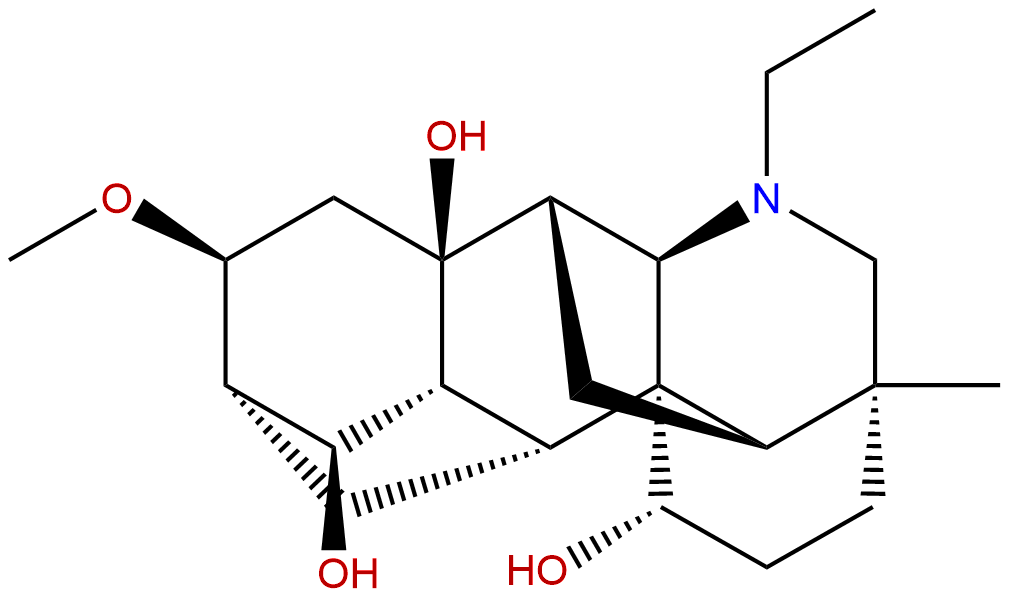


Product name: Karacoline
Synonym name:
Catalogue No.: BP3653
Cas No.: 39089-30-0
Formula: C22H35NO4
Mol Weight: 377.525
Botanical Source:
Physical Description:
Type of Compound: Alkaloids
Purity: 95%~99%
Analysis Method: HPLC-DAD or/and HPLC-ELSD
Identification Method: Mass, NMR
Packing: Brown vial or HDPE plastic bottle
The product could be supplied from milligrams to grams. Inquire for bulk scale.
We provide solution to improve the water-solubility of compounds, thereby facilitating the variety of activity tests and clinic uses.
For Reference Standard and R&D, Not for Human Use Directly.
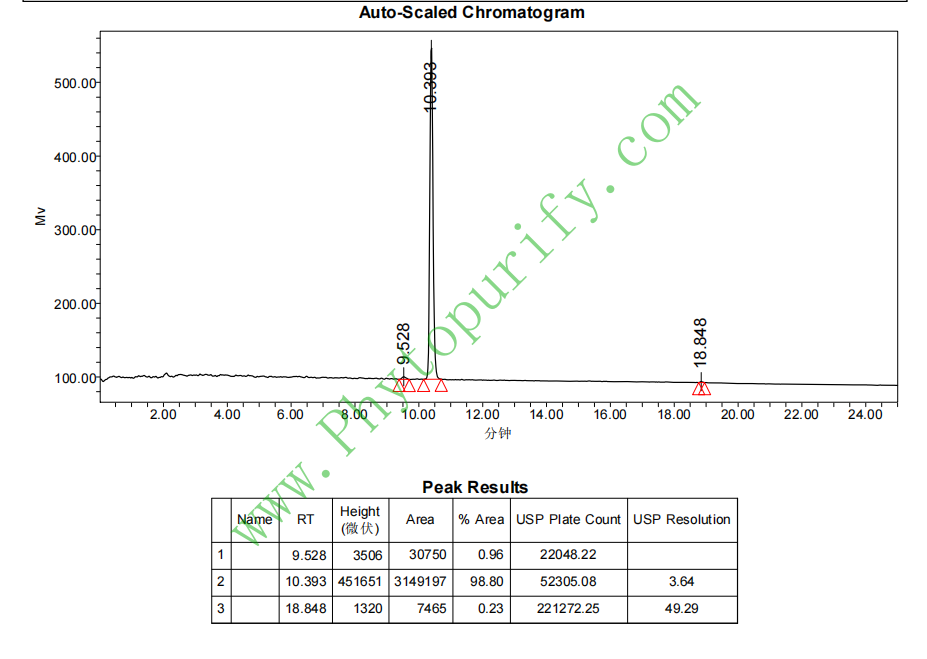
HPLC of Karacoline
Storage conditions:Short-term storage at 2~8℃, long-term storage at -20 ~ -80℃
73.1600
1.7261
1.2897
.9265
2.2409
15.3226
Low
46.2261
6.9892
No
No
No
No
No
No
0.0
Yes
No
Yes
No
Karacoline (CAS number: 39089-30-0) is a compound isolated from Aconitum plants in the Ranunculaceae family C20 diterpenoid alkaloids Its molecular formula is C22H35NO4 and its molecular weight is 377.5250 g/mol. The compound was initially Aconitum kusnezofii Discovered in China and later in traditional Chinese medicine Aconitum carmichaelii It has also been confirmed. Aconitum plants have a long history of application in traditional Chinese medicine, often used to treat diseases such as pain, rheumatism, and inflammation. However, their strong toxicity also makes them a double-edged sword. Duogan aconitine, as one of the active ingredients, has been used in recent years due to its unique properties analgesia And potential anti-inflammatory Active and attracting attention.
Existing research indicates that multiple aconitines can be regulated through modulation NF - κ B signaling pathway Reducing the degradation of extracellular matrix during intervertebral disc degeneration suggests its potential in the treatment of degenerative bone and joint diseases. In addition, its pharmacological effects involve multiple key targets, including TRPV1、 Cannabinoid receptor CNR1 and opioid receptor (OPRD1, OPRM1, OPRK1)These targets are closely related to pain perception and inflammation regulation. Therefore, multiple aconitines are not only important molecules for studying the efficacy and toxicity of Aconitum plants, but may also provide lead compounds for the development of new analgesic or anti-inflammatory drugs.
This article will provide a systematic and professional interpretation of this natural product from the aspects of its chemical structure, plant origin, pharmacological mechanism, medicinal evaluation, and research prospects.
Duogan aconitine belongs to Tetracyclic diterpenoid alkaloids Its structure is complex, with multiple chiral centers and clear stereochemistry. From the provided SMILES string, it can be seen that the molecule contains a Piperidine ring Multiple fused ring systems are connected to functional groups such as hydroxyl (- OH) and methoxy (- OCH3). This complex ring system and abundant oxygen-containing substituents are the structural basis of its biological activity.
Its physicochemical properties can be preliminarily evaluated through a series of pharmacological parameters:
- Molecular weight (MW):377.5250 g/mol, Slightly higher than conventional small molecule drugs (usually<500), but still within an acceptable range.
- Lipid water partition coefficient (LogP)The calculated value is 1.7261, and the LogD (pH 7.4) is 1.2897, indicating that the compound has moderate Lipophilic nature It is beneficial for transmembrane absorption without causing metabolic or distribution problems due to excessive lipid solubility.
- Polarized surface area (TPSA)73.16 Å ² reflects the polarity brought by multiple oxygen-containing functional groups (hydroxyl, ether bonds) in the molecule. Usually, TPSA>140 Å ² significantly affects membrane permeability, while the TPSA of multiple aconitines is at a moderate level, suggesting that they may have some membrane permeability.
- Water solubility The predicted value is 0.9265 mg/mL, belonging to the range of slightly soluble to soluble, which is consistent with its moderate LogP and certain polarity.
- Permeability The predicted permeability value of Caco-2 cells (15.3226 × 10 ⁻⁶ cm/s) is relatively high, indicating its Good intestinal absorption potential However, it The blood-brain barrier (BBB) penetration is predicted to be 'low'This may be due to its high TPSA and the presence of polar groups in the molecule, which limit its free diffusion into the central nervous system. This may be a challenge for analgesic effects targeting central opioid receptors, but it may also reduce the risk of central side effects.
Overall, the chemical structure of aconitine endows it with the potential to interact with multiple biological targets, and its physicochemical properties indicate that it has a partial basis as an orally active drug.
Duogan aconitine mainly comes from the Ranunculaceae family Aconitum genus Plant The information shows that it exists in Aconitum carmichaelii In the middle. Fuzi is a precious medicinal herb in traditional Chinese medicine, which is a processed product of Aconitum root. Its original plant is Aconitum carmichaelii In addition, it is North Aconitum (A. kusnezofii)It has also been discovered.
Aconitum plants are widely used in many traditional medical systems around the world, especially in Traditional Chinese Medicine (TCM)China has a long history. Fuzi has a hot nature, a pungent and sweet taste, and is toxic. It belongs to the heart, kidney, and spleen meridians. The traditional efficacy is Returning to Yang and Rescuing Reversal, Tonifying Fire and Assisting Yang, dispersing Cold and Relieving Pain It is commonly used to treat diseases such as Yang deficiency, limb cold and weak pulse, insufficient heart yang, chest obstruction and heartache, deficiency cold vomiting and diarrhea, abdominal cold pain, kidney yang deficiency and weakness, impotence and uterine cold, yin cold edema, cold dampness and pain. The efficacy of its "dispelling cold and relieving pain" is highly consistent with the analgesic and anti-inflammatory activities revealed by modern research.
However, plants of the Aconitum genus Highly toxic It is also widely known that its main toxic components are Diester type diterpenoid alkaloids Aconitine, such as aconitine and neoaconitine, have strong toxicity to the heart and nervous system. As one of the alkaloids, aconitine has relatively low toxicity, which can be seen from the preliminary toxicity prediction parameters (Ames test negative, no chromosomal aberration, hERG inhibition negative). Traditional Chinese medicine is processed through complex methods Processing technology(such as soaking, steaming, and blending) to reduce the toxicity of Aconitum/Aconitum, while retaining or converting the active ingredients. Duogan aconitine may have been hydrolyzed and transformed from more toxic diester alkaloids during the processing, reflecting the wisdom of traditional Chinese medicine in "reducing toxicity and preserving efficacy" or "reducing toxicity and enhancing efficacy".
Although the pharmacological activity research of aconitine is currently in its early stages, it has shown multifaceted potential, and its mechanism of action involves multiple key targets related to pain and inflammation.
Core pharmacological activity:
1. Analgesic effect This is the most highly regarded activity of aconitine. Its analgesic mechanism is not a single pathway, but may produce synergistic effects by acting on multiple targets.
2. Anti inflammation and anti intervertebral disc degeneration The existing description clearly states that it can be achieved through NF - κ B signaling pathway Reduce the degradation of extracellular matrix (such as collagen and proteoglycans) in intervertebral disc degeneration. NF - κ B is a core transcription factor in inflammatory response, and its activation leads to the expression of various pro-inflammatory factors (such as TNF - α, IL-1 β, IL-6) and matrix degrading enzymes (such as MMPs, ADAMTS). Inhibiting the NF - κ B pathway is a classic strategy for treating degenerative diseases such as osteoarthritis and intervertebral disc herniation.
Detailed explanation of target and mechanism of action:
The database suggests that multiple aconitines are associated with the following five targets:
- TRPV1 (Transient receptor potential vanillic acid subtype 1)Also known as capsaicin receptor, it is a non selective cation channel widely distributed in sensory neurons. It can be activated by heat, acid, capsaicin, etc., mediating the transmission of pain and heat signals.Antagonistic TRPV1 receptor It is an important direction for developing new analgesics, especially effective for inflammatory pain and neuropathic pain. Duogan aconitine may reduce the excitability of pain neurons by regulating TRPV1 function.
- CNR1 (cannabinoid receptor 1)The cannabinoid system is an important component of the endogenous pain regulation system. CNR1 is mainly distributed in the central nervous system and can produce analgesic, anti-inflammatory, and mood regulating effects after activation. If multiple aconitines are used as modulators (agonists or allosteric modulators) of CNR1, they may enhance endogenous analgesia through this pathway.
- OPRD1, OPRM1, OPRK1 (δ, μ, κ opioid receptors)This is a classic analgesic target. Activation of the μ receptor produces potent analgesia, but is also accompanied by serious side effects such as respiratory depression and addiction; Activation of δ and κ receptors is also involved in analgesia, with different side effect profiles. The interaction between multiple aconitines and these three types of opioid receptors suggests that they may have Opioid activity Considering its low BBB penetration, if it mainly acts on peripheral opioid receptors, it may develop into Peripheral selective analgesics To avoid central side effects.
- NF - κ B pathway (although not listed as a target, it is the core mechanism)The activation or inhibition of the above receptors (especially TRPV1 and CNR1) often leads to downstream signal aggregation and affects the activity of NF - κ B. For example, TRPV1 activation can promote NF - κ B nuclear translocation, while CNR1 activation may inhibit it. Duoduo aconitine may be regulated by upstream receptors, ultimately inhibiting the transcriptional activity of NF - κ B, thereby reducing the production of pro-inflammatory factors and matrix degrading enzymes, and protecting the extracellular matrix of intervertebral disc cells.
Related disease associations:
- analgesia Its multi-target mechanism of action may make it effective for various types of pain (inflammatory pain, neuropathic pain).
- Intervertebral disc degeneration/osteoarthritis By anti-inflammatory and inhibiting matrix degradation, it directly targets the pathological processes of diseases and has the potential for disease modification.
In summary, multiple aconitines may be obtained through Multi target, multi pathway The method of exerting analgesic and anti-inflammatory effects: on the one hand, it directly regulates pain signals through TRPV1, opioid receptors, and cannabinoid receptors; On the other hand, by inhibiting the NF - κ B pathway, tissue inflammation and destruction can be alleviated. This synergistic effect may lead to better therapeutic efficacy and lower risk of side effects.
Based on the provided pharmacological parameters and combined with Lipinski's Five Rules The potential of Aconitine as a lead compound for oral administration can be preliminarily evaluated using standards such as Rule of Five
Lipinski's Five Rules Compliance Analysis:
1. Molecular weight (MW)<500:377.5,Comply with。
2. Lipid water partition coefficient (LogP)<5:1.73,Comply with。
3. The number of hydrogen bond donors (HBDs) is less than 5 From the structural formula, it can be inferred that there are at least 3 hydroxyl groups (- OH) and possibly secondary amines, and the total number should be less than 5,May meet。
4. The number of hydrogen bond acceptors (HBAs) is less than 10 The molecule contains 4 oxygen atoms and 1 nitrogen atom, both of which can be used as HBAs, with a total of 5,Comply with。
5. Number of rotatable keys Usually requires<10. Judging from its rigid multi ring structure, there are fewer rotatable keys,May meet。
Therefore, multiple aconitines Basically meets Lipinski's five rules It indicates that it has good oral absorption potential.
Interpretation of other key pharmacological parameters:
- Absorption and distribution:
- Caco-2 permeability (15.32): High value, indicating Good intestinal absorption。
- Blood-brain barrier (BBB) penetrability Predicted as' low '. This is a double-edged sword for its pharmacological effects. If its analgesic effect mainly relies on central opioid or cannabinoid receptors, low BBB penetration is a disadvantage. But if it mainly works through peripheral TRPV1, peripheral opioid receptors, or anti-inflammatory mechanisms, then low BBB penetration can actually Avoid central nervous system side effects(such as drowsiness, addiction, respiratory depression) to improve safety.
- Plasma protein binding rate (PPB)46.23%, belonging to the moderate to low level. This means that there is a higher proportion of free drugs available to exert pharmacological effects, but the half-life may be relatively short.
- Metabolism and toxicity:
- Ames test Predicted as negative (0.0), indicating No mutagenicity。
- HERG inhibition A prediction of 'no' indicates that it Low risk of cardiac toxicity (QT interval prolongation)This is an important security advantage.
- Chromosomal aberration, skin/respiratory sensitization, phototoxicity All predictions are negative or absent.
- Serum enzyme indicators Prediction shows that it may cause Elevated levels of serum AST (aspartate aminotransferase) and ALK (alkaline phosphatase), indicating the existence of potential Risk of liver injury This is a toxicity endpoint that needs to be closely monitored in subsequent development.
Comprehensive evaluation:
Duoduo Aconitine Good performance in oral absorption, compliance with basic physicochemical rules, preliminary genetic toxicity, and cardiac safety It has the foundation to become an orally active lead compound. The main challenge lies in: ① BBB penetration is low It is necessary to clarify the ratio of central and peripheral contributions of its analgesic effect; ② Potential Hepatotoxic signal Experimental verification is required; ③ As a natural product, it SyneAccessibility: 6.99 It is somewhat difficult, but not insurmountable. Future research needs to further confirm its therapeutic window and safety through in vitro and in vivo pharmacological and toxicological experiments.
Research Status:
At present, research on aconitine in Duoduo is still in progress Early preclinical stage The existing literature mainly focuses on:
1. Separation and identification Isolate this component from various Aconitum plants and determine its chemical structure.
2. Preliminary activity screening Based on its traditional use as a plant source, in vitro and in vivo model screening will be conducted in areas such as pain relief and anti-inflammatory effects. The discovery of its anti intervertebral disc degeneration effect through the NF - κ B pathway represents a deeper direction in mechanism research.
3. Target prediction and validation Predicting potential targets of action (such as the 5 receptors listed in this article) through computational simulations (such as molecular docking), but most of these targets Experimental validation data is still lacking It remains to be clarified whether it is an agonist or antagonist, and what its affinity is.
Application prospects and future directions:
1. Lead compounds of novel multi-target analgesics The potential of its simultaneous action on TRPV1, opioid receptors, and cannabinoid receptors deserves further exploration. Experiments can be designed to verify the type and intensity of activity against each target, and to investigate whether multi-target synergy can truly produce more potent and safer analgesic effects (such as reducing the risk of opioid addiction). development Peripheral restrictive multi-target analgesics It is an attractive direction.
2. Candidate molecules for treating musculoskeletal disorders Its anti-inflammatory and protective effects on the extracellular matrix enable it to Osteoarthritis, intervertebral disc degeneration, rheumatoid arthritis It has application prospects in the treatment of diseases. Further validation of its efficacy is needed in animal models of such diseases.
3. Structural optimization and improvement of drug properties Based on its core skeleton Structural modification It is a crucial step in the development of natural product drugs. Optimization can be carried out to address its shortcomings, such as improving water solubility or BBB penetration (if necessary) through prodrug strategies while retaining activity; Reduce potential liver toxicity through modification; Simplify the structure to improve synthesis efficiency.
4. Modern scientific interpretation of traditional Chinese medicine Fuzi's "reducing toxicity and increasing efficiency"Studying the changes of multiple aconitines during the processing of Aconitum carmichaelii and their transformation relationship with highly toxic alkaloids (such as aconitine) can elucidate the scientific principles of traditional Chinese medicine processing from the perspective of chemical substance basis.
Conclusion:
Duogan aconitine is a natural diterpenoid alkaloid with a unique structure and diverse mechanisms of action. It not only carries some medicinal value of traditional Chinese medicine Aconitum/Aconitum, but also provides valuable chemical templates for modern innovative drug development due to its relatively low toxicity and clear multi-target action characteristics. Although there is still a need for extensive biological validation, pharmacokinetic studies, and safety evaluations, its potential in the fields of analgesia and anti-inflammatory effects undoubtedly makes it a natural product star molecule worthy of continuous attention. Future research should focus on the confirmation of target action, in-depth evaluation of in vivo efficacy, and rational optimization based on structure, in order to ultimately transform it from an ancient plant component into a modern drug with clear clinical value.
