Introduction/Overview
Multiple sclerosis (MS) is an autoimmune disease characterized by chronic inflammation, demyelination, and neurodegeneration of the central nervous system. Its pathological process is complex and involves abnormal activation of multiple immune cells, inflammatory factors, and glial cells. At present, first-line clinical treatment drugs such as interferon - β and fingolimod can regulate immunity and reduce recurrence, but there are still limitations in preventing disease progression and promoting myelin repair, often accompanied by varying degrees of side effects. Therefore, exploring new active molecules with multi-target, high efficiency and low toxicity characteristics from natural products has become one of the important directions for the development of MS drugs.
Ganoderma lucidum(Ganoderma lucidum)As a traditional precious medicinal fungus, its anti-inflammatory, immune regulatory, and neuroprotective activities have been widely recognized. Ganoderma triterpenoids are one of its main active ingredients, among which ganoderic acid C2, as a unique lanostane type triterpenoid acid, has attracted much attention in recent years due to its significant activity in neuroinflammation related disease models. This article aims to systematically review the chemical properties, plant sources, pharmacological activities, mechanisms of action, and medicinal properties of Ganoderma lucidum acid C2, with a focus on exploring its potential therapeutic value in neuroimmune diseases such as multiple sclerosis, in order to provide scientific basis for the in-depth research and development of this compound.
Chemical structure and physicochemical properties
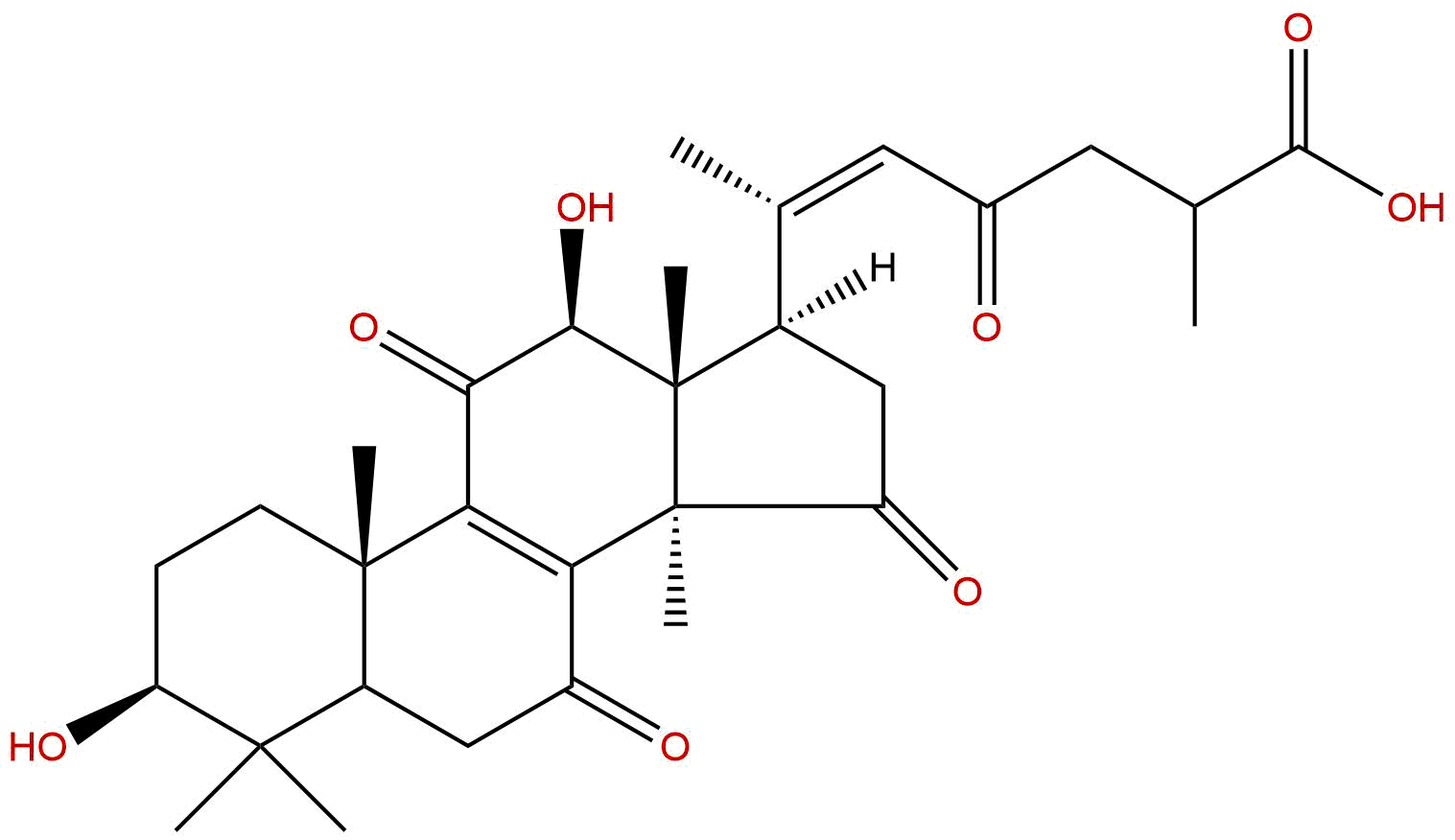
The chemical name of ganoderic acid C2 is (24E) -3 α - hydroxy-5 α - lanostane-7,9 (11), 24-triene-26-oic acid, with a CAS number of 1961358-00-8. Its molecular formula is C ∝₀ H ₄₀ O ₆, and its molecular weight is 528.6420. This compound belongs to the highly oxidized lanostane type tetracyclic triterpenes, with a core structure consisting of a steroid like tetracyclic system (A/B/C/D ring) and a conjugated diene (Δ ² ⁴) and a terminal carboxylic acid group (C-26) on the side chain. The 3 α - hydroxyl group on the A ring and the conjugated diene (Δ ⁷, ⁹⁽¹¹⁾) in the B ring are important active functional groups, and these structural features are closely related to their electronic distribution, spatial conformation, and biological activity.
From the analysis of physicochemical parameters related to drug properties, the lipid water partition coefficient (LogP) of Ganoderma lucidum acid C2 is 2.5488, indicating that it has moderate lipophilicity and is conducive to penetrating cell membranes. Its topological polar surface area (TPSA) is 146.0400 Å ², which is relatively high and mainly attributed to multiple oxygen-containing groups (hydroxyl, carboxyl) in the molecule, indicating its strong ability to form hydrogen bonds. The water solubility parameter is 0.0487, belonging to the category of slightly soluble to poorly soluble, which is in line with the characteristics of most triterpenoid compounds. Solubilization strategies may need to be considered in formulation development. Considering its molecular weight (>500) and polar surface area, this compound may not fully comply with the traditional "five principles of drugs", but as a natural product lead compound, its unique biological activity often compensates for certain deficiencies in physicochemical properties.
Plant sources and extraction methods
Lingzhi oleic acid C2 mainly comes from fungi of the Ganoderma genus in the family Polyporus, with Lingzhi being the most abundant(Ganoderma lucidum)And Zizhi(Ganoderma sinense)The content of fruiting bodies, mycelium, and spore powder is relatively abundant. Its content is significantly affected by the type of strain, growth environment (such as temperature, humidity, light), cultivation substrate, and growth stage. Usually, the cap of mature fruiting bodies, especially the area near the shell, accumulates more triterpenoid components.
The extraction method mainly relies on its weak acidity and moderate polarity characteristics. The standard procedure is as follows:
1. Preprocessing After crushing the dried Ganoderma lucidum material, petroleum ether or cyclohexane is commonly used for degreasing to remove non-polar impurities.
2. Subject extraction Extract using a medium polarity solvent.Alcohol extraction method The most commonly used and efficient methods include 95% ethanol or methanol reflux extraction and ultrasound assisted extraction.Supercritical CO ₂ fluid extraction SFE-CO ₂ has shown advantages in obtaining high-purity triterpenoids due to its low temperature, no solvent residue, and adjustable selectivity. By adjusting pressure and temperature, the yield of ganoderic acid C2 can be optimized.
3. Separation and purification After vacuum concentration, the crude extract can be used to utilize the carboxyl properties of Ganoderma lucidum acid C2 Alkali dissolution and acid precipitation method Perform preliminary enrichment. Further purification relies on chromatographic techniques: silica gel column chromatography is commonly used, with chloroform methanol or petroleum ether ethyl acetate gradient elution; Reverse phase medium pressure or high pressure liquid chromatography (RP-MPLC/HPLC, commonly using C18 column, methanol water or acetonitrile water system) is a key step in obtaining high-purity monomers. Prepared thin layer chromatography (PTLC) can also be used for refining small amounts of samples. Structural identification involves the comprehensive use of mass spectrometry (MS), nuclear magnetic resonance (NMR, especially ¹ H-NMR, ¹ ³ C-NMR, 2D NMR), and X-ray single crystal diffraction techniques.
Pharmacological activity research
The pharmacological research of Ganoderma lucidum acid C2 is currently mainly focused on the fields of immune regulation, anti-inflammatory, and neuroprotection, especially showing remarkable activity in experimental models related to multiple sclerosis.
-
Anti inflammatory and immune regulatory effects In the LPS induced inflammation model of microglia (BV2 cells) and macrophages (RAW264.7 cells), ganoderic acid C2 can dose dependently inhibit the excessive production of inflammatory mediators such as nitric oxide (NO) and prostaglandin E2 (PGE2). More importantly, it can significantly downregulate key pro-inflammatory cytokines Tumor necrosis factor alpha (TNF - α)and Interleukin-6 (IL-6)Gene expression and protein secretion. In T cell-mediated immune response, preliminary studies suggest that it may affect the differentiation of Th1/Th17 cells, which play a central role in the pathogenesis of MS.
-
Neuroprotective and anti demyelinating effects In the experimental autoimmune encephalomyelitis (EAE) mouse model, which is the most commonly used animal model for MS, intervention with ganoderic acid C2 can significantly delay the onset of the disease and reduce clinical neurological function scores. Histopathological analysis showed that the infiltration of inflammatory cells in the spinal cord and brainstem of the treatment group mice decreased, and the degree of myelin sheath loss was reduced. Immunohistochemical staining further confirms that it can downregulate the central nervous system Glial fibrillary acidic protein (GFAP)and Myelin basic protein (MBP)Abnormal expression. GFAP is a marker of activated astrocytes, and a decrease in its expression suggests relief of neuroinflammation; MBP is the main component of myelin sheath, and its expression is relatively preserved or abnormally reduced, which directly reflects the protective effect of myelin sheath structure. In addition, regarding Protein lipid protein (PLP)The regulation of expression also suggests its potential benefits for oligodendrocyte function and myelin stability.
-
anti-oxidative stress Oxidative stress is an important driving factor for MS neurodegeneration. Lingzhi acid C2 can enhance the activity of intracellular antioxidant enzymes such as superoxide dismutase (SOD) and glutathione peroxidase (GSH Px), and reduce the accumulation of reactive oxygen species (ROS), thereby protecting neurons and oligodendrocytes from oxidative damage.
Mechanism of action and molecular targets
The molecular mechanism of the multi-target pharmacological effects of Ganoderma lucidum acid C2 is gradually being revealed, and its core lies in regulating key signaling pathways related to neuroinflammation and immune imbalance.
-
Inhibition of NF - κ B signaling pathway This is the core mechanism of its anti-inflammatory effect. Under stimulation such as LPS, ganoderic acid C2 can prevent the phosphorylation degradation of I κ B α, thereby inhibiting the nuclear translocation of nuclear factor kappa B (NF - κ B) p65 subunit. Inhibition of the NF - κ B pathway directly leads to downstream effects TNF-α、IL-6 Waiting for the downregulation of transcription of a large number of pro-inflammatory cytokine genes. This pathway serves as a hub connecting the activation of microglia/astrocytes and the amplification of central inflammation.
-
Regulating the MAPK signaling pathway Research has shown that ganoderic acid C2 can also inhibit the inflammatory activation of the mitogen activated protein kinase (MAPK) pathway, particularly the phosphorylation of p38 MAPK and JNK. The MAPK pathway and NF - κ B pathway have a cross-talk, jointly regulating the production of inflammatory mediators and cellular stress response.
-
Regulating the Nrf2/HO-1 antioxidant pathway Lingzhi acid C2 can activate nuclear factor E2 related factor 2 (Nrf2), promote the expression of downstream phase II detoxifying enzymes such as heme oxygenase-1 (HO-1) and antioxidant proteins. The activation of the Nrf2 pathway not only counteracts oxidative stress, but its product HO-1 also has anti-inflammatory and cell protective effects, forming a negative feedback regulation with the NF - κ B pathway.
-
Direct targets and interactions In addition to the aforementioned pathway regulation, research is exploring its direct interactions with specific proteins. For example, its structure may compete or undergo conformational inhibition with the active centers of certain inflammation related enzymes, such as COX-2 and iNOS. Computer simulation docking analysis suggests that ganoderic acid C2 may have certain binding potential with TNF - α, IL-6 or their receptors, but experimental verification is needed. It pairs GFAP The inhibition of expression reflects its direct or indirect inhibitory effect on reactive astrocytes; And yes MBP and PLP The protection of oligodendrocyte precursor cells may be achieved by promoting their survival, differentiation, and inhibiting their apoptosis, involving neural nutrition pathways such as PI3K/Akt and BDNF.
Evaluation of drug properties and pharmacokinetics
Based on the provided parameters and existing research, the preliminary evaluation of the pharmacological properties of Ganoderma lucidum acid C2 is as follows:
-
Absorption, distribution, metabolism, excretion (ADME) characteristics:
- absorb Moderate LogP values are beneficial for its passive diffusion transmembrane absorption, but lower water solubility and larger molecular weight may limit its oral bioavailability. Formulation techniques such as nanocrystals, liposomes, and cyclodextrin inclusion may be key to improving their absorption.
- distribution: Its The blood-brain barrier (BBB) permeability is predicted to be 'low'This is a major challenge for treating central nervous system diseases such as MS. However, during the acute or active phase of MS, the integrity of the blood-brain barrier is disrupted, and drugs may have more opportunities to enter the brain. Future research needs to confirm the actual brain distribution through in vivo experiments (such as cerebrospinal fluid/plasma concentration ratio), or design delivery systems targeting the BBB.
- Metabolism and excretion As a triterpenoid acid, it may undergo liver phase I metabolism (such as oxidation by cytochrome P450 enzymes) and phase II binding metabolism (such as glucuronidation). The presence of carboxyl groups makes it easy to form complexes. The prototype and metabolites may be mainly excreted through bile and kidneys. The specific metabolic enzyme spectrum and excretion pathways need to be further studied.
-
Preliminary evaluation of safety:
- cardiotoxicity:HERG inhibition is' no 'This is a positive signal indicating a lower risk of inducing QT interval prolongation and apical torsion ventricular tachycardia in the heart.
- Genotoxicity:The Ames test result is 0.0(usually indicating no mutagenicity at the tested concentration), indicating no direct risk of DNA damage and low potential for genetic toxicity.
- Acute and long-term toxicity data are currently lacking, and systematic preclinical toxicology studies are needed to evaluate their safety window.
-
Challenges and optimization of drug development The main challenges lie in poor water solubility and limited BBB penetration ability. By modifying the structure (such as preparing prodrugs, esterifying carboxyl groups to increase lipid solubility), or developing novel drug delivery systems (such as nasal delivery, brain targeted nanomaterials based on exosomes or receptor-mediated transport), it is expected to improve their pharmacokinetic properties and enhance therapeutic efficacy.
Clinical application prospects and prospects
Lingzhi acid C2 has shown unique application potential in the field of MS treatment. Its multi-target mechanism of action (anti-inflammatory, immune regulation, antioxidant, neuroprotective) precisely targets the complex pathological network of MS, and may achieve comprehensive therapeutic effects from inhibiting acute inflammation to protecting neurons, making up for the shortcomings of existing immunosuppressants in neural repair. Its preliminary good safety features (no hERG inhibition, Ames negative) laid the foundation for its further development.
Future research directions should focus on:
1. Deep exploration of mechanisms Using proteomics, chemical proteomics, and other techniques to identify the molecular targets directly affected by it; Elucidate its specific regulatory mechanism on the differentiation of oligodendrocyte lineage and myelin regeneration.
2. Pharmacokinetic improvement Conduct systematic animal in vivo ADME research to clarify its absolute bioavailability, tissue distribution (especially in brain tissue), major metabolites, and excretion pathways.
3. Preclinical development Complete standardized pharmacological evaluation (dose-response relationship and treatment time window studies in different MS animal models) and comprehensive toxicological evaluation (acute toxicity, long-term toxicity, reproductive toxicity, etc.) to provide data support for its application for clinical research.
4. Formulation Development To address its physical and chemical deficiencies, actively develop suitable drug delivery formulations, especially innovative agents that can promote brain delivery.
5. Indications expansion Due to its anti-inflammatory and neuroprotective properties, its indications can be extended to other neuroinflammatory diseases such as Alzheimer's disease, Parkinson's disease, cerebral ischemia-reperfusion injury, etc.
Conclusion
Ganoderma lucidum acid C2, as an active triterpenoid acid isolated from the traditional medicinal fungus Ganoderma lucidum, has shown important lead compound value in the exploration of multiple sclerosis treatment due to its diverse pharmacological activities of inhibiting neuroinflammation, regulating immunity, protecting myelin sheaths and neurons. It acts on multiple targets closely related to MS pathology, such as TNF - α, IL-6, GFAP, MBP, etc., by regulating key signaling pathways such as NF - κ B, MAPK, Nrf2, etc., demonstrating the advantages of multi-component and multi-target synergistic effects of natural products. Despite facing challenges such as water solubility and blood-brain barrier penetration in drug development, its preliminary good safety and clear mechanism of action provide direction for subsequent structural optimization, formulation innovation, and system development. With the continuous deepening of research, ganoderic acid C2 is expected to provide important candidate molecules for the development of new, efficient, and low toxicity MS therapeutic drugs, while also adding new evidence to the modern scientific connotation of interpreting the traditional efficacy of "strengthening the body and consolidating the foundation" of ganoderic acid.