


Product name: Geraniin
Synonym name:
Catalogue No.: BP0639
Cas No.: 60976-49-0
Formula: C41H28O27
Mol Weight: 952.648
Botanical Source: Phyllanthus urinaria L.
Physical Description:
Type of Compound: Polyphenols
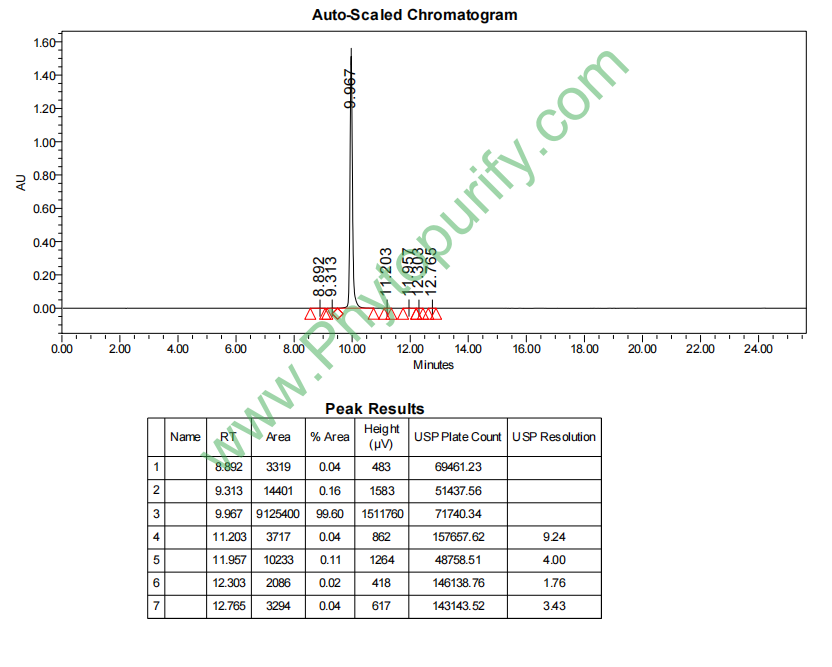
Purity: 95%~99%
Analysis Method: HPLC-DAD or/and HPLC-ELSD
Identification Method: Mass, NMR
Packing: Brown vial or HDPE plastic bottle
Storage: Store in a well closed container, protected from air and light. Put into refrigerate or freeze for long term storage.
Whenever possible, you should prepare and use solutions on the same day. However, if you need to make up stock solutions in advance, we recommend that you store the solution as aliquots in tightly sealed vials at -20℃. Generally, these will be useable for up to two weeks.
The product could be supplied from milligrams to grams
Inquire for bulk scale.
Chengdu Biopurify Phytochemicals Ltd. is a leading company in the research, development, manufacture and marketing of High Quality Phytochemicals and Extracts(especially Active Ingredients from Traditional Chinese Medicine,TCM), Natural Active Pharmaceutical Ingredients worldwide.
The main services:
A. Supply active ingredients and reference standards of TCM, from mgs to kgs scale
B. Custom extraction and purification, target Herb Active Ingredients
C. Custom synthesis and semi-synthesis for Natural Active Ingredients
D. CR(contract research), CM(contract manufacture) and PD(process development) services from lab scale, pilot scale to commercial scale(GMP is also available)
E. TCM compounds library for drug screen,more than 3000 compounds available, many of them are rare and unique.
HPLC of Geraniin
Storage conditions:Short-term storage at 2~8℃, long-term storage at -20 ~ -80℃
450.2500
.9199
.9200
.0109
.6456
.6492
Low
84.3934
7.3863
Yes
No
No
No
Yes
No
0.6
Yes
No
Yes
No
Natural products, as an important treasure trove for drug discovery and development, play an irreplaceable role in the long history of human fight against diseases. Among them, tanning tannin compounds have attracted much attention due to their structural diversity and wide range of biological activities. Geraniin (CAS number: 60976-49-0), as an outstanding representative of this class of compounds, has attracted the attention of pharmacology and medicinal chemistry researchers since its discovery due to its multi-target and multi pathway pharmacological action mode. Gerakan was initially isolated from plants of the Geraniaceae family and the Geraniaceae genus, and subsequent studies have found that it is widely distributed in various medicinal plants. Its core pharmacological activity is defined as an effective inhibitor of tumor necrosis factor alpha (TNF - α) release (IC50=43 μ M), which establishes its cornerstone position in the anti-inflammatory field. However, in-depth research has revealed that the biological activity of resveratrol is far beyond this, and it has shown significant potential in anti-tumor, anti hyperglycemic, antioxidant, antiviral and other aspects. This article aims to systematically review the chemical properties, plant sources, pharmacological activities, molecular mechanisms of action, pharmacological evaluation, and clinical application prospects of resveratrol, in order to provide comprehensive academic references for the in-depth development and transformation research of this natural product.
Gerakan extract is a hydrolyzed tannic acid with a molecular weight of 952.6480 Da, and its chemical structure is complex and unique. Its core skeleton is composed of hexahydroxybiphenyldicarboxylic acid (HHDP) and glucose connected by ester bonds. The glucose core is usually in an open chain form, which is relatively rare in natural tannins. The structure is rich in multiple phenolic hydroxyl groups, giving it strong hydrogen bond donor ability and electron delocalization system, which is also the structural basis for its excellent antioxidant activity.
From the analysis of physical and chemical properties, the calculated lipid water partition coefficient (LogP) of Gerakan is about 0.9199, indicating that it has a certain degree of amphiphilicity, but overall it leans more towards hydrophilicity. Its topological polar surface area (TPSA) is as high as 450.2500 Å ², which is closely related to its large molecular weight and numerous polar groups, especially multiple phenolic hydroxyl groups. A high TPSA value usually indicates poor molecular membrane permeability. The experimental data also confirms this point: its water solubility value is 0.0109 (unit may be mg/mL or molar concentration, usually indicating poor solubility), and its ability to penetrate the blood-brain barrier is predicted to be "low". These physical and chemical parameters collectively depict a typical image of a "large polar molecule", with relatively limited water solubility, potential challenges in oral bioavailability, and difficulty in entering the central nervous system to exert its effects. However, there is no risk of hERG channel inhibition causing cardiac toxicity in its molecule (hERG inhibition: No), and the Ames test result is 0.6 (usually a value close to 1 indicates no mutagenicity, specific threshold needs to refer to experimental standards), indicating a low genetic toxicity risk and providing early positive signals for its safety evaluation.
Gerakan is not an exclusive component of a single plant, but is widely present in various plant families and genera, reflecting its universality in secondary metabolites of plants. Although its name originates from plants of the Geranium genus, such as Geranium nepalense in Nepal, more diverse sources include:
1. Yexiazhu family Many plants in the Phyllanthus genus, such as Phyllanthus emblica (blackcurrant) and Phyllanthus niruri, are important sources of gibberellins with high content.
2. Geraniaceae family In addition to the Old Stork Grass genus, some Pelargonium plants also contain this ingredient.
3. Lacquer tree family Some species of the genus Toxicodendron.
4. Euphorbiaceae、Qianqucai family It is also distributed in plants.
Efficient extraction of resveratrol from plant materials is the first step in studying its activity. The traditional method mainly adopts solvent extraction method:
- Solvent selection Due to the polarity of resveratrol, water, methanol, ethanol, acetone, and their different ratios of aqueous solutions are commonly used as extraction solvents. Water containing methanol or ethanol (such as 70% -80%) often achieves high extraction rates due to their good solubility and permeability towards polyphenolic substances.
- Auxiliary technology To improve extraction efficiency and purity, modern extraction techniques have been widely used, such as ultrasound assisted extraction (UAE), microwave-assisted extraction (MAE), and pressurized liquid extraction (PLE). These technologies accelerate solvent penetration and component dissolution through physical field effects, shorten extraction time, and reduce solvent consumption.
- Separation and purification The crude extract needs to be further separated and purified to obtain high-purity resveratrol. The conventional process includes: preliminary enrichment with macroporous adsorption resins (such as AB-8, D101), and fine separation with a variety of column chromatography technologies, such as silica gel column chromatography, Sephadex gel (LH-20) column chromatography, and high-performance liquid chromatography (HPLC) or preparative liquid chromatography (prep HPLC). Among them, Sephadex LH-20 column chromatography is widely used due to its unique separation effect on polyphenolic compounds.
Gerakan has demonstrated a wide range of pharmacological activities, and its research has expanded from the initial anti-inflammatory field to multiple disease models.
anti-inflammatory activity This is the earliest confirmed and most extensively studied core activity of resveratrol. In various animal models of acute and chronic inflammation, such as colitis induced by carrageenan or dextran sulfate sodium, systemic inflammation induced by lipopolysaccharide, and arthritis induced by Freund's complete adjuvant, resveratrol can significantly inhibit inflammatory response, manifested by reducing tissue edema, decreasing inflammatory cell infiltration, and inhibiting excessive production of pro-inflammatory mediators. Its role as a TNF - α release inhibitor has been repeatedly validated at the cellular and animal levels.
Antitumor activity Geranium has growth inhibition and apoptosis promoting effects on many cancer cell lines, including liver cancer, breast cancer, colon cancer, lung cancer, cervical cancer, etc. Its anti-tumor mechanisms are diverse, not limited to direct cytotoxic effects, but also involve inducing cell cycle arrest (such as G1 phase or G2/M phase), activating mitochondrial apoptosis pathways, inhibiting tumor cell invasion and metastasis, and regulating the tumor microenvironment (such as inhibiting the pro tumorigenic function of tumor associated macrophages).
Anti hyperglycemia and improvement of metabolic syndrome activity: The study shows that Geranium has protective effect in the model of diabetes and its complications. It can improve insulin resistance, promote peripheral tissue uptake and utilization of glucose; In the animal model of streptozotocin induced diabetes, it can reduce the fasting blood glucose level and alleviate the oxidative damage of kidney and liver, which has a potential improvement effect on diabetes nephropathy and liver damage.
Antioxidant and organ protective activity Due to its strong free radical scavenging ability and metal ion chelation ability, resveratrol is an effective antioxidant. In liver injury (induced by acetaminophen and carbon tetrachloride), kidney injury (induced by cisplatin and diabetes), myocardial ischemia-reperfusion injury and other models, it can play a significant role in organ protection by reducing oxidative stress and inflammatory reaction.
Other activities In addition, the study also reported the antiviral (such as against herpes simplex virus and dengue virus), antibacterial, anti ulcer, analgesic, and neuroprotective activities of resveratrol, demonstrating its multifaceted medicinal potential.
The multiple pharmacological activities of resveratrol stem from its interactions with multiple key signaling molecules and pathways within cells, and its mechanism of action is complex and synergistic.
Regulation of core anti-inflammatory signaling pathway:
Pain and sensory nerve regulation Gerakan can antagonize or regulate transient receptor potential (TRP) channels, especially TRPV1 (vanilloid receptor 1) and TRPA1 (anchor protein receptor 1), which play a central role in inflammatory pain and neurogenic inflammation, explaining some of its analgesic activity.
Oxidative stress regulation In addition to directly clearing free radicals, resveratrol can also upregulate the cell's own antioxidant defense system, such as activating the nuclear factor E2 related factor 2 (Nrf2) pathway, promoting the expression of phase II detoxifying enzymes and antioxidant proteins such as heme oxygenase-1 (HO-1) and quinone oxidoreductase 1 (NQO1).
Cell death and autophagy regulation In terms of anti-tumor effects, resveratrol can induce cancer cell apoptosis by regulating Bcl-2 family proteins and activating caspase cascade reactions; Meanwhile, studies have shown that it can induce protective autophagy or inhibit abnormal autophagy, with specific effects varying depending on cell type and microenvironment.
Metabolic pathway influence In terms of anti hyperglycemic effects, resveratrol may activate the AMP activated protein kinase (AMPK) pathway, enhance membrane translocation of glucose transporters (such as GLUT4), and improve insulin signaling (such as the PI3K/Akt pathway).
In summary, resveratrol acts like a "versatile hand" by simultaneously acting on multiple key signaling nodes such as NF - κ B, STAT3, Nrf2, AMPK, etc., forming a synergistic network to exert therapeutic effects on inflammation, oxidation, metabolism, proliferation, and other levels.
Although resveratrol has shown excellent biological activity in vitro and animal models, its conversion into drugs faces significant challenges due to its physicochemical properties.
Absorption, distribution, metabolism, excretion (ADME):
Challenges and Strategies in Drug Development:
At present, there is still a relative lack of complete preclinical pharmacokinetic research data on the resveratrol system, which is a key information gap that must be filled before it can move towards clinical application.
The multi-target properties of resveratrol make it uniquely attractive for treating complex diseases, especially those involving chronic inflammation, oxidative stress, and metabolic disorders.
Potential therapeutic areas:
Future research directions and challenges:
As a natural tanning tannin with unique structure and wide biological activity, the ability of geraniol to act on key signaling pathways such as NF - κ B, STAT3, and Nrf2 with multiple targets provides a promising multifunctional molecular template for the treatment of inflammation, tumors, metabolic diseases, and more. From the experience of traditional medicinal plants to the interpretation of modern molecular pharmacology, the research process of resveratrol is a model for exploring the value of natural products. However, the inherent physical and chemical properties of the drug pose significant challenges to its drug development, particularly in terms of low oral bioavailability, which remains a major obstacle between laboratory research and clinical application. Future research should focus on overcoming these bottlenecks through advanced medicinal chemistry and pharmacology methods, while deepening their understanding of systems pharmacology and toxicology. Only in this way can this ancient natural molecule be revitalized and potentially developed into a new type of multi-target therapeutic drug based on natural products, benefiting human health.
