


Synonym name:
Catalogue No.: BP0537
Cas No.: 6873-09-2
Formula: C20H18NO4+
Mol Weight: 336.366
Botanical Source: Alkaloid from Berberis floribunda, Coptis chinensis, Coptis trifolia and Nandina domestica
Purity: 95%~99%
Analysis Method: HPLC-DAD or/and HPLC-ELSD
Identification Method: Mass, NMR
Packing: Brown vial or HDPE plastic bottle
Can be supplied from milligrams to grams.
For Reference Standard and R&D, Not for Human Use Directly.
Inquire for bulk scale.
HPLC of epiberberine
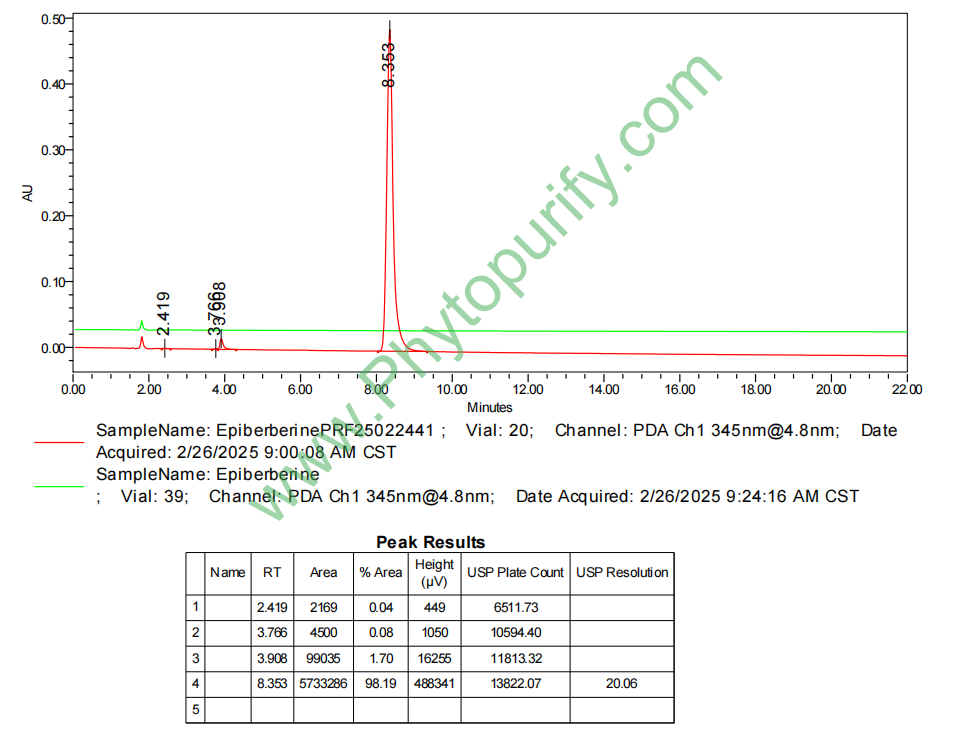
Storage conditions:Short-term storage at 2~8℃, long-term storage at -20 ~ -80℃
40.8000
.2153
.2153
.3192
2.9741
29.5393
High
24.7933
2.8423
Yes
No
Yes
No
Yes
Yes
2.4
No
No
No
No
Chronic complex diseases such as Alzheimer's disease and diabetes have become major global public health challenges. In exploring new therapeutic strategies with multiple targets and low toxicity, natural products continue to provide valuable lead compounds for drug development due to their structural diversity and rich biological activity. Epiberberine, an isoquinoline alkaloid isolated from traditional Chinese medicine Coptis chinensis, has attracted much attention in recent years because of its multiple pharmacological activities in neurodegenerative diseases, metabolic diseases and infectious diseases. As a stereoisomer of berberine, berberine not only retains some characteristics of its parent compound, but also exhibits unique advantages in specific targets and pathways of action. Existing studies have shown that berberine is an effective non competitive inhibitor of acetylcholinesterase, butyrylcholinesterase, and β - secretase 1, with significant antioxidant and antibacterial potential, and can regulate key signaling pathways related to adipocyte differentiation. This article aims to systematically review the chemical properties, plant sources, pharmacological activities, molecular mechanisms of action, pharmacological properties, and clinical application prospects of berberine, in order to provide comprehensive scientific references for the in-depth research and development of this compound.
The chemical name of berberine is 5,6-dihydro-9,10-dimethoxybenzo [g] -1,3-benzodioxolane [5,6-a] quinoline, and its CAS number is 6873-09-2. Structurally, berberine belongs to the original berberine alkaloids, with a molecular formula of C20H18NO4 ⁺ and a molecular weight of 336.3670. Its core structure consists of a fused isoquinoline ring and a benzodioxolane ring, forming a rigid planar conjugated system. Compared with berberine, the stereochemistry of the methoxy group at C-13 position and the methylenedioxy group at C-8 position of berberine is different, which profoundly affects its interaction mode and biological activity with biomolecules.
In terms of physical and chemical properties, berberine usually exists in the form of quaternary ammonium salts, appearing as yellow crystals or powders. Its calculated lipid water partition coefficient (LogP) is about 0.2153, indicating that it has a certain hydrophilicity, but not a high degree of lipophilicity. The topological polar surface area (TPSA) is 40.8000 Å ², relatively low, which is related to the number and distribution of polar groups (quaternary ammonium nitrogen, methoxy) in its molecule. The predicted value of its water solubility is about 0.3192 mg/mL, which belongs to the category of slightly soluble to poorly soluble, which to some extent limits its bioavailability. It is worth noting that the predictive model shows that berberine has a high blood-brain barrier permeability, which provides a key physicochemical basis for its direct action on central nervous system targets, such as the treatment of Alzheimer's disease. Preliminary safety assessment shows that it does not significantly inhibit hERG potassium channels (hERG inhibition: No), indicating a low risk of cardiac toxicity; But the Ames test value is 2.4, indicating potential mutagenicity under specific conditions, which needs to be closely monitored in subsequent development.
Berberine mainly comes from plants of the genus Coptis in the Ranunculaceae family, among which Coptis is the most famous and commonly used. Huanglian, as a traditional Chinese medicine, has the effects of clearing heat, drying dampness, purging fire, and detoxifying. Its pharmacological substance is mainly based on a group of structurally similar isoquinoline alkaloids, including berberine, palmatine, berberine, and berberine. The content of berberine in Huanglian is usually lower than that of berberine, but its unique biological activity makes it an important component for Huanglian to exert comprehensive pharmacological effects. In addition, a small amount has also been found in other medicinal plants such as Phellodendron amurense and Ten Great Merits.
Extracting and isolating berberine from plant materials usually follows the conventional process of natural product chemistry. Firstly, solvent extraction method is adopted, commonly using acidic water (such as 0.5% sulfuric acid or hydrochloric acid), methanol or ethanol as extraction solvents. Alkaloids are dissolved from plant tissues through immersion, reflux or ultrasound assisted extraction methods. Due to the salt form of berberine, acid water extraction can form soluble salts and improve extraction efficiency. After filtration and concentration, the crude extract is preliminarily purified using the solubility and acidity differences of alkaloids, such as acid precipitation and alkaline precipitation or liquid-liquid extraction (commonly extracted from alkaline aqueous solutions with chloroform or n-butanol).
Further separation and purification rely on modern chromatographic techniques. Silica gel column chromatography is commonly used, with a chloroform methanol system for gradient elution, to separate different alkaloids based on polarity differences. High performance liquid chromatography, especially preparative HPLC, is a key technology for obtaining high-purity berberine monomers. It usually uses a reverse phase C18 chromatography column with acetonitrile water (containing a small amount of buffer salts such as potassium dihydrogen phosphate) as the mobile phase. In recent years, liquid-liquid distribution chromatography techniques such as high-speed countercurrent chromatography have also been applied to the separation of berberine due to their high recovery rate and avoidance of irreversible adsorption caused by solid adsorbents. The isolated compounds need to be structurally confirmed through techniques such as nuclear magnetic resonance and mass spectrometry.
Epiberberine exhibits a wide and diverse range of pharmacological activities, with research hotspots mainly focused on neurological diseases, metabolic diseases, and anti infective fields.
1. Neuroprotection and anti Alzheimer's activity: This is the pharmacological effect of berberine that has received the most attention. Research has shown that it is a dual effective inhibitor of acetylcholinesterase and butyrylcholinesterase, with IC50 values of 1.07 μ M and 6.03 μ M, respectively. By inhibiting these two enzymes, berberine can reduce the degradation of acetylcholine, thereby improving cholinergic neurotransmission deficits in Alzheimer's disease patients. More importantly, it can also inhibit β - secretase 1 in a non competitive manner with an IC50 of 8.55 μ M. BACE1 is a key rate limiting enzyme for the generation of β - amyloid protein, and its inhibition can reduce the production of A β, intervening in the core pathological process of Alzheimer's disease from the source. In addition, berberine has strong antioxidant properties and can effectively remove peroxynitrite anions, with an IC50 of 16.83 μ M. ONOO - is a strong oxidative and nitrifying stress factor closely associated with neuronal damage and abnormal modification of tau protein. Therefore, berberine forms a solid pharmacological basis for its anti Alzheimer's disease effect through the synergistic action of multiple pathways including acetylcholinesterase inhibition, ACE1 inhibition, and antioxidant.
2. Anti diabetes and regulation of lipid metabolism activity: The study of berberine in 3T3-L1 preadipocyte model showed that it can downregulate the Raf/MEK1/2/ERK1/2 and AMPK α/Akt signaling pathways during early differentiation. These pathways play a crucial role in adipogenesis and cell differentiation. By inhibiting these pro differentiation pathways, berberine may reduce the excessive differentiation and lipid accumulation of adipocytes, thereby helping to improve insulin resistance and metabolic disorders. This suggests that epiberberine has potential value in the treatment of type 2 diabetes and its complications.
3. Antibacterial activity: Berberine exhibits broad-spectrum antibacterial potential, with diverse targets of action. Research has shown that it may act on multiple key links in bacteria: targeting DNA replication, it may interfere with DNA gyrase subunit A; targeting cell division, it may affect the cell division protein FtsZ; Targeting metabolic pathways, it may inhibit the biosynthesis of acyl ACP reductase and dihydrofolate reductase in fatty acid biosynthesis. In addition, for fungi such as Candida albicans, berberine may interfere with ergosterol biosynthesis and disrupt fungal cell membrane integrity by inhibiting lanosterol 14 α - demethylase. Its multi-target mechanism of action helps to delay the development of bacterial resistance.
4. Other activities: Preliminary studies also suggest that berberine may have anti-inflammatory and anti-tumor activities, but related research is still in its infancy and further exploration is needed.
The multiple pharmacological activities of berberine stem from its interactions with various biomolecule targets.
In terms of Alzheimer's disease:
* Enzyme inhibition: Epiberberine directly binds to the active or peripheral sites of AChE and BChE, hindering the entry of substrate acetylcholine into the catalytic site and inhibiting its hydrolysis. For BACE1, its non competitive inhibitory properties indicate that berberine does not bind to substrate binding sites, but rather to other conformational sites of the enzyme, altering its conformation and causing it to lose catalytic activity. This mode of action is less susceptible to substrate concentration and may be more advantageous.
* Antioxidant effect: Its benzodioxolane and isoquinoline structures enable it to directly donate electrons, neutralize reactive nitrogen/oxygen species such as ONOO -, and alleviate oxidative stress damage to neuronal lipids, proteins, and DNA.
* Signal pathway regulation: Although the specific pathway research in AD models is not yet sufficient, based on the study of its analogues, berberine may indirectly exert neuroprotective effects by regulating pathways related to cell survival and antioxidant defense, such as PI3K/Akt and Nrf2/HO-1.
In terms of anti diabetes/regulation of metabolism:
* Signal pathway inhibition: In 3T3-L1 cells, berberine inhibits the classic pro proliferative and differentiation pathway Raf/MEK/ERK, blocking key early signals of adipogenesis. Meanwhile, its regulatory effect on the AMPK α/Akt pathway is complex. AMPK is generally considered as an energy receptor that promotes fatty acid oxidation and inhibits synthesis. However, in this model, the downregulation of berberine may be related to its intervention in specific spatiotemporal regulatory networks during early differentiation. The specific mechanism needs to be comprehensively analyzed by combining its effects on AMPK upstream and downstream molecules (such as LKB1, CaMKK β) and different phosphorylation sites.
In terms of antibacterial properties:
* Multi target effect: The antibacterial effect of berberine is likely achieved by simultaneously interfering with multiple bacterial life processes. For example, inhibiting GYRA (DNA gyrase A subunit) can hinder the release of DNA supercoils and affect replication; Inhibiting FTSZ can interfere with the formation of fission loops and prevent bacterial division; Inhibiting FABI (acyl ACP reductase) blocks the extension of bacterial fatty acid synthesis chains. This "multi pronged" approach makes it less susceptible to developing drug resistance due to single target mutations. The inhibition of fungi ERG11/CYP51A1 is similar to the mechanism of action of azole antifungal drugs.
Although berberine exhibits excellent biological activity in vitro, its pharmacological development still faces challenges, and pharmacokinetic studies are relatively limited.
Absorption, distribution, metabolism, excretion: As a quaternary ammonium alkaloid, the oral absorption of berberine may be limited, and its low lipid solubility and potential role as an intestinal epithelial efflux pump (such as P-glycoprotein) may affect its bioavailability. However, its high predictive blood-brain barrier permeability is a significant advantage that is beneficial for the treatment of central nervous system diseases. In terms of distribution, it is expected to enter multiple organizations. Metabolism mainly occurs in the liver and may involve II binding reactions such as oxidation, demethylation, glucuronic acid binding, and sulfation of the CYP450 enzyme system. The metabolites and their activities need to be elucidated. The main pathways of excretion may be through the kidneys and bile.
Optimization strategy for drug properties:
1. Formulation improvement: In response to its poor water and lipid solubility, nano formulations (such as liposomes, nanoparticles, solid lipid nanoparticles), microemulsions, cyclodextrin inclusion complexes, etc. can be developed to improve solubility and stability, promote intestinal absorption, and potentially achieve targeted delivery.
2. Structural modification: Structural modification of the parent nucleus of berberine through chemical synthesis methods, such as introducing different substituents and preparing prodrugs (such as esterified quaternary ammonium nitrogen to increase lipid solubility and hydrolyze into the original drug in vivo), aims to optimize its LogP value, improve membrane permeability, and possibly enhance target selectivity or reduce potential toxicity (such as focusing on the chemical root of Ames positive results and avoiding modifications).
3. Combination therapy: Given its multi-target nature, drugs with complementary mechanisms of action (such as other neuroprotective agents, antibiotics) can be considered for combination therapy to reduce their respective doses, minimize side effects, enhance efficacy, and delay drug resistance.
At present, there is still a lack of systematic preclinical pharmacokinetic and toxicological research data on berberine, which is a key gap that must be filled before its conversion into candidate drugs.
The clinical application prospects of berberine are broad, but the road ahead is long.
Potential application directions:
1. Prevention and treatment of Alzheimer's disease: As a candidate molecule with triple effects of improving cholinergic function, inhibiting A β production, and antioxidant stress, berberine is expected to be developed as a novel anti AD drug or functional food additive. Especially suitable for early intervention and combination therapy of diseases.
2. Type 2 diabetes and metabolic syndrome: Based on its role in inhibiting preadipocyte differentiation, it may be used to improve insulin resistance, control body weight, as an adjunctive treatment of hypoglycemic drugs, or to prevent and treat complications of diabetes.
3. Anti infection treatment: Its broad-spectrum antibacterial and antifungal activity, especially its multi-target mechanism of action, makes it potentially useful for treating infections caused by multidrug-resistant bacteria or as an antibacterial enhancer.
4. Others: Its preliminary activities in anti-inflammatory, anti-tumor and other aspects are also worth further exploration.
Challenges and future research directions:
1. In depth mechanism research: It is necessary to use techniques such as gene knockout/knock in, proteomics, molecular docking, and dynamic simulation to more accurately elucidate its binding patterns with various targets, downstream signaling networks, and systemic pharmacological mechanisms in complex disease models.
2. Systematic drug evaluation: Comprehensive preclinical ADME/T studies must be conducted to clarify its in vivo processes, absolute bioavailability, tissue distribution, major metabolites and pathways, as well as safety parameters such as acute and chronic toxicity and genetic toxicity.
3. Formulation technology research and development: Developing efficient, stable, and targeted delivery new formulations is the key to overcoming their physical and chemical shortcomings and achieving therapeutic effects.
4. Clinical translational exploration: After completing sufficient preclinical research, gradually advance clinical trials to verify its safety and effectiveness in humans.
Epiberberine, as a natural alkaloid derived from the traditional Chinese medicine Huanglian, has shown great potential in the field of modern disease treatment due to its unique chemical structure and multi-target pharmacological activity. From inhibiting key pathological enzymes in Alzheimer's disease to regulating metabolic signaling pathways, and then to broad-spectrum antibacterial effects, its spectrum of action reveals the unique advantages of natural products in dealing with complex diseases. However, from active compounds to successful drugs, there are still many gaps that need to be bridged, such as pharmacokinetic optimization, formulation development, comprehensive safety evaluation, and clinical validation. Future research should focus on deepening the understanding of the mechanism of action, systematically evaluating drug properties, and actively utilizing modern pharmaceutical and medicinal chemistry methods for optimization and modification. It is believed that with the deepening of interdisciplinary research, epiberberine is expected to gradually develop from an excellent natural lead compound into an innovative drug for treating neurodegenerative diseases, metabolic diseases or infectious diseases, contributing its value to the cause of human health.
