


Synonym name: 13-Methylberberine chloride
Catalogue No.: BP3676
Cas No.: 54260-72-9
Formula: C21H20ClNO4
Mol Weight: 385.844
Botanical Source:
Purity: 95%~99%
Analysis Method: HPLC-DAD or/and HPLC-ELSD
Identification Method: Mass, NMR
Packing: Brown vial or HDPE plastic bottle
Can be supplied from milligrams to grams. Inquire for bulk scale.
For Reference Standard and R&D, Not for Human Use Directly.
HPLC of 13-Methylberberine
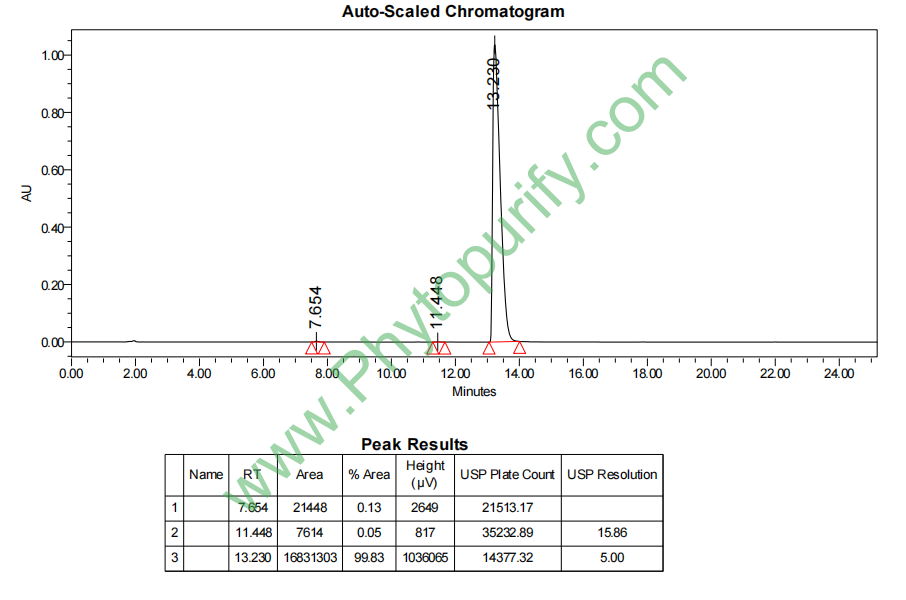
Storage conditions:Short-term storage at 2~8℃, long-term storage at -20 ~ -80℃
40.8000
.2983
.2981
.1853
2.8460
16.9987
High
31.5377
3.0324
Yes
No
Yes
No
Yes
Yes
2.4
No
No
No
No
13 Methylberberine (CAS number: 54260-72-9) is a naturally occurring isoquinoline alkaloid and a methylated derivative of berberine. As one of the active ingredients of plants in the Ranunculaceae family, such as Coptis chinensis, it inherits the extensive biological activity spectrum of the berberine family and exhibits unique potential in specific pharmacological effects. In recent years, with the deepening development of natural product chemistry and molecular pharmacology, 13 methylberberine has attracted much attention due to its significant activities in metabolic diseases, immune regulation, and anti-inflammatory fields. Existing research reveals that it not only has significant Anti fat generation It is expected to become a candidate molecule for anti obesity drugs and play a role in the immunotherapy of tumors, infectious diseases and airway inflammation by inducing the secretion of interleukin-12 (IL-12). More notably, in a sepsis mouse model, it can reduce the level of circulating high mobility group protein B1 (HMGB1) by activating AMP activated protein kinase (AMPK), thereby improving survival rate. These findings have transformed it from a traditional phytochemical component to a modern multi target candidate drug molecule with clear molecular targets and clear mechanism of action, providing a new idea for the development of new therapies for diabetes, obesity and their complications.
The molecular formula of 13 methylberberine is C21H20ClNO4 The molecular weight is 385.8440 g/mol Its chemical structure is based on the isoquinoline cation skeleton and is a typical berberine alkaloid. From SMILES expression(COc1ccc2c(C)c3[n+](cc2c1OC)CCc1cc2c(cc1-3)OCO2.[Cl-])Its core features can be analyzed: a quaternary ammonium nitrogen atom (positively charged), connected to an aromatic ring system with multiple methoxy (- OCH3) and methylenedioxy (- OCH2O -) substituents, and a methyl substituent (- CH3) at position 13. The introduction of this methyl group may alter the spatial conformation, electron distribution, and binding mode with target proteins of the molecule compared to the prototype berberine, thereby affecting its physicochemical properties and biological activity.
Based on the analysis of drug parameters, the calculated molecular weight (MW) is approximately 350.39 g/mol, which meets the requirement of Lipinski's five rules for molecular weight less than 500 Da. Its topological polar surface area (TPSA) is 40.80 ŲA lower value indicates that the molecule has good membrane permeability. The coefficient of lipid water partition (LogP) is approximately 0.30 This indicates that the compound has moderate lipophilicity and tends towards hydrophilicity, which is related to the hydrophilicity of its quaternary ammonium salt structure. The water solubility parameter is 0.1853 (unit may be mg/mL or log mol/L, depending on the context, usually indicating moderate but acceptable solubility). The key permeability index shows that its Caco-2 cell permeability value is 16.9987 (usually on the order of apparent permeability coefficient Papp × 10 ⁻⁶ cm/s), indicating that it has Good intestinal absorption potential More noteworthy is that its blood-brain barrier (BBB) penetration is predicted to be "high", which means that 13 methylberberine may act on targets related to the central nervous system, providing a possibility for the treatment of neuroinflammation or metabolic center regulation related diseases. These physicochemical properties laid the foundation for its subsequent in vivo pharmacological and pharmacokinetic studies.
13 Methylberberine mainly comes from traditional Chinese medicine Coptis(Chinese Goldthread), scientific name Coptis chinensis Franch., Belonging to the Ranunculaceae family. Huanglian is used as medicine with its roots and stems, which have an extremely bitter taste and a cold nature. It can be found in the meridians of the heart, spleen, stomach, liver, gallbladder, and large intestine, and has the effects of clearing heat, drying dampness, purging fire, and detoxifying. It has been applied in traditional Chinese medicine for thousands of years in clinical practice. Classic prescriptions such as "Huanglian Jiedu Tang" and "Gegen Qinlian Tang" mainly use it as the main medicine, used to treat diseases such as damp heat and fullness, vomiting and acid swallowing, diarrhea, jaundice, high fever and dizziness, excessive heart fire, restlessness and insomnia, blood heat and vomiting, red eyes, toothache, thirst quenching, and abscesses.
Modern plant chemistry research has confirmed that Huanglian is rich in various isoquinoline alkaloids, among which berberine has the highest content, and 13 methylberberine is one of its important derivatives. Traditionally, the effects of Coptis chinensis on "clearing away heat" and "eliminating thirst" (similar to diabetes and related metabolic syndrome in modern medicine) are probably closely related to its alkaloids to regulate glucose and lipid metabolism, improve insulin resistance and anti-inflammatory effects. Therefore, in-depth research on 13 methylberberine is essentially a decoding and refining of specific active ingredients in the traditional medicinal efficacy of Huanglian from the perspective of modern science. It is a typical path for the modernization of traditional Chinese medicine and the development of natural medicines.
13 Methylberberine has a wide range of pharmacological activities, and its core mechanism involves the regulation of multiple key signaling pathways and molecular targets. The existing target information points to its anti-diabetic The core network of the field involves multiple links in the insulin signaling pathway and glucose metabolism:
Direct target and insulin secretion/signaling pathway:
Regulation of peripheral tissue glucose and lipid metabolism:
AMPK pathway and pleiotropy:
In addition to the above targets directly related to diabetes, 13 methylberberine can also activate AMPK AMPK is an energy receptor in cells that, when activated, can promote fatty acid oxidation, glucose uptake, and inhibit the synthesis of fat and cholesterol. In sepsis models, it exhibits strong anti-inflammatory and organ protective effects by reducing the pro-inflammatory mediator HMGB1 through AMPK dependent pathways. In addition, induction IL-12 The ability to generate indicates that it can promote Th1 type immune response, which is of great significance for combating intracellular pathogen infections and enhancing anti-tumor immune surveillance.
Mechanism integration and disease association:
To sum up, the anti diabetes effect of 13 methylberberine is the result of multi target and multi pathway synergy. It may pass through Protect/promote insulin secretion (GCK/INS acting on beta cells)、Improve insulin signaling (enhance IRS1 function)、Inhibit excessive fat production (regulate PPARG) and Enhance peripheral glucose uptake (upregulate SLC2A4) Comprehensively improve glucose metabolism disorders and insulin resistance at multiple levels. At the same time, its ability to activate AMPK and regulate immunity (IL-12) enables it not only to control blood sugar, but also to fight against chronic low-grade inflammation, abnormal lipid metabolism, and even potential infection risks often associated with diabetes, which reflects the potential of "multi disease treatment".
Based on the provided pharmacokinetic parameters, we can conduct a preliminary evaluation of the potential of 13 methylberberine as an oral candidate drug, and combine it with Lipinski's Five Rules(Rule of Five, Ro5) for analysis:
Lipinski Five Rule Compliance:
Key parameters of absorption, distribution, metabolism, and excretion (ADME):
Comprehensive evaluation of drug properties:
13 Methylberberine is present in Exhibiting excellent properties in terms of absorption and distribution(Good oral absorption potential, high BBB penetration, low plasma protein binding), its chemical structure also basically meets the rules of drug likeness. However, it Potential genetic toxicity (chromosomal aberration) and phototoxicity risks are the main obstacles to advancing its preclinical development It must be clarified and evaluated through more comprehensive in vitro and in vivo experiments in subsequent research. In addition, a higher number of hydrogen bond acceptors may affect its absolute bioavailability, which needs to be optimized through formulation techniques such as salt production, use of absorption enhancers, nano formulations, etc.
At present, research on 13 methylberberine is still in progress Preclinical stage Mainly focused on the discovery of pharmacological activity and exploration of mechanism of action. The existing evidence has fully demonstrated its application prospects in metabolic diseases (anti obesity, anti diabetes), sepsis and immune regulation. As a derivative of berberine, it is expected to achieve stronger targeting or better pharmacokinetic properties through specific structural modifications (13 methylation) while retaining the broad-spectrum benefits of berberine.
Future research directions may focus on the following aspects:
1. In depth mechanism research Using techniques such as gene knockout and co crystallization, accurately elucidate its interaction mode with targets such as PPARG and GCK; Systematically investigate the upstream signaling network induced by AMPK activation and IL-12.
2. Comprehensive preclinical development The primary task is to carry out standardized safety evaluation Conduct in-depth mechanistic research and in vitro and in vivo validation, especially for its warning genetic toxicity and phototoxicity. At the same time, systematic pharmacokinetic studies (absorption, distribution, metabolism, excretion) need to be completed to clarify its fate in different animal models.
3. Structural Optimization and Medicinal Chemistry Given its potential toxicity risks and optimizable physicochemical properties, it can be subjected to Structural modification Intended to preserve the core pharmacophore while reducing toxicity, improving selectivity, or enhancing pharmacokinetic properties (such as improving metabolic stability).
4. Indications expansion and combination therapy To explore the possibility of its application in nonalcoholic fatty liver disease (NAFLD), atherosclerosis, autoimmune diseases and tumor immunotherapy adjuvant. At the same time, study its combined efficacy with existing hypoglycemic drugs or immune modulators.
5. Interpretation of Modernization of Traditional Chinese Medicine Further elucidate the scientific connotations of Huanglian's "clearing heat and eliminating fire" and "treating thirst" at the molecular level, providing a basis for the secondary development and precise application of Huanglian and its compounds.
In summary, 13 methylberberine is a highly attractive natural product lead compound. It bridges the gap between traditional Chinese medicine wisdom and modern molecular medicine. Despite the challenges of safety and other aspects on the way to new drugs, its clear multi target mechanism of action and good pharmaceutical basis make it have a promising prospect in developing innovative drugs for the treatment of type 2 diabetes, obesity and its related metabolic inflammatory syndrome. Future research needs to balance its efficacy and risks under rigorous scientific standards, and promote the revitalization of this ancient plant molecule with new therapeutic vitality.
