Introduction/Overview
Natural products have always been an important source of innovative drug discovery, among which isoquinoline alkaloids have attracted much attention due to their structural diversity and wide range of biological activities. Tetrahydroepiberberine (CAS number: 38853-67-7) is a plant species from the poppy family Corydalis impatiens (Pall) Tetrahydroisoquinoline alkaloids isolated from the middle. Early research revealed its antifungal and selective inhibition of PI-3 virus (a plant virus) activity, preliminarily demonstrating its potential biological activity. In recent years, with the deepening of tumor research, especially for colorectal cancer, a global malignant tumor with high incidence rate and mortality, it is urgent to find new therapeutic drugs with high efficiency and low toxicity. Tetrahydroberberine, due to its potential anti-tumor activity, especially its regulatory effects on various key pathological processes and molecular targets (such as AMPK, STAT3, BCL2 family, drug transporters, etc.) in colorectal cancer, has gradually emerged from numerous natural compounds and become an emerging hotspot in pharmacological research. This article aims to systematically review the chemical properties, plant sources, pharmacological activities, mechanisms of action, pharmacological properties, and application prospects of tetrahydroberberine in the treatment of colorectal cancer, in order to provide comprehensive academic references for the in-depth research and development of this compound.
Chemical structure and physicochemical properties
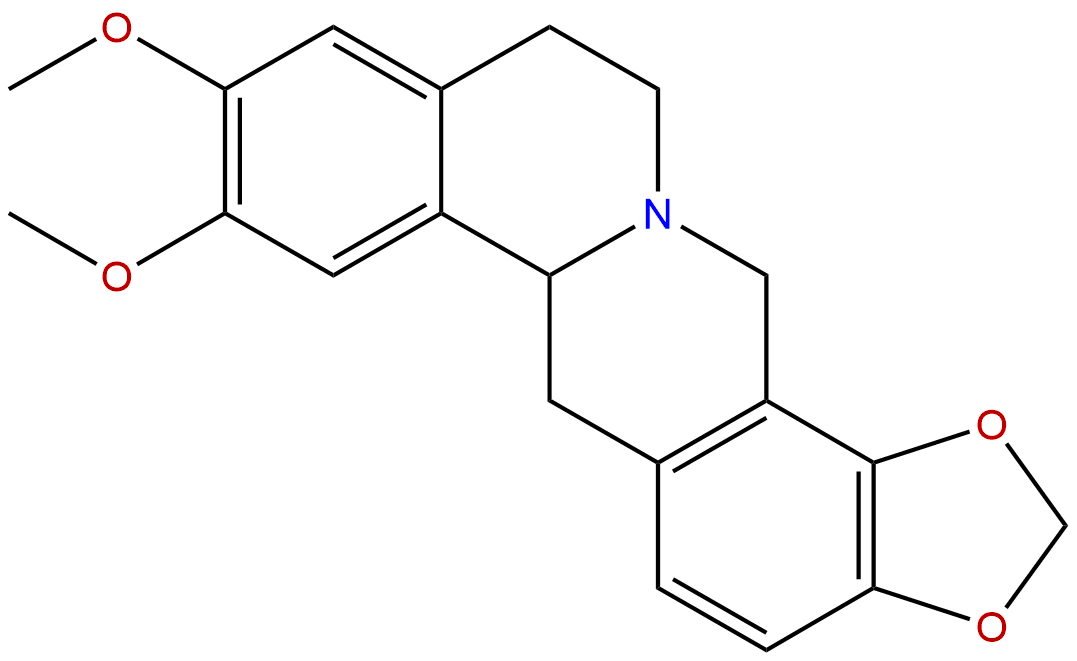
The molecular formula of tetrahydroberberine is C20H21NO4 The molecular weight is 339.3910 Its chemical structure belongs to the tetrahydroberberine type isoquinoline alkaloid, and its core structure consists of two fused isoquinoline ring systems, which are in a fully hydrogenated tetrahydro state. Compared with the common berberine, tetrahydroepiberberine exhibits a "epi -" configuration difference in the stereoisomers of the C and D rings, and lacks a conjugated system due to complete saturation, which directly affects its physicochemical properties and biological activity.
From the perspective of physicochemical parameters related to drug properties, the lipid water partition coefficient (LogP) of this compound is 2.7997 It indicates that it has moderate lipophilicity, which is conducive to transmembrane absorption. The topological polar surface area (TPSA) is 40.1600 ŲThe relatively low value suggests that the molecular polarity is small, which is consistent with its good lipid solubility. Its water solubility is relatively low, about 0.0163 mg/mL This may be a potential limiting factor for its oral bioavailability. It is worth noting that calculations and preliminary experimental model predictions show that tetrahydroberberine has High blood-brain barrier permeability This provides the possibility for its potential central nervous system related applications, such as certain brain tumors or neurological diseases. In the early safety screening, the compound did not show significant efficacy HERG potassium channel inhibition Activity reduces the risk of causing QT interval prolongation in the heart. The Ames test result is 0.6(Usually expressed as the ratio of the number of mutant colonies to the control or a specific evaluation system, the values here need to be interpreted in conjunction with specific experimental conditions, but generally indicate a low risk of mutagenicity under this testing system), providing preliminary support for its genetic toxicity safety.
Plant sources and extraction methods
Tetrahydroberberine is mainly derived from plants of the genus Corydalis in the family Papaveraceae Corydalis impatiens (Pall)Commonly known as "carved leaf violet" or "impactive corydalis". This plant is widely distributed in East Asia, and although it has been applied in traditional medicine, systematic research on this specific alkaloid was relatively late.
The extraction of tetrahydroberberine from plant materials usually follows the conventional process of natural product chemistry. Firstly, the dried plant whole grass or roots are crushed and subjected to cold soaking or hot reflux extraction using a suitable solvent (such as methanol, ethanol, or acidic alcohol solution) to fully dissolve the alkaloids. Due to the fact that alkaloids often exist in the form of salts, acid water extraction is also an effective method. After obtaining the crude extract, the characteristics of alkaloids can be utilized for preliminary enrichment through acid precipitation and alkaline precipitation method: the extract is acidified to make alkaloids salt soluble in water, filtered to remove acid insoluble impurities, and then the aqueous phase is alkalized to precipitate free alkaloids.
Further purification relies on chromatographic techniques. The silica gel column chromatography method is commonly used, which uses a mixed solvent system such as chloroform methanol for gradient elution to separate different components based on polarity differences. High performance liquid chromatography (HPLC), especially preparative HPLC, is a key step in obtaining high-purity tetrahydroberberine. It is usually separated using a reverse phase C18 column with methanol water or acetonitrile water (sometimes with a small amount of buffer salts such as triethylamine added) as the mobile phase. Structural identification involves the comprehensive use of mass spectrometry (MS), nuclear magnetic resonance (NMR, including 1H NMR and 13C NMR), and optical rotation measurement techniques to confirm its molecular weight, planar structure, and stereoconfiguration. Modern extraction techniques also explore green technologies such as ultrasound assisted extraction and microwave-assisted extraction to improve efficiency and yield.
Pharmacological activity research
The pharmacological activity research of tetrahydroberberine has expanded from early antimicrobial fields to more challenging anti-tumor fields, especially demonstrating multifaceted activities in colorectal cancer (CRC) models.
-
Antitumor activity This is the core of current research. In vitro and in vivo experiments have shown that tetrahydroberberine can significantly inhibit the proliferation of various colorectal cancer cell lines (such as HCT-116, SW480, HT-29), and its effect is concentration - and time-dependent. It can induce cancer cell cycle arrest, typically blocking cells in the G0/G1 or G2/M phase, preventing them from entering the stages of DNA synthesis and mitosis. More importantly, the compound can effectively induce apoptosis in colorectal cancer cells, characterized by typical features such as morphological changes, phosphatidylserine eversion, activation of caspase family proteases, and decreased mitochondrial membrane potential. In addition, research has found that it can inhibit the migration and invasion ability of cancer cells, indicating its potential for anti metastasis.
-
Antifungal and antiviral activity As its initial discovered activity, tetrahydroberberine has shown inhibitory effects on various plant pathogenic fungi and PI-3 viruses. Although there is limited direct research on human pathogens, their mechanisms of action may involve interfering with the basic metabolism or replication processes of pathogens, providing a lead structure for the development of novel anti infective drugs.
-
Other potential activities Based on its similarity in structure with certain tetrahydroisoquinoline alkaloids with anti-inflammatory and neuroprotective activities, it is speculated that tetrahydroepiberberine may also have immunomodulatory and antioxidant effects, which need further exploration to expand its application scope.
Mechanism of action and molecular targets
The anti colorectal cancer effect of tetrahydroberberine involves the synergistic regulation of multiple targets and pathways, which is the molecular basis of its pharmacological activity. For colorectal cancer, its main targets and mechanisms include:
-
Energy metabolism and growth regulation hub: AMPK (PRKAA1)Tetrahydroberberine has been confirmed to be an activator of AMP activated protein kinase (AMPK). AMPK is a sensor of cellular energy status, and its activation can inhibit synthetic metabolic pathways such as mammalian rapamycin target protein (mTOR), leading to cell cycle arrest, reduced protein synthesis, and promotion of autophagy. By activating AMPK, tetrahydroberberine inhibits the growth and survival of tumor cells from the perspective of energy metabolism.
-
Core of apoptosis regulation: BCL2 family (MCL1, BCL2)This compound can downregulate the expression of anti apoptotic proteins MCL1 and BCL2. BCL2 family proteins are key regulatory factors in the mitochondrial apoptosis pathway. The reduction of MCL1 and BCL2 disrupts the balance of mitochondrial outer membrane permeability, promotes the release of cytochrome C, and initiates the caspase cascade reaction, ultimately leading to cell apoptosis.
-
Drug metabolism and activation: Carboxyesterase (CES1, CES2)Research has shown that tetrahydroberberine may be a substrate or regulator of carboxylesterase CES1 and CES2. These two enzymes are highly expressed in the liver and intestine and participate in prodrug activation or drug metabolism. Their interactions may affect the metabolic transformation of tetrahydroberberine itself, and may also regulate the activity of other ester drugs in the tumor microenvironment, affecting the efficacy of chemotherapy.
-
Inflammation and Immune Microenvironment: TLR4/STAT3 Pathway Toll like receptor 4 (TLR4) and its downstream signaling and transcription activator 3 (STAT3) play a critical role in tumor associated inflammation and immune evasion. Tetrahydroberberine can inhibit the abnormal activation of TLR4/STAT3 signaling pathway, reduce the expression of pro-inflammatory cytokines and pro survival genes, thereby suppressing the inflammatory microenvironment of tumors, enhancing anti-tumor immune response, and promoting the sensitivity of cancer cells to apoptotic signals.
-
Reversal of multidrug resistance: drug efflux pumps (ABCB1/P-gp, ABCG2/BCRP)ABCB1 (P-glycoprotein) and ABCG2 (breast cancer resistant protein) are members of the ATP binding cassette transporter superfamily, which can pump chemotherapy drugs out of cells, leading to multidrug resistance (MDR). Tetrahydroberberine has been shown to inhibit the function of these efflux pumps, increase the accumulation of intracellular chemotherapy drugs (such as 5-fluorouracil and doxorubicin), thereby reversing the MDR phenotype of colorectal cancer cells and improving the efficacy of conventional chemotherapy.
-
Extracellular matrix degradation and transfer: matrix metalloproteinase-2 (MMP2)Tumor metastasis requires the degradation of extracellular matrix and basement membrane. MMP2 is one of the key hydrolytic enzymes. Tetrahydroberberine can inhibit the expression and activity of MMP2, thereby weakening the invasion and metastasis ability of colorectal cancer cells.
In summary, tetrahydroberberine forms a multi-target anti-tumor network by simultaneously acting on multiple key processes such as energy metabolism, apoptosis, inflammation, drug resistance, and metastasis, which gives it potential advantages in overcoming tumor heterogeneity and avoiding single target drug resistance.
Evaluation of drug properties and pharmacokinetics
Although tetrahydroberberine has shown good pharmacological activity in vitro, its potential as a drug still requires systematic pharmacological evaluation and pharmacokinetic studies.
-
Absorption, distribution, metabolism, excretion (ADME):
- absorb Moderate LogP values and lower TPSA are beneficial for its passive transmembrane absorption. However, lower water solubility may limit its dissolution rate in gastrointestinal fluids, thereby affecting oral bioavailability. The formulation strategy, such as making nanocrystals, solid dispersions, cyclodextrin inclusion complexes, or salt forms, is key to improving their solubility and absorption.
- distribution The predicted high blood-brain barrier permeability implies that it may reach effective concentrations in the central nervous system, which has positive implications for the treatment of brain metastases or primary brain tumors. Further in vivo distribution experiments are needed to determine its accumulation in various tissues and organs, especially tumor tissues.
- Metabolism As an isoquinoline alkaloid, its metabolism may involve oxidative metabolism of liver cytochrome P450 enzymes (CYPs) and hydrolysis of the aforementioned carboxylesterase (CES). It is crucial to clarify the main metabolic enzymes and metabolites for evaluating drug interactions and individual differences.
- excretion The prototype drug and its metabolites may be mainly excreted through the kidneys or bile. It is necessary to study its excretion rate and pathway.
-
Pharmacokinetic characteristics The currently available pharmacokinetic research data on the tetrahydroberberine system is insufficient. Future research requires measuring the blood drug concentration time curve after administration in animal models such as rats and dogs, and calculating key parameters such as half-life (t1/2), peak time (Tmax), peak concentration (Cmax), area under the drug time curve (AUC), and oral bioavailability (F). These data will directly guide the design of medication regimens.
-
Preliminary evaluation of safety Non hERG inhibition and negative Ames test results are positive signals for its early safety. However, comprehensive preclinical toxicology studies are still needed, including acute toxicity, subacute/chronic toxicity, reproductive toxicity, as well as evaluation of potential off target effects and long-term medication safety related to its potential targets (such as AMPK's widespread involvement in systemic metabolism).
Clinical application prospects and prospects
Tetrahydroberberine shows unique application prospects in the treatment of colorectal cancer:
-
As a monotherapy or combination therapy With its multi-target mechanism of action, it may be used as a single drug for early intervention or maintenance treatment of colorectal cancer. A more realistic strategy is to use it in combination with existing standard chemotherapy regimens (such as FOLFOX, FOLFIRI) or targeted drugs. It can reverse the multidrug resistance mediated by ABCB1/ABCG2, especially improving the therapeutic effect on chemotherapy resistant patients.
-
Overcoming tumor heterogeneity and drug resistance The high heterogeneity and drug resistance of colorectal cancer are the main causes of treatment failure. Tetrahydroberberine simultaneously regulates proliferation, apoptosis, inflammation, metabolism, and drug resistance pathways, which may more effectively inhibit tumor cells with different driver gene subtypes and delay or overcome the development of drug resistance.
-
Targeting special populations or metastatic lesions Its potential BBB penetration ability provides a new candidate molecule for the clinical challenge of treating brain metastases in colorectal cancer. Meanwhile, its anti-inflammatory (TLR4/STAT3) and anti metastatic (MMP2) effects may have value in preventing postoperative recurrence and inhibiting distant metastasis.
However, pushing it into clinical practice still faces many challenges:
* Optimization of drug properties The primary task is to solve the problem of poor water solubility and improve its bioavailability through prodrug design, formulation improvement, or structural modification (while retaining the pharmacophore).
* Deep analysis of mechanism More precise elucidation of its direct interaction modes (eutectic structure, binding sites) with various targets (especially AMPK, CES) is needed to distinguish between primary targets and secondary effects, in order to guide more rational drug design.
* Preclinical and clinical research It is necessary to complete preclinical pharmacodynamics (validated on more human tumor xenograft PDX models), pharmacokinetics, and toxicology studies of the system to support clinical trial applications. Subsequently, phase I (safety, tolerability, pharmacokinetics), phase II (efficacy exploration), and phase III (confirmatory) clinical trials will be conducted.
* Source and synthesis Plant extraction is limited by resources, seasons, and content, therefore developing efficient and economical fully synthetic or semi synthetic routes is the foundation for achieving large-scale production and quality control.
Conclusion
Tetrahydroberberine, as a tetrahydroisoquinoline alkaloid discovered from traditional medicinal plants, has evolved from an initial antimicrobial active compound to a highly promising multi-target candidate molecule in the pharmacological research of colorectal cancer. It synergistically regulates the AMPK and BCL2 families STAT3、 The drug efflux pump and multiple key targets such as MMP2 have shown comprehensive effects in inhibiting tumor cell proliferation, inducing apoptosis, reversing drug resistance, anti-inflammatory and anti metastasis. Although further research and optimization are needed in terms of its physicochemical properties (especially solubility) and systemic pharmacokinetics, its unique molecular action network and preliminary safety characteristics provide a solid scientific foundation for its further development as a novel therapeutic drug for colorectal cancer, especially as a component of the combination therapy strategy for overcoming drug resistance and inhibiting metastasis. Future research should focus on drug improvement, precise localization of mechanisms of action, and systematic preclinical development, in order to promote this natural molecule from the laboratory to clinical practice and bring new hope to colorectal cancer patients.