


Synonym name: 2,3:9,10-Bismethylenedioxyprotoberberine
Catalogue No.: BP0390
Cas No.: 3486-66-6
Formula: C19H14NO4
Mol Weight: 320.324
Botanical Source: Quaternary alkaloid from Coptis japonica (Ranunculaceae) and many other spp., mostly in the Papaveraceae and Fumariaceae
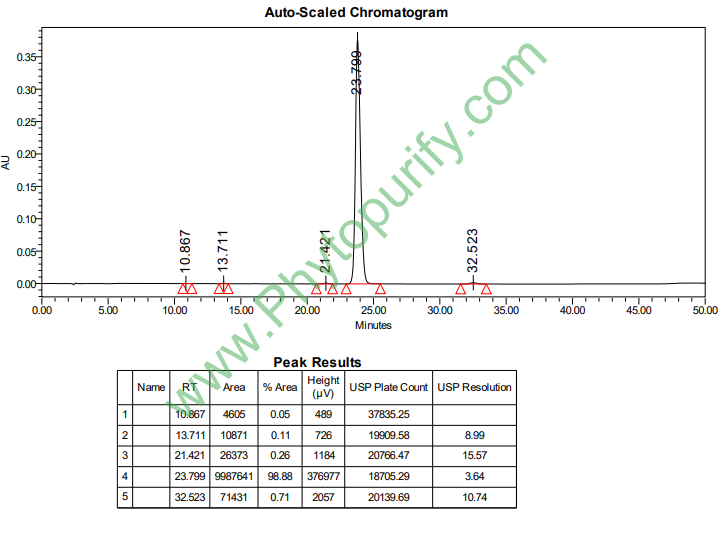
Purity: 95%~99%
Analysis Method: HPLC-DAD or/and HPLC-ELSD
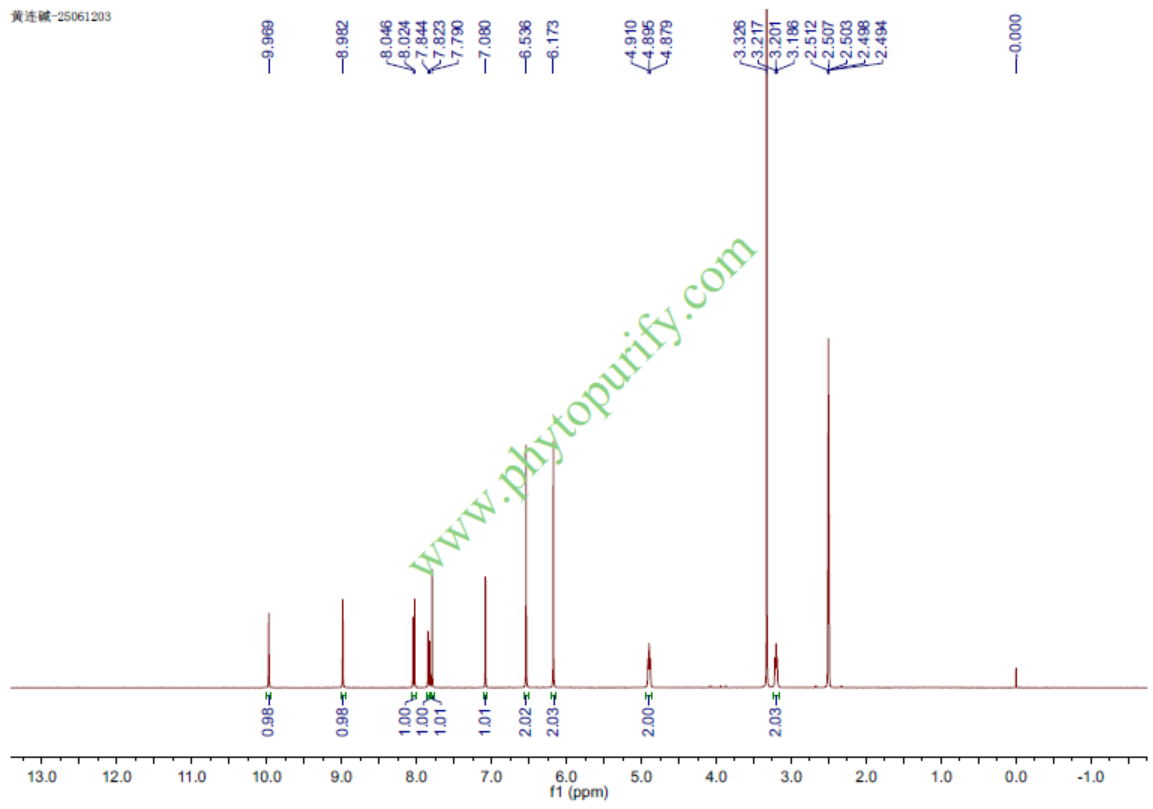
Identification Method: Mass, NMR
Packing: Brown vial or HDPE plastic bottle
Can be supplied from milligrams to grams.
For Reference Standard and R&D, Not for Human Use Directly.
Inquire for bulk scale.
HPLC of Coptisine
HNMR of Coptisine
Storage conditions:Short-term storage at 2~8℃, long-term storage at -20 ~ -80℃
64.8800
.1000
-2.0000
Low
No
No
Yes
Unknown
No
Unknown
Coptis chinensis is a typical isoquinoline alkaloid, which was first isolated from the Chinese medicinal herb Coptis chinensis Franch. As one of the main active ingredients of Huanglian, berberine is widely used in traditional Chinese medicine for clearing heat and detoxifying, antibacterial and anti-inflammatory purposes. In recent years, with the advancement of natural product pharmacology and molecular biology techniques, the pharmacological activity and mechanism of action of berberine have gradually been revealed, especially in the fields of drug-resistant bacterial infections and immune regulation, showing significant potential.
Huanglian alkaloid, as an effective non competitive indoleamine 2,3-dioxygenase (IDO) inhibitor, exhibits good enzyme inhibitory activity with a Ki value of 5.8 μ M and an IC50 value of 6.3 μ M. As an important regulator of immune escape, IDO plays a key role in tumor immunosuppression and infectious diseases. Therefore, the IDO inhibitory function of coptidine provides a theoretical basis for its anti-tumor and anti infection research. In addition, berberine exhibits potential inhibitory effects on various drug-resistant bacterial targets such as DNA gyrase A (GYRA) and dihydrofolate reductase (DHFR), indicating its potential application value in the field of anti drug-resistant bacterial infections.
This article will systematically review the chemical structure and physicochemical properties, plant sources and extraction methods, pharmacological activity and mechanism of action, pharmacological evaluation and pharmacokinetic characteristics of coptisine, and explore its clinical application prospects and future research directions, aiming to provide scientific basis and reference for the development and utilization of coptisine.
Coptis alkaloids have a molecular formula of C19H14NO4 and a molecular weight of 320.32. Its structure belongs to the isoquinoline alkaloids, specifically a tetracyclic isoquinoline skeleton containing multiple benzene rings and methoxy substituents. The chemical structure contains 5 hydrogen bond acceptors, with a polar surface area (TPSA) of 64.88 Å ² and a LogP value of approximately 0.10, indicating low lipid solubility and some hydrophilicity.
The structural characteristics of berberine determine its biological activity and pharmacokinetic properties. A lower LogP value suggests that its distribution in vivo may be biased towards plasma and extracellular fluid, and its ability to penetrate the blood-brain barrier is weaker (predicted as Low). In addition, the molecular structure of berberine is stable and easy to separate and purify through various chromatographic techniques.
The summary of physical and chemical properties is as follows:
These properties provide fundamental data for the drug design and formulation development of berberine.
Huanglian alkaloids are mainly found in plants of the Coptis genus, with the highest content found in the traditional Chinese medicine Coptis chinensis Franch. Huanglian is a perennial herbaceous plant of the genus Huanglian in the Ranunculaceae family, widely distributed in southwestern China. In addition to Huanglian, Huanglian alkaloids are also present in other Huanglian plants and some traditional Chinese medicine formulas.
The extraction of berberine usually involves the following steps:
In recent years, green extraction techniques such as supercritical CO2 extraction and microwave-assisted extraction have also been applied to the extraction of coptisine, improving extraction efficiency and environmental friendliness.
Huanglian alkaloid, as an important active ingredient in Huanglian, exhibits various pharmacological activities, covering fields such as antibacterial, anti-inflammatory, anti-tumor, and immune regulation.
Berberine has inhibitory effects on various Gram positive and Gram negative bacteria, especially on drug-resistant strains such as methicillin-resistant Staphylococcus aureus (MRSA) and multidrug-resistant Klebsiella pneumoniae. Its targets include:
These mechanisms of action make berberine a potential candidate drug for combating drug-resistant bacterial infections.
As a non competitive inhibitor of IDO, berberine can inhibit the IDO mediated tryptophan metabolism pathway, reverse the immunosuppressive state in the tumor microenvironment, and promote T cell immune response. The inhibitory activity of IDO makes berberine have potential application value in the field of tumor immunotherapy.
In addition, berberine also exhibits anti-inflammatory effects by downregulating the expression of inflammatory factors such as TNF - α and IL-6, and reducing tissue inflammatory responses.
The study also found that berberine has multiple biological effects such as antioxidant, neuroprotective, and blood glucose and lipid regulation, demonstrating its multi-target and multi pathway pharmacological properties.
The pharmacological effects of berberine are based on its interactions with multiple molecular targets, mainly including:
IDO (indoleamine 2,3-dioxygenase) is a key enzyme in tryptophan metabolism, involved in regulating immune escape. As a non competitive inhibitor, berberine reduces its catalytic activity by binding to the inactive sites of IDO, with a Ki value of 5.8 μ M and an IC50 of 6.3 μ M. This inhibitory effect helps restore the immune system's ability to recognize and eliminate tumor cells or infectious pathogens.
Huanglian alkaloids also affect cellular signaling pathways such as NF - κ B and MAPK, regulate inflammatory responses and cell apoptosis, and promote the recovery of immune function in the body.
The pharmacological parameters of coptisine indicate that it has certain potential for drug development, but there are also several challenges.
At present, there is limited data on the in vivo absorption, distribution, metabolism, and excretion (ADME) of berberine. Previous studies have shown that:
In the future, systematic pharmacokinetic studies are needed to clarify the in vivo behavior and metabolic safety of berberine.
Huanglian alkaloids have shown broad prospects in clinical applications due to their multi-target and multifunctional pharmacological properties.
With the global threat of drug-resistant bacterial infections, the development of berberine as a novel antibacterial agent is of great significance. Its inhibitory effect on multiple drug-resistant bacterial targets provides a new approach for clinical anti infective treatment. In the future, its antibacterial activity and safety can be improved through structural optimization and drug combination strategies.
IDO inhibitors have attracted much attention in tumor immunotherapy. Huanglian alkaloid, as a natural product IDO non competitive inhibitor, has the potential to regulate the immune microenvironment and is expected to be used in combination with immune checkpoint inhibitors to enhance anti-tumor effects.
The cardiac toxicity and hERG channel inhibition of berberine suggest that its clinical application should be cautious, and systematic toxicological evaluation and dose optimization must be carried out to ensure medication safety.
Huanglian alkaloid, as an isoquinoline alkaloid derived from the traditional Chinese medicine Huanglian, has shown significant research value in the fields of anti drug resistant bacterial infections and tumor immune regulation due to its unique chemical structure and diverse pharmacological activities. The discovery of it as a non competitive inhibitor of IDO provides a new natural drug candidate molecule for tumor immunotherapy. Meanwhile, the inhibitory effect of berberine on various bacterial targets gives it potential advantages in the development of antibacterial drugs.
However, the cardiac toxicity and pharmacokinetic properties of berberine still require further research and optimization. In the future, through structural modification, dosage form innovation, and systematic safety evaluation, berberine is expected to become an important component of the new generation of anti infective and immunomodulatory drugs. Overall, the study of berberine not only enriches the theoretical system of natural product pharmacology, but also provides valuable resources and insights for clinical drug development.
