


Product name: Coptisine Chloride
Synonym name:
Catalogue No.: BP0391
Cas No.: 6020-18-4
Formula: C19H14ClNO4
Mol Weight: 355.774
Botanical Source: Coptidis rhizoma
Physical Description:
Type of Compound: Alkaloids
Purity: 95%~99%
Analysis Method: HPLC-DAD or/and HPLC-ELSD
Identification Method: Mass, NMR
Packing: Brown vial or HDPE plastic bottle
Storage: Store in a well closed container, protected from air and light. Put into refrigerate or freeze for long term storage.
Whenever possible, you should prepare and use solutions on the same day. However, if you need to make up stock solutions in advance, we recommend that you store the solution as aliquots in tightly sealed vials at -20℃. Generally, these will be useable for up to two weeks.
The product could be supplied from milligrams to grams
Inquire for bulk scale.
Chengdu Biopurify Phytochemicals Ltd. is a leading company in the research, development, manufacture and marketing of High Quality Phytochemicals and Extracts(especially Active Ingredients from Traditional Chinese Medicine,TCM), Natural Active Pharmaceutical Ingredients worldwide.
The main services:
A. Supply active ingredients and reference standards of TCM, from mgs to kgs scale
B. Custom extraction and purification, target Herb Active Ingredients
C. Custom synthesis and semi-synthesis for Natural Active Ingredients
D. CR(contract research), CM(contract manufacture) and PD(process development) services from lab scale, pilot scale to commercial scale(GMP is also available)
E. TCM compounds library for drug screen,more than 3000 compounds available, many of them are rare and unique.
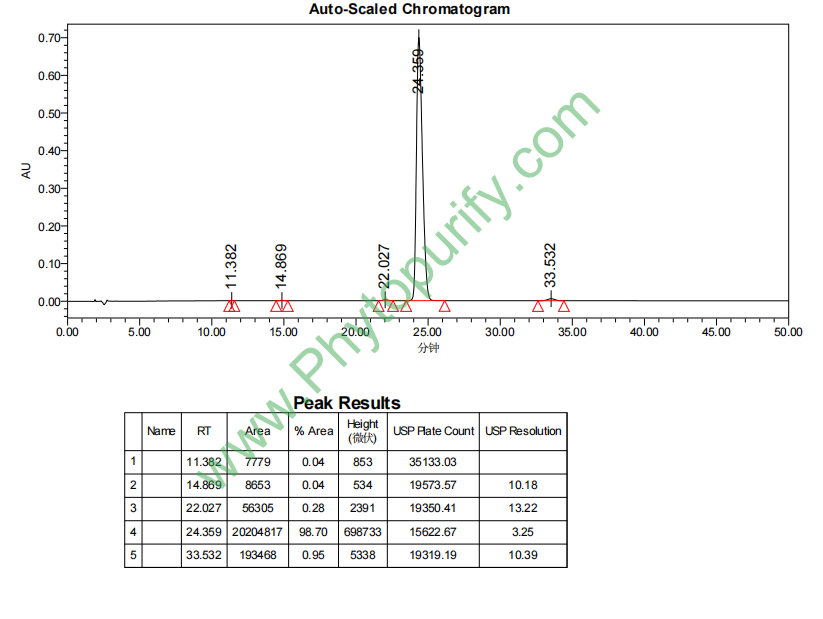
HPLC of Coptisine Chloride
Storage conditions:Short-term storage at 2~8℃, long-term storage at -20 ~ -80℃
Coptis hydrochloride (CAS number: 6020-18-4) is a natural alkaloid isolated from the traditional Chinese medicine Coptis chinensis Franch., belonging to the family of isoquinoline alkaloids. As one of the main active ingredients in Huanglian, berberine hydrochloride has attracted much attention in recent years due to its multi-target and multifunctional pharmacological activities. It not only exhibits significant biological activities such as anti-inflammatory, antibacterial, and antiviral, but also demonstrates potential therapeutic value in regulating immune related enzymes such as indoleamine 2,3-dioxygenase (IDO). Especially in the fields of drug-resistant bacterial and viral infections, berberine hydrochloride has shown unique advantages as a new drug candidate molecule.
This review aims to systematically summarize the chemical structure and physicochemical properties, plant sources, and extraction methods of berberine hydrochloride, with a focus on its pharmacological activity and mechanism of action, analyzing its pharmacological properties and pharmacokinetic characteristics, exploring its potential and future development directions in clinical applications, and providing reference for the fields of natural product pharmacology and new drug development.
The chemical formula of berberine hydrochloride is C19H14ClNO4, with a molecular weight of 355.77. Its structural core is a typical isoquinoline skeleton, containing polycyclic aromatic structures and multiple oxygen-containing functional groups. In terms of physical and chemical properties, the LogP value of berberine hydrochloride is 0.19, indicating its strong hydrophilicity and moderate lipid solubility, which is beneficial for in vivo distribution. The polar surface area (TPSA) is 71.69 Å ², and the number of hydrogen bond acceptors is 6, indicating that the molecule has good water solubility and potential to bind with biomolecules.
Huanglian alkaloid hydrochloride has high blood-brain barrier permeability (BBB), and its "high" level of penetration ability provides a theoretical basis for its application in neurological related diseases. Its hepatotoxicity, cardiotoxicity, and hERG channel inhibition effects are not yet clear, and the Ames mutagenicity test results are negative, indicating a low risk of genotoxicity and good safety potential.
Hydrochloric acid berberine mainly exists in plants of the Coptis genus, especially in the rhizomes of the classic Chinese medicine herb Coptis chinensis Franch. Huanglian, as a traditional Chinese medicine, is widely used in therapeutic fields such as clearing heat and dampness, purging fire and detoxifying. Coptidine hydrochloride, as one of its main alkaloid components, is abundant in content and has significant activity.
The traditional methods for extracting berberine hydrochloride often use acidic aqueous solutions or alcohol solvents for extraction, combined with liquid-liquid distribution, column chromatography and other techniques for separation and purification. Modern extraction techniques include ultrasound assisted extraction, microwave-assisted extraction, and high-performance liquid chromatography (HPLC) separation, which significantly improve extraction efficiency and purity. The typical process flow is: drying and crushing of Huanglian → extraction with acidic water or ethanol → concentration of crude extract → separation by silica gel column chromatography → hydrochloric acid salt formation to obtain Huanglian alkaloid hydrochloride. The purity can usually reach over 95%, meeting the needs of medicine and research.
Hydrochloric acid berberine has inhibitory effects on various bacteria, especially showing potential therapeutic effects on drug-resistant strains. Its target involves key enzymes such as bacterial DNA gyrase (GYRA) and dihydrofolate reductase (DHFR), which interfere with bacterial DNA replication and metabolic processes. Related studies have shown that berberine hydrochloride has inhibitory effects on Gram positive bacteria such as Staphylococcus aureus and Streptococcus pneumoniae, as well as some Gram negative bacteria, and exhibits certain activity against drug-resistant strains such as methicillin-resistant Staphylococcus aureus (MRSA).
Huanglian alkaloid hydrochloride, as an effective inhibitor of H1N1 influenza virus neuraminidase (NA-1), has an IC50 of approximately 104.6 μ g/mL. Neuraminidase is a key enzyme involved in the replication and release of influenza A virus, and inhibiting its activity can block the virus's lifecycle. Huanglian alkaloid hydrochloride exhibits good anti influenza virus activity by reducing virus replication efficiency through non competitive inhibition, and has the potential to develop new anti influenza drugs.
Indoleamine 2,3-dioxygenase (IDO) is a key enzyme in immune regulation, involved in tryptophan metabolism, regulating immune tolerance and tumor immune escape. As a non competitive IDO inhibitor, berberine hydrochloride exhibits significant enzyme inhibitory activity with a Ki value of 5.8 μ M and an IC50 of 6.3 μ M. By inhibiting IDO, berberine hydrochloride can regulate the immune microenvironment, enhance anti-tumor immune response, and has potential anti-tumor and immunotherapy value.
In addition to the main activities mentioned above, berberine hydrochloride also exhibits various biological effects such as anti-inflammatory, antioxidant, and neuroprotective effects. It inhibits the release of inflammatory factors and reduces tissue damage by regulating signaling pathways such as NF - κ B and MAPK. In addition, berberine hydrochloride also has a certain protective effect on neurological diseases such as Alzheimer's disease, Parkinson's disease, etc., and the relevant mechanisms are being further studied.
The multi-target mechanism of action of berberine hydrochloride is the basis for its diverse pharmacological activities. Its main targets include:
Molecular docking and dynamic simulation studies further revealed the binding mode between berberine hydrochloride and target proteins, providing a theoretical basis for its structural optimization and pharmacological enhancement.
Huanglian alkaloid hydrochloride has excellent pharmacological parameters. Its molecular weight of 355.77 conforms to Lipinski's rule, and its LogP value of 0.19 shows a moderate hydrophilic/lipophilic balance, which is beneficial for drug absorption and distribution. The TPSA is 71.69 Å ², suitable for cell membrane penetration and target binding. The number of hydrogen bond receptors is 6, supporting stable hydrogen bond interactions between molecules and target proteins.
The high penetration ability of the blood-brain barrier suggests its potential advantages in the treatment of central nervous system diseases. In terms of safety, the Ames test for berberine hydrochloride was negative, indicating a low risk of genotoxicity. However, key safety indicators such as hepatotoxicity, cardiotoxicity, and hERG channel inhibition still need to be systematically evaluated.
In terms of pharmacokinetics, existing research is relatively limited. The characteristics of absorption, distribution, metabolism, and excretion (ADME) in the body need further clarification. Preliminary data shows that the oral bioavailability of berberine hydrochloride is moderate, and liver metabolism is mainly through the cytochrome P450 enzyme system. The metabolites and half-life need to be further studied to guide clinical medication plans.
Huanglian alkaloid hydrochloride, as a multifunctional drug candidate molecule derived from natural products, has broad clinical application potential. It provides new drug design ideas in the field of anti drug resistant bacterial infections, especially for the treatment of multidrug-resistant strains. The activity against H1N1 influenza virus makes it a powerful supplement for the prevention and treatment of influenza virus infection, especially in the context of increasingly severe virus mutation and drug resistance.
The inhibitory effect of IDO endows berberine hydrochloride with potential value in tumor immunotherapy, which can be combined with immune checkpoint inhibitors in the future to enhance anti-tumor efficacy. In addition, its neuroprotective and anti-inflammatory activities provide possibilities for the treatment of neurodegenerative diseases and chronic inflammation related diseases.
Future research directions include:
With the advancement of modern drug development technology, berberine hydrochloride is expected to become a model for natural product drug development, promoting the modernization and internationalization of traditional Chinese medicine.
Hydrochloric acid berberine, as an important alkaloid component in Coptis chinensis, has demonstrated potential applications in various fields such as anti drug resistant bacterial infections, antiviral, immune regulation, and neuroprotection due to its unique chemical structure and multi-target pharmacological activity. Its excellent pharmacokinetic parameters and safety foundation have laid a solid foundation for the development of new drugs. Although there are still shortcomings in pharmacokinetics and clinical research, with the deepening of related research, berberine hydrochloride is expected to become an important breakthrough in the field of natural product pharmacology, providing new strategies and choices for the treatment of various diseases.
In the future, combining modern molecular biology, medicinal chemistry, and clinical pharmacology methods, the research and development of berberine hydrochloride will further promote the innovation and application of natural product drugs, and help the development of human health.
