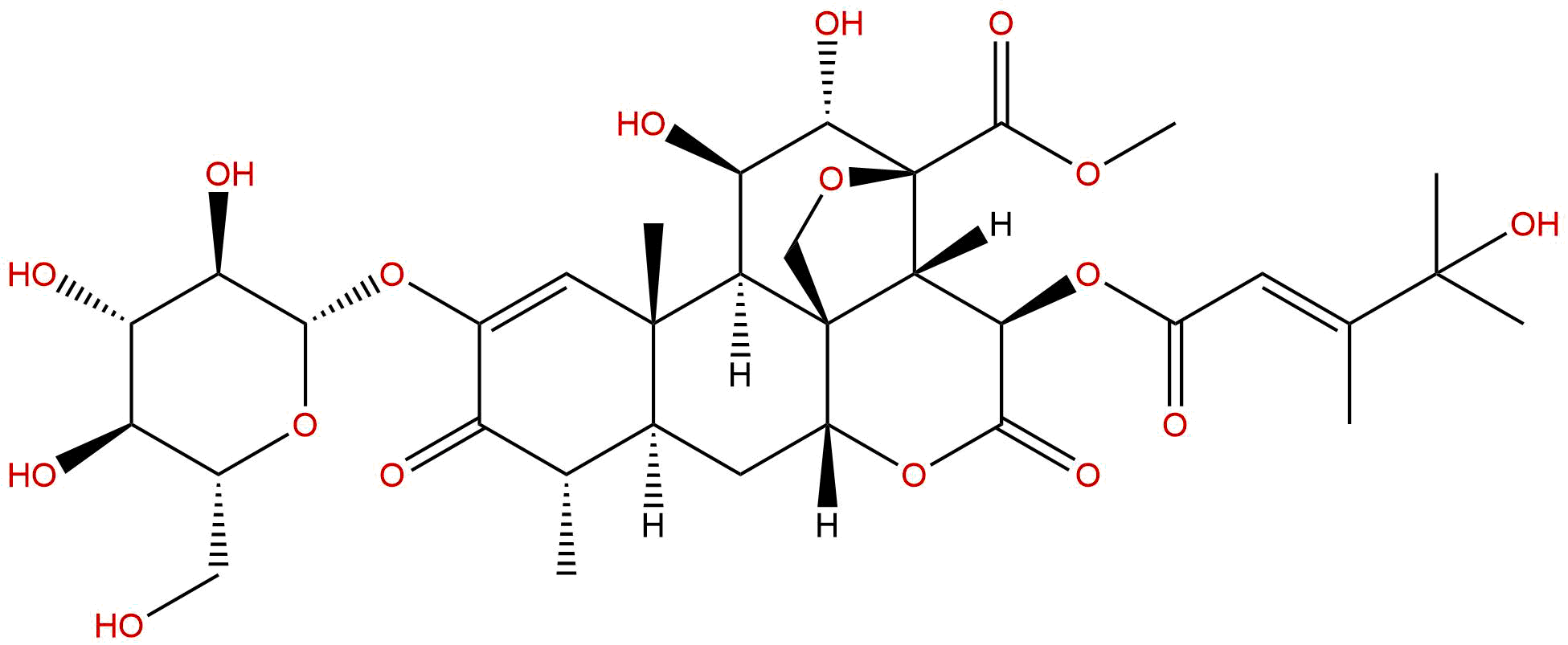


Product name: Yadanzioside C
Synonym name:
Catalogue No.: BP5357
Cas No.: 95258-16-5
Formula: C34H46O17
Mol Weight: 726.725
Botanical Source:
Type of Compound: Diterpenoids
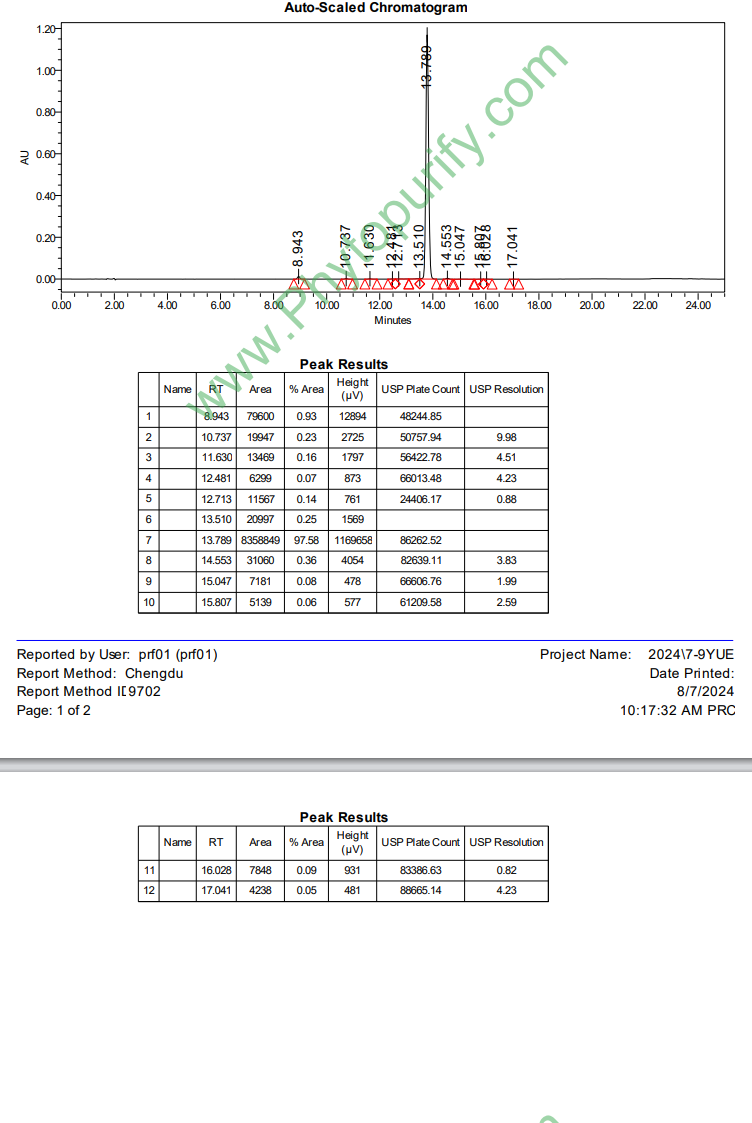
Purity: 95%~99%
Analysis Method: HPLC-DAD or/and HPLC-ELSD
Identification Method: Mass, NMR
Packing: Brown vial or HDPE plastic bottle
Storage: Store in a well closed container, protected from air and light. Put into refrigerate or freeze for long term storage.
Whenever possible, you should prepare and use solutions on the same day. However, if you need to make up stock solutions in advance, we recommend that you store the solution as aliquots in tightly sealed vials at -20℃. Generally, these will be useable for up to two weeks.
The product could be supplied from milligrams to grams
Inquire for bulk scale.
For Reference Standard and R&D, Not for Human Use Directly.
HPLC of Yadanzioside C
Storage conditions:Short-term storage at 2~8℃, long-term storage at -20 ~ -80℃
265.2700
-.2327
-.2330
1.6613
.5179
1.0582
Low
55.1565
7.1770
Yes
No
No
No
Yes
No
0.0
Yes
Yes
Yes
Yes
Natural products, as an important source of drug discovery, have long played an irreplaceable role in the human fight against diseases. Among the numerous natural product families with novel structures and significant activities, lignin compounds (Quassinoids) have attracted much attention due to their unique tetracyclic triterpenoid skeleton and extensive biological activity. This type of compound mainly comes from plants in the Simaroubacheae family, including the genus Brucea(Brucea)Plants, especially brucea(Brucea javanicaB. amarissima)The seeds are one of the main sources of lignin compounds. Brucea has a long history of application in traditional medicine, especially in Asia and Africa, where it is commonly used to treat dysentery, malaria, cancer, and inflammatory diseases.
Yadanzioside C (CAS number: 95258-16-5) is a representative bitter lignin glycoside compound isolated from the seeds of Yadanzioside. As a member of the bitter lignin family, Brucea Javanese Glycoside C inherits the highly oxidized and complex cyclic characteristics of its parent nucleus structure, while exhibiting unique physicochemical properties and biological activity spectrum through glycosylation modification. In recent years, with the advancement of separation and purification technology and the improvement of pharmacological evaluation system, the anti-inflammatory activity and potential mechanism of action of Brucea Javanese Glycoside C have gradually become a research hotspot. Inflammation is a defensive response of the body to infection and tissue damage, but chronic, uncontrolled inflammation is the core pathological link of various major diseases such as autoimmune diseases, metabolic diseases, neurodegenerative diseases, and cancer. Therefore, the search for efficient and low toxicity novel anti-inflammatory molecules has important clinical value.
This article aims to provide a comprehensive professional review of Brucea Javanese Glycoside C, systematically sorting out its chemical structure, plant sources, extraction methods, pharmacological activity, mechanism of action, medicinal characteristics, and clinical application prospects, in order to provide reference for the in-depth research and development of this natural product.
Brucea Javanese Glycoside C belongs to the class of bitter lignin glycosides, and the core of its chemical structure is a highly oxidized bitter lignin glycoside. The basic skeleton of bitter lignin compounds is a C20 or C25 tetracyclic triterpenoid (or descending triterpenoid) structure, usually consisting of an A/B/C/D tetracyclic system, where the A ring is mostly an alpha, beta unsaturated ketone or lactone structure, and the D ring is often a delta lactone ring. This unique skeleton endows lignin compounds with rich chemical reactivity and diverse biological activities.
Specifically, the glycoside portion of Brucea Javanese Glycoside C exhibits typical bitter lignin characteristics, with the introduction of multiple functional groups such as hydroxyl, carbonyl, and double bonds into its molecule, significantly increasing its polarity. The sugar moiety is usually connected to specific hydroxyl groups of the aglycone, and common sugar moieties include glucose, xylose, etc. Glycosylation modification not only increases the water solubility of the molecule, but may also affect its interaction mode with biological targets, thereby regulating its pharmacological and pharmacokinetic properties. According to existing research data, the molecular weight of Brucea Javanese Glycoside C is 726.7250 Da, which is considered moderate to large in natural products and is mainly attributed to its complex glycoside skeleton and glycosylation.
In terms of physical and chemical properties, Brucea Javanese Glycoside C exhibits significant characteristics. Its lipophilic water partition coefficient (LogP) is -0.2327, indicating that the compound has strong hydrophilicity and better solubility in the aqueous phase than in the lipid phase. This property is consistent with the presence of multiple hydroxyl and sugar groups in its molecule. The topologically polar surface area (TPSA) is as high as 265.2700 Å ², far exceeding the recommended upper limit of 140 Å ² for oral drugs, strongly suggesting poor membrane permeability and potential limitations in oral bioavailability. The water solubility data (1.6613 mg/mL) further confirms its good water solubility. In addition, the predictive model shows that the blood-brain barrier (BBB) penetration ability of Brucella Javanese Glycoside C is relatively low, indicating limited potential for its application in the treatment of central nervous system diseases. However, this may also mean that its peripheral side effects are relatively small. The prediction of hERG inhibition is' no ', indicating a low risk of cardiac toxicity. The Ames test result is 0.0, indicating a low risk of genetic toxicity, which provides important safety evidence for it as a candidate drug. These physical and chemical properties together outline the profile of Brucea Javanese Glycoside C as a natural product molecule with high polarity, good water solubility, low central permeability, and preliminary good safety.
Brucea Javanese Glycoside C mainly comes from plants in the genus Brucea Javanese in the family Sapindaceae, among which Brucea Javanese is the main source(Brucea javanica)He Ku Ya Gan(Brucea amarissima)The seeds are relatively abundant in content. Brucea is native to Southeast Asia, southern China, and northern Australia, and is a small tree or shrub. The fruit is a drupe, which appears black or purple black when ripe, and the seed is the traditional Chinese medicine "Brucea Javanese". In addition to the seed, other parts of the plant such as roots, stems, and leaves also contain lignin components, but the seed is recognized as an enriched site.
The efficient and high-purity extraction of bruce acid glycoside C from plants is the basis for subsequent research. The classic extraction process usually includes the following key steps:
As an important member of the bitter lignin family, the pharmacological activity research of Brucea Javanese Glycoside C mainly focuses on the anti-inflammatory field, while also involving other potential activities such as anti-tumor and antiviral.
1. Anti inflammatory activity
Inflammatory response involves a series of complex cellular and molecular events, including the release of pro-inflammatory cytokines, activation of inflammation related enzymes, and cascade amplification of signaling pathways. Existing studies have shown that Brucea Javanese Glycoside C exhibits significant anti-inflammatory effects in various in vitro and in vivo inflammatory models.
2. Other pharmacological activities
In addition to its anti-inflammatory effect, Brucella Javanese Glycoside C has also been reported to have other biological activities. Some studies have pointed out that Brucea javanica C shows certain cytotoxicity to a variety of tumor cell lines (such as liver cancer, lung cancer, breast cancer cells), which may be achieved by inducing cell apoptosis or cycle arrest. In addition, its antiviral activity, especially its anti malaria activity, as a traditional efficacy of lignin compounds, is also worth further exploration. However, compared to its anti-inflammatory activity, research in these areas is not yet in-depth and requires more experimental evidence to support it.
The molecular mechanism of the anti-inflammatory activity of Brucea Javanese Glycoside C is multi-layered and multi-target, with its core being the precise regulation of the inflammatory signaling network. According to existing research, its mechanism of action mainly involves the following aspects:
1. Inhibit the NF - κ B signaling pathway
Nuclear factor kappa B (NF - κ B) is the core transcription factor of inflammatory response, regulating the expression of a large number of pro-inflammatory genes such as TNF - α, IL-6, iNOS, COX-2. In the resting state, NF - κ B (usually p65/RELA and p50 dimer) binds to its inhibitory protein I κ B and exists in an inactive form in the cytoplasm. When cells are stimulated by LPS, TNF - α, etc., I κ B kinase (IKK, composed of IKK α, IKK β/IKBKB, and IKK γ) is activated, phosphorylating I κ B and leading to its ubiquitination degradation. The released NF - κ B immediately translocates into the nucleus and binds to the promoter region of the target gene, initiating transcription.
Research has shown that Brucea Javanese Glycoside C can significantly inhibit LPS induced phosphorylation and degradation of I κ B α, thereby blocking the nuclear translocation of NF - κ B. Its target may be located at the level of IKK complex, which inhibits the kinase activity of IKK β (IKBKB) and prevents signal transmission downstream. In addition, bruce acid glycoside C may directly interact with the p65 (RELA) subunit, interfering with its binding ability to DNA. By inhibiting the NF - κ B pathway, Brucea Javanese Glycoside C effectively downregulated the expression of a series of pro-inflammatory genes such as TNF - α, IL-6, iNOS (NOS2), and COX-2 (PTGS1/2).
2. Regulating the STAT3 signaling pathway
Signal transducer and activator of transcription factor 3 (STAT3) is another transcription factor that plays a critical role in inflammation and tumors. After binding to cytokines such as IL-6 and their receptors, JAK kinase is activated, which phosphorylates STAT3 to form a dimer and translocates it into the nucleus, regulating the expression of target genes such as IL-6 itself, anti apoptotic protein Bcl xL, cyclin D1, etc. Research has found that Brucea Javanese Glycoside C can inhibit IL-6-induced tyrosine phosphorylation of STAT3, thereby blocking the activation of the STAT3 signaling pathway. This inhibitory effect may be achieved by directly interfering with JAK kinase activity or promoting STAT3 dephosphorylation. Due to the extensive cross-talk between STAT3 and NF - κ B, the dual inhibition of these two pathways by Brucella Javanese Glycoside C may produce a synergistic anti-inflammatory effect.
3. Affects NLRP3 inflammasome
NLRP3 inflammasome is an important component of the innate immune system, and its activation leads to cleavage activation of caspase-1 (CASP1), which promotes the maturation and secretion of IL-1 β and IL-18, and induces cell pyroptosis. Brucea Javanese Glycoside C has been reported to inhibit the assembly and activation of NLRP3 inflammasomes. The mechanism may include inhibiting the production of reactive oxygen species (ROS), blocking potassium ion efflux, or directly binding to NLRP3 protein, interfering with its interaction with ASC and pro-caspase-1. By inhibiting the activity of CASP1, Brucea Javanese Glycoside C reduces the release of mature IL-1 β, thereby alleviating the inflammatory response.
4. Regulating transient receptor potential (TRP) channels
Transient receptor potential (TRP) channels, especially TRPV1 and TRPA1, are important ion channels on sensory neurons that play a crucial role in perceiving pain, heat, chemical stimuli, and mediating neurogenic inflammation. Research has shown that Brucea Javanese Glycoside C may alleviate pain and inflammatory responses mediated by these channels by antagonizing TRPV1 and TRPA1 channels, inhibiting calcium ion influx. This provides a new molecular target for its application in the treatment of inflammatory pain.
In summary, the anti-inflammatory mechanism of Brucea Javanese Glycoside C is a complex network involving multiple signaling pathways such as NF - κ B, STAT3, NLRP3 inflammasome, and TRP channel. It synergistically inhibits the production of pro-inflammatory cytokines and the transmission of inflammatory signals by acting on key targets such as IKBKB, RELA, STAT3, CASP1, TRPV1, and TRPA1, ultimately exerting a powerful anti-inflammatory effect.
The systematic evaluation of the pharmacological properties of Brucea Javanese Glycoside C from a natural product to a clinical candidate drug is necessary, with pharmacokinetic characteristics being a key step.
1. Analysis of drug characteristics
Based on the parameters provided earlier, the pharmacological properties of Brucea Javanese Glycoside C exhibit a "double-edged sword" characteristic. Its advantages lie in:
* Good water solubility The LogP is -0.2327 and the water solubility is 1.6613 mg/mL, which is beneficial for its dissolution and distribution in aqueous environments such as blood and tissue fluid, and also facilitates the design of injection formulations.
* Low risk of cardiac toxicity HERG inhibition is predicted as' no ', reducing the risk of QT interval prolongation and fatal arrhythmias.
* Low genetic toxicity A negative Ames test indicates a low risk of mutagenicity and is an important safety indicator for drug development.
However, its disadvantages are also quite obvious:
* Low oral bioavailability High TPSA (265.27 Å ²) and low LogP values strongly suggest poor membrane permeability, making it difficult to pass through the lipid bilayer of intestinal epithelial cells. Therefore, after oral administration, it is likely that the absorption of Brucea Javanese Glycoside C is extremely poor, leading to low bioavailability. This is the biggest challenge facing its oral development.
* Low blood-brain barrier penetration The low penetration ability of BBB limits its application in brain diseases such as neuroinflammation and brain tumors.
2. Pharmacokinetic characteristics
At present, there is relatively limited detailed research data on the pharmacokinetics of Brucea Javanese Glycoside C in vivo, but based on its physicochemical properties and studies of similar compounds, it can be inferred that:
* absorb Poor oral absorption may require injection (intravenous, intramuscular, or subcutaneous) to achieve effective systemic exposure. Its absorption mechanism may involve passive diffusion and/or active transport mediated by transporters.
* distribution Due to its high polarity and low fat solubility, bruce acid glycoside C may mainly be distributed in extracellular fluid, and its binding rate with plasma proteins may not be high. Its distribution volume may be small.
* Metabolism As a glycoside, Brucea Javanese Glycoside C may be hydrolyzed by glycosidases in the intestine or liver, releasing glycosides. Glycosides may further undergo phase I (oxidation, reduction) and phase II (glucuronidation, sulfation) metabolism. The activity and toxicity of metabolites need further research.
* excretion Due to its high water solubility, bruce acid glycoside C and its metabolites are likely to be mainly excreted from urine through the kidneys in their original form or as metabolites. Bile excretion may also be an important pathway.
Despite the challenge of low oral bioavailability in drug development, the unique anti-inflammatory mechanism and good preliminary safety data of Brucea Javanese Glycoside C have opened up prospects for its application in specific therapeutic fields.
1. Local or injectable drug formulations
Given the poor oral absorption, developing non oral routes of administration is a practical choice to promote the clinical translation of brucea Javanese Glycoside C.
* injection Intravenous or intramuscular injection can bypass the absorption barrier and directly enter the systemic circulation, achieving rapid and efficient systemic administration. This is applicable for the treatment of acute and severe inflammatory diseases, such as sepsis, acute pancreatitis, severe pneumonia, etc. Its good water solubility provides convenience for the development of injections.
* Local preparation For skin inflammation (such as eczema, psoriasis), eye inflammation (such as uveitis), or oral mucosal inflammation, the development of topical creams, eye drops, or oral patches and other local preparations can directly act on the lesion, increase local drug concentration, and reduce systemic exposure and side effects.
2. New drug delivery system
By utilizing modern pharmaceutical techniques, it is possible to attempt to overcome the oral absorption barrier of bruce acid glycoside C.
* Nano drug delivery system Encapsulating Brucella Javanese Glycoside C in liposomes, polymer nanoparticles, solid lipid nanoparticles, or micelles can protect the drug from gastrointestinal degradation and promote uptake by intestinal epithelial cells through endocytosis and other pathways, thereby improving oral bioavailability.
* Prodrug strategy Chemical modification of the hydroxyl group of Brucea Javanese Glycoside C, such as the synthesis of ester or phosphate prodrugs, can increase its lipid solubility and improve membrane permeability. After enzymatic hydrolysis or hydrolysis in the body, the prodrug is released to exert its activity.
* Absorption enhancer Combined with certain safe and effective absorption enhancers (such as bile salts and surfactants), it may temporarily and reversibly increase the permeability of intestinal epithelial cells and promote the absorption of bruce acid glycoside C.
3. Combination therapy strategy
Based on its multi-target anti-inflammatory mechanism, the combination of Brucea Javanese Glycoside C with other anti-inflammatory or chemotherapy drugs may produce synergistic effects and reduce toxicity. For example, in combination with low-dose glucocorticoids, it may enhance anti-inflammatory effects and reduce hormone side effects; Combined with traditional chemotherapy drugs, it may enhance chemotherapy sensitivity by inhibiting inflammatory responses in the tumor microenvironment.
4. Future research directions
Future research should focus on the following aspects:
* In depth mechanism research Using gene knockout, proteomics, chemical biology, and other methods, we aim to more accurately elucidate the direct target of Brucella Javanese Glycoside C and its precise regulatory relationship with pathways such as NF - κ B, STAT3, and NLRP3.
* Pharmacokinetic study of the system Conduct comprehensive in vivo ADME (absorption, distribution, metabolism, excretion) research, particularly to clarify its metabolic pathways, major metabolites and their activity/toxicity, as well as differences among different animal species.
* toxicological evaluation Conduct standardized acute, subchronic, and chronic toxicity tests to evaluate the safety of long-term use, particularly the effects on the liver, kidneys, and gastrointestinal tract.
* structural optimization Using Brucea Javanese Glycoside C as the lead compound, its structure is modified through semi synthetic or total synthetic methods to enhance activity, improve pharmacokinetic properties (such as increasing oral bioavailability), and reduce potential toxicity. For example, one can try simplifying the sugar moiety or introducing specific functional groups.
* Indications expansion In addition to anti-inflammatory effects, its potential in anti-tumor (especially inflammation related tumors), antiviral, immune regulation, and other aspects should be systematically evaluated.
As a bitter lignin glycoside derived from the traditional Chinese medicine Brucea Javanica, Brucea Javanese Glycoside C occupies a place in the field of natural product pharmacology due to its unique chemical structure and significant anti-inflammatory activity. This article systematically reviews its chemical structure, physicochemical properties, plant origin, extraction process, pharmacological activity, molecular mechanism, medicinal characteristics, and clinical application prospects. Research has shown that Brucea Javanese Glycoside C exerts strong anti-inflammatory potential by regulating multiple signaling pathways such as NF - κ B, STAT3, NLRP3 inflammasomes, and TRP channels, targeting key targets such as IKBKB, RELA, STAT3, CASP1, and TRPV1. Its good water solubility, low cardiac and genetic toxicity lay the foundation for its safety, but its extremely low membrane permeability and oral bioavailability are the main bottlenecks in its drug development.
Looking ahead to the future, the clinical translation of Brucea Javanese Glycoside C is full of challenges and opportunities. By developing injection or local drug delivery formulations, designing novel nano drug delivery systems or prodrugs, and exploring combination therapy strategies, it is expected to overcome its pharmacokinetic deficiencies and unleash its therapeutic potential. Meanwhile, in-depth basic research and systematic preclinical evaluation will be key to driving this natural product into clinical practice. The study of Brucea Javanese Glycoside C not only provides valuable lead molecules for the development of new anti-inflammatory drugs, but also once again confirms the enormous value of traditional natural products in modern drug discovery.
