Introduction/Overview
Natural products, as an important source of drug discovery, play an irreplaceable role in the long history of human fight against diseases. Bitter lignin compounds are a class of highly oxidized and complex tetracyclic triterpenoid natural products that have attracted much attention due to their significant cytotoxicity and diverse biological activities. Bruceantin (CAS number: 41451-75-6), as an important member of the lignin family, has attracted extensive research interest in pharmacology and medicinal chemistry due to its unique anti-tumor and anti parasitic activities since its discovery. This compound is mainly isolated from the traditional medicinal plant brucea, and its core biological effect is to activate the caspase signaling pathway, induce mitochondrial dysfunction, thereby inhibiting cell proliferation and strongly inducing cell apoptosis. Early research has confirmed its potential in anti leukemia, while recent studies have expanded its activity spectrum to various solid tumors, including colon cancer. With the advancement of molecular biology technology, the complex functional network of Yadanting has gradually been revealed, involving multiple key targets such as AMPK, STAT3, BCL-2 family proteins, and multidrug resistance protein ABCB1. This article aims to systematically review the chemical characteristics, plant sources, pharmacological activities, multi-target mechanisms of action, pharmacological evaluation, and clinical application prospects of Yadanting, in order to provide comprehensive academic references for the deep development and transformation research of this natural product.
Chemical structure and physicochemical properties
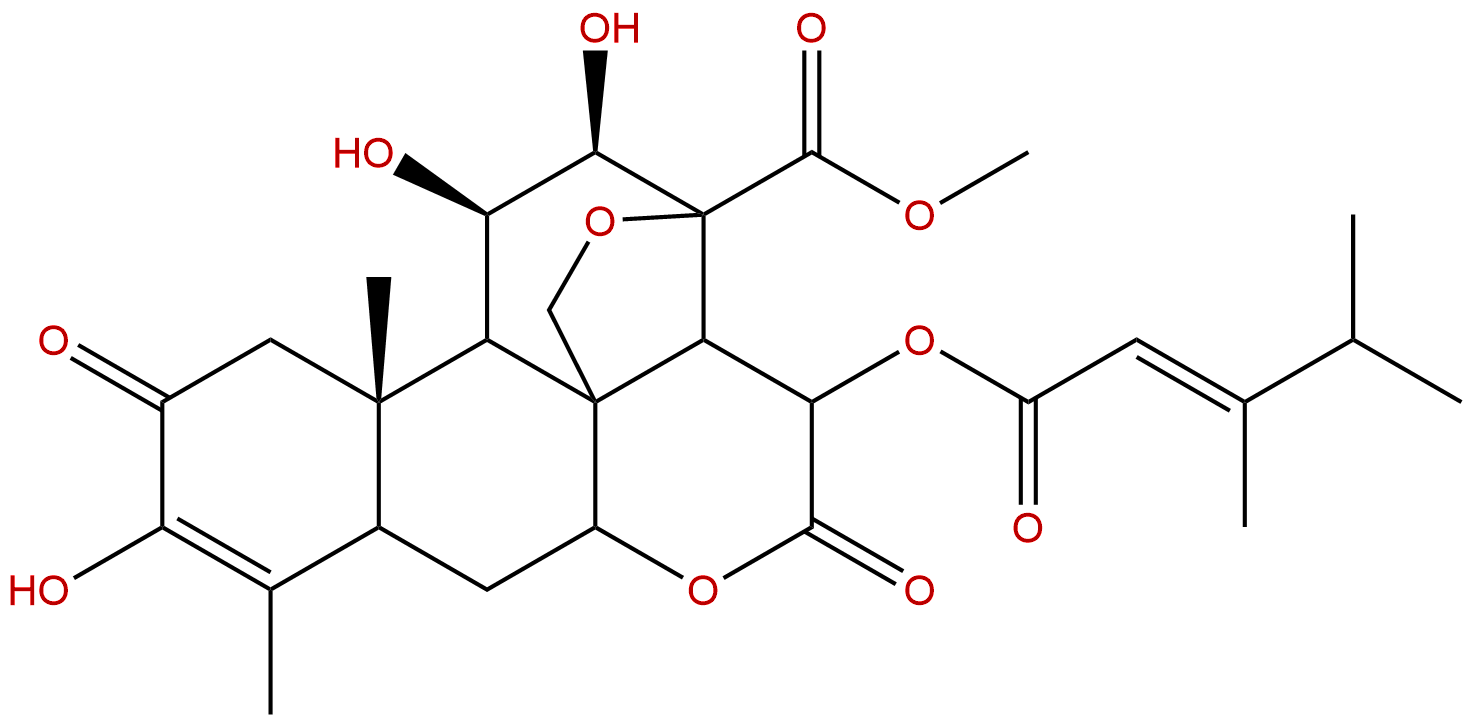
The molecular formula of Yadan Pavilion is C ₂₈ H ∝₆ O ₁₁, with a molecular weight of 548.5850 Da. Its chemical structure belongs to the highly oxidized lignin type tetracyclic triterpenoid, with a core skeleton of a twenty carbon quassinoid nucleus and multiple oxygen-containing functional groups connected, including alpha, beta unsaturated lactone rings, epoxy groups, as well as multiple hydroxyl and ester groups. This complex structure is the material basis for its biological activity, especially the alpha, beta unsaturated lactone rings, which are considered to be the key pharmacophores involved in Michael addition reactions with biomolecules (such as thiol groups in proteins) to exert cytotoxicity.
Based on the analysis of physicochemical parameters related to drug properties, the lipid water partition coefficient (LogP) of Yadanting is 1.7129, indicating its moderate lipophilicity, which facilitates its penetration into cell membranes. Its topological polar surface area (TPSA) is 165.89 Å ², which is relatively high and reflects the presence of multiple hydrogen bond donors and acceptors in the molecule, which may affect its membrane permeability. The water solubility parameter is 0.1994 mg/mL, which belongs to the category of slightly soluble to poorly soluble. This is usually a common characteristic of high LogP and high TPSA natural products, and it is also one of the key challenges that need to be overcome in their formulation development. Preliminary computer simulation toxicity prediction shows that the Ames test result is negative (0.0), indicating that it may not have direct genetic toxicity; There was no significant inhibition of hERG potassium channels, indicating a low risk of causing QT interval prolongation in the heart. However, its blood-brain barrier permeability is predicted to be 'low', which means it may have difficulty entering the central nervous system, which is unfavorable for treating brain tumors, but may also reduce its potential side effects on the central nervous system.
Plant sources and extraction methods
The Yadan Pavilion is mainly derived from the Sapindaceae family's Sapindaceae plant Sapindaceae. As a traditional Chinese medicine, the fruit, seeds, and bark of brucea have been used in folk medicine to treat diseases such as malaria and amoebic dysentery. Yadan Pavilion is one of the components of bitter lignin with very low content but extremely strong activity.
Its extraction and separation is a complex multi-step process. Usually, the dried brucea plant material (such as seeds or bark) is first crushed and subjected to cold soaking or heating reflux extraction using organic solvents such as methanol, ethanol, or acetone to obtain the crude extract. Subsequently, the crude extract was preliminarily separated using solvent partitioning method (such as liquid-liquid extraction between different polar solvent systems, such as petroleum ether, ethyl acetate, n-butanol, and water), and Yadanting was mostly enriched in the moderately polar ethyl acetate fraction. Further purification relies on various chromatographic techniques. Silica gel column chromatography is commonly used for separation using gradient elution systems such as chloroform methanol or petroleum ether ethyl acetate. High performance liquid chromatography (HPLC), especially preparative or semi preparative reverse phase HPLC (commonly using C18 column with methanol water or acetonitrile water as mobile phase), is the final key step in obtaining high-purity Yadanting monomers. Modern technologies such as high-speed countercurrent chromatography (HSCCC) have also been applied for the separation of such natural products due to their high recovery rate and avoidance of irreversible adsorption. The entire separation process requires the combination of thin-layer chromatography (TLC) or high-performance liquid chromatography-mass spectrometry (HPLC-MS) for activity tracking and component identification to ensure efficient acquisition of the target compound.
Pharmacological activity research
Yadan Pavilion exhibits extensive and strong pharmacological activity, and its research was initially focused on anti-tumor and antigen insect fields.
-
Antitumor activity Yadan Ting has significant cytotoxicity against various tumor cell lines. Its most prominent activity is reflected in hematological malignancies. Research has shown that it exhibits nanomolar level growth inhibitory activity on various leukemia cell lines, such as P388 lymphocytic leukemia, L1210 leukemia, and human myeloid leukemia HL-60 cells (IC ₅₀ values typically range from 0.001-0.1 μ M). In recent years, research hotspots have expanded to solid tumors. Especially in the field of colon cancer, Yadanting has shown strong proliferation inhibition and apoptosis induction effects on various colon cancer cell lines (such as HCT-116, SW480), and its efficacy far exceeds that of some commonly used clinical chemotherapy drugs, making it a potential candidate molecule for colon cancer treatment. In addition, it has also been reported on breast cancer, prostate cancer, lung cancer and other cell lines.
-
Antigen parasite activity As an active ingredient of traditional antimalarial medicinal plants, Yadanting has significant inhibitory activity against Plasmodium falciparum. Its mechanism of action may be related to interfering with parasite protein synthesis or energy metabolism, but specific details still need to be further elucidated.
-
Other activities There are studies suggesting that Yadanting may have certain anti-inflammatory and immune regulatory effects, which may be related to its regulation of inflammation related signaling pathways such as NF - κ B and STAT3.
Mechanism of action and molecular targets
The anti-tumor mechanism of Yadanting is complex, involving synergistic effects of multiple targets and pathways, ultimately converging on the core endpoint of inducing cell apoptosis. Research on colon cancer has revealed several key nodes in its functional network:
-
Inhibition of protein synthesis and activation of AMPK pathway Yadanting was initially identified as a potent inhibitor of protein synthesis in eukaryotic cells. It binds and inhibits the 60S subunit of ribosomes, preventing peptide chain elongation and rapidly shutting down intracellular protein synthesis. This' nutrient deprivation 'signal rapidly activates the cell's energy receptor - AMP activated protein kinase (AMPK, encoded by the PRKAA1 gene). The activation of AMPK further inhibits the mammalian rapamycin target protein (mTOR) signaling pathway, leading to cell cycle arrest (often in the G1 phase) and initiating autophagy or apoptosis programs.
-
Inducing mitochondrial apoptosis pathway This is the core apoptosis induction mechanism of Yadan Pavilion. It directly or indirectly affects mitochondrial outer membrane permeability. On the one hand, it relieves the inhibition of pro apoptotic proteins such as BAX and BAK by inhibiting the expression or function of anti apoptotic proteins B cell lymphoma 2 (BCL-2) and myeloid leukemia 1 (MCL1); On the other hand, it may directly or through upstream signals cause mitochondrial membrane potential collapse. Mitochondrial dysfunction leads to the release of cytochrome c into the cytoplasm, which forms apoptotic bodies with Apaf-1 and caspase-9, and subsequently activates downstream effector caspases (such as caspase-3) to perform cell apoptosis.
-
Regulating key signaling pathways:
- Inhibit STAT3 signal Signal transducer and activator of transcription factor 3 (STAT3) is an important pro survival and pro proliferative transcription factor that is continuously activated in various cancers. Yadan Ting can effectively inhibit the phosphorylation (activated form) and nuclear translocation of STAT3, thereby downregulating the expression of downstream target genes (such as MCL1, BCL-2, Cyclin D1), promoting apoptosis, and inhibiting proliferation.
- Affects the MAPK/ERK pathway Mitogen activated protein kinase 1 (MAPK1, ERK2) is a key kinase that regulates cell growth and differentiation. The effect of Yadanting on its activity is cell type dependent, and its activation may be interfered by upstream signals.
- Inhibition of NF - κ B activity The nuclear factor kappa B (NF - κ B) subunit RELA (p65) is another important pro-inflammatory and anti apoptotic transcription factor. Yadan Ting can inhibit the activity of I κ B kinase (IKK) or promote the stability of I κ B α, prevent NF - κ B nuclear translocation, and weaken its transcriptional activity.
- Interactions with other targets Research has shown that Yadanting can also inhibit 5-lipoxygenase (ALOX5, affecting the synthesis of inflammatory mediator leukotrienes), lymphocyte specific protein tyrosine kinase (LCK, involved in immune signaling), and may act as an inhibitor of DNA topoisomerase I (TOP1), causing DNA damage. In addition, it has been confirmed to be a substrate for P-glycoprotein (ABCB1), but it can also inhibit the function of this efflux pump at higher concentrations, which is related to its potential to overcome multidrug resistance.
In summary, Yadan Ting forms a multi pronged attack network by simultaneously attacking the protein synthesis machinery, energy metabolism, apoptosis regulation system, and multiple survival promoting signaling pathways of tumor cells, which may be the fundamental reason for its efficient anti-tumor activity.
Evaluation of drug properties and pharmacokinetics
Although Yadanting has excellent in vitro activity, its pharmacological development faces significant challenges, which limits its clinical translation.
-
Drug like analysis As mentioned earlier, its moderate LogP and high TPSA meet the boundaries of drug like rules (such as Lipinski's Five Rules), but poor water solubility and predicted low blood-brain barrier permeability are the main drawbacks. Its molecular weight is close to the upper limit of 500 Da, but still within an acceptable range.
-
Pharmacokinetic (PK) characteristics The pharmacokinetic studies of Yadanting in vivo are relatively limited. Based on its physicochemical properties, it can be inferred that its oral bioavailability may be low due to poor gastrointestinal solubility, first pass effects (due to the presence of easily metabolized ester bonds and hydroxyl groups in its structure), and possible efflux by intestinal P-glycoprotein. Non intestinal administration (such as intravenous injection) is a more feasible route, but its water solubility issue needs to be addressed, usually requiring the use of solubilization techniques (such as co solvents, cyclodextrin inclusion, or nanoformulations). There is still a lack of systematic research on its distribution, metabolism, and excretion pathways in the body. Early animal experiments suggest that its half-life in the body may be short and cleared quickly.
-
Toxicity considerations Although computers predict that it has no genetic toxicity or cardiotoxicity risk, as a potent protein synthesis inhibitor, its potential toxicity to normal tissues, especially those rapidly renewing cells such as gastrointestinal mucosal cells and bone marrow hematopoietic cells, cannot be ignored. The therapeutic window (the range between effective dose and toxic dose) may be a key obstacle to its clinical development. Therefore, dosage form optimization (such as targeted delivery systems) and structural modification (synthesizing derivatives with retained activity but reduced toxicity) are important directions for improving their drug properties.
Clinical application prospects and prospects
The clinical application prospects of Yadan Pavilion are both hopeful and challenging.
-
Direct drug development Developing Yadanting as a single component anti-tumor drug is a traditional approach. Given its strong in vitro activity, especially its potential in refractory leukemia and colon cancer, it is worth further exploration. The focus of future work should be on:① In depth preclinical pharmacodynamic and toxicological evaluation Systematically evaluate its efficacy and toxicity in animal models of diseases that are closer to humans, such as human derived tumor xenograft models, and clarify its therapeutic index.② Formulation innovation Develop new drug delivery systems, such as liposomes, polymer micelles, albumin nanoparticles, etc., to improve their solubility, stability, tumor targeting, and reduce systemic toxicity.③ Structural optimization By using semi synthetic or fully synthetic methods to modify its structure, the aim is to improve water solubility, metabolic stability, reduce toxicity, or overcome multidrug resistance mediated by ABCB1.
-
Combination therapy strategy Given its unique multi-target mechanism, the combination of Yadanting and existing standard therapies may produce synergistic effects and potentially reverse drug resistance. For example, the combination of conventional chemotherapy drugs (such as 5-fluorouracil for colon cancer), targeted drugs (such as STAT3 inhibitors, BCL-2 inhibitors), or immune checkpoint inhibitors is a highly attractive research direction. Its ability to inhibit ABCB1 also provides a theoretical basis for its combination with certain chemotherapy drugs.
-
As a chemical probe and mechanism research tool As a classic tool for studying ribosome function and protein synthesis, Yadanting's value will continue to exist. Meanwhile, its multi-target properties make it a valuable chemical probe for studying the interaction between tumor cell apoptosis networks, energy stress responses, and signaling pathways.
-
Challenges and limitations The biggest challenge lies in balancing its potent activity with potential toxicity. The limitations of its natural source content, extraction and separation costs, and complex total synthesis routes also pose economic considerations for its large-scale supply. In addition, its exact pharmacokinetic behavior and metabolite profile in the human body still need to be thoroughly elucidated.
Conclusion
As a natural product of bitter lignin discovered from traditional medicinal plants, Yadan Pavilion continues to exude charm in the field of tumor pharmacology due to its unique and powerful multi-target anti-tumor mechanism. From inhibiting protein synthesis to activating AMPK, from disrupting mitochondrial function to regulating key signaling axes such as STAT3 and NF - κ B, it constructs a dense pro apoptotic network and exhibits excellent in vitro activity against malignant tumors such as leukemia and colon cancer. However, its inherent pharmaceutical defects, such as poor water solubility, potential systemic toxicity, and unclear pharmacokinetic characteristics in vivo, constitute a gap that must be overcome on its path to clinical translation. Future research should focus on optimizing its pharmaceutical properties through advanced formulation techniques and rational structural modifications, and actively exploring its potential for combined applications with existing therapies. Regardless of whether Yadanting itself can be successfully launched, its profound revelation of the mechanism of tumor cell death, as well as the rich structural information and biological insights it provides as a lead compound, will continue to inject vitality into the development of innovative anti-tumor drugs. The continuous in-depth research on Yadan Pavilion is a vivid example of connecting traditional medical wisdom with modern precision medicine.