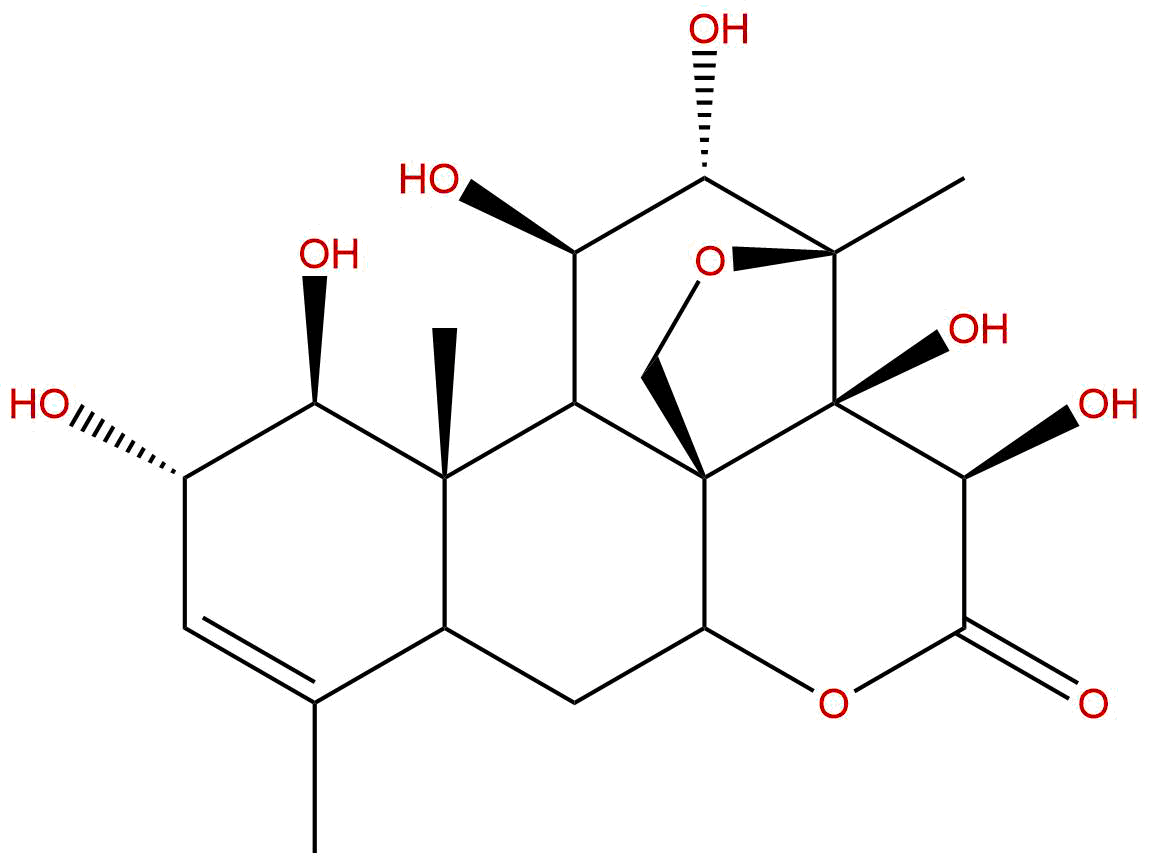


Product name: Bruceine E
Synonym name: Brucein E
Catalogue No.: BP4225
Cas No.: 21586-90-3
Formula: C20H28O9
Mol Weight: 412.435
Botanical Source: Brucea javanica(L.)Merr.
Type of Compound: Diterpenoids
Purity: 95%~99%
Analysis Method: HPLC-DAD or/and HPLC-ELSD
Identification Method: Mass, NMR
Packing: Brown vial or HDPE plastic bottle
Storage: Store in a well closed container, protected from air and light. Put into refrigerate or freeze for long term storage.
Whenever possible, you should prepare and use solutions on the same day. However, if you need to make up stock solutions in advance, we recommend that you store the solution as aliquots in tightly sealed vials at -20℃. Generally, these will be useable for up to two weeks.
The product could be supplied from milligrams to grams
Inquire for bulk scale.
For Reference Standard and R&D, Not for Human Use Directly.
Storage conditions:Short-term storage at 2~8℃, long-term storage at -20 ~ -80℃
156.9100
-.6783
-.6785
4.8518
.5397
2.3466
Low
32.3375
6.7540
No
No
No
No
Yes
No
0.0
Yes
No
Yes
Yes
Brucein E (CAS number: 21586-90-3) is a natural penicillin like compound isolated from the seeds of Brucea javanica. Due to its significant biological activity, especially in lowering blood sugar and anti-tumor effects, Brucea Javanese E has received widespread attention in the fields of pharmacology and natural product chemistry in recent years. Diabetes and its complications have become a major challenge to global public health, and the high incidence rate of tumor diseases and complex treatment needs also prompted researchers to continue to explore new natural drugs. As a natural product with multiple targets and mechanisms of action, Brucea Javanese E has shown great pharmacological potential and potential as a drug.
This article will provide a systematic review of the chemical structure and physicochemical properties, plant sources, and extraction methods of Brucea Javanese E, and deeply analyze its pharmacological activity and mechanism of action, especially the latest research progress in the fields of hypoglycemic and anti-tumor effects. It will evaluate its pharmacological parameters and pharmacokinetic characteristics, and finally explore its clinical application prospects and future research directions, aiming to provide theoretical basis and research references for the further development and utilization of this compound.
Brucea Javanese E belongs to the class of penicillin compounds, with a molecular formula of C21H28O9 and a molecular weight of 412.4350. Its structural features include multiple oxygen-containing functional groups and a cyclic skeleton, endowing it with a complex three-dimensional conformation and rich chemical reactivity. The LogP value of Brucea Javanese E is -0.6783, indicating its strong hydrophilicity and water solubility of 4.8518, showing good water solubility, which has a positive impact on oral absorption and in vivo distribution. The polar surface area (TPSA) is 156.91 Å ², indicating that its molecules have high polarity, which may affect its cell membrane penetration ability and bioavailability.
The lack of hERG channel inhibitory activity in Brucea Javanese E indicates a low risk of cardiac toxicity. The Ames test result was 0.0, indicating no significant genotoxicity. In addition, the compound has a low blood-brain barrier penetration ability, indicating its limited distribution in the central nervous system, which may reduce central nervous system side effects.
The detailed analysis and characterization of its chemical structure provide a foundation for subsequent structural modifications and pharmacological optimization. Through techniques such as nuclear magnetic resonance (NMR), mass spectrometry (MS), and infrared spectroscopy (IR), researchers have systematically confirmed the molecular structure of Brucea Javanese E.
The main source of Brucea Javanica E comes from its seeds. Brucea Javanica is a plant in the family Simaroubacheae, widely distributed in southern China and Southeast Asia. Brucea javanica seeds have always been used in traditional Chinese medicine to treat malaria, cancer, diabetes and other diseases, and their medicinal value is closely related to the rich penicillin like ingredients in the seeds.
The common methods for extracting Brucea Javanese E include solvent extraction, liquid-liquid distribution, and column chromatography separation. Ethanol or methanol is usually used as the extraction solvent, and the extraction efficiency is improved by ultrasound assisted extraction or reflux extraction. After concentration, the extraction solution was separated and purified using techniques such as silica gel column chromatography and reverse phase high performance liquid chromatography (RP-HPLC) to obtain high-purity brucine E.
In recent years, green extraction techniques such as supercritical fluid extraction (SFE) and microwave-assisted extraction (MAE) have also been applied to the extraction of brucea Javanese E, aiming to improve extraction efficiency, reduce solvent usage and environmental pollution. The optimization of the extraction process not only ensures the quality and purity of the product, but also lays the foundation for industrial production.
The research on the hypoglycemic effect of Brucea Javanese E is relatively systematic. In vivo experiments showed that Brucea javanica E had significant hypoglycemic effect on non diabetes mice and streptozotocin (STZ) induced diabetes rats. STZ is a compound that selectively destroys islet β cells and is commonly used to establish animal models of diabetes. Brucea Javanese E can effectively reduce blood glucose levels and improve glucose metabolism abnormalities in this model.
Its hypoglycemic effect may be achieved through various pathways, including promoting insulin secretion, enhancing insulin sensitivity, inhibiting hepatic gluconeogenesis, and regulating the activity of glucose metabolism related enzymes. In addition, Brucea javanica E also shows antioxidant and anti-inflammatory effects, which helps to reduce diabetes related oxidative stress and chronic inflammatory reaction, thus protecting the function of pancreatic islets and improving metabolic disorders.
Brucea Javanese E exhibits broad-spectrum anti-tumor activity in various tumor cell lines. Research has shown that it can inhibit tumor cell proliferation, induce cell apoptosis, block cell cycle progression, and suppress tumor cell migration and invasion. Its anti-tumor effect involves multiple signaling pathways and molecular targets, exhibiting the characteristic of coordinated regulation of multiple targets.
The specific tumor types include lung cancer, breast cancer, liver cancer, gastric cancer, etc. Brucea javanica E can play an obvious cytotoxic role on these tumor cells. In vivo tumor model experiments have also confirmed its potential to inhibit tumor growth and metastasis.
In addition to its hypoglycemic and anti-tumor effects, Brucea Javanese E also exhibits various biological activities such as anti-inflammatory, antioxidant, and immune regulation. These effects may synergistically promote their therapeutic efficacy, especially in the comprehensive management of chronic diseases, which is of great significance.
The pharmacological mechanism of Brucea Javanese E is complex, involving multiple molecular targets and signaling pathways. The main targets related to anti-tumor effects include:
In terms of hypoglycemic mechanism, Brucea Javanese E may improve pancreatic beta cell function and insulin secretion by regulating the insulin signaling pathway, enhancing insulin receptor sensitivity, inhibiting the expression of key gluconeogenesis enzymes such as glucose-6-phosphatase and phosphoenolpyruvate carboxykinase. In addition, its antioxidant and anti-inflammatory effects can protect pancreatic islet tissue and delay the progress of diabetes by reducing the levels of oxidative stress and inflammatory mediators.
The pharmacological evaluation of Brucea Javanese E shows that it has good potential for drug development. The molecular weight of 412.4350 conforms to Lipinski's "drug similarity rule", with a LogP value of -0.6783, indicating moderate hydrophilicity and favorable in vivo distribution and solubility. The TPSA is 156.91 Å ², which is relatively high but still within an acceptable range and may affect its oral bioavailability.
Brucea Javanese E does not exhibit hERG channel inhibition, reducing the risk of cardiac toxicity. The Ames test is negative, indicating no significant genetic toxicity. Low blood-brain barrier penetration ability reduces the possibility of central nervous system side effects.
In terms of pharmacokinetics, existing research is relatively limited. Preliminary in vivo experiments have shown that Brucea Javanese E is well absorbed orally, with a moderate plasma half-life, mainly metabolized through the liver, and excreted through bile and urine pathways. The activity and safety of its metabolites still need further research.
In addition, the stability, drug interactions, and formulation development of Brucea Javanese E still require systematic evaluation. The application of novel drug delivery systems such as nanocarriers and liposomes may further improve their bioavailability and targeting.
Brucea Javanese E, as a natural product with multiple biological activities, has shown broad clinical application prospects. Its hypoglycemic effect in the treatment of diabetes, especially in the STZ induced diabetes model, provides a theoretical basis for the development of new natural hypoglycemic drugs. Considering the complex pathological mechanism of diabetes, the antioxidant and anti-inflammatory effects of Brucea javanica E also help to reduce the complications of diabetes and improve the quality of life of patients.
In the field of tumor therapy, Brucea Javanese E regulates the growth, apoptosis, and metastasis of tumor cells through multiple targets and pathways, and has potential adjuvant therapeutic value. In the future, chemotherapy, radiotherapy, and immunotherapy can be combined to achieve synergistic effects, improve efficacy, and reduce toxic side effects.
However, the clinical translation of Brucea Javanese E still faces many challenges. Firstly, it is necessary to conduct systematic toxicological evaluations and safety studies to clarify the long-term medication risks. Secondly, in-depth research on pharmacokinetics and pharmacodynamics is the foundation of clinical trial design. Again, the optimization of dosage forms and innovation in administration routes will enhance the feasibility of its clinical application and patient compliance.
Future research should focus on mechanism analysis, structural optimization, and preclinical evaluation to promote the clinical application of Brucea Javanese E. In addition, combining modern drug design and biotechnology methods such as computer-aided drug design (CADD), genomics, and metabolomics is expected to accelerate its drug development process.
As an important penicillin like compound in Brucea seeds, Brucea Javanese E has become a research hotspot in the field of natural product pharmacology due to its significant hypoglycemic and anti-tumor activities. Its multi target and multi mechanism biological effects provide new ideas and strategies for the treatment of major diseases such as diabetes and cancer. The drug efficacy evaluation shows that it has good potential for drug development, but further pharmacokinetic, safety, and preclinical studies are still needed.
With the continuous advancement of natural product research technology and the innovation of drug development concepts, brucea Javanese E is expected to become an important candidate for new natural medicines. Future research should strengthen the systematic elucidation of its mechanism of action, optimize extraction and preparation processes, improve pharmacological and toxicological evaluations, promote its clinical application, achieve successful transformation from "seeds" to "drugs", and contribute to the cause of human health.
