


Synonym name:
Catalogue No.: BP0821
Cas No.: 22688-78-4
Formula: C21H18O12
Mol Weight: 462.363
Botanical Source: the leaves of Euphorbia lathyris, Euphorbia cyparissias, Anemone alpina and Phaseolus vulgaris (kidney bean) and many other plants
Purity: 95%~99%
Analysis Method: HPLC-DAD or/and HPLC-ELSD
Identification Method: Mass, NMR
Packing: Brown vial or HDPE plastic bottle
Can be supplied from milligrams to grams.
For Reference Standard and R&D, Not for Human Use Directly.
Inquire for bulk scale.
HPLC of Kaempferol 3-glucuronide
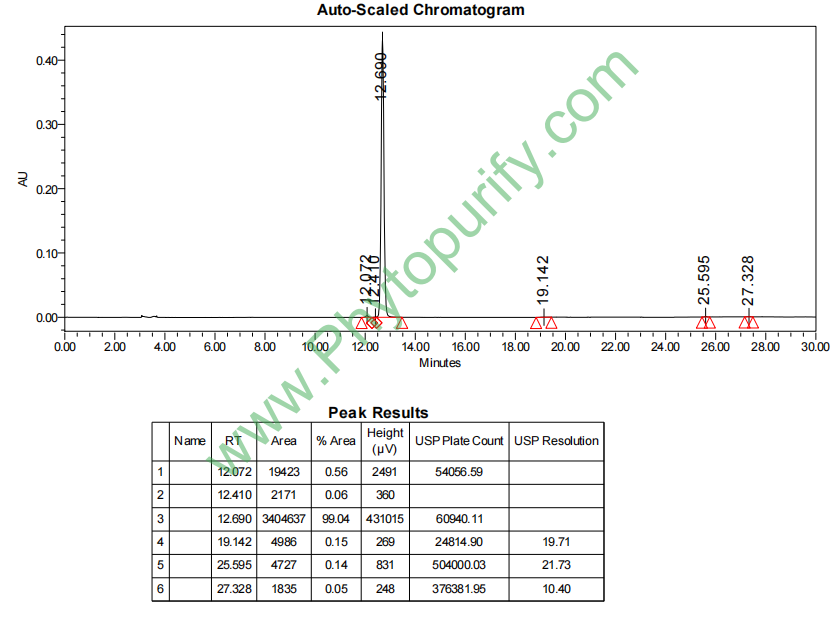
Storage conditions:Short-term storage at 2~8℃, long-term storage at -20 ~ -80℃
Kaempferol 3-glucuronide (CAS number: 22688-78-4), as an important flavonoid natural product derivative, has received widespread attention in the field of natural product pharmacology in recent years. Kaempferol, the parent compound of Kaempferol, is a flavonoid compound commonly found in various plants, with significant antioxidant, anti-inflammatory, and anti-tumor activities. As a glucuronic acid complex of kaempferol, kaempferol glucuronide has become an important molecule for studying tumor treatment and antioxidant damage due to its unique chemical structure and biological activity. Especially in the cell models of breast cancer, glioblastoma, lung cancer and other malignant tumors, kaempferol glucuronide shows the potential to induce apoptosis and inhibit the expression of tumor related targets by regulating cell signaling pathways.
This article aims to systematically review the chemical structure and physicochemical properties, plant sources and extraction methods, pharmacological activity and mechanism of action of kaempferol glucuronide, and explore its clinical application prospects and future development directions based on drug evaluation and pharmacokinetic characteristics. It provides theoretical basis and research reference for the drug development of this natural product.
Kaempferol glucuronide is a flavonoid derivative formed by the combination of kaempferol and glucuronic acid through glycosidic bonds at the 3rd hydroxyl group. Its molecular formula is C21H18O13, with a molecular weight of 462.3630 Da. The structure contains a typical flavonoid skeleton and highly polar glucuronic acid groups. This structure endows it with high polarity and water solubility (1.3933 mg/mL), which is beneficial for distribution and metabolism in the body.
In terms of physicochemical properties, the LogP value of kaempferol glucuronide is 0.2159, indicating its strong hydrophilicity and weak lipophilicity. The topological polar surface area (TPSA) is 207.35 Å ², indicating its limited ability to penetrate cell membranes, especially its low permeability to the blood-brain barrier (blood-brain barrier penetration is low). In addition, the compound did not exhibit hERG channel inhibitory activity, with an Ames test result of 0.6, indicating a low risk of genotoxicity and good safety characteristics.
Kaempferol glucuronide is widely present in various traditional medicinal and edible plants, such as ginkgo leaves, green tea, goji berries, astragalus, red dates, etc. Its content is greatly affected by plant species, growth environment, and harvesting period. Usually, kaempferol glucuronide, as one of the flavonoids in plants, exists in the leaves, stems, and fruits of plants.
The extraction methods mainly include traditional solvent extraction and modern techniques such as ultrasonic assisted extraction and microwave-assisted extraction. The commonly used extraction solvents are methanol, ethanol, and their aqueous solutions. The extraction process is generally as follows: after crushing plant materials, appropriate proportions of organic solvents are used for extraction, and then the extraction solution is concentrated by rotary evaporation, and then separated and purified by high performance liquid chromatography (HPLC) or ultra high performance liquid chromatography (UPLC). Some studies used glucuronidase hydrolysis method to convert kaempferol glucuronide into kaempferol for activity detection and structural identification.
Kaempferol glucuronide has shown significant anti proliferative and pro apoptotic effects in various tumor cell lines. Studies have shown that this compound can inhibit the expression of estrogen receptor α (ER α) in breast cancer cells, interfere with estrogen signaling pathway, and then inhibit the proliferation and invasion of tumor cells. In addition, in glioblastoma and lung cancer cells, kaempferol glucuronide exhibits good anti-tumor potential by activating the MEK-MAPK signaling pathway, inducing cell apoptosis.
As a natural flavonoid product, kaempferol glucuronide has excellent antioxidant properties. It can regulate the expression and activity of various antioxidant enzymes, including superoxide dismutase (SOD1, SOD2), catalase (CAT), glutathione peroxidase 1 (GPX1), and heme oxygenase 1 (HMOX1). In addition, the compound can activate the nuclear factor erythroid 2-related factor 2 (NFE2L2/NRF2) signaling pathway, enhance the cell's defense against oxidative stress, alleviate oxidative damage, and protect cellular function.
In addition to anti-tumor and antioxidant effects, some studies have also reported that kaempferol glucuronide has the potential to have anti-inflammatory, antibacterial, and immunomodulatory effects. These functions provide a theoretical basis for their application in the prevention and treatment of various diseases.
The pharmacological activity of kaempferol glucuronide is mainly achieved through multiple signaling pathways:
Inhibition of estrogen receptor alpha (ER alpha)
In breast cancer cells, kaempferol glucuronide significantly down regulates the expression of ER α, blocks estrogen mediated cell proliferation signals, and inhibits the growth and metastasis potential of tumor cells. This mechanism makes it a potential therapeutic molecule for estrogen dependent breast cancer.
Activation of MEK-MAPK signaling pathway
In glioblastoma and lung cancer cells, kaempferol glucuronide activates the MEK (mitogen activated protein kinase) and downstream MAPK (mitogen activated protein kinase) signaling pathways, promotes the expression of apoptosis related proteins, and induces programmed cell death in tumor cells.
Regulation of NFE2L2/NRF2 antioxidant signaling pathway
Kaempferol glucuronide can activate NFE2L2/NRF2 transcription factors, promote their nuclear translocation, enhance the transcriptional expression of antioxidant enzyme genes, improve the ability of cells to clear reactive oxygen species (ROS), and slow down cell damage caused by oxidative stress.
Regulation of antioxidant enzyme system
By upregulating the expression of SOD1, SOD2, CAT, GPX1, and HMOX1, kaempferol glucuronide enhances cellular antioxidant defense, maintains intracellular redox homeostasis, and protects cells from free radical damage.
In summary, kaempferol glucuronide exerts its anti-tumor and antioxidant protective effects through multi-target and multi pathway synergistic effects.
The pharmacological characteristics of kaempferol glucuronide indicate its potential for drug development. Its molecular weight is 462.3630 Da, which meets the basic requirements for molecular weight in Lipinski's rules. The LogP value is 0.2159, indicating its strong hydrophilicity, which is beneficial for dissolution and transport in the blood, but may limit passive diffusion of the cell membrane.
The TPSA value is as high as 207.35 Å ², indicating strong polarity that may affect oral absorption and tissue penetration ability. The low penetration of the blood-brain barrier limits its application in central nervous system diseases, but it helps to reduce central nervous system related side effects.
In terms of safety, kaempferol glucuronide did not exhibit hERG channel inhibition, reducing the risk of cardiac toxicity. The Ames test result is 0.6, indicating a low risk of genotoxicity and good safety.
Pharmacokinetic studies are still in the preliminary stage, and existing data indicate limited oral bioavailability, possibly due to incomplete intestinal absorption caused by high polarity and glycosidic structure. The metabolism in the body is mainly mediated by hepatic glucuronide conjugates and β - glucosidase, releasing active kaempferol. Further in vivo pharmacokinetic and metabolic studies are needed in the future to optimize dosage form design and dosing regimens.
Based on the anti-tumor activity of kaempferol glucuronide in breast cancer, glioblastoma and lung cancer cells, especially its inhibitory effect on estrogen receptor α, this compound shows good application potential in the field of tumor treatment. It regulates the proliferation and apoptosis of tumor cells through multiple targets and pathways, providing a theoretical basis for the development of new anti-tumor drugs.
In addition, the role of kaempferol glucuronide in antioxidant damage is expected to be applied as an adjuvant therapy for chronic inflammation, neurodegenerative diseases, and cardiovascular diseases. Its ability to activate the NFE2L2/NRF2 signaling pathway makes it a potential candidate molecule for regulating oxidative stress-related pathological states.
However, current research is mostly focused on cell and animal models, lacking systematic preclinical and clinical research data. Future research should focus on the following directions:
Pharmacokinetic and Toxicological Systematic Review
Clarify the in vivo absorption, distribution, metabolism, and excretion characteristics of kaempferol glucuronide, and evaluate the safety of long-term medication.
Optimization of dosage form and exploration of administration route
Improve its bioavailability and targeting through novel drug delivery systems such as nanocarriers and liposomes.
Research on Combination Medication Strategy
Explore the synergistic effect with existing anti-tumor drugs to improve treatment efficacy and reduce drug resistance.
Clinical trial design and implementation
Gradually promote the transition from preclinical to clinical research to verify its efficacy and safety.
Through interdisciplinary collaboration, kaempferol glucuronide is expected to become an important candidate molecule in the development of natural product drugs.
As a structurally unique and functionally diverse flavonoid natural product derivative, kaempferol glucuronide has demonstrated its extensive pharmacological activity in the fields of anti-tumor and antioxidant activities. It exerts a multi-target synergistic effect by regulating estrogen receptor expression, activating the MEK-MAPK signaling pathway, and enhancing NFE2L2/NRF2 mediated antioxidant defense, demonstrating good safety and potential for drug development.
Although there is a preliminary understanding of its pharmacological mechanism, further pharmacokinetic, toxicological, and preclinical studies are still needed to optimize the administration strategy and promote its clinical application. In the future, with the deepening of research, kaempferol glucuronide is expected to become an important natural drug resource in the field of anti-tumor and antioxidant damage treatment, providing new treatment ideas and drug choices for the prevention and treatment of related diseases.
