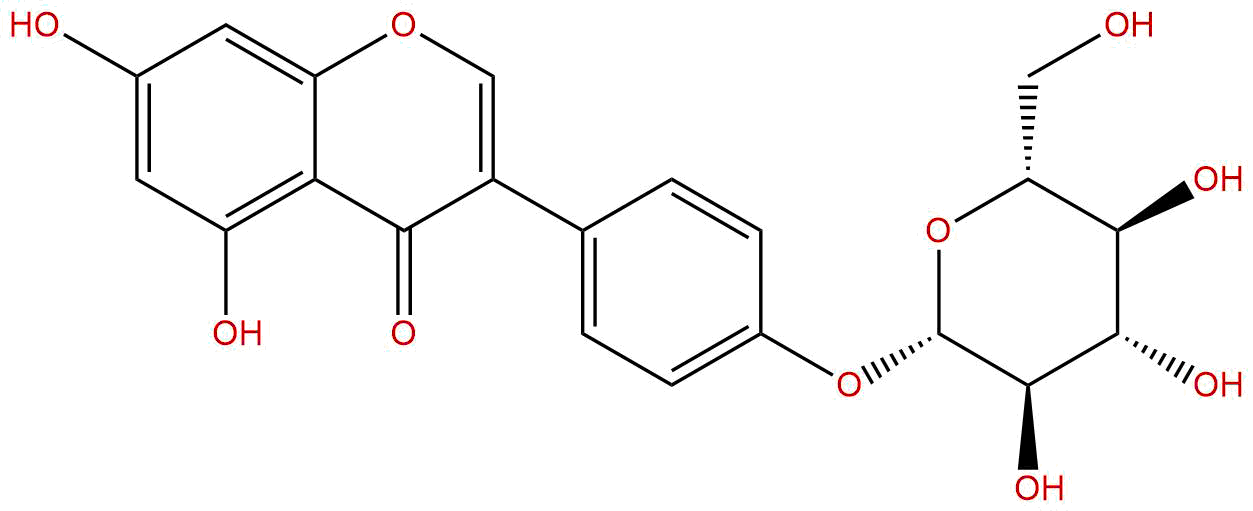


Synonym name: Genistein 4'-glucoside
Catalogue No.: BP1326
Cas No.: 152-95-4
Formula: C21H20O10
Mol Weight: 432.381
Botanical Source: Sophora japonica and Piptanthus nepalensis
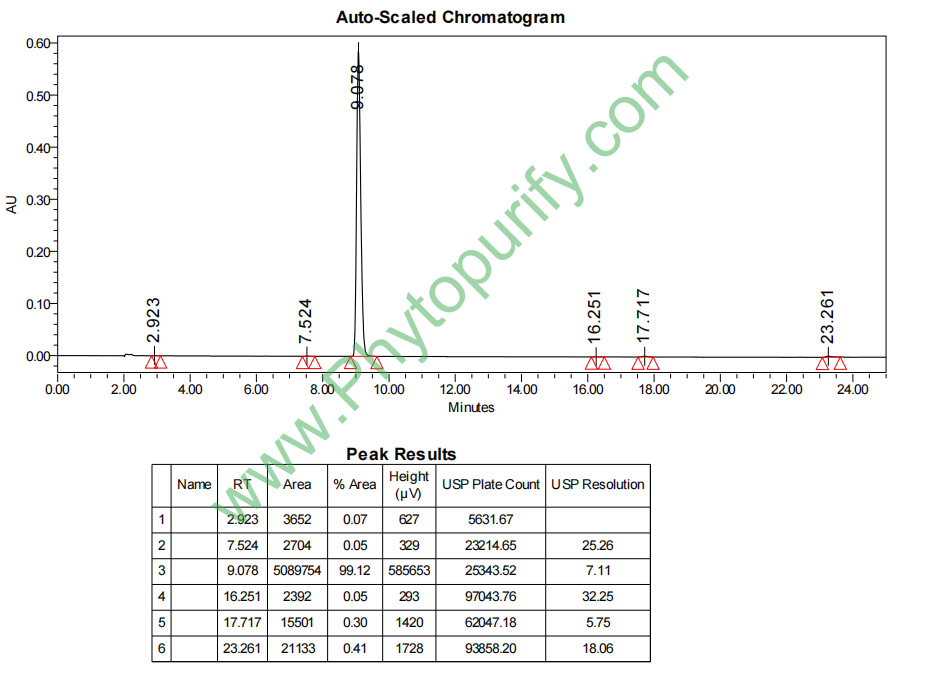
Purity: 95%~99%
Analysis Method: HPLC-DAD or/and HPLC-ELSD
Identification Method: Mass, NMR
Packing: Brown vial or HDPE plastic bottle
Can be supplied from milligrams to grams.
For Reference Standard and R&D, Not for Human Use Directly.
Inquire for bulk scale.
HPLC of Sophoricoside
Storage conditions:Short-term storage at 2~8℃, long-term storage at -20 ~ -80℃
170.0500
.1579
.0376
1.1047
.5462
.2871
Low
81.7409
3.8098
Yes
No
Yes
No
Yes
No
1.2
Yes
Yes
Yes
No
Natural products have always been an important source of innovative drug discovery, among which isoflavone compounds have attracted much attention due to their wide range of biological activities. Sophoricoside, also known as 5,4 '- dihydroxyflavone-7-O - β - D-glucopyranoside, is an isoflavone glycoside isolated from the traditional medicinal plant Sophora japonica L. Since its discovery, research has revealed its significant potential in anti-inflammatory, anticancer, and immune regulation, making it a hot topic in pharmacological research. In recent years, with the increasingly clear role of oxidative stress in the occurrence and development of various chronic diseases such as neurodegenerative diseases, cardiovascular diseases, metabolic syndrome, and cancer, natural compounds with antioxidant activity have shown great potential for application. Huaijiao glycoside regulates the antioxidant defense system centered on nuclear factor E2 related factor 2 (NRF2, encoded by NFE2L2 gene), exerting its antioxidant damage effect, laying a theoretical foundation for its prevention and treatment of oxidative stress-related diseases. This article aims to systematically review the chemical properties, plant sources, pharmacological activities, especially the mechanism and molecular targets of antioxidant damage of sophora flavescens, and to prospect its pharmacological properties and clinical application prospects.
The molecular formula of sophora japonica glycoside is C21H20O10, with a molecular weight of 432.3810. Its chemical structure is based on isoflavones as the mother nucleus, specifically composed of the 7th hydroxyl group of 5,7,4 '- trihydroxyflavone (genistein) connected to a molecule of β - D-glucose through glycosidic bonds. This glycosidic structure significantly affects its physicochemical properties.
From the perspective of pharmacological parameters, the theoretical lipid water partition coefficient (LogP) of sophocarpine is 0.1579, indicating its good hydrophilicity. Its topological polar surface area (TPSA) is as high as 170.0500 Å ², mainly attributed to the numerous hydrogen bond acceptors (oxygen atoms) in the molecule. The higher TPSA and lower LogP together determine its good water solubility, with a calculated value of approximately 1.1047 mg/mL. These properties suggest that the absorption and distribution of sophora flavescens glycosides in the body may face challenges, especially as their blood-brain barrier permeability is predicted to be "low", which limits their direct effects on central nervous system diseases. However, its good water solubility is beneficial for formulation development. In terms of preliminary safety evaluation, sophora flavescens has no significant inhibitory effect on hERG potassium channels (hERG inhibition: No), indicating a low risk of causing QT interval prolongation in the heart. The Ames test result was 1.2, indicating that no significant mutagenicity was observed under the experimental conditions, providing preliminary safety evidence for its further development.
Sophora japonica L., a legume plant, is the main source of Sophora japonica glycosides. Its flower buds (Sophora japonica) and fruits (Sophora japonica) are the main medicinal parts. As a traditional Chinese medicine, Sophora japonica has a bitter and slightly cold taste, and belongs to the liver and colon meridians. It has the effects of cooling blood, stopping bleeding, clearing liver and purging fire, and is commonly used to treat symptoms such as rectal bleeding, hemorrhoids, dysentery, diarrhea, liver heat, and blurred vision. Huaijiao glycoside is one of the key active ingredients that exert pharmacological effects in Huaihua and Huaijiao.
The extraction of sophocarpin from plant materials is usually carried out using solvent extraction method. Common solvents include methanol, ethanol, or their aqueous solutions. In order to improve extraction efficiency, modern extraction techniques such as ultrasound assisted extraction, microwave-assisted extraction, and supercritical fluid extraction have been widely used. For example, using a 70% ethanol solution for ultrasonic extraction can effectively shorten the extraction time and improve the yield of sophocarpin. After filtration and concentration, the extraction solution is usually preliminarily enriched and purified using macroporous adsorption resin column chromatography. Commonly used resins such as AB-8 and D101 have good adsorption and desorption properties for sophocarpin. Further purification can be achieved through techniques such as silica gel column chromatography and preparative high-performance liquid chromatography to obtain high-purity sophoricoside monomers for in-depth pharmacological and mechanistic studies.
Sophora japonica glycoside exhibits diverse pharmacological activities, mainly including the following aspects:
Antioxidant damage activity This is one of the core pharmacological activities of sophora flavescens glycoside. Numerous in vitro studies have shown that sophora flavescens can effectively scavenge free radicals such as DPPH and ABTS, and alleviate cellular oxidative damage caused by hydrogen peroxide (H ₂ O ₂), lipopolysaccharide (LPS), or other oxidative stress inducers. In various cell models such as endothelial cells, neuronal cells, and liver cells, pre-treatment with sophocarpine can significantly improve cell survival rate, reduce intracellular reactive oxygen species (ROS) levels, decrease the production of lipid peroxidation product malondialdehyde (MDA), and enhance the activity of endogenous antioxidant enzymes such as superoxide dismutase (SOD), catalase (CAT), and glutathione peroxidase (GPX).
anti-inflammatory effect Inflammation is closely related to oxidative stress. Huaijiao glycoside exerts anti-inflammatory effects by inhibiting the production of pro-inflammatory mediators such as tumor necrosis factor - α, interleukin-6, and nitric oxide, as well as downregulating the expression of inducible nitric oxide synthase and cyclooxygenase-2. It has also demonstrated good anti-inflammatory effects in animal models such as mouse ear swelling, arthritis, and colitis models.
anticancer activity Sophoroside can inhibit the growth and induce apoptosis of many cancer cell lines (such as breast cancer, liver cancer, colon cancer and lung cancer). Its anti-cancer mechanism involves cell cycle arrest, induction of apoptosis, inhibition of invasion and metastasis, etc. It is worth noting that its antioxidant activity may play a dual role in anti-cancer: on the one hand, it protects normal cells by clearing ROS; On the other hand, in some cancer cells, cancer cell death may be promoted by regulating the redox balance.
Immune regulatory effect Huaijiao glycoside has been reported to have immunosuppressive activity, which can inhibit the excessive proliferation of T lymphocytes and B lymphocytes, regulate cytokine secretion, making it potentially valuable in the treatment of autoimmune diseases such as rheumatoid arthritis.
Other activities The study also suggests that sophocarpine has certain effects in protecting bone density (anti osteoporosis) and improving insulin resistance.
The various pharmacological activities of sophora flavescens, especially its core antioxidant damage effect, are closely related to its regulation of specific molecular signaling pathways and targets. The core of its mechanism of action network is the NRF2/ARE pathway.
Core pathway: NRF2/ARE signaling pathway
NRF2 is a central regulatory factor of cellular antioxidant response. In the resting state, NRF2 binds to its negative regulatory protein Keap1 and is degraded by ubiquitination, maintaining low levels. When stimulated by oxidative stress or activators such as sophora flavescens, NRF2 dissociates from Keap1, translocates to the nucleus, and binds to antioxidant response elements (ARE), initiating the transcriptional expression of a series of downstream phase II detoxifying enzymes and antioxidant proteins.
The function of sophora flavescens glycoside Research has shown that sophocarpine can effectively activate the NRF2 signaling pathway. It may interfere with the Keap1-NRF2 interaction by modifying cysteine residues on Keap1, thereby stabilizing the NRF2 protein and promoting its nuclear translocation. The activated NRF2 further upregulates the expression of a series of genes with cell protective effects.
Key downstream target genes and proteins:
Interaction with other pathways:
The antioxidant effect of sophora japonica glycoside does not exist in isolation. The NRF2 pathway has extensive cross-talk interactions with signaling pathways such as NF - κ B, MAPK, and PI3K/Akt. For example, the anti-inflammatory effect produced by the activation of the NRF2/HMOX1 pathway by sophocarpine can inhibit the excessive activation of NF - κ B, thereby synergistically reducing the inflammatory response. In addition, its anti-cancer activity may also be partially derived from regulating the proliferation and apoptosis signals of cancer cells by modulating the redox state.
In summary, sophora flavescens systematically enhances the entire endogenous antioxidant defense network, including SOD, CAT, GPX, and HMOX1, by targeting and activating the "main switch" NRF2. This is the fundamental molecular mechanism for its resistance to oxidative damage and multiple pharmacological activities.
Although sophocarpine has shown good activity in vitro and some animal models, its drug like and pharmacokinetic (PK) properties are the key factors determining its successful development as a drug.
Absorption, distribution, metabolism, excretion (ADME):
Challenges and Strategies in Drug Development:
At present, there are relatively limited research reports on the pharmacokinetics of sophoricoside system. In vivo ADME research and formulation exploration are necessary steps to promote its clinical application.
Huaijiao glycoside, as a natural active molecule with multiple targets and functions, has shown broad application prospects in the prevention and treatment of various oxidative stress-related diseases.
Potential therapeutic areas:
Research and Development Prospects:
Sophora flavescens glycoside is an important research value isoflavone glycoside discovered from traditional Chinese medicine Sophora flowers. It precisely activates the NRF2 signaling pathway, upregulates the expression of key antioxidant enzymes such as HMOX1, SOD, CAT, GPX, and constructs a powerful cellular defense system, effectively combating oxidative damage, and thus deriving multiple pharmacological activities such as anti-inflammatory, anticancer, and immune regulation. Despite facing challenges in terms of bioavailability and target tissue distribution for drug development, these challenges are gradually being transformed into innovative opportunities with the continuous development of modern pharmaceutical chemistry, pharmacology, and molecular biology technologies. In the future, through in-depth basic research, systematic preclinical development, and innovative formulation strategies, sophoricoside is expected to develop from a promising lead compound into an innovative drug or functional health product for the prevention and treatment of oxidative stress-related chronic diseases, fully reflecting the unique value of natural products in modern medicine.
