


Product name: Kaempferol-3-O-sophoroside
Synonym name: Sophoraflavonoloside
Catalogue No.: BP0822
Cas No.: 19895-95-5
Formula: C27H30O16
Mol Weight: 610.521
Botanical Source: Sophora japonica L.
Physical Description:
Type of Compound: Flavonoids
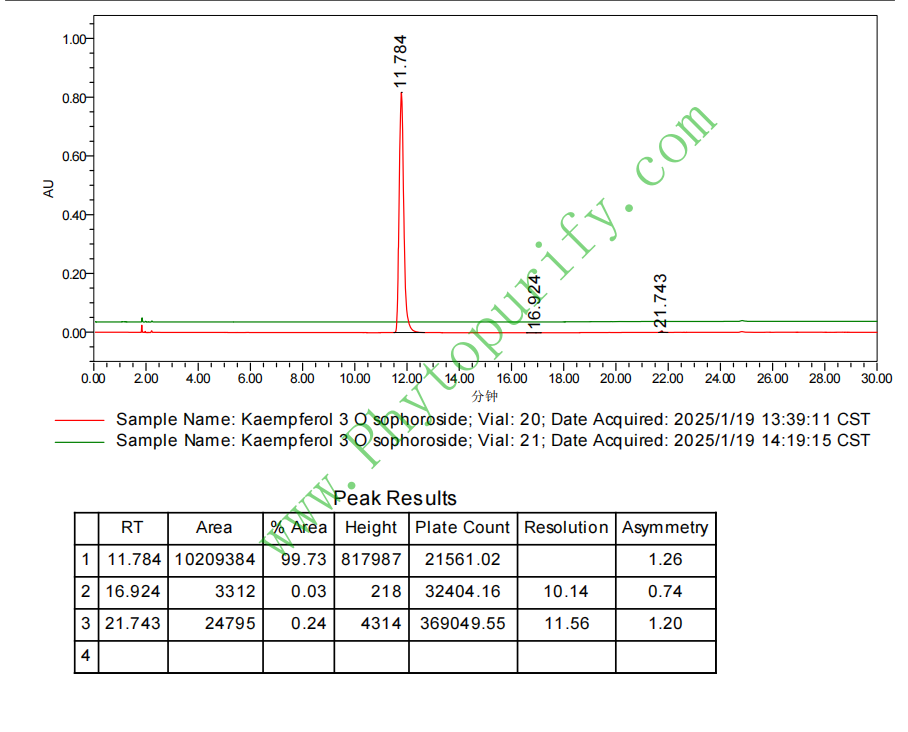
Purity: 95%~99%
Analysis Method: HPLC-DAD or/and HPLC-ELSD
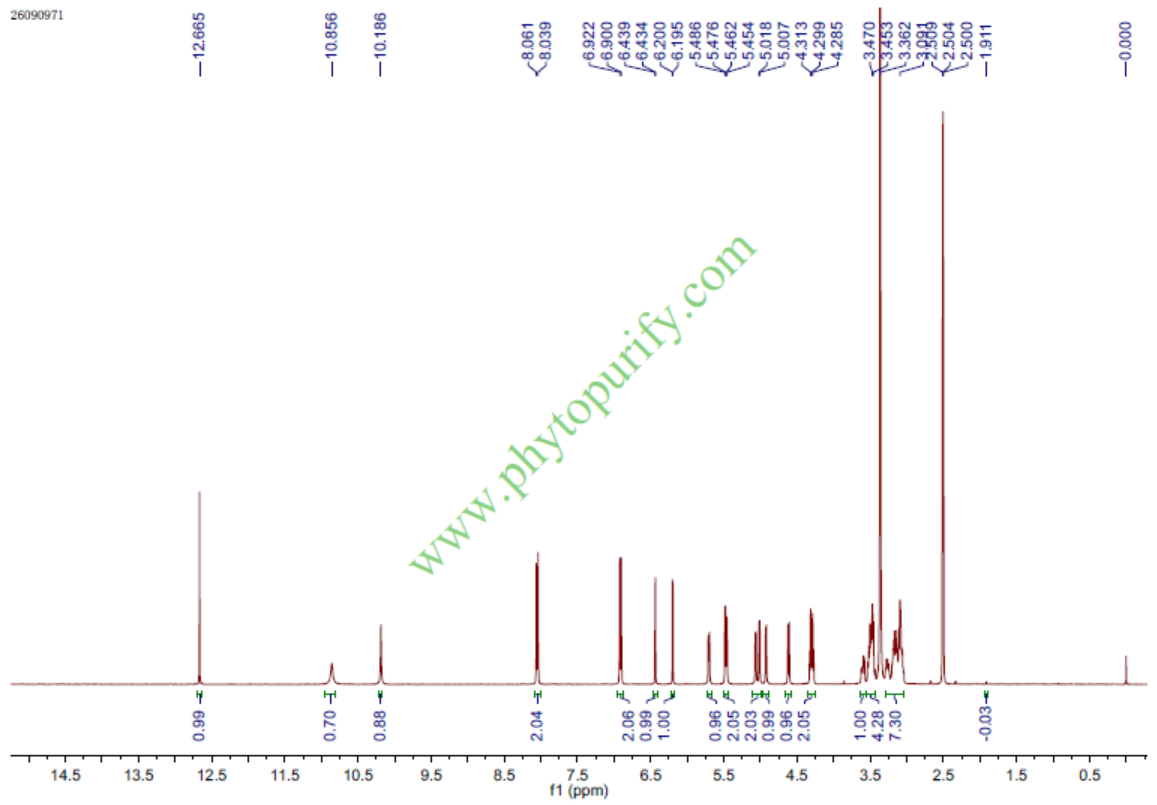
Identification Method: Mass, NMR
Packing: Brown vial or HDPE plastic bottle
Storage: Store in a well closed container, protected from air and light. Put into refrigerate or freeze for long term storage.
Whenever possible, you should prepare and use solutions on the same day. However, if you need to make up stock solutions in advance, we recommend that you store the solution as aliquots in tightly sealed vials at -20℃. Generally, these will be useable for up to two weeks.
The product could be supplied from milligrams to grams
Inquire for bulk scale.
Chengdu Biopurify Phytochemicals Ltd. is a leading company in the research, development, manufacture and marketing of High Quality Phytochemicals and Extracts(especially Active Ingredients from Traditional Chinese Medicine,TCM), Natural Active Pharmaceutical Ingredients worldwide.
The main services:
A. Supply active ingredients and reference standards of TCM, from mgs to kgs scale
B. Custom extraction and purification, target Herb Active Ingredients
C. Custom synthesis and semi-synthesis for Natural Active Ingredients
D. CR(contract research), CM(contract manufacture) and PD(process development) services from lab scale, pilot scale to commercial scale(GMP is also available)
E. TCM compounds library for drug screen,more than 3000 compounds available, many of them are rare and unique.
HPLC of Kaempferol-3-O-sophoroside
HNMR of Kaempferol-3-O-sophoroside
Storage conditions:Short-term storage at 2~8℃, long-term storage at -20 ~ -80℃
269.4300
-.8745
-.9676
3.3781
.3570
.1511
Low
76.7293
4.6839
Yes
No
No
No
Yes
No
1.2
Yes
Yes
Yes
Yes
Kaempferol-3-O-sophoroside (CAS number: 19895-95-5), as a natural flavonoid compound, has received widespread attention in recent years due to its significant biological activity and potential medicinal value. This compound is a glycoside derivative of Kaempferol, which has good oral activity and exhibits multiple pharmacological effects, especially in anti-inflammatory, analgesic, and antidepressant fields, showing unique therapeutic potential. With the incidence rate of inflammation related diseases and neuropsychiatric diseases rising year by year, the development of safe and effective natural drugs has become a research hotspot. Shanbaifen-3-O-sophoroside exhibits complex and precise biological effects through multi-target and multi pathway regulation, providing new ideas for the treatment of inflammation and neurological diseases.
This article provides a systematic review of the chemical structure, physicochemical properties, plant sources, and extraction methods of kaempferol-3-O-sophoroside. The focus is on analyzing its pharmacological activity and mechanism of action, exploring its pharmacological properties and pharmacokinetic characteristics, and finally looking forward to its clinical application prospects. The aim is to provide comprehensive and in-depth reference materials for researchers in related fields.
Kaempferol-3-O-sophoroside is a flavonoid compound, which is composed of a kaempferol nucleus and two glucose residues connected by glycosidic bonds. It belongs to the flavone-3-O-glycoside class. Its molecular formula is C27H30O16 and its molecular weight is 610.5210. The structure contains multiple hydroxyl and sugar groups, making it highly polar and exhibiting strong water solubility (3.3781), which is beneficial for its absorption and distribution in organisms.
In terms of physicochemical properties, the LogP value of kaempferol-3-O-sophoroside is -0.8745, indicating its strong hydrophilicity and difficulty in freely diffusing through lipid bilayer membranes, resulting in low blood-brain barrier permeability. Its topological polar surface area (TPSA) is 269.43 Å ², further supporting its high polarity and difficulty in penetrating the central nervous system barrier. The hERG channel inhibition experiment showed a negative result, indicating a low risk of cardiac toxicity. The Ames mutagenicity test score is 1.2, indicating a low risk of genotoxicity and a good safety foundation.
Kaempferol-3-O-sophoroside is widely present in various plants, especially in some traditional Chinese medicinal materials and edible plants such as Sophora japonica, Ginkgo biloba leaves, and certain vegetables and fruits. The buds and leaves of locust trees are the main source of this compound, with abundant content and easy extraction.
Extraction methods often use water extraction and alcohol precipitation, combined with modern technologies such as ultrasound assisted extraction and microwave-assisted extraction, to improve extraction efficiency and purity. The specific process usually includes:
In recent years, the application of green solvents and membrane separation technology has provided a new technological path for the industrial production of kaempferol-3-O-sophoroside.
Kaempferol-3-O-sophoroside exhibits significant anti-inflammatory activity. Both in vitro cell models and in vivo inflammatory animal models have confirmed that it can effectively inhibit the release of pro-inflammatory cytokines and alleviate inflammatory reactions. Research has shown that this compound can inhibit the binding of high mobility group protein B1 (HMGB1) to its cell surface receptor Toll like receptor (TLR) 2/4, block the activation of downstream signaling pathways, thereby reducing the expression and activation of nuclear factor kappa B (NF - κ B), inhibiting the production of inflammatory mediators such as tumor necrosis factor alpha (TNF - α), and ultimately achieving anti-inflammatory effects.
Kaempferol-3-O-sophoroside has shown analgesic effects in various pain models. Its mechanism may be closely related to anti-inflammatory effects, reducing pain perception by inhibiting the release of inflammatory mediators. In addition, some studies suggest that this compound may regulate neurotransmitter balance in the central nervous system and enhance endogenous analgesic pathways.
Research in the field of neurological and psychiatric disorders has shown that kaempferol-3-O-sophoroside has antidepressant potential. Its mechanism of action mainly activates AMP activated protein kinase (AMPK), promotes the expression of brain-derived neurotrophic factor (BDNF) and enhances autophagy, improves neuronal function and plasticity, and alleviates depressive symptoms. This mechanism provides new targets and ideas for the development of natural product antidepressants.
Kaempferol-3-O-sophoroside also has good antioxidant activity. It can regulate various antioxidant enzymes and related transcription factors, such as nuclear factor erythroid associated factor 2 (NFE2L2/NRF2), superoxide dismutase (SOD1, SOD2), catalase (CAT), glutathione peroxidase 1 (GPX1), heme oxygenase 1 (HMOX1), etc., enhancing the cell's resistance to oxidative stress and protecting tissues from oxidative damage.
The multi-target mechanism of action of kaempferol-3-O-sophoroside is the basis for its diverse pharmacological activities. The main targets and signaling pathways include:
HMGB1-TLR2/4 signaling pathway
HMGB1, as an important inflammatory mediator, activates the downstream NF - κ B pathway by binding to TLR2/4, inducing inflammatory responses. Kaempferol-3-O-sophoroside exerts anti-inflammatory effects by inhibiting the interaction between HMGB1 and TLR2/4, blocking the nuclear translocation of NF - κ B, and reducing the expression of inflammatory factors such as TNF - α and IL-1 β.
NF - κ B signaling pathway
NF - κ B, as a key transcription factor in inflammatory response, activation leads to the expression of various pro-inflammatory genes. Kaempferol-3-O-sophoroside inhibits the phosphorylation and degradation of I κ B α, prevents NF - κ B nuclear translocation, and reduces the production of inflammatory mediators.
AMPK-BDNF pathway
AMPK, as a regulatory enzyme of cellular energy metabolism, participates in neuroprotection and autophagy regulation. Kaempferol-3-O-sophoroside activates AMPK, promotes BDNF expression, enhances neuronal survival and synaptic plasticity, and exerts antidepressant effects by regulating autophagy to clear intracellular damage components.
Regulation of antioxidant enzymes
This compound activates the NRF2 signaling pathway, promotes the expression of downstream antioxidant enzymes (SOD, CAT, GPX1, HMOX1, etc.), enhances cellular antioxidant capacity, and reduces cellular damage caused by oxidative stress.
In summary, kaempferol-3-O-sophoroside achieves multiple pharmacological effects such as anti-inflammatory, analgesic, antidepressant, and antioxidant effects through the synergistic regulation of multiple signaling pathways.
The pharmacological evaluation of kaempferol-3-O-sophoroside shows that it has certain advantages and challenges:
Molecular weight and polarity
The molecular weight of 610.5210 is relatively high, with a TPSA of 269.43 Å ², indicating its strong polarity, which may limit its cell membrane permeability and central nervous system penetration.
Fat solubility (LogP)
The LogP value is -0.8745, indicating strong hydrophilicity and favorable solubility, but may affect oral absorption and bioavailability.
Water solubility
Good water solubility (3.3781), which is beneficial for formulation development and in vivo distribution.
Blood-brain barrier permeability
The prediction is low, indicating that its ability to directly act on the central nervous system is limited, but there is a possibility of exerting antidepressant effects through activation of the peripheral nervous system or indirect mechanisms.
safety
HERG channel inhibition is negative, Ames test shows low mutagenicity, indicating good safety.
pharmacokinetics
At present, there is limited data on the in vivo metabolism, absorption, distribution, metabolism, and excretion (ADME) of kaempferol-3-O-sophoroside. Preliminary studies have shown that its oral bioavailability is improved compared to the parent nucleus of kaempferol, but further systematic pharmacokinetic studies are needed to clarify its in vivo behavior and metabolic pathways.
Due to its multiple pharmacological effects, particularly its potential in anti-inflammatory, antidepressant, and antioxidant fields, kaempferol-3-O-sophoroside provides broad prospects for its clinical application. Inflammatory diseases such as rheumatoid arthritis, inflammatory bowel disease, and neurodegenerative diseases such as Alzheimer's disease and Parkinson's disease are closely related to chronic inflammation and oxidative stress. Kaempferol-3-O-sophoroside is expected to become a candidate molecule for new anti-inflammatory drugs by regulating the HMGB1-TLR2/4 and NF - κ B signaling pathways.
In the field of neurological and psychiatric disorders, current antidepressants have problems such as delayed efficacy and multiple side effects. Kaempferol-3-O-sophoroside promotes neuroplasticity and autophagy by activating the AMPK-BDNF pathway, and is expected to be developed as a safe and effective natural antidepressant. In addition, its good safety and low toxicity provide assurance for long-term use.
Future research should focus on:
As a natural flavonoid glycoside with multiple biological activities, kaempferol-3-O-sophoroside exhibits pharmacological potential in anti-inflammatory, analgesic, antidepressant, and antioxidant effects. Its mechanism of action involves key pathways such as HMGB1-TLR2/4, NF - κ B, and AMPK-BDNF, reflecting the advantage of multi-target regulation of natural products. Although there are certain challenges in its drug development, its good safety and unique mechanism of action make it a highly valuable candidate drug for the development of inflammation and neurological diseases. In the future, through systematic pharmacokinetic studies, formulation optimization, and clinical validation, kaempferol-3-O-sophoroside is expected to become an important breakthrough in natural product pharmacology research and new drug development.
