
| Catalog No | Package | Original Price | Price | Inventory | Quantity | Operating |
|---|---|---|---|---|---|---|
| BP1187-20mg | 20mg | $30.00 | Sign in |
|


Product name: Quercetin
Synonym name: Sophoretin; Meletin; Quercetol; Quertin; Ericin
Catalogue No.: BP1187
Cas No.: 117-39-5
Formula: C15H10O7
Mol Weight: 302.238
Botanical Source: many plants, esp. fruits, such as Helichrysum, Euphorbia and Karwinskia spp. Present in the Solanaceae, Rhamnaceae, Passifloraceae and many other families. For example detected in almost all studied Umbelliferae
Physical Description: Yellow powder
Type of Compound: Flavonoids
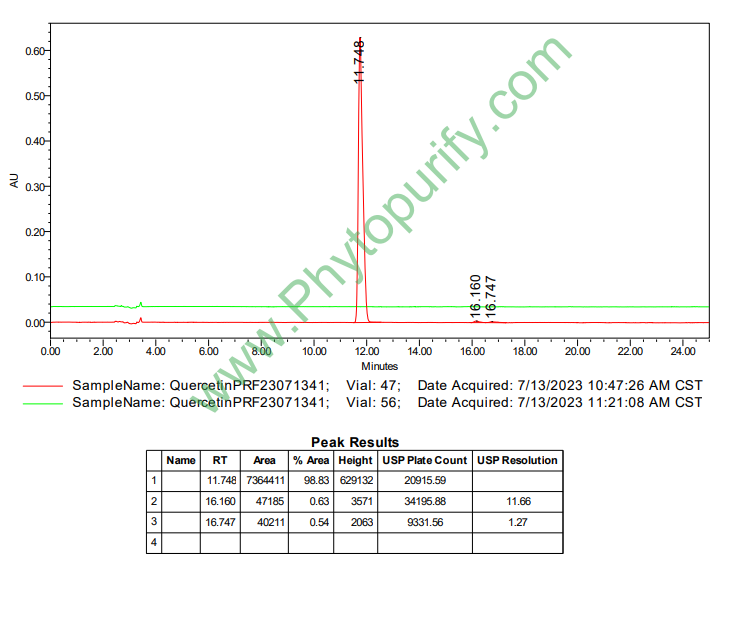
Purity: 95%~99%
Analysis Method: HPLC-DAD or/and HPLC-ELSD
Identification Method: Mass, NMR
Packing: Brown vial or HDPE plastic bottle
Storage: Store in a well closed container, protected from air and light. Put into refrigerate or freeze for long term storage.
Whenever possible, you should prepare and use solutions on the same day. However, if you need to make up stock solutions in advance, we recommend that you store the solution as aliquots in tightly sealed vials at -20℃. Generally, these will be useable for up to two weeks.
The product could be supplied from milligrams to grams, up to kilograms
Inquire for bulk scale.
Descriptions:
Quercetin, a member of the flavonoids family, is one of the most prominent dietary antioxidants. It is ubiquitously present in foods including vegetables, fruit, tea and wine as well as countless food supplements and is claimed to exert beneficial health effects. This includes protection against various diseases such as osteoporosis, certain forms of cancer, pulmonary and cardiovascular diseases but also against aging. [1]
Quercetin aglycone modulates several signal transduction pathways involving MEK/ERK and Nrf2/keap1, which are associated with the processes of inflammation and carcinogenesis.[2]
Guercetin can attenuate the function of AR by repressing its expression, inhibit the secretion of the prostate-specific, androgen-regulated tumor markers, PSA and hK2. and has the potential to become a chemopreventive and/or chemotherapeutic agent for prostate cancer.[3]
Quercetin and curcumin modulate ACFs correlates well with their ability to induce apoptosis via the mitochondrial pathway, may exert significant and potentially beneficial effects on decreasing the amount of precancerous lesions and inducing apoptosis in the large intestine.[4]
Quercetin supplementation reduces blood pressure in hypertensive subjects.[5]
References:
[1] Boots A W, Haenen G R M M, Bast A.Eur J Phamarmacol , 2008, 585(2–3):325-37.
[2] Murakami A, Ashida H, Terao J.Cancer Lett , 2008, 269(2):315–25.
[3] Xing N, Chen Y, Mitchell S H, et al. Carcinogenesis, 2001, volume 22(22):409-14.
[4] Volate S R, Davenport D M, Muga S J, et al. Carcinogenesis, 2005, 26(8):1450-6.
[5] Edwards R L, Lyon T, Litwin S E, et al. Brit J Nutr, 2007, 137(11):2405-11.
[6] Liu H P, Shi X F, Zhang Y C, et al. Cell Biochem Biophy, 2011, 61(1):59-64.
HPLC of Quercetin
Storage conditions:Short-term storage at 2~8℃, long-term storage at -20 ~ -80℃
131.3600
1.9444
1.3384
.0767
2.0593
14.2084
Low
86.8659
2.5447
Yes
No
Yes
No
Yes
No
0.6
Yes
No
Yes
No
Quercetin, also known as 3,3 ', 4', 5,7-pentahydroxyflavone, is a natural flavonoid compound widely found in fruits, vegetables, grains, and tea. Its CAS number is 117-39-5, which is one of the most abundant flavonoids in the diet and an important bioactive ingredient in human diet. Since its discovery, quercetin has been a hot topic in natural product pharmacology and nutrition research due to its excellent multiple biological activities such as antioxidant, anti-inflammatory, antiviral, anti-tumor, and cardiovascular protection. It is not only a representative of phytochemicals and has attracted much attention in the field of preventive medicine, but also demonstrates great potential as a lead compound or therapeutic drug due to its precise regulation ability on multiple key cellular signaling pathways. Modern pharmacological research has revealed that quercetin can intervene in the pathological processes of various diseases at the cellular and molecular levels by activating or inhibiting a series of key protein targets, such as SIRT1 and PI3K family members. This article aims to systematically review the chemical properties, sources, pharmacological activities, molecular mechanisms of action, pharmacological evaluation, and clinical application prospects of quercetin, in order to provide comprehensive scientific references for the in-depth research and development of this important natural product.
The molecular formula of quercetin is C ₁₅ H ₁₀ O ₇, with a molecular weight of 302.2380. Its basic chemical structure is the flavonoid nucleus (2-phenylchromenone), with hydroxyl groups attached to the 5th and 7th positions of the A ring, the 3rd position of the C ring, and the 3rd and 4th positions of the B ring, forming a 3,3 ', 4', 5,7-pentahydroxyl substitution pattern. This specific polyhydroxy structure is the chemical basis for its strong antioxidant activity. The catechol structure (3 ', 4' - dihydroxy) on the B ring and the conjugated system of the double bond at positions 2 and 3 on the C ring with the carbonyl group at position 4 enable them to effectively scavenge free radicals and chelate transition metal ions through single electron transfer or hydrogen atom transfer mechanisms.
In terms of physicochemical properties, quercetin appears as yellow needle shaped crystals with a melting point of approximately 316 ° C. Its lipid water partition coefficient (LogP) is 1.9444, indicating that it has a certain degree of lipophilicity, but not high lipid solubility. Its topological polar surface area (TPSA) is 131.3600 Å ², reflecting the strong polarity brought by multiple hydroxyl groups in the molecule. Quercetin has poor water solubility, about 0.0767 mg/mL, mainly due to its strong hydrogen bonding within and between molecules, as well as its large planar rigid structure, which to some extent limits its bioavailability. Relatively stable under acidic and neutral conditions, but prone to oxidation and darkening in alkaline solutions.
Quercetin is widely distributed in the plant kingdom, mainly in the form of glycosides (such as rutin, isoquercitrin, etc.), with a small amount existing in the form of free glycosides. Food sources rich in quercetin include onions (especially red onions), apples, berries (such as cranberries and blueberries), broccoli, kale, tea (especially green tea), red wine, and various medicinal plants such as Ginkgo biloba leaves and Forsythia suspensa. There are significant differences in the content and glycoside form of quercetin among different sources and varieties.
There are various methods for extracting quercetin from plant materials, including traditional methods such as solvent extraction (commonly using methanol, ethanol, acetone, or their aqueous solutions) and hot water extraction. Modern extraction techniques have significantly improved extraction efficiency and selectivity, such as:
1. Ultrasound assisted extraction Utilizing ultrasonic cavitation effect to destroy cell walls, accelerate solvent permeation, shorten extraction time, and improve yield.
2. Microwave assisted extraction By microwave heating, the temperature and pressure inside the cell rapidly increase, leading to cell rupture and rapid dissolution of active ingredients.
3. Supercritical fluid extraction Supercritical CO ₂ is commonly used to achieve selective extraction by adjusting temperature and pressure to change its solubility. This method has no solvent residue, but the cost is relatively high.
4. Enzymatic hydrolysis Using cellulase, pectinase, and other enzymes to disrupt the structure of plant cell walls, releasing bound quercetin glycosides, which are then converted into glycoside forms through acid hydrolysis or enzymatic hydrolysis.
After extraction, it is usually necessary to undergo column chromatography (such as silica gel, polyamide, macroporous adsorption resin), preparative high-performance liquid chromatography and other techniques for separation and purification to obtain high-purity quercetin monomers.
Quercetin has broad and significant pharmacological activities, and its research involves multiple disease fields.
1. Antioxidant and anti-inflammatory activities This is the core biological activity of quercetin. It can directly eliminate reactive oxygen/nitrogen species such as superoxide anions, hydroxyl radicals, and peroxynitrite, and upregulate the endogenous antioxidant defense system (see mechanism section below for details). Its strong antioxidant capacity is the basis of its anti-inflammatory effect. Quercetin can effectively inhibit the production of inflammatory factors induced by lipopolysaccharide, such as tumor necrosis factor - α (TNF - α), interleukin-6 (IL-6), interleukin-1 β (IL-1 β), and inflammatory mediators such as prostaglandin E2 (PGE2) and nitric oxide (NO). Quercetin has potential therapeutic value for chronic inflammatory related diseases such as arthritis, atherosclerosis, and neurodegenerative diseases.
2. Cardiovascular protective effect Quercetin exerts cardiovascular benefits through multiple pathways. It can improve endothelial function, promote nitric oxide production, inhibit angiotensin-converting enzyme activity, and thus lower blood pressure. Its antioxidant and anti-inflammatory properties help to inhibit the oxidation of low-density lipoprotein, reduce the formation of foam cells, and delay the development of atherosclerotic plaque. In addition, quercetin can also inhibit platelet aggregation and has a certain anti thrombotic effect.
3. Antitumor activity A large number of in vitro and animal model studies have shown that quercetin has growth inhibition and apoptosis promoting effects on a variety of cancer cell lines (such as breast cancer, lung cancer, prostate cancer, colon cancer, liver cancer, etc.). Its anti-tumor mechanism involves inducing cell cycle arrest (usually in G1 or G2/M phase), mitochondrial pathway apoptosis, inhibiting cell invasion and metastasis, inhibiting angiogenesis, and regulating oncogenic/anticancer signaling pathways.
4. Neuroprotective effect Quercetin can cross the blood-brain barrier (although its permeability is low) and exert antioxidant and anti-inflammatory effects in the brain. It can inhibit β - amyloid aggregation and toxicity, reduce tau protein hyperphosphorylation, counteract glutamate excitotoxicity, protect neurons from oxidative damage, and has shown protective effects in experimental models of neurodegenerative diseases such as Alzheimer's disease and Parkinson's disease.
5. Metabolic regulation effect Quercetin can improve insulin resistance, reduce blood sugar level, and improve diabetes and its complications. It can also regulate lipid metabolism, reduce serum total cholesterol and triglycerides.
6. Antiviral and immunomodulatory activity Research has shown that quercetin has inhibitory effects on various viruses, such as influenza virus, respiratory syncytial virus, herpes simplex virus, and even some coronaviruses, mainly by interfering with virus entry, replication, and assembly. It can also regulate the function of immune cells and enhance the body's immunity.
The pleiotropic pharmacological effects of quercetin stem from its multi-target regulatory ability on various cellular signaling pathways and key protein targets.
1. Activate endogenous antioxidant pathway - Nrf2/ARE system Quercetin is an effective activator of nuclear factor E2 related factor 2 (Nrf2, encoded by the NFE2L2 gene). Under oxidative stress, quercetin promotes the translocation of Nrf2 from the cytoplasm to the nucleus by conformational changes or modifications of Keap1, the negative regulatory protein of Nrf2. In the nucleus, Nrf2 binds to the antioxidant response element (ARE) and initiates the transcriptional expression of a series of downstream phase II detoxifying enzymes and antioxidant proteins, including heme oxygenase-1 (HMOX1), superoxide dismutase (SOD1, SOD2), catalase (CAT), glutathione peroxidase (GPX1), etc. This is the core molecular mechanism by which quercetin enhances cellular antioxidant defense capabilities.
2. Inhibiting pro-inflammatory and pro survival pathways - PI3K/Akt signaling axis Quercetin is a natural inhibitor of phosphatidylinositol 3-kinase (PI3K), exhibiting different inhibitory effects on PI3K gamma, delta, and beta subtypes (IC50 values of 2.4 μ M, 3.0 μ M, and 5.4 μ M, respectively). PI3K/Akt/mTOR is an important growth promoting, anti apoptotic, and metabolic regulatory pathway in cells, often overactivated in cancer and inflammatory diseases. By inhibiting PI3K, quercetin can downregulate the phosphorylation activity of Akt and mTOR, thereby affecting the function of downstream transcription factors such as NF - κ B (pro-inflammatory, anti apoptotic) and HIF-1 α (angiogenesis), ultimately leading to cell cycle arrest, apoptosis induction, and inflammation inhibition.
3. Activate the longevity protein SIRT1 Quercetin can activate the deacetylase SIRT1. SIRT1 participates in regulating cellular stress response, energy metabolism, inflammation, and aging processes by deacetylating various substrate proteins such as p53, FOXOs, PGC-1 α, NF - κ B. Quercetin activates SIRT1, which helps enhance mitochondrial function, alleviate oxidative stress, inhibit inflammation, and delay cellular aging. This has protective significance in metabolic diseases, neurodegenerative diseases, and cardiovascular diseases.
4. Adjust other key targets In addition, quercetin can directly or indirectly affect various other targets, such as inhibiting the activity of cyclooxygenase-2 (COX-2), lipoxygenase (LOX), and inducible nitric oxide synthase (iNOS); Inhibit the expression of matrix metalloproteinases (MMPs); Regulating the phosphorylation status of MAPK signaling pathway members (such as ERK, JNK, p38); And as a partial agonist of estrogen receptor beta (ER β).
These mechanisms of action are intertwined, forming the complex and synergistic network pharmacology basis of quercetin.
Although quercetin has excellent pharmacological activity, its pharmacological development faces certain challenges, mainly due to its poor solubility and unsatisfactory pharmacokinetic properties.
Pharmacokinetic characteristics:
* absorb After oral administration, quercetin glycosides (such as rutin) need to be hydrolyzed by gut microbiota or intestinal mucosal enzymes to form aglycones before they can be absorbed. The absorption site of free quercetin is mainly in the small intestine, but its poor water solubility and first pass effect result in generally low oral bioavailability (usually reported<2%). The absorption process involves passive diffusion and active transport.
* distribution After absorption, quercetin rapidly binds to plasma proteins (mainly albumin) and is widely distributed in tissues throughout the body, but the concentration varies greatly in different organs. Its blood-brain barrier permeability was evaluated as' low ', limiting its direct exposure to the central nervous system, but not completely impermeable.
* Metabolism Quercetin undergoes extensive metabolic transformation in the body, mainly in the liver and intestines. Metabolic reactions include glucuronidation, sulfation, methylation, and other II combined reactions, generating various metabolic products. These metabolites usually have reduced activity, but some still retain some biological activity.
* excretion Quercetin and its metabolites are mainly excreted through urine and bile, with a relatively short half-life.
Analysis of drug properties parameters:
* Molecular weight (302.24)Meets the standards for small molecule drugs.
* LogP(1.94)Being within the ideal range (usually 1-3) indicates that it has appropriate lipid solubility, which is conducive to transmembrane absorption.
* TPSA(131.36 Ų)The high value reflects its multi hydroxyl characteristics, which may affect its membrane permeability, but it is still within an acceptable range.
* Water solubility (poor)This is the main limiting factor that affects its dissolution and absorption.
* Preliminary evaluation of safety The Ames test result is 0.6 (usually<2 considered non mutagenic), indicating no significant genetic toxicity. The hERG inhibition test was negative, indicating a low risk of cardiac toxicity. Overall, quercetin has high safety at dietary doses, and systematic evaluation is necessary for high-dose drug use.
Improvement strategy To improve the bioavailability of quercetin, researchers have developed various strategies, including preparing prodrugs (such as quercetin esters), using cyclodextrin inclusion, preparing phospholipid complexes, developing nano delivery systems (such as liposomes, nanoparticles, micelles), and utilizing solid dispersion technology. These techniques can effectively increase its solubility, stability, and intestinal absorption.
The transformation of quercetin from a dietary component to a therapeutic drug has broad prospects but a long way to go.
Current applications and clinical trials:
At present, quercetin is mainly circulated in the market as a dietary supplement and functional food ingredient, used for antioxidant, immune enhancement, and alleviation of allergic symptoms. At the clinical research level, numerous trials have explored its potential applications in various diseases, including:
* cardiovascular disease Used to assist in lowering blood pressure and improving endothelial function.
* Metabolic syndrome and diabetes Study its regulatory effects on blood glucose and blood lipids.
* Inflammatory diseases Auxiliary anti-inflammatory and analgesic measures for conditions such as osteoarthritis and rheumatoid arthritis.
* Cancer adjuvant therapy Combined with chemotherapy drugs, aimed at enhancing efficacy and reducing side effects.
* respiratory disease Such as combating viral infections and alleviating asthma symptoms.
* Neurodegenerative diseases In the early stage of clinical exploration.
Some clinical trials have shown positive effects, but the results are sometimes inconsistent, which may be related to differences in subjects, dosage forms, doses, and treatment courses of quercetin.
Future prospects and challenges:
1. Formulation innovation and precise delivery One of the key focuses of future research is to develop novel drug delivery systems to address the fundamental problem of low bioavailability of quercetin. Targeted delivery systems, such as tumor targeting and inflammation site targeting, are expected to increase local drug concentration, enhance efficacy, and reduce systemic side effects.
2. Structural modification and derivative development By chemically modifying the mother nucleus of quercetin, a series of derivatives or analogues are synthesized with the aim of optimizing its activity, selectivity, and pharmacokinetic properties, and discovering more potent candidate drugs.
3. Deep analysis of the mechanism of action Using methods such as systems biology, network pharmacology, and artificial intelligence, we aim to comprehensively and deeply elucidate the complex action network and key nodes of quercetin in multi disease environments, providing a theoretical basis for precision medicine.
4. High quality clinical validation More rigorous, large-scale, multicenter randomized controlled clinical trials need to be designed to clarify the effective dosage, treatment duration, long-term safety, and interactions with other drugs of quercetin in specific diseases.
5. Combination therapy strategy Explore the synergistic effects of quercetin with existing standard therapeutic drugs such as chemotherapy drugs, immune checkpoint inhibitors, and anti-inflammatory drugs, and develop new combination therapy regimens.
Quercetin, as a classic natural flavonoid compound, is endowed with excellent antioxidant free radical scavenging ability and multi-target regulatory properties due to its multi hydroxyl chemical structure. The molecular mechanisms underlying the activation of Nrf2/ARE endogenous defense system, inhibition of PI3K/Akt survival pathway, and activation of SIRT1 longevity protein are increasingly being studied, providing a solid scientific explanation for their pharmacological activities in antioxidant damage, anti-inflammatory, anti-tumor, cardiovascular, and neuroprotective aspects. Although its poor solubility and oral bioavailability are the main obstacles on the road to mature drugs, this challenge is gradually being overcome through interdisciplinary innovation in pharmacy, medicinal chemistry, and pharmacology, including the development of novel delivery systems, the design of structural derivatives, and the exploration of combination drug strategies. In the future, with the continuous deepening of basic research and steady progress in clinical translation and application, quercetin and its derivatives are expected to surpass their traditional role as dietary supplements and develop into important drugs or adjuvant treatments for the prevention and treatment of various chronic diseases, especially those closely related to oxidative stress and chronic inflammation, and play a greater value in human health maintenance.
